
Michigan is home to a diverse range of birds of prey, from fish-eating Bald Eagles and Ospreys along the Great Lakes to widespread Red-tailed Hawks and Turkey Vultures over open country, as well as forest owls and swift falcons. Across the Upper and Lower Peninsulas, lakes, rivers, wetlands, grasslands, and mature forests each support raptors adapted to specific habitats. Seasonal movements further shape this assemblage, bringing migrants in spring and fall and, in some winters, Arctic visitors to windswept shorelines and expansive fields. This guide highlights Michigan’s most characteristic and regularly encountered raptors across these varied landscapes.
Bald Eagle
Haliaeetus leucocephalus
- Identification: Very large eagle with broad, flat-held wings; adults show a stark white head and tail contrasting with a dark brown body and wings.
- Where found: Breeds widely across Michigan near large lakes, rivers, and wetlands, with strong concentrations along the Great Lakes shorelines and major river systems.
- How to spot: Look for slow, powerful wingbeats, long periods of soaring on broad flat wings, and frequent perching near water or open shorelines.
- Conservation status: Least Concern (IUCN); populations have increased dramatically in Michigan following severe mid-20th century declines.

The Bald Eagle is Michigan’s most iconic and widely recognized raptor, closely tied to the state’s extensive freshwater systems. As a large fish-eating predator and opportunistic scavenger, it occupies the top of aquatic food webs across both peninsulas. Adults measure 71 to 96 centimeters (28.0 to 37.8 inches) in length, with a wingspan of 168 to 244 centimeters (66.1 to 96 inches), giving them a commanding presence in flight. They have a heavy body, a large projecting head, and a massive hooked beak. Adult plumage is unmistakable, with a dark brown body and wings contrasting sharply with a white head and tail and a bright yellow beak and legs; younger birds are darker overall and lack the clean white head and tail of adults.

In the field, Bald Eagles are often detected first by size and silhouette. They fly with slow, deliberate wingbeats and frequently soar or glide with wings held flat, forming a straight horizontal profile. Individuals commonly perch in tall shoreline trees or on snags overlooking lakes and rivers. Fish make up a large portion of the diet, though waterfowl, mammals up to rabbit size, turtles, and carrion are also taken. Bald Eagles readily scavenge road-killed deer in winter and may steal fish from Ospreys. Near nests and feeding areas they give high-pitched chattering and piping calls, quite unlike the harsher screams often associated with large raptors in popular media.
The Bald Eagle breeds widely across Michigan and is the most widespread of the state’s eagle species, occupying suitable habitat in both the Upper and Lower Peninsulas. Nesting occurs in all 15 counties of the Upper Peninsula and throughout much of the Northern and Southern Lower Peninsula, with especially strong concentrations along the shores of Lakes Superior, Michigan, and Huron. The species is closely tied to large bodies of water, including inland lakes, reservoirs, and major river systems, where dependable food supplies and tall nesting trees are available. Nests are typically placed high in mature trees – often white pines with open crowns, but also red pines and a variety of deciduous species. Adults nesting south of Lake Superior are generally resident, moving locally when food becomes unavailable, while additional birds may gather in winter around areas of open water and reliable food sources.
Once widespread across Michigan, the Bald Eagle declined sharply in the mid-20th century due to persecution, habitat loss, and DDT-related reproductive failure, with breeding largely restricted to the northern half of the state. Recovery began in the 1970s following legal protection and pesticide bans. Nesting numbers fell to roughly 86 pairs in the 1970s but increased to about 550 pairs by 2008 and approximately 900 by 2019, reflecting strong expansion across both peninsulas. Although federally delisted in 2007 and removed from Michigan’s endangered species list in 2009, the species remains protected, and localized threats such as lead poisoning, vehicle collisions, shoreline development, and environmental contamination persist.
Red-tailed Hawk
Buteo jamaicensis
- Identification: Large, stout-bodied buteo with broad, rounded wings and a short, wide tail; many adults show a reddish upper tail and dark markings along the leading edge of the underwing.
- Where found: Widespread across Michigan in open country, farmland, woodland edges, and suburban landscapes, especially in the southern Lower Peninsula.
- How to spot: Commonly seen perched on utility poles or soaring in broad circles over fields; listen for its hoarse, rising scream.
- Conservation status: Least Concern (IUCN); abundant and secure in Michigan, with high densities in southern portions of the state.

The Red-tailed Hawk is the most familiar and widespread bird of prey in Michigan, commonly seen across open landscapes, especially in the Lower Peninsula. As a dominant open-country predator, it helps regulate small mammal populations across agricultural and suburban areas. The species measures 45 to 65 centimeters (17.7 to 25.6 inches) in length, with a wingspan of 114 to 133 centimeters (44.9 to 52.4 inches), and shows classic buteo proportions with broad, rounded wings and a short, wide tail built for soaring and perch hunting. Plumage is variable, but many adults show a reddish upper tail with a darker band near the tip, especially visible from above. Light individuals are typically brown above and paler below, often with darker streaking across the belly and a dark band along the trailing edge of the underwing.

In the field, Red-tailed Hawks are often detected by behavior before plumage details are noted. They frequently hunt from elevated perches – utility poles, wires, fence posts, or isolated trees, dropping in controlled dives onto prey. When in flight, they soar in broad circles on thermals or hillside updrafts, and in strong winds may face into the breeze and hold position with minimal wingbeats. Their familiar hoarse, two- to three-second scream carries far across open country. In Michigan, their diet consists primarily of small to medium-sized mammals such as rodents and rabbits, though birds and reptiles are also taken.
In Michigan, the Red-tailed Hawk breeds widely across the state and is confirmed from Monroe County in the far southeast to Isle Royale in Lake Superior. Densities are highest in the Southern Lower Peninsula, where agricultural fields, old farmsteads, suburban developments, and scattered woodlots create ideal edge habitat. The species is well established throughout the Northern Lower Peninsula and across much of the Upper Peninsula, where atlas data show an increase in distribution between recent survey periods. Formerly rare or absent in winter, Red-tailed Hawks are now common year-round residents in southern Michigan, benefiting from roadside microhabitats and snow-free foraging areas in urban and agricultural zones.
The Red-tailed Hawk has likely increased in Michigan over the past century as extensive forest cover gave way to a more fragmented landscape of farms, towns, and woodland edges. After mid-20th century declines linked to shooting and pesticide use, the population rebounded and is now considered one of the most populous raptors in the state. While overall numbers remain strong, slight shifts in distribution between atlas periods, particularly modest decreases in parts of the Northern Lower Peninsula, warrant continued monitoring. The species’ adaptability to human-altered landscapes and broad prey base suggest it will remain a permanent and prominent component of Michigan’s raptor community.
Osprey
Pandion haliaetus
- Identification: Large, long-winged raptor with narrow wings held in a distinctive kinked “M” shape in flight, dark brown above and mostly white below with a bold dark eye stripe.
- Where found: Breeds mainly across the northern two-thirds of Michigan near lakes, rivers, impoundments, and wetlands, expanding into the southern Lower Peninsula.
- How to spot: Watch for steady wingbeats over open water, brief hovering, and dramatic feet-first plunges to catch fish, often carrying prey head-first.
- Conservation status: Least Concern (IUCN); recovered strongly in Michigan after DDT-related declines and now increasing, especially in the southern Lower Peninsula.

The Osprey is Michigan’s specialized fish-eating raptor and one of the most distinctive birds of prey in the state. As a top predator of aquatic ecosystems, it is closely tied to freshwater habitats across both peninsulas. Adults measure 54 to 58 centimeters (21.3 to 22.8 inches) in length and have a wingspan of 150 to 180 centimeters (59.1 to 70.9 inches), giving them a long-winged, rangy appearance. The body is relatively slender, with long legs and powerful feet adapted for grasping fish. Plumage is dark chocolate-brown above and mostly white below, with a white crown and forehead and a bold dark stripe through the eye. The underwings are largely white with prominent dark patches at the wrists.

In the field, Ospreys are identified as much by structure and behavior as by plumage. They fly with steady, somewhat shallow wingbeats and long, angled wings that form a noticeable crook at the wrist, creating a shallow “M” profile when seen from below. Hunting birds patrol shorelines, lakes, and rivers, sometimes hovering briefly before plunging feet-first into the water to seize fish near the surface. They emerge carrying fish aligned head-first to reduce drag in flight. Unlike hawks and eagles, they regularly dive directly into water. Individuals are often heard before seen on the breeding grounds, giving sharp, whistled calls near nests or during aerial interactions.
In Michigan, Ospreys breed mainly in the northern two-thirds of the state and are expanding into the southern third. They nest widely across the Upper Peninsula, including Isle Royale, and throughout much of the northern Lower Peninsula, with more scattered nesting in the southern Lower Peninsula. Confirmed nesting has been recorded in 13 of the 15 counties of the Upper Peninsula and in numerous counties of both the northern and southern Lower Peninsula. The species is closely associated with lakes, rivers, reservoirs, beaver ponds, and man-made impoundments. Nests are built in dead trees along shorelines, in conifer swamps, or on snags, and a large majority of nests in the Lower Peninsula are now placed on artificial structures such as nest platforms, power-transmission towers, utility poles, and navigational aids. Most Ospreys arrive at Michigan nest sites in early April and begin departing in August, with most gone by October.
Osprey numbers in Michigan declined sharply in the early 1960s due to DDE (a breakdown product of DDT) contamination of aquatic food webs, which caused reproductive failure. By the early 1970s productivity had improved, and the population gradually increased. Statewide totals rose substantially through the late twentieth century, with continued expansion into the southern Lower Peninsula aided by reintroduction efforts and the installation of nesting platforms. Although an unexplained decline occurred during the mid-1990s, partial recovery followed, and current numbers are considered stable to increasing in many areas. The species was removed from Michigan’s threatened list in 2009. As a top predator of aquatic systems, it remains vulnerable to environmental pollutants and changes affecting fish populations, and continued monitoring of nesting success and habitat quality is warranted.
Turkey Vulture
Cathartes aura
- Identification: Large, long-winged vulture with dark brown to blackish body, small featherless red head in adults, pale beak, and silvery underwings contrasting with darker coverts.
- Where found: Breeds widely across Michigan in open and semi-open landscapes, from farmland and forests to roadsides and suburban areas; mostly migratory, with small numbers lingering in winter.
- How to spot: Look for birds soaring with wings held in a shallow “V,” rocking side to side with few wingbeats, often gliding low over open country or circling on thermals.
- Conservation status: Least Concern (IUCN); populations have increased substantially in Michigan in recent decades and continue to expand northward.

The Turkey Vulture is Michigan’s most widespread obligate scavenger and one of the most frequently observed large birds of prey across the state. As a specialized carrion feeder, it plays an important ecological role by removing animal remains and reducing the spread of potentially harmful bacteria. Adults measure 64 to 81 centimeters (25.2 to 31.9 inches) in length and have a wingspan of 150 to 200 centimeters (59.1 to 78.7 inches). The species has long, broad wings, a relatively small bare head, and a long tail that projects noticeably in flight. Plumage is dark brown to blackish overall, with the undersides of the flight feathers appearing silvery gray in contrast to darker underwing coverts, creating a distinctly two-toned effect. Adults show a red, featherless head and a pale ivory beak, while juveniles have a darker head and beak.

In the field, the Turkey Vulture is identified primarily by flight behavior and silhouette. It soars extensively, holding its wings in a shallow “V” and rocking side to side while riding thermals or deflected air currents. Wingbeats are infrequent and shallow, and birds often glide low over open ground while searching for carrion. Unlike hawks and eagles, it feeds almost entirely on dead animals, using both keen eyesight and a highly developed sense of smell to locate carcasses. Mammals form the bulk of the diet, including road-killed deer and smaller animals, though birds and other vertebrates are also consumed. At carcasses or roosts it may give guttural hisses, but it is generally quiet while soaring.
Turkey Vultures are the most widespread of Michigan’s vultures and now breed across much of the state, having expanded notably in recent decades. They are recorded in a majority of townships statewide, with particularly strong gains in the Upper Peninsula, where the number of occupied townships increased markedly between atlas periods. Breeding is confirmed in scattered townships, especially in the Southern Lower Peninsula, though the species’ secretive nesting habits likely result in underreporting. Nests are placed in secluded sites such as hollow logs, caves, brush piles, or other sheltered recesses rather than in constructed stick nests. Most birds arrive in southern Michigan in March, with typical arrival in late March farther north, and the majority depart by late autumn. Small numbers now linger into winter, with sporadic records in December through February and regular winter observations since the mid-1990s, indicating later departures and earlier spring returns.
The Turkey Vulture has increased steadily in Michigan, mirroring broader regional and continental trends. Atlas comparisons show substantial growth in distribution, and long-term monitoring indicates significant annual increases in the state. Contributing factors may include increased availability of road-killed carrion, expanding deer populations, forest clearing that creates suitable foraging landscapes, and warming climate trends. Although the population is not currently at risk, the species depends on relatively undisturbed areas for nesting and roosting. Habitat fragmentation, potential competition from the northward-expanding Black Vulture, and risks associated with airports and birdstrike incidents represent ongoing management considerations. Its adaptability and efficient soaring flight, however, ensure that it remains a prominent and ecologically important scavenger across Michigan.
Cooper’s Hawk
Astur cooperii
- Identification: Medium-sized accipiter with broad, rounded wings and a long, rounded tail; adults are blue-gray above with rufous barring below; juveniles are brown above with crisp brown streaking on whitish underparts.
- Where found: Breeds across much of Michigan in wooded habitats, from mixed forests to fragmented woodlots and suburban neighborhoods; fairly common migrant and winter resident in the Southern Lower Peninsula.
- How to spot: Watch for a stealthy woodland hawk flying with a flap-flap-glide pattern or cutting low through trees in pursuit of birds; listen near nests for repeated, sharp “cak-cak-cak” alarm calls.
- Conservation status: Least Concern (IUCN); populations have increased substantially in Michigan since mid-20th century declines and are stable to increasing statewide.

The Cooper’s Hawk is the state’s most characteristic woodland accipiter and a regular predator of backyard birds in many communities. As a fast, maneuverable hunter of medium-sized birds, it occupies a key role as a mesopredator within forest edges, suburban woodlots, and fragmented landscapes. It measures 37 to 45 centimeters (14.6 to 17.7 inches) in length and shows the classic accipiter structure, with short, rounded wings and a long, rounded tail adapted for rapid turns through dense canopy. Adults are blue-gray above with white underparts barred warm rufous, often showing a darker cap contrasting with a paler nape. Juveniles are brown above with brown streaking on whitish underparts.

Field identification in Michigan relies heavily on structure and behavior. Cooper’s Hawks typically fly with several quick, stiff wingbeats followed by a short glide, a flap-flap-glide rhythm that is especially noticeable along woodland edges and across residential openings. When hunting, they often course low and fast through trees or along hedgerows, using cover to approach prey before accelerating in a sudden burst. Medium-sized birds such as Mourning Doves, Northern Cardinals, and other songbirds form the core of the diet, and individuals may patrol areas near feeders though studies indicate they are not disproportionately attracted to feeder sites. Around nests, adults give rapid, repeated “cak-cak-cak” alarm calls that carry through wooded neighborhoods.
In Michigan, the Cooper’s Hawk is an uncommon breeder in the Lower Peninsula and a rare breeder in the Upper Peninsula, though it is widely distributed at low densities. Breeding activity is documented across much of the Southern Lower Peninsula, where more than half of townships show evidence of nesting, with particularly notable increases in southeastern counties such as Lenawee, Monroe, Washtenaw, and Wayne. In the Northern Lower Peninsula and Upper Peninsula, the species remains sparsely distributed, with confirmed nesting in relatively few townships. It nests in mixed and deciduous forests but is tolerant of habitat fragmentation and increasingly uses suburban and urban woodlots. In migration, it is fairly common in the Southern Lower Peninsula during fall, and many birds now overwinter there. In the Upper Peninsula, winter records are occasional and the species remains generally rare outside the breeding season.
Cooper’s Hawk populations in Michigan have rebounded strongly since mid-20th century declines caused by persecution and pesticide use. Atlas comparisons and long-term monitoring show substantial increases, especially in the Southern Lower Peninsula, and statewide trends align with broader regional growth across the Upper Midwest. The species was formerly listed as Threatened in Michigan and later as a species of Special Concern, but those designations have been removed as numbers improved. Although the population is now stable to increasing, maintaining local woodlots and forest edges remains important for breeding and foraging. The hawk’s adaptability to suburban landscapes has allowed it to thrive in much of southern Michigan, making it a regular and sometimes conspicuous predator within the state’s evolving human-dominated habitats.
American Kestrel
Falco sparverius
- Identification: Small, slender falcon with long pointed wings and a relatively long square-tipped tail; males show slate-blue wings and a rufous back; females are heavily barred rufous above; both sexes have bold black facial slashes.
- Where found: Breeds throughout Michigan in open and semi-open habitats including farmland, grasslands, marshes, clear cuts, and urban areas; migratory in the Northern Lower and Upper Peninsulas, with partial residency in the Southern Lower Peninsula.
- How to spot: Look for birds perched on wires, poles, or fence posts in open country, hovering into the wind over fields, pumping the tail when perched, and giving a rapid, repeated “killy” call.
- Conservation status: Least Concern (IUCN); populations have declined in Michigan since earlier atlas periods, though the species remains widespread statewide.

The American Kestrel is the smallest bird of prey in Michigan and a familiar predator of open landscapes across the state. As a small, versatile hunter of insects and small vertebrates, it occupies an important role in regulating populations of terrestrial arthropods and small mammals. The species measures 22 to 31 centimeters (8.7 to 12.2 inches) in length and has a wingspan of 51 to 61 centimeters (20.1 to 24.0 inches). It has long, pointed wings, a relatively long square-tipped tail, and a compact hooked beak. Plumage shows marked sexual dimorphism: males have slate-blue wings and crown with a rufous back and tail bearing a single black band, while females are rufous above with heavy black barring; both sexes show two bold black facial slashes on a pale face.

In the field, American Kestrels are often detected by their conspicuous perching behavior along roadsides and open fields. They commonly hunt from utility wires, fence posts, poles, or isolated trees, dropping to the ground to seize prey. They also hover into the wind over grasslands and agricultural fields, holding the body nearly stationary while the head remains fixed on the ground below. The species feeds primarily on large insects such as grasshoppers and beetles, as well as small mammals including voles and mice. During the breeding season, newly fledged young may be observed in family groups from mid-June through early August, and multiple birds may be seen hunting in close proximity in late summer. The rapid, repeated “killy” call often carries across open country.
The American Kestrel breeds throughout the state and is somewhat more numerous in the extensively deforested Southern Lower Peninsula than in the Northern Lower or Upper Peninsulas. It inhabits agricultural fields, grasslands, marshes, bogs, clear cuts, and urban environments where short vegetation and hunting perches are available. The species is an obligate cavity nester, using natural tree cavities, woodpecker holes, crevices in buildings, highway sign pipes, grain augers, and nest boxes. Availability of nesting cavities and perches strongly influences breeding distribution. In the Northern Lower Peninsula and Upper Peninsula, kestrels are migratory, while in the Southern Lower Peninsula the population includes both permanent residents and partial migrants. Severe winter weather can reduce numbers in areas where birds remain year-round.
Although still widespread, American Kestrels have shown evidence of decline in Michigan since earlier atlas efforts. Both atlas comparisons and portions of Breeding Bird Survey data indicate reductions in distribution and abundance, particularly in more urbanized counties of the Southern Lower Peninsula. Contributing factors may include habitat changes associated with suburban sprawl, loss of nesting cavities, competition with European Starlings for nest sites, predation by larger raptors such as Cooper’s Hawks, exposure to environmental contaminants, and weather-related effects on breeding success. Despite these pressures, the species remains the most numerous falcon in Michigan and is broadly distributed across the state, while nest box programs and continued monitoring are considered valuable tools for sustaining local populations.
Broad-winged Hawk
Buteo platypterus
- Identification: Small, compact buteo with broad wings and a short tail marked by bold black-and-white bands; adults show warm rufous barring below.
- Where found: Breeds across most of Michigan in extensive deciduous and mixed forests, with highest concentrations in the Upper Peninsula and sparse occurrence in heavily fragmented southeastern counties.
- How to spot: Most visible during migration in large circling “kettles,” while in summer it is best detected by its piercing two-parted whistle above forest canopies.
- Conservation status: Least Concern (IUCN); populations are generally stable in Michigan, though breeding has declined in parts of the Northern Lower Peninsula.

The Broad-winged Hawk is Michigan’s smallest buteo and one of the state’s most dramatic migrants, yet it remains secretive during the breeding season. As a forest-dwelling predator, it occupies moist hardwood and mixed forests where it hunts from shaded perches below the canopy. It measures 34 to 44 centimeters (13.4 to 17.3 inches) in length and has broad wings and a short, banded tail suited for soaring above forest tracts. Adults of the common light morph are brown above with underparts barred cinnamon to chestnut and a whitish throat. The tail shows a broad pale band across a darker background, a feature often visible even at distance.

Field identification in Michigan depends largely on voice and migration behavior. On the breeding grounds, birds often soar slowly above the forest canopy and give a high, piercing two-parted whistle frequently rendered as “pee-eee.” Foraging birds typically hunt from concealed perches beneath the canopy, dropping quickly onto prey in nearby openings or along wet forest edges. The diet is broad and includes amphibians, small mammals, insects, and young birds, reflecting the species’ association with moist forest habitats and nearby water. During migration, especially in late summer and early autumn, Broad-winged Hawks form conspicuous circling flocks, or “kettles,” that can number in the thousands as they move south.
In Michigan, the Broad-winged Hawk breeds in most counties, with the highest concentrations in the extensive forests of the Upper Peninsula. Breeding evidence is widespread across the Upper Peninsula and remains stable there between atlas periods. In the Northern Lower Peninsula, breeding distribution has declined compared to earlier surveys, while in the Southern Lower Peninsula the species is present at low densities and largely absent from the fragmented southeastern border counties where forest patches are small. The species prefers continuous hardwood and mixed hardwood-conifer forests with openings and water nearby. Birds arrive on breeding territories in late April to early May and depart by early autumn, undertaking long-distance migration to wintering grounds in Central and South America.
Although Broad-winged Hawks remain common in Michigan, particularly in the Upper Peninsula, regional patterns show some shifts. Atlas data indicate stable breeding in the Upper Peninsula but declines in parts of the Northern Lower Peninsula, the causes of which remain unclear. Because the species depends on large forest blocks and a diet that includes amphibians, it may be sensitive to forest fragmentation, climate-related changes, and declines in prey populations. Additional pressures occur during migration and on wintering grounds, where deforestation and unregulated shooting may increase mortality. Continued monitoring of breeding distribution, particularly in the Lower Peninsula, is warranted to clarify recent trends.
Peregrine Falcon
Falco peregrinus
- Identification: Medium to large, long-winged falcon with blue-gray upperparts, barred underparts, and a dark head marked by a thick black malar stripe; juveniles are browner above with vertical streaking below.
- Where found: Nests on cliffs along the Great Lakes and increasingly on tall buildings, bridges, and industrial structures in southern Michigan; migrants and wintering birds occur statewide near large water bodies and cities.
- How to spot: Look for birds perched on high cliffs, skyscrapers, bridges, or smokestacks, and for fast, direct flight or steep hunting stoops over shorebirds, ducks, or city pigeons.
- Conservation status: Least Concern (IUCN); listed as Threatened in Michigan, with populations recovering following reintroduction efforts.

The Peregrine Falcon is the state’s premier high-speed aerial predator, specializing in the pursuit of birds in flight. Historically associated with high cliffs along Lake Superior and Lake Michigan, it now also thrives in urban landscapes. It measures 36 to 58 centimeters (14.2 to 22.8 inches) in length and has a wingspan of 79 to 114 centimeters (31.1 to 44.9 inches). Adults are blue-gray above with whitish to buff underparts barred dark, and the head shows a bold black malar stripe against a pale cheek. Juveniles are browner overall with vertical streaking below rather than horizontal barring.

In the field, Peregrine Falcons are identified by their swift, purposeful flight and high-speed hunting stoops. They travel with strong, steady wingbeats and often perch on elevated vantage points before launching into pursuit. Prey consists primarily of medium-sized birds captured in flight, including shorebirds, waterfowl, and, in urban areas, feral pigeons. On territory they give harsh, repeated “cack” calls, especially near nest sites. Their hunting strategy relies on surprise and speed, striking prey mid-air after a rapid descent from height.
In Michigan, Peregrine Falcons historically nested on high cliffs along the Lake Superior shoreline and other Great Lakes sites, but the population was extirpated by the mid-20th century. Following reintroduction efforts in the 1980s, breeding pairs are now established in two primary settings. In the Upper Peninsula, Peregrines nest mainly on natural cliffs at sites such as Pictured Rocks, Grand Island, Au Train Island, and Porcupine Mountains Wilderness State Park. In the Lower Peninsula, most nesting occurs on tall buildings, bridges, smokestacks, and power plants, with the largest concentration in southeastern Michigan between Port Huron and Monroe, including multiple sites in Detroit. Additional breeding territories have been recorded in cities such as Flint, Lansing, East Lansing, Grand Rapids, and Muskegon. Most adult birds breeding in the Midwest are resident, while migrants pass through Michigan during spring and autumn, particularly along Great Lakes shorelines.
The Peregrine Falcon suffered severe mid-20th-century declines due to DDT contamination, which caused eggshell thinning and reproductive failure. Intensive reintroduction efforts and pesticide bans allowed populations to rebound, and breeding numbers in Michigan have steadily increased since the early 1990s. Although recovery goals in the Lower Peninsula have been exceeded, numbers in parts of the Upper Peninsula remain below historic levels. The species remains listed as Threatened in Michigan, reflecting its limited breeding distribution and continued sensitivity to disturbance, environmental contaminants, and habitat alteration. Ongoing monitoring, protection of nesting sites, and careful management of artificial nest structures remain essential to maintaining its recovery within the state.
Northern Harrier
Circus hudsonius
- Identification: Slender, long-winged and long-tailed hawk with a distinct white rump patch and owl-like facial disk; males are gray above and whitish below with black wingtips; females and immatures are brown with streaked or buffy underparts.
- Where found: Breeds sparsely across Michigan in open grasslands, wet meadows, marshes, and bogs, with lower densities in the southern third of the Lower Peninsula.
- How to spot: Look for low, slow flight over marshes and fields with wings held in a strong “V,” a conspicuous white rump, and buoyant, tilting glides while coursing just above vegetation.
- Conservation status: Least Concern (IUCN); breeding distribution has declined in Michigan, largely due to wetland loss, grassland conversion, and agricultural intensification.

The Northern Harrier is a characteristic marsh hawk in Michigan, a low-flying predator of open country. As a specialist of wetlands and expansive grasslands, it occupies a distinct ecological niche among the state’s raptors. The species measures 46 to 50 centimeters (18.1 to 19.7 inches) in length and has a wingspan of 102 to 118 centimeters (40.2 to 46.5 inches). It has a slim body, long wings, a long rounded tail, and long legs that give it a light, buoyant profile in flight. Adult males are gray above and mostly whitish below with black wingtips and a dark trailing edge to the wing. Females are brown above with buffy to whitish underparts marked by brown streaking and are noticeably larger than males. All ages show a conspicuous white rump patch in flight, and the rounded facial disk gives the face an owlish appearance.

In the field, Northern Harriers are most often identified by their distinctive hunting behavior. They fly low over marshes, hayfields, and wet meadows with wings held in a strong “V,” weaving back and forth in slow, buoyant glides interspersed with steady flaps. Unlike soaring buteos, they hunt primarily on the wing, often at heights only a few meters above vegetation. The species relies on both vision and hearing to detect prey concealed in grasses, using its facial disk to locate small animals. In Michigan, voles and other small rodents form the core of the diet, supplemented by grassland birds and, in wet areas, frogs. During the breeding season in March and April, males perform conspicuous aerial display flights, climbing high before diving steeply in U-shaped arcs over territory.
In Michigan, the Northern Harrier breeds sparsely across the state, with the highest concentrations in extensive wetland and grassland complexes of the Upper Peninsula and parts of the northern Lower Peninsula. It is less common in the southern third of the Lower Peninsula, where suitable open habitat is more fragmented. The species occupies large marshes, wet meadows, bogs, hayfields, and grasslands, especially where tall, dense vegetation is present. Nests are placed directly on the ground in grasses or on elevated hummocks within marshes and bogs. Northern Harriers migrate into Michigan in March and April and depart in autumn, with most birds moving south for winter.
Northern Harrier populations in Michigan have declined substantially from historical levels. Atlas comparisons indicate a marked reduction in the number of townships with breeding evidence, including significant decreases in former concentration areas such as the Gladwin-Midland wetlands, wetlands of the south-central and eastern Upper Peninsula, and grasslands of the Thumb region. Once described as one of the state’s most common raptors, the species has been affected by wetland drainage, conversion of grasslands to intensive agriculture, earlier hay cutting cycles, pesticide use, and forest regrowth that fragments formerly open landscapes. Because breeding success depends on large, undisturbed expanses of tall vegetation, habitat loss and fragmentation remain the primary threats. Continued monitoring and protection of extensive wetland and grassland systems are essential for maintaining the species as a breeding raptor in Michigan.
Great Horned Owl
Bubo virginianus
- Identification: Large, thick-bodied owl with broad wings, prominent ear tufts, a white throat patch, and striking yellow eyes set in a mottled brown, buff, and black plumage.
- Where found: Widespread across Michigan in wooded areas interspersed with open country, including forest edges, farmland, suburban woodlots, and urban parks.
- How to spot: Listen for deep, multi-note hoots before dawn or at dusk, or look for a bulky owl perched upright on exposed limbs near open hunting areas.
- Conservation status: Least Concern (IUCN); populations in Michigan appear stable, though secondary poisoning from rodenticides and other contaminants remains a concern.
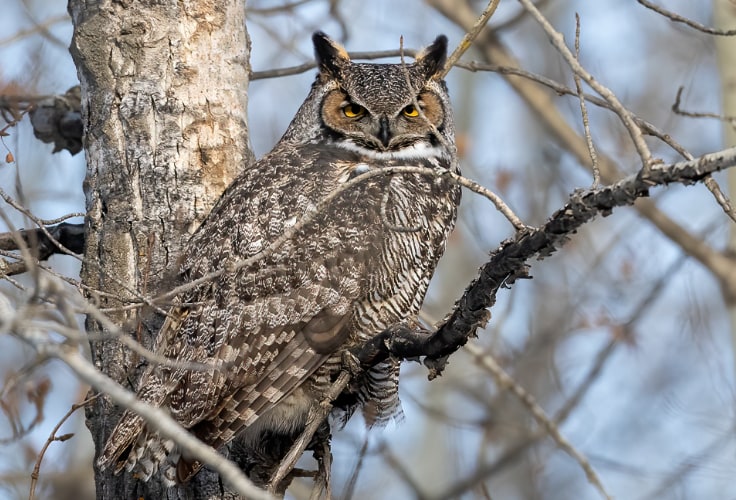
The Great Horned Owl is Michigan’s most familiar and widespread nocturnal raptor, breeding across both peninsulas and occupying the top tier of the state’s nighttime food web. Its adaptability to varied landscapes has allowed it to persist in both forested regions and agricultural mosaics across the state. The species measures 46 to 63 centimeters (18.1 to 24.8 inches) in length and presents a large, thick-bodied profile with a broad head and prominent ear tufts. The facial disc frames large yellow eyes, and a white throat patch often shows clearly in low light. Plumage is heavily mottled brown, buff, gray, and black, providing effective camouflage in woodland settings.
In the field, Great Horned Owls are most often detected by voice. Their deep, resonant hoots carry across still winter and early spring nights, especially before dawn, when territorial pairs proclaim breeding territories. Birds perch upright on exposed branches, poles, or the tops of broken trees bordering open areas. Flight is strong and deliberate, with deep wingbeats and short glides as the owl moves between hunting perches. Although primarily nocturnal, individuals may also hunt at dusk or dawn. They hunt from elevated perches overlooking fields, clearings, or forest edges, dropping onto prey on the ground or seizing it during low hunting flights. Their diet includes mammals and birds, along with other vertebrates, reflecting their role as a dominant generalist predator in Michigan’s nocturnal ecosystems.
The species breeds throughout Michigan, with records from the southern Lower Peninsula through the northern Lower Peninsula and across the Upper Peninsula. Atlas coverage indicates particularly high detection rates in the southern Lower Peninsula, where scattered woodlots and agricultural openings create favorable edge habitat, though distribution in more extensively forested northern regions is likely underestimated. Great Horned Owls require wooded areas that provide nesting structures – often abandoned nests of other raptors, tree cavities, or broken tree tops, combined with adjacent open areas for hunting. They also occupy suburban woodlots and urban parks. The species is a permanent resident statewide, maintaining territories year-round.
Michigan populations appear stable, and no specific management is currently required. Historical persecution in the early 20th century reduced numbers, but protective legislation and changes in agricultural practices allowed populations to expand beginning in the 1940s. Breeding Bird Survey data indicate no significant long-term decline in the state, and atlas differences likely reflect survey effort rather than population change. As a top predator, the Great Horned Owl is vulnerable to secondary poisoning from rodenticides, organochlorines, and lead, particularly in suburban areas where rats form part of the diet. Despite these pressures, it remains a common and enduring component of Michigan’s raptor community.
Barred Owl
Strix varia
- Identification: Large gray-brown owl with a rounded head lacking ear tufts, dark brown eyes, a well-defined facial disc, and brown-and-white barred and streaked plumage across the breast and underparts.
- Where found: Occurs statewide in Michigan in mature forests, especially in the Upper Peninsula and northern Lower Peninsula, with increasing presence in parts of the southwestern Lower Peninsula.
- How to spot: Listen at dusk or night for the distinctive “Who cooks for you?” call, or watch for a broad, rounded owl gliding quietly through wooded swamps and mature forest.
- Conservation status: Least Concern (IUCN); populations in Michigan show a slight but steady increase in recent decades.

The Barred Owl is one of the most characteristic voices of Michigan’s mature forests and wooded swamps, where it functions as a dominant nocturnal predator beneath the forest canopy. It measures 43 to 50 centimeters (16.9 to 19.7 inches) in length and presents a broad-bodied profile with a rounded head and no ear tufts. The large dark brown eyes and pale yellow bill sit within a full facial disc that enhances its expressive appearance. Plumage is gray-brown overall, with horizontal brown barring across the upper breast and bold vertical streaking down the belly, creating a softly patterned effect that blends with bark and deep shade.
In the field, Barred Owls are most often detected by voice. Their far-carrying hoots, commonly rendered as “Who cooks for you? Who cooks for you-all?,” echo through forested wetlands and riparian corridors, especially at dusk and during the night. Birds roost quietly in dense cover by day and move through the woods with buoyant, silent flight after dark. As crepuscular and nocturnal hunters, they use elevated perches to watch for prey and may drop to the forest floor or wade into shallow water. Their diet includes small mammals, birds, and amphibians, reflecting their role as versatile forest predators.
Barred Owls occur statewide in Michigan. Both atlas periods recorded the species across the Upper Peninsula, northern Lower Peninsula, and southern Lower Peninsula, with most territories detected in the Upper Peninsula and northern Lower Peninsula. The current atlas indicates growth in parts of the southwestern Lower Peninsula, likely associated with the maturation of woodlots. Preferred habitat consists of mature woods with numerous old trees and large cavities suitable for nesting. In northern Michigan, large beech trees appear favored for nest cavities, though maples and dead snags are also used. The species depends on forest structure that provides both nesting cavities and adjacent open areas for hunting, and it occupies territories year-round.
Barred Owl numbers in Michigan show a slight but steady increase since the early 1980s based on regional monitoring. Atlas comparisons indicate modest statewide increases in occupancy, though confirmation rates vary and may reflect survey effort rather than true population shifts. The species is not currently on any watch lists in Michigan. Forest management that preserves large live trees and standing snags is important for maintaining nesting opportunities. As a top forest predator, the Barred Owl benefits agricultural areas by reducing rodent populations, and overall it remains a stable and increasingly widespread component of Michigan’s woodland raptor community.
Snowy Owl
Bubo scandiacus
- Identification: Large, powerful white owl with a rounded head, bright yellow eyes, and variable dark barring that is heavier on females and younger birds and often minimal on older males.
- Where found: Winter visitor to Michigan, most often in open coastal and agricultural landscapes, especially along the Great Lakes shorelines and in the eastern Upper Peninsula.
- How to spot: Scan wide-open shorelines, fields, dunes, airports, and hayfields for a pale owl perched on the ground or low structures, or watch for low, buoyant flights over open terrain.
- Conservation status: Vulnerable (IUCN); global populations are declining, and Michigan birds face winter mortality risks including collisions and food limitation.

The Snowy Owl is Michigan’s most dramatic winter raptor and a highly sought-after visitor during irruption years. Unlike the state’s resident owls, it does not breed here but arrives from the Arctic tundra to spend the winter in open landscapes that resemble its northern home. The species measures 52 to 71 centimeters (20.5 to 28.0 inches) in length and is among the largest and heaviest owls in the world. It has a broad, rounded head and intense yellow eyes set in a strikingly pale face. Plumage varies with age and sex: adult males may appear nearly pure white, while females and younger birds show extensive dark barring across the crown, back, wings, and underparts. The legs and toes are densely feathered, an adaptation to cold environments.
In Michigan, Snowy Owls are typically detected in open settings rather than forests. They perch conspicuously on the ground, on hay bales, fenceposts, utility poles, barns, dunes, piers, and other low structures overlooking wide expanses. Flight is low and buoyant over fields or shorelines, becoming direct and powerful when pursuing prey. Unlike most owls in the state, they are strongly diurnal in winter and may be active at any hour, though dawn and dusk are often productive times for observation. Their diet in Michigan consists primarily of small mammals such as meadow voles, though ducks and other waterfowl may also be taken, particularly near open water along the Great Lakes.
The Snowy Owl is a non-breeding winter visitor in Michigan, arriving irregularly from late December and typically remaining through March. Numbers vary dramatically from year to year in response to Arctic prey cycles. In most winters only a few individuals are present, but irruption years can bring widespread sightings across the state. The highest concentrations are often recorded in the eastern Upper Peninsula, particularly in Chippewa and Mackinac Counties, including areas south of Sault Ste. Marie such as Sault Township, Rudyard, and Pickford. The Saginaw Bay region, including Fish Point, is another well-known concentration area. Snowy Owls also occur along much of the Great Lakes coastline, in hayfields and pastureland, and occasionally at airports and other large open areas. Although individuals have been recorded in every county in recent decades, they are most consistent in open northern and coastal landscapes.
Global populations of Snowy Owls are declining, largely tied to long-term changes in Arctic ecosystems and prey availability. In Michigan, wintering birds face hazards including vehicle collisions, starvation during poor prey years, and conflicts in developed landscapes such as airports. Despite these risks, the species remains one of the most celebrated winter visitors in the state. During peak irruption years, its presence along windswept shorelines and snow-covered fields provides one of Michigan’s most memorable raptor spectacles.
Where and When to See Birds of Prey in Michigan
Birds of prey can be found somewhere in Michigan in every season, but the best locations shift with habitat and time of year. In spring and summer, forested regions of the Upper Peninsula and northern Lower Peninsula support breeding Barred Owls, Broad-winged Hawks, and Northern Harriers in extensive woods, wetlands, and grasslands, while Ospreys and Bald Eagles nest along lakes, rivers, and Great Lakes shorelines. Open farmland and suburban edges across the Southern Lower Peninsula hold Red-tailed Hawks, American Kestrels, and Cooper’s Hawks, and Peregrine Falcons occupy cliffs and urban skylines. Dawn and dusk are often most productive for owls and harriers, while mid-morning thermals reveal soaring hawks and eagles.
Autumn brings visible migration along the Great Lakes, where Peregrine Falcons and Broad-winged Hawks pass south in steady numbers, and open marshes and shorelines attract hunting Northern Harriers and lingering Ospreys. Winter shifts the focus to open water and expansive fields. Bald Eagles gather where rivers and lakes remain ice-free, Red-tailed Hawks and Cooper’s Hawks remain widespread, and Turkey Vultures increasingly linger in milder years. During irruption winters, Snowy Owls become the state’s most sought-after raptor, especially along Great Lakes shorelines, Saginaw Bay, and the open fields of the eastern Upper Peninsula. From forest canopy to windswept shoreline, Michigan’s varied landscapes ensure that attentive observers can encounter birds of prey in every region of the state.
For a broader perspective, explore our guide to the types of birds of prey, and visit the Birds of Michigan and Birds of the United States pages for additional regional and national bird guides.


