
Across North America’s wetlands, lakes, and coastal shallows, the most distinctive white birds with long necks and legs include the elegant herons, egrets, and cranes. A few other species, such as swans, share a similar long-necked silhouette, though they lack the long legs of waders and spend more time swimming than walking in the shallows.
This ID guide looks at the main species that fit this description across the United States and Canada, highlighting those most often seen in wetlands, marshes, and coastal habitats. It also includes birds that may cause confusion in the field, outlining the key traits that separate them by size, structure, and behavior.
Great Egret
Ardea alba
- Identification: Large, all-white heron with a long, S-shaped neck, black legs and feet, and a yellow bill. In breeding season, shows fine white plumes on the back and lime-green facial skin.
- Where found: Common in wetlands, marshes, ponds, estuaries, and coastal lagoons across most of North America; winters mainly in the southern U.S., Mexico, and Central America.
- How to spot: Often stands motionless or wades slowly in shallow water, neck coiled for a lightning-fast strike. Flies with steady, deliberate wingbeats and retracted neck.
- Conservation status: Least Concern (IUCN); once decimated by plume hunting in the early 1900s, now widespread and stable thanks to wetland protection efforts.

The great egret is one of North America’s most familiar white birds with a long neck and legs, a striking figure in marshes and coastal wetlands. It measures 80-104 centimeters (31.5-41 inches) in length and has a slender body, S-shaped neck, and dagger-like yellow bill. Its plumage is pure white throughout the year, but during the breeding season adults develop long, delicate back plumes called aigrettes and vivid lime-green lores. The combination of white feathers, black legs, and a yellow bill makes this tall heron easy to recognize even from afar.
Graceful and deliberate, the great egret hunts by wading slowly or standing still, striking with precision at fish, amphibians, or small crustaceans. It sometimes swims short distances or hovers briefly before dipping into the water for prey. In flight, it retracts its neck into a tight curve and trails long black legs behind, moving its broad wings in slow, steady beats. Despite its size, its flight is buoyant and silent. The bird is mostly quiet outside the breeding season, though colonies are filled with croaking “kraak” or “frawnk” calls.
Great egrets breed widely across the continent, from coastal New England and the Great Lakes to the Gulf Coast, California, and Pacific Northwest. They nest colonially in trees near water, often alongside other herons and ibises. Northern populations migrate south after breeding, wintering across the southern United States, Mexico, Central America, and the Caribbean. Once nearly eradicated for the plume trade, the species became a symbol of early bird protection and the emblem of the National Audubon Society. Today, it remains abundant and adaptable, thriving in both pristine and human-altered wetlands across North America.
Snowy Egret
Egretta thula
- Identification: Medium-sized, slender white heron with black legs, a thin black bill, and vivid yellow feet. During breeding season, adults develop wispy white plumes and bright facial colors.
- Where found: Common in shallow coastal lagoons, tidal marshes, and freshwater wetlands across much of the U.S., Mexico, Central America, and the Caribbean; breeds locally into southern Canada.
- How to spot: Active forager that often runs, dashes, and stirs the water with its yellow feet to flush prey. Flies with buoyant wingbeats and a tucked neck. Usually seen alone or in loose groups with other waders.
- Conservation status: Least Concern (IUCN); once decimated by plume hunting, the species has rebounded and remains widespread, though sensitive to wetland loss.

The snowy egret is one of the continent’s most elegant long-legged white waders, instantly recognizable by its slender build, inky-black bill, and striking yellow feet. Measuring 56-66 centimeters (22-26 inches) in length, it is smaller than the great egret, with entirely white plumage and long, delicate plumes that appear during the breeding season. In spring, adults also show colorful bare parts – reddish facial skin and orange-yellow feet that glow against black legs. Outside the breeding season, the face returns to yellow and the feet to greenish-yellow.
Snowy egrets are lively and animated hunters, wading through shallow water with quick, darting movements. They often stir the bottom with their bright feet or chase small fish and crustaceans while spreading their wings for balance. Their foraging behavior is one of the most varied among North American herons, including running, hopping, and foot-stirring techniques. In flight, the bird’s deep, steady wingbeats and retracted neck create a buoyant, elegant silhouette. Its higher-pitched calls are mostly heard around nesting colonies, where males perform aerial displays while giving raspy “aahr” or “wah-wah-wah” calls.
This species breeds in colonies across much of the continent, from the Atlantic and Gulf coasts and Florida wetlands to inland lakes and rivers as far north as southern Canada and the Great Lakes. In the West, it nests locally from California to the Great Basin and the Rockies. Northern populations migrate south after breeding, wintering across the southern United States, Mexico, the Caribbean, and Central America. Once nearly exterminated by plume hunters, snowy egrets have made a remarkable recovery and are now a common sight in coastal wetlands. Their future, however, depends on the preservation of tidal marshes and shallow-water habitats throughout the Americas.
Whooping Crane
Grus americana
- Identification: Tallest bird in North America. White body with black wingtips visible in flight, red crown and face, and dark bill and legs.
- Where found: Breeds in Wood Buffalo National Park, Canada, and winters along the Texas Gulf Coast; reintroduced populations occur in Wisconsin, Louisiana, and Florida.
- How to spot: Look for a towering, white crane with a long neck held straight in flight and black wing tips clearly visible. Often seen among smaller Sandhill Cranes during migration.
- Conservation status: Endangered (IUCN); once reduced to only 21 individuals in the 1940s, the species has rebounded through intensive conservation, but remains highly vulnerable.

The whooping crane is the tallest bird in North America, standing up to 1.6 meters (5.2 feet) tall. It is unmistakable in its gleaming white plumage, long dark legs, and black wingtips, which flash dramatically in flight. Adults show a red crown and face patch, contrasting with the dark bill and eyes. Despite their great size, these cranes move with striking grace, walking with deliberate, stately strides and flying with deep, slow wingbeats and neck fully extended.
In flight or on the ground, whooping cranes are highly vocal, producing the resonant, trumpet-like “whoop” that gives the species its name. Their unison calls, loud, synchronized duets between mated pairs, carry for miles across open wetlands. They feed by probing shallow water and soft soil for crustaceans, insects, amphibians, and roots, switching to crabs, clams, and grains on wintering grounds. During migration, they are often seen in the company of sandhill cranes, which appear noticeably smaller and grayer.
The only self-sustaining wild population breeds in Wood Buffalo National Park, Canada, and winters at Aransas National Wildlife Refuge on the Texas coast. Reintroduction programs have established additional, smaller populations in Wisconsin, Louisiana, and Florida. Although their numbers have risen from just over 20 birds in the 1940s to several hundred today, the species remains highly threatened. Its survival depends on continued habitat protection, powerline management, and close international cooperation between Canada and the United States.
Great White Heron
Ardea herodias occidentalis
- Identification: Very large, all-white heron with long legs, an extended S-shaped neck, and a thick, pale yellow bill. Similar but larger and bulkier than the great egret.
- Where found: Restricted to southern Florida, the Florida Keys, and parts of the Caribbean. Prefers shallow coastal and marine habitats with seagrass flats and mangroves.
- How to spot: Solitary or loosely social; hunts by standing still or wading slowly through shallow water. In flight, shows broad wings, slow deliberate beats, and a coiled neck.
- Conservation status: Least Concern (IUCN); Endangered (if treated as a distinct species) due to its restricted range, small population, and habitat degradation.

The great white heron is the striking white form of the great blue heron and one of the largest white birds found in North America. Measuring 97-137 centimeters (38.2-54 inches) in length, it dwarfs the great egret and shares the same long-legged, long-necked silhouette typical of large herons. Its plumage is entirely white, and its robust yellow bill and grayish legs set it apart from the slimmer, black-legged great egret.
In behavior, the great white heron closely resembles the great blue heron – patient, solitary, and methodical in its foraging. It wades or stands motionless in shallow coastal waters, often over turtle-grass flats, waiting to spear fish or crustaceans with a lightning jab of its bill. Its flight is steady and powerful, with slow, deep wingbeats and a retracted neck. The species’ deep croaks and harsh “fraaank” calls are rarely heard outside colonies. Its bulk, pale coloration, and broad wings make it an unmistakable presence against the turquoise shallows of the Keys.
Endemic to the subtropical coasts of southern Florida and the lower Keys, the great white heron also occurs locally in Cuba and possibly on nearby Caribbean islands. It nests mainly on mangrove islands or remote keys, building large stick nests in trees or shrubs above the high-tide line. While some birds disperse short distances after breeding, most remain year-round residents. The population is small and localized, facing threats from habitat degradation, wetland loss, declining fish stocks, and invasive predators. Rising sea levels and more frequent hurricanes further endanger its nesting sites.
Although the taxonomic debate continues, whether a distinct species or a color morph of the great blue heron, the great white heron remains one of the most distinctive and regionally restricted large waders in North America.
Reddish Egret (White Morph)
Egretta rufescens
- Identification: Medium-sized coastal heron with entirely white plumage, pink-and-black bill, and grayish legs. Distinguished from similar egrets by dusky legs and highly animated foraging behavior.
- Where found: Rare and local along the Gulf Coast, southern Florida, the Bahamas, and parts of the Caribbean; restricted to shallow coastal flats, tidal lagoons, and mangrove islands.
- How to spot: Watch for an energetic white heron running, spinning, and spreading its wings while chasing fish in shallow water – a hallmark behavior of the species. Usually seen singly or in small groups.
- Conservation status: Near Threatened (IUCN); once reduced by plume hunting and now declining due to habitat loss and coastal development; sensitive to disturbance and climate-driven storm impacts.

The white morph of the reddish egret is a rare and striking coastal heron, instantly recognizable by its pure white plumage, pink-and-black bill, and restless foraging style. Measuring 70-80 centimeters (27.6-31.5 inches) in length, it rivals the great egret in size but appears stockier and heavier-billed. While the dark morph dominates along U.S. and Mexican coasts, the white morph is more frequent in the Bahamas and parts of the Caribbean. Its bright plumage can make it easy to mistake for other egrets, yet its behavior – bold, erratic, and highly animated – gives it away at once.
Few herons are as lively in the field as the reddish egret. It darts through tidal shallows with wings raised or half-spread, alternately running, spinning, and leaping as it chases small fish. The bird often creates shade with its wings – a “canopy feeding” behavior that attracts prey into the shadow, and may even hover briefly while striking. Foraging is visual and highly active, in contrast to the patient, still-hunting style of most egrets. When alarmed, the bird emits a throaty “awwh” call or short croaks, though it is usually quiet away from colonies.
This species occurs mainly along the warm coasts of the Gulf of Mexico, Florida Keys, and the Caribbean, nesting on mangrove islands or low coastal islets. It favors open tidal flats and shallow lagoons only a few centimeters deep. Reddish egrets suffered heavily during the plume trade and remain one of the rarest herons in North America. Although populations have partially recovered, they continue to decline in parts of their range due to coastal habitat loss, disturbance at colonies, and the effects of hurricanes and rising sea levels.
Little Blue Heron (Juvenile)
Egretta caerulea
- Identification: Slender heron, similar in size to snowy egret, but with a thicker bill, duller greenish legs, and slower, more deliberate movements. Juveniles are entirely white with a dark-tipped grayish-blue bill and pale greenish legs.
- Where found: Breeds across the southeastern U.S. north to the lower Midwest and Atlantic Coast; winters mainly in the Gulf states, Mexico, Central America, and the Caribbean.
- How to spot: Look for a white heron in shallow marshes or ponds moving slowly and methodically rather than darting like a snowy egret. Transitional birds with mixed white and blue feathers are particularly distinctive.
- Conservation status: Least Concern (IUCN); though regional declines linked to wetland loss and water pollution have prompted concern.

The juvenile little blue heron is a deceptive sight among North America’s waders. Though adults are dark slate-blue with a maroon head and neck, the young birds are pure white for their first year, often leading to confusion with snowy or cattle egrets. Closer inspection reveals key differences: a sturdy two-toned bill, dull greenish legs instead of bright yellow, and calm, deliberate foraging behavior.
Juvenile little blue herons forage alone or in small groups in shallow wetlands, ponds, tidal flats, and flooded fields. They stalk prey with slow, measured steps, peering carefully into the water before striking at small fish, frogs, or crustaceans. This patient hunting style contrasts with the quick, darting movements of other white egrets. As they molt into adult plumage, juveniles pass through a distinctive piebald phase of white and blue feathers, earning them the nickname “calico herons” among birders.
In North America, little blue herons breed mainly in the southeastern and Gulf states, often nesting in mixed colonies with snowy egrets and other waders. Their breeding range extends northward along the Atlantic coast to southern New England and inland to the Mississippi River valley. While the species remains widespread, populations have declined in many areas due to wetland degradation, water management, and pollution. Protecting coastal and freshwater marshes remains essential for sustaining this quiet, understated member of the heron family.
Western Cattle Egret
Ardea ibis
- Identification: Small, stocky white egret with a short neck and thick yellow bill. Breeding adults show orange-buff plumes on the head, chest, and back; non-breeding birds are entirely white.
- Where found: Found mainly in the southern and eastern United States, especially Florida, the Gulf Coast, and parts of California; widespread across Mexico, Central America, and the Caribbean.
- How to spot: Look for small white herons walking near cattle or tractors in fields and pastures, often perching on livestock backs or foraging in loose groups. Flies with neck folded and legs extended.
- Conservation status: Least Concern (IUCN); populations are widespread and adaptable, though showing mild declines in North America; locally affected by pollution and water contamination.

The western cattle egret is one of the most terrestrial and adaptable of North America’s white herons. Smaller and more thick-set than other egrets, it measures 46-56 centimeters (18.1-22 inches) in length and often appears short-necked and hunched when compared to its longer-necked relatives. In breeding season, adults develop soft orange-buff plumes on the crown, breast, and back, giving them a warm wash of color against their white plumage. Their sturdy yellow bill and dark legs add to the bird’s compact, purposeful look.
Unlike most herons that haunt marshes and shallows, the western cattle egret thrives in dry grasslands, pastures, and agricultural areas. It feeds primarily on grasshoppers, crickets, and other insects flushed by grazing cattle, horses, or farm machinery, walking briskly or running in pursuit of prey. The bird’s feeding reflex is highly flexible – it may forage alone, in groups, or even from the backs of livestock. Its short neck and robust bill are well suited for seizing terrestrial prey, and its constant head-bobbing gait makes it conspicuous in open country.
In North America, the cattle egret breeds locally from California and Texas across the Southeast to Florida and the Atlantic coastal plain, nesting in mixed colonies with other herons and egrets. It winters in the southern United States, Mexico, and the Caribbean, moving north again as temperatures rise. Its global success stems from its remarkable adaptability and close association with human-altered habitats – a versatile survivor among North America’s white long-legged birds.
White Ibis
Eudocimus albus
- Identification: Medium-sized wading bird with a long, downward-curved pink bill, long neck, and reddish legs. Adults are white with black wingtips visible in flight.
- Where found: Common in coastal and inland wetlands of the southeastern United States, especially Florida and the Gulf Coast; also found through Mexico, Central America, and the Caribbean.
- How to spot: Often seen walking in flocks through shallow water, probing the mud for prey with rhythmic movements of its curved bill. Flies with neck and legs fully extended in loose V-formations.
- Conservation status: Least Concern (IUCN); populations stable and adaptable, though dependent on wetland health and water-level management.

The white ibis is one of the most distinctive long-legged white birds of North America’s wetlands. Measuring 56-68 centimeters (22-26.8 inches) in length, it is instantly recognized by its bright reddish-pink bill, face, and legs, contrasting with pure white plumage and black wingtips. The long, decurved bill is perfectly adapted for probing mud and shallow water for food. The species’ pale blue eyes and pink bare facial skin give adults a gentle yet striking appearance in bright light.
Highly social and nomadic, white ibises forage in flocks, wading through shallow marshes, mudflats, or flooded fields with slow, deliberate steps. They feed mainly on small crustaceans, insects, and aquatic invertebrates, detecting prey by touch with their sensitive bill tips. Unlike herons, which stalk their prey, ibises probe continuously while walking. In flight, they travel in loose, undulating formations with neck and legs extended, alternating bursts of rapid wingbeats with short glides. Their calls are low, nasal “honk” notes often heard when flying to or from feeding sites.
White ibises breed in colonies across the southeastern United States, from the Carolinas through Florida and west to Texas and Louisiana. They also nest locally in Mexico, the Caribbean, and parts of Central America. Colonies are usually established in trees or mangroves on islands within coastal or inland wetlands, and they may shift sites from year to year depending on water levels. After breeding, ibises disperse widely, sometimes moving northward as far as the mid-Atlantic states. Once confined mostly to remote marshes, the species has adapted well to suburban landscapes, and in parts of Florida it is now a familiar sight in parks, golf courses, and lawns.
Wood Stork
Mycteria americana
- Identification: Very large wading bird. White plumage with glossy black flight feathers and tail; long, thick, decurved bill; unfeathered gray head and neck.
- Where found: Resident in wetlands of the southeastern United States, and widespread through Mexico, Central America, and South America.
- How to spot: Look for a massive white wader with a dark, bare head and hefty down-curved bill, often feeding in shallow water with its bill submerged. In flight, it soars with black-and-white wings and neck fully extended.
- Conservation status: Least Concern (IUCN); threatened in the U.S. due to breeding range limitations and sensitivity to water-level changes.
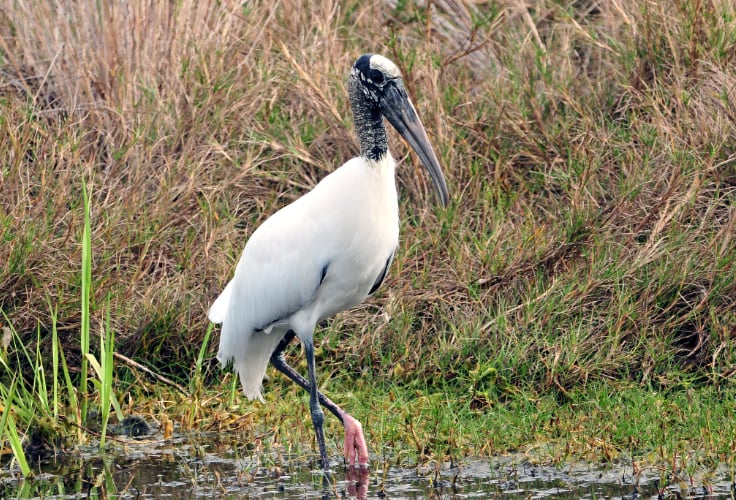
The wood stork is the only stork native to North America and among its most imposing wetland birds. Standing up to 115 centimeters (45.3 inches) tall, it combines the bulk of a heron with the distinctive bare, scaly head and long, decurved bill typical of true storks. Adults are mostly white, with glossy black flight feathers and tail that flash in contrast during flight. The bill is thick and dark, designed for tactile feeding, and the legs are dark with pinkish feet, especially during the breeding season.
Unlike most herons and egrets, wood storks feed by touch rather than sight. They wade slowly through shallow water with bills held slightly open, snapping them shut with lightning speed when a fish or frog brushes the sensitive interior – a reflex faster than most prey can react. To stir hidden prey, they rhythmically move their feet and occasionally flick their wings for balance. They often forage in groups, moving methodically through drying wetlands or tidal creeks, where fish are concentrated.
In the United States, wood storks breed mainly in Florida, Georgia, and South Carolina, nesting in colonies on trees over flooded swamps or mangrove islands. They occur year-round across the Southeast but shift locally in response to rainfall and water levels, moving to areas where food is more abundant. South of the U.S., they range widely through Central and South America. Once endangered due to wetland drainage in the Everglades, their population has stabilized, though success still depends on seasonal flooding cycles. Prolonged drought, altered water management, and coastal development remain the main threats to this striking and ancient wader.
Trumpeter Swan
Cygnus buccinator
- Identification: Enormous white waterbird with a long neck, all-black bill, and black legs; often shows a slight rufous stain on head and neck from iron-rich waters.
- Where found: Breeds across Alaska, western and central Canada, and the northern U.S.; winters wherever open water persists, including the Pacific Northwest, Midwest, and mountain valleys.
- How to spot: Watch for very large, all-white swans on shallow lakes, ponds, or marshes, often in pairs or family groups. In flight, note the deep, powerful wingbeats and loud, trumpet-like calls.
- Conservation status: Least Concern (IUCN); a major conservation success story following near-extinction in the early 1900s.

The trumpeter swan is North America’s largest native waterfowl and one of its most striking white birds with a long, graceful neck. Adults are entirely white with black bills and feet, measuring up to 1.83 meters (6 feet) in length. The head and neck often appear rust-stained from iron-rich wetlands. Immatures are gray-brown with pinkish tones on the bill. In flight or at rest, they appear clean white and imposing, easily dwarfing other swans and geese.
Unlike the long-legged herons and egrets of shallow marshes, trumpeter swans belong to a different world – broad wetlands, lakes, and slow rivers. They forage by tipping forward in shallow water, reaching underwater vegetation with their long necks, or grazing in fields on leftover grain. They often trumpet in resonant, far-carrying calls, giving the species its name. In the field, note their straight bill profile and the broad black skin connecting the bill to the eye, which sets them apart from tundra swans with smaller, more concave bills and visible yellow spots near the eyes.
Once nearly extinct due to overhunting and habitat loss, trumpeter swans have made one of North America’s great conservation recoveries. After a low point of fewer than 100 known birds in the 1930s, reintroduction and protection have restored populations across the northern U.S. and southern Canada. Today, they breed widely from Alaska to the Great Lakes and the northern Rockies and winter on ice-free lakes, rivers, and estuaries. Continued protection from disturbance and pollution ensures that their resonant calls will remain part of the continent’s northern wetlands.
Mute Swan
Cygnus olor
- Identification: Large white swan with an orange bill topped by a black knob, a gracefully curved neck, and black to grayish-pink legs. Immatures are pale gray-brown.
- Where found: Introduced and established locally in the northeastern, Great Lakes, and Pacific Northwest regions of North America; favors city ponds, lakes, and coastal bays.
- How to spot: Look for an elegant white swan gliding with its neck curved in an S-shape and wings slightly raised, often on ornamental or suburban waters.
- Conservation status: Least Concern (IUCN); non-native and managed in some U.S. states due to impacts on native wetland species and habitats.

The mute swan is among the most familiar long-necked white birds across parks and ponds of the northeastern U.S. and Great Lakes. Adults are entirely white, with a long curved neck, bright orange bill, and a prominent black knob at the bill’s base. They measure 1.27-1.52 meters (4.2-5 feet) in length and are slightly smaller and daintier than trumpeter swans. Juveniles are grayish-brown and gradually turn white during their first year.
In the water, mute swans are instantly recognizable by their curved-neck posture and partially raised wings – an elegant “sailing” pose unique among North American swans. They feed mainly on aquatic vegetation, dipping their long necks underwater to reach submerged plants, but also graze on land when food is scarce. Despite the name, they are not silent – soft grunts, snorts, and hisses accompany courtship, defense, and territorial displays. Their rhythmic wingbeats produce a distinct throbbing hum audible in flight.
Native to Eurasia, the species was introduced to North America in the late 1800s to decorate estates and city lakes. Now naturalized in several regions, mute swans thrive in urban and suburban wetlands, reservoirs, and estuaries. With few predators and high tolerance for humans, they can outcompete native waterfowl, trample nests of smaller birds, and deplete vegetation crucial for other species. As a result, wildlife agencies in some states control their populations to protect native habitats and support recovering trumpeter swan flocks.
Tundra Swan
Cygnus columbianus
- Identification: Large, long-necked white swan with a black bill that usually shows a small yellow spot near the base; juveniles are pale gray.
- Where found: Breeds on Arctic tundra from Alaska to northern Canada; winters mainly along the mid-Atlantic and Pacific coasts.
- How to spot: Straight-necked posture, strong flapping flight in V-formations, soft wing whistles; often in large, vocal flocks on lakes and estuaries.
- Conservation status: Least Concern (IUCN); population stable though locally impacted by lead poisoning and habitat loss.

The tundra swan is the smallest and most numerous of North America’s native swans. Adults are entirely white with a sleek, straight neck and black bill, often marked with a small yellow spot in front of the eye. Measuring 1.20-1.50 meters (3.9-4.9 feet) in length, it appears more delicate and slightly smaller than the trumpeter swan. Juveniles are pale gray with pinkish-gray bills that darken by spring. The gently sloping forehead and bill, along with the absence of a knob, help distinguish it from mute swans.
On the water, tundra swans hold their necks straight and often tip up to feed in shallow areas like dabbling ducks. They travel and migrate in family groups that form long, V-shaped flocks, accompanied by clear, trumpet-like calls and audible wing whistles. Their flight is steady and buoyant, and they are often seen feeding or resting together in open wetlands and agricultural fields. Compared to trumpeter swans, their calls are higher-pitched and more musical, and their overall appearance is lighter and more graceful.
This species breeds on Arctic lakes, ponds, and tundra wetlands across northern Alaska and Canada. In winter, most gather along the mid-Atlantic coast, from New Jersey to the Carolinas, and on the Pacific coast from British Columbia to central California. They frequent shallow, open water and nearby farmlands, often in large flocks. Despite localized impacts from pollution, disease, and habitat loss, tundra swans remain widespread and abundant across North America.
American White Pelican
Pelecanus erythrorhynchos
- Identification: Enormous white bird with black wing tips, long neck, massive orange bill with throat pouch, and orange legs.
- Where found: Breeds on inland lakes and islands across the northern and western U.S. and Canada; winters mainly along southern coasts, inland reservoirs, and the Gulf region.
- How to spot: Often seen soaring high in large, graceful flocks or feeding cooperatively on lakes and wetlands; flies with steady, shallow wingbeats and head tucked back.
- Conservation status: Least Concern (IUCN); populations increasing after mid-century declines; locally sensitive to disturbance at nesting sites.

The American white pelican is one of the continent’s largest and most spectacular white waterbirds, easily recognized by its vast wingspan and long orange bill. Measuring 1.27-1.65 meters (4.2-5.4 feet) in length, it dwarfs most other species in this group. Adults are entirely white except for black primaries visible in flight, while their immense bills feature a flexible throat pouch used for scooping fish. During breeding, the bill and legs turn vivid orange and a short, flattened “horn” appears on the upper mandible, later shed after nesting.
Despite their size, pelicans fly with remarkable grace, soaring on broad wings in tight formations that can be seen from miles away. On the water, these social birds feed in coordinated groups, herding schools of fish toward shallow areas where they can scoop them up in unison. Unlike their coastal relative, the brown pelican, they do not plunge-dive but instead feed while swimming, often in synchronized lines. Pelicans frequently travel and forage in large flocks, and their synchronized soaring flocks are a familiar sight over inland lakes and reservoirs. When resting, they form dense colonies on remote islands where their large white forms are conspicuous from afar.
American white pelicans breed on isolated islands in freshwater lakes across the northern Great Plains, interior West, and southern Canada. After the breeding season, they migrate to wintering areas along the Gulf Coast, southern California, and Mexico, where they frequent coastal lagoons and large inland water bodies. Populations have rebounded strongly following historical persecution and habitat loss, though colonies remain vulnerable to disturbance and flooding. Today, these magnificent birds are once again a common sight in North America’s great inland wetlands and coastal refuges.
Telling Them Apart in the Field
This overview covered the white birds of North America that share the graceful proportions of long necks, and, in many cases, long legs. Whether found wading in marshes, gliding over lakes, or swimming on open water, these species can appear deceptively alike. When identification seems uncertain, pay close attention to details such as bill and leg color, overall size, and characteristic behavior – often the surest clues to telling one from another.