
North America supports 12 species of herons that occur regularly across the United States and Canada, from large, conspicuous wetland birds to small, highly secretive marsh specialists. All are members of the family Ardeidae, which includes species commonly referred to as herons, egrets, and bitterns, a distinction based largely on size, behavior, and habitat use. These species collectively occupy a wide range of wetland habitats, from coastal estuaries and tidal flats to inland marshes, rivers, and flooded forests, with some breeding near the northern limits of suitable wetland conditions.
This ID guide focuses on the heron species that occur regularly in the United States and Canada, beginning with the most widespread and familiar forms and continuing through more localized or regionally restricted species. Each account emphasizes field-oriented identification features, including overall structure, plumage patterns, flight style, behavior, and habitat use, with attention to age-related and seasonal variation where relevant.
Great Blue Heron
Ardea herodias
- Identification: Very large heron with long legs and neck, blue-gray upperparts, a thick dagger-like bill, and a distinctive black stripe over the eye.
- Where found: Widespread across the United States and southern Canada in freshwater and coastal habitats, including rivers, lakes, marshes, estuaries, shorelines, and open fields near water.
- How to spot: Look for a tall, slow-moving heron standing motionless in shallow water or flying overhead on deep, deliberate wingbeats with a tucked-in neck and legs trailing well beyond the tail.
- Conservation status: Least Concern (IUCN); populations generally stable or increasing in much of North America, though local declines occur due to wetland loss, disturbance at nesting colonies, and water pollution.

The great blue heron is the largest and most familiar heron in North America, and for many people it is the archetypal long-legged wading bird seen along rivers, ponds, and coastlines. This imposing species measures 97 to 137 centimeters (38.2 to 53.9 inches) in length and shows a tall, elongated silhouette with very long legs, an S-shaped neck, and a heavy, pointed bill. The sexes are similar in appearance, though females average slightly smaller, and adults often appear shaggy due to elongated head, chest, and back plumes.
Adult plumage is predominantly blue-gray above, with a streaked foreneck marked by white, black, and rusty brown lines. The head is mostly white, highlighted by a bold black stripe that runs from above the eye to the back of the head and extends into long occipital plumes in adults. The eyes are yellow, the bill is yellowish to dull horn-colored, and the legs range from brownish to greenish. Juveniles lack the long plumes of adults and appear more uniformly gray, with a darker crown that gradually becomes whiter as birds mature. In southern Florida, an all-white form known as the great white heron occurs, and in areas where white and blue forms overlap, especially in the Florida Keys, intermediate birds known as Würdemann’s herons show a gray body with a mostly white head and neck.

In the field, great blue herons are often detected by their posture and movement long before fine plumage details are visible. Birds typically forage by standing motionless or wading slowly in shallow water, then striking prey with a rapid forward thrust of the head and neck. Flight is slow and powerful, with deep wingbeats and a tucked-in neck, while the long legs trail straight behind the body. The species gives a variety of harsh, squawking calls, most often heard at breeding colonies or when birds are alarmed, including a loud, rasping “frawnk” that has earned it local nicknames in some regions. The diet consists mainly of fish, but also includes amphibians, reptiles, invertebrates, small mammals, and occasionally birds, taken using a wide range of flexible hunting techniques.
The breeding range of the great blue heron spans much of North America, from southern coastal and central Alaska across southern Canada and throughout most of the United States, extending south into Mexico and Central America. In Canada, breeding occurs from British Columbia through the Prairie Provinces, southern Ontario and Quebec, and the Maritime Provinces, primarily south of the boreal forest. In the United States, the species breeds widely from coast to coast, using freshwater wetlands, river systems, lakes, estuaries, and coastal shorelines. Birds typically nest in colonies known as heronries, building bulky stick nests high in trees or, less commonly, on cliffs or islands. Many northern birds move south in winter, while individuals in milder regions remain year-round, making the species present somewhere on the continent in all seasons.
Across North America, the great blue heron is considered secure and remains one of the most successful and adaptable large wading birds. Long-term monitoring indicates generally stable or increasing populations in much of the United States and Canada, reflecting its ability to use a wide range of natural and human-altered habitats. Nevertheless, local declines have been documented, particularly in parts of southern Florida and near heavily developed waterways. The species remains vulnerable to wetland loss, degradation of water quality, chemical contamination, and disturbance at nesting colonies from logging, boating, and other human activities. Continued protection of wetlands and undisturbed breeding sites is important to maintain healthy regional populations of this iconic North American heron.
Great Egret
Ardea alba
- Identification: Large, all-white heron with very long legs, a long dagger-like bill, and a tall, slender profile; adults typically show a yellow bill outside the breeding season and black legs.
- Where found: Widespread across much of the United States and southern Canada in freshwater and coastal wetlands, including marshes, lakes, rivers, estuaries, and flooded fields.
- How to spot: Look for a tall white heron wading slowly or standing motionless in shallow water, or flying with slow, buoyant wingbeats, a tucked-in neck, and legs extending well beyond the tail.
- Conservation status: Least Concern (IUCN); populations are stable or increasing across most of North America, though local vulnerability persists due to wetland loss, disturbance at colonies, and water pollution.

The great egret is one of the most elegant and recognizable wading birds in North America, noted for its gleaming white plumage and stately presence in wetlands. Slightly smaller and more slender than the great blue heron, this species measures 80 to 104 centimeters (31.5 to 40.9 inches) in length and shows a tall, elongated silhouette with very long legs, an S-shaped neck, and a long, sharply pointed bill. The overall impression is of a graceful but powerful bird adapted for deliberate movement and sudden, precise strikes.
Adult great egrets are entirely white in all plumages, with no dark color morphs. Outside the breeding season, adults have a yellow bill, yellowish to olive-green facial skin, and predominantly black legs and feet. During the early breeding season, adults grow long, delicate scapular plumes known as aigrettes, which can reach lengths of up to 50 centimeters (19.7 inches) and extend well beyond the tail; these plumes are raised prominently during courtship displays. At the same time, the bare parts become more vividly colored, with the bill turning partly or wholly black in many populations and the lores and eyering becoming brighter bluish green. Juveniles closely resemble non-breeding adults but typically show a yellow bill with a darker tip and lack ornamental plumes.

In the field, great egrets are most often identified by their behavior and striking white coloration. Birds typically forage by walking slowly through shallow water or standing statue-like for long periods before striking prey with a rapid thrust of the neck and bill. Flight is graceful and buoyant, with deep, measured wingbeats, the neck held tucked in against the body, and the long legs trailing far beyond the short tail. The species is generally quiet away from breeding colonies, giving harsh, guttural calls mainly when alarmed or during social interactions, with vocal activity increasing noticeably during the nesting season. The diet consists primarily of fish, but also includes amphibians, reptiles, small mammals, birds, and a variety of aquatic invertebrates, taken using flexible foraging techniques that range from slow wading to occasional hovering or short plunges.
In North America, the great egret breeds locally but widely across the United States and parts of southern Canada. In Canada, nesting has been recorded in southern portions of Saskatchewan, Manitoba, Ontario, and Quebec, with colonies often small and localized. In the United States, breeding occurs across much of the East, Southeast, Gulf Coast, and parts of the Midwest, as well as at scattered sites in the West, including California, the Pacific Northwest, and interior basins of the Southwest. The species nests colonially, often in mixed-species heronries, building stick nests high in trees, shrubs, or occasionally on islands that offer protection from ground predators. Many northern birds migrate south in winter, while individuals in milder regions remain year-round; wintering birds occur widely across the southern United States, Mexico, the Caribbean, and Central America, with winter distribution shifting northward during mild years.
The great egret has a notable conservation history in North America, having been hunted nearly to extinction in the late 19th and early 20th centuries for its ornamental plumes. Strong legal protection and organized conservation efforts led to a dramatic recovery, and today the species is considered secure across most of its range. Long-term monitoring shows stable or increasing populations in many regions, though localized declines and heightened sensitivity persist where wetlands are lost, water quality is degraded, or nesting colonies are frequently disturbed. Continued protection of wetland habitats and breeding sites remains essential to ensure the long-term stability of this iconic symbol of North American bird conservation.
Snowy Egret
Egretta thula
- Identification: Medium-sized, slender white heron with a long black bill, black legs, and contrasting yellow feet; adults show delicate plumes in the breeding season.
- Where found: Occurs widely across the United States and locally in southern Canada, primarily in coastal and inland wetlands such as marshes, mudflats, tidal channels, lakes, and flooded fields.
- How to spot: Watch for an active white egret wading quickly through shallow water, often using rapid movements and conspicuous foot-stirring, or flying with buoyant wingbeats, a tucked-in neck, and trailing legs.
- Conservation status: Least Concern (IUCN); populations are generally stable in North America, though regional declines persist due to wetland loss, disturbance at colonies, and changes in prey availability.

The snowy egret is one of the most elegant and animated herons in North America, easily recognized by its crisp white plumage and lively foraging style. Smaller and more delicately built than the great egret, this species measures 56 to 66 centimeters (22.0 to 26.0 inches) in length and presents a slender silhouette with long legs, a thin neck, and a fine, pointed bill. The sexes are similar in appearance, though males average slightly larger, and the overall impression is of a light, agile wader adapted for active hunting in shallow water.
Adult snowy egrets are entirely white in all plumages. Outside the breeding season, adults show a black bill, black legs, and yellow to greenish-yellow feet, with bright yellow bare skin in the lores. During the breeding season, adults develop long, wispy plumes on the breast and lower back, along with a short, shaggy crest on the nape. At the height of breeding condition, the lores may become reddish and the feet deepen to a richer orange-yellow, while the bill remains black. Juveniles resemble non-breeding adults but have duller, greenish-yellow feet that extend partly up the rear of the lower leg and a paler base to the lower mandible.

In the field, snowy egrets are often identified as much by their behavior as by their plumage. Birds typically forage by wading actively through shallow water, making quick dashes, abrupt turns, and sudden stops as they pursue prey. A distinctive feature of their feeding behavior is the frequent use of bright feet to stir the substrate, flushing small animals into view before striking. Snowy egrets also use wing-flicking, hopping, and short runs, and may occasionally hover or plunge when prey is concentrated. Flight appears buoyant and graceful, with deep wingbeats, little gliding, a tucked-in neck, and long legs extending well beyond the tail. The species is generally quiet away from breeding colonies, giving sharp or raspy calls mainly when alarmed or during social interactions. Diet consists mainly of small fish and aquatic invertebrates, including crustaceans and insects, with amphibians and other small vertebrates taken opportunistically.
In North America, snowy egrets breed in a wide but patchy distribution across much of the United States and very locally in southern Canada. Breeding occurs primarily in coastal regions along the Atlantic, Gulf, and Pacific coasts, but also inland along large river systems, lakes, and wetlands of the interior West and Midwest. In Canada, breeding is rare and localized, with small numbers reported historically in southern Ontario and probable breeding in Nova Scotia. Snowy egrets nest colonially, often in mixed-species heronries, placing stick nests in trees, shrubs, or on protected islands. During winter, northern breeders migrate south, and the species becomes concentrated along the southern coasts of the United States, Mexico, the Caribbean, and Central America, with winter distribution shifting northward during mild years.
The snowy egret has a notable conservation history marked by severe declines during the late 19th and early 20th centuries, when birds were heavily hunted for their ornamental breeding plumes. Legal protection and changing public attitudes allowed the species to recover and reoccupy much of its former range. Today, snowy egret populations are generally considered stable across North America, though evidence points to regional declines along parts of the Atlantic coast and in some interior areas. Ongoing threats include wetland loss, altered hydrology, disturbance at nesting colonies, and reductions in prey availability. Continued protection and restoration of coastal and inland wetlands remain essential to maintaining healthy populations of this iconic white heron.
Black-Crowned Night Heron
Nycticorax nycticorax
- Identification: Stocky, medium-sized heron with a relatively short neck and legs, gray wings, a black crown and back in adults, red eyes, and a stout black bill.
- Where found: Widespread across the United States and southern Canada in a broad range of freshwater, brackish, and coastal wetlands, often near sheltered roosting sites.
- How to spot: Most active at dusk and at night; watch for stout herons flying out from daytime roosts in the evening or listen for harsh, guttural squawks near wetlands and colonies.
- Conservation status: Least Concern (IUCN); populations generally stable across North America, with regional declines linked to wetland loss, pollution, and disturbance at breeding colonies.

The black-crowned night heron is the most widespread heron in the world and one of the most widely distributed herons in North America. Despite its abundance, it is often less noticeable than many other herons because of its crepuscular and nocturnal habits and its tendency to remain concealed during the day. This species measures 58 to 66 centimeters (22.8 to 26.0 inches) in length and has a compact, thick-set appearance, with a relatively short neck and legs compared to most other herons. Females average slightly smaller than males, but the sexes are otherwise similar in size and plumage.
Adult black-crowned night herons are distinctive, with a glossy black crown, upper back, and scapulars that contrast sharply with pale gray wings, rump, and tail. The face and sides of the neck are white, and the underparts are white to pale gray. The bill is stout and black, and the eyes are deep red. For most of the year, the legs are yellow-green, becoming pinkish during the height of the breeding season. Breeding adults also develop long, white head plumes, and the black areas of the head and back may show a blue-green gloss. Non-breeding adults appear duller and lack the elongated plumes. Juveniles and first-year birds look very different, showing brown upperparts with large pale spots, heavily streaked underparts, and duller, gray-brown wings and tail, giving them a mottled appearance.

In the field, black-crowned night herons are most often detected by their behavior and timing rather than by constant visibility. During daylight hours, they typically roost quietly in trees, shrubs, or dense vegetation near water, often hunched with the head tucked close to the body. Foraging activity peaks from evening through early morning, when birds emerge to feed along pond margins, marsh edges, tidal flats, and shorelines. Flight appears heavier and more labored than that of many day-active herons, with slightly faster wingbeats; the head is held back against the shoulders so that the neck appears shortened, while the legs trail behind the body. The most familiar vocalization is a harsh, guttural squawk often rendered as “quak” or “wok,” given when alarmed, flushed, or during social interactions, especially at breeding colonies. The species is an opportunistic feeder, taking a wide range of prey that includes fish, amphibians, crustaceans, insects, reptiles, small mammals, birds, eggs, and even carrion or refuse.
The black-crowned night heron breeds widely across North America, from Washington State and southern Canada east through Quebec and the Maritime Provinces, and south through much of the United States into coastal Mexico, the Caribbean, and Central America. Breeding distribution is strongly tied to the availability of suitable wetland foraging habitat and secure nesting sites, and the largest concentrations occur in coastal regions, especially along the Atlantic, Gulf, and Pacific coasts. Colonies are typically established over water or on islands, where birds build stick nests in trees, shrubs, or reed beds, often in mixed-species heronries. After breeding, extensive dispersal occurs, and birds from northern regions migrate south to winter primarily along the southern United States, Mexico, and the Caribbean, while some populations, particularly in milder coastal areas, remain resident year-round.
Across North America, the black-crowned night heron is considered common to locally abundant and is not globally threatened. Long-term monitoring indicates generally stable populations, though notable regional declines have occurred in parts of the Pacific Northwest, the Midwest, and along portions of the Atlantic coast. Major threats include the loss and degradation of wetland habitats, reduced water quality, and exposure to pollutants such as pesticides, PCBs, and heavy metals, to which this species is particularly susceptible because it forages high in the aquatic food web. Disturbance at nesting colonies can also negatively affect local populations. Despite these pressures, the species’ broad range, flexible diet, and tolerance of some human-altered environments have helped it remain one of the most successful and widespread herons in North America.
Green Heron
Butorides virescens
- Identification: Small, stocky heron with a short neck and legs, a dark cap and back, rich chestnut neck, gray underparts, and a long, straight bill.
- Where found: Occurs widely across the United States and locally in southern Canada in freshwater and coastal wetlands, especially along wooded ponds, streams, marsh edges, and estuaries.
- How to spot: Look for a compact heron hunched at the water’s edge, often partly concealed by vegetation, or listen for its harsh “skeow” call; in flight it shows slow wingbeats and a briefly unfolding neck.
- Conservation status: Least Concern (IUCN); populations are declining across much of North America, likely due to wetland loss, habitat degradation, and the species’ reliance on small, vegetated water bodies.

The green heron is one of North America’s smallest and most secretive herons, notable for its compact build and solitary habits. This species measures 41 to 46 centimeters (16.1 to 18.1 inches) in length and has a distinctly stocky appearance, with a relatively short neck and legs compared to most other herons. Adults often appear hunched, especially when perched or stalking prey, a posture that helps them blend into dense shoreline vegetation. Females average slightly smaller and duller than males, but the sexes are otherwise similar in appearance.
Adult plumage is dark and richly colored, with a glossy greenish-black cap and back, dark wings that may show a greenish or bluish sheen, and gray underparts. The neck is rufous, a key feature distinguishing North American green herons from closely related Old World forms. Wing feathers are edged in buff, and the crown feathers can be raised into a short, shaggy crest. The bill is dark and relatively heavy for the bird’s size, and the legs are orange to yellowish. Juveniles look quite different, with brown upperparts marked by buffy spots, streaked brown underparts, and a generally mottled appearance that provides effective camouflage; their size and shape help separate them from young of other heron species.

In the field, green herons are often detected by their characteristic posture and movements rather than by overt visual display. Birds typically forage alone, standing motionless at the water’s edge or on low branches, roots, or rocks, then striking quickly at passing prey. Unlike larger herons, they often feed under cover and wade less frequently, preferring very shallow water or solid footing near the shoreline. Flight is slow and steady, with rounded wings and a wingbeat sometimes compared to that of a tailless crow. The head is usually retracted in flight, though green herons often briefly extend the neck, giving them a distinctive, front-heavy look. The most familiar call is a harsh, descending “skeow” or “skow,” given as an alarm or during flight; a variety of rasping or squawking calls may be heard near nests. The species feeds primarily on small fish but also takes amphibians, aquatic insects, crustaceans, and other invertebrates, selecting prey opportunistically based on local availability.
The green heron breeds widely across eastern and central North America, from southeastern Canada through much of the eastern United States and west into the Great Plains, with scattered populations in the Southwest. Along the Pacific coast, it occurs from British Columbia south through California and Baja California, continuing into Mexico and Central America. Breeding is closely tied to the availability of suitable wetland habitats, both freshwater and coastal, often with dense vegetation that provides cover for solitary feeding. Nests are usually placed in trees or shrubs near water, sometimes in loose groups but more often singly or in small clusters. Most northern populations migrate south after breeding, wintering along the Gulf Coast, in Florida, the Caribbean, Mexico, and Central America, while birds in the southern United States and along parts of the Pacific coast may remain resident year-round.
Across North America, the green heron remains fairly common but shows a consistent long-term decline in many regions. Monitoring data indicate widespread decreases in abundance, even though the species still occupies a broad range and is not currently considered globally threatened. The primary concerns are the loss and degradation of wetlands, especially small, vegetated water bodies that this species relies on for feeding, as well as changes in land use along shorelines. Because green herons are solitary, inconspicuous, and widely dispersed, population changes can be difficult to detect, underscoring the importance of conserving a network of intact wetlands and riparian habitats to support this distinctive small heron.
American Bittern
Botaurus lentiginosus
- Identification: Medium-large, heavily streaked brown heron with a stout body, thick neck, relatively short legs, and a distinctive dark stripe running down the side of the neck.
- Where found: Breeds widely across freshwater marshes of the United States and Canada, favoring dense emergent vegetation; winters mainly in the southern United States and coastal wetlands.
- How to spot: Most often detected by its deep, booming calls in spring or by careful scanning of reed beds, where its striped plumage blends seamlessly with vertical vegetation.
- Conservation status: Least Concern (IUCN); populations have declined in parts of the United States and Canada due to wetland loss, though the species remains widespread overall.
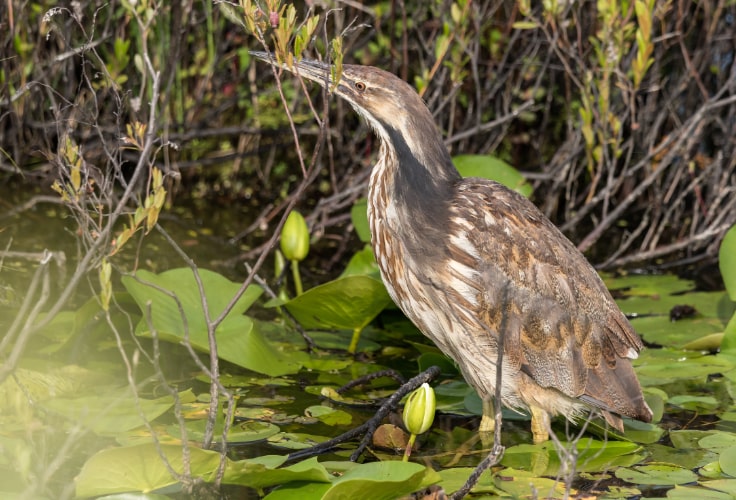
The American bittern is widespread across North America, yet remains a highly secretive heron that is often heard long before it is seen. This species measures 60 to 85 centimeters (23.6 to 33.5 inches) in length and has a compact, thick-bodied profile unlike the taller, more elegant silhouettes of most herons. Its short legs, stout neck, and broad body give it a hunched appearance, well suited to life concealed within dense marsh vegetation.
Adult plumage is intricately patterned in warm browns, buff, and white, with fine black flecking above and bold vertical streaking below. A rusty-brown crown contrasts with a pale throat, while a long black stripe extending from below the eye down the side of the neck is unique among North American herons. The outer flight feathers are dark brown and contrast sharply with the paler body in flight. Sexes are similar in appearance, with males averaging slightly larger. Juveniles resemble adults but lack the bold black neck stripe and appear somewhat duller overall.

In the field, American bitterns are usually detected by sound or subtle movement rather than by open display. Birds forage alone, standing motionless at the edge of shallow water or stalking prey with extremely slow, deliberate steps through emergent vegetation. When alarmed, they often adopt a classic concealment posture, stretching the neck upward and pointing the bill skyward to align with surrounding reeds. Flight is typically short and abrupt when flushed, with stiff, hurried wingbeats and the neck usually retracted. The species’ most famous vocalization is a deep, resonant, three-syllable “pump-er-lunk” or “dunk-a-doo,” produced mainly by males during the breeding season and audible over long distances. Diet consists primarily of insects, amphibians, small fish, crayfish, and occasionally small mammals, captured through stealth rather than pursuit.
This species is strongly tied to freshwater marshes with tall, dense emergent vegetation such as cattails, sedges, and reeds. During the breeding season it occurs from the northern United States through much of southern and central Canada, reaching the southern shores of Hudson Bay and parts of Newfoundland. Breeding becomes increasingly patchy southward, reflecting the fragmented distribution of suitable marsh habitat. In winter, American bitterns migrate to regions where wetlands remain ice-free, concentrating in the southern Atlantic and Gulf coastal plains, the Everglades, the Mississippi Delta region, and parts of coastal California. Nests are built low and well concealed within marsh vegetation, with breeding birds relying heavily on cover rather than aggression for protection.
Although still widespread, the American bittern has experienced regional declines, particularly in the northeastern United States and parts of the Upper Midwest. These trends are closely linked to the extensive loss, drainage, and degradation of inland freshwater wetlands. Because the species depends on dense marsh vegetation throughout its life cycle and is difficult to monitor accurately, population changes can be hard to detect until declines are well advanced. Conservation of large, intact marsh systems remains the most critical factor in maintaining healthy populations of this elusive wetland specialist.
Western Cattle-Egret
Ardea ibis
- Identification: Small, stocky white heron with a short, thick neck, relatively short legs, and a distinctive head-pumping walk; breeding birds show orange-buff plumes.
- Where found: Occurs widely across much of the United States and parts of southern Canada, primarily in grasslands, pastures, agricultural fields, and open areas near wetlands.
- How to spot: Look for groups walking confidently on dry ground near livestock or farm machinery, often foraging in the open rather than standing in water.
- Conservation status: Least Concern (IUCN); common and widespread, though North American populations have shown moderate long-term declines linked to habitat changes and environmental contamination.

The western cattle-egret is one of the most distinctive and unconventional herons in North America, notable for its strong association with dry, upland habitats and grazing animals rather than water. This compact species measures 46 to 56 centimeters (18.1 to 22.0 inches) in length and appears noticeably smaller and more thickset than most familiar white herons. Its short legs, thick neck, and slightly hunched posture give it a chunky silhouette that stands out immediately when seen alongside cattle or other livestock.
Adult plumage is predominantly white throughout the year, but breeding birds develop conspicuous orange-buff plumes on the head, lower neck, and lower back. During this period, the bill, legs, and irides may briefly turn bright reddish, with purplish-pink lores, creating a striking but short-lived appearance. Outside the breeding season, adults lack the buff plumes and show yellow bills, yellow irides, and dark green legs that can appear black at a distance. Sexes are similar in plumage, with females averaging slightly shorter breeding plumes, a difference rarely noticeable in the field. Juveniles are also white but show darker legs and a darker bill, with only faint buff tones on the crown.
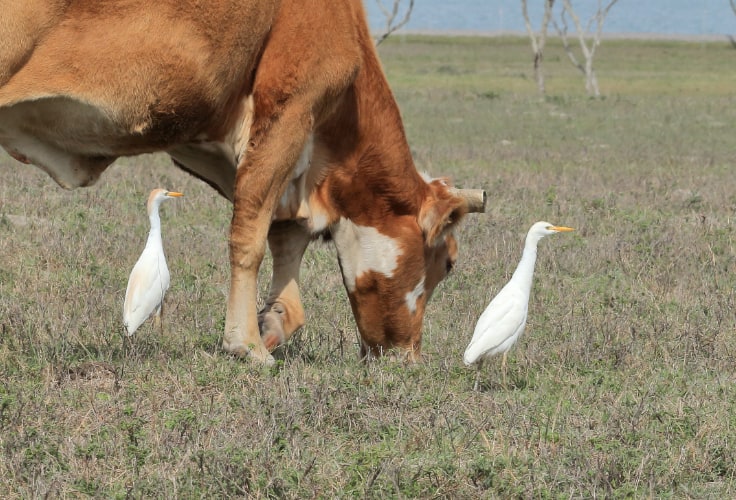
In the field, western cattle-egrets are often identified as much by behavior as by plumage. Birds typically forage while walking or running across fields with a steady, bobbing head motion, sometimes leaping or weaving among one another as flocks advance. They frequently feed in loose groups ranging from small parties to large flocks, often following cattle, horses, or farm machinery that flush insects and small vertebrates from the grass. Flight is direct and purposeful, with relatively rapid, shallow wingbeats and the neck held tucked in against the body, typical of herons. Away from nesting colonies, the species is generally quiet, though soft, hoarse calls may occasionally be heard during flight or brief social interactions. The diet consists mainly of insects such as grasshoppers and flies, as well as spiders, frogs, and other small animals, with fish taken only opportunistically in shallow water.
In North America, the western cattle-egret occupies a broad and still-expanding range that reflects its adaptability to human-altered landscapes. Breeding occurs across much of the southern and central United States, with concentrations in the Gulf Coast states, the southern Great Plains, parts of the Southeast, and localized areas of the Southwest and California. In Canada, regular breeding is limited and localized, primarily in southern Ontario, Manitoba, and Saskatchewan, though sightings occur more widely during the breeding season. Many birds migrate south in winter, with most North American breeders overwintering in Mexico, Central America, the Caribbean, and the warmest parts of the southern United States, especially Florida, southern Texas, coastal California, and the Gulf Coast. Nests are built in dense colonies, usually in trees or emergent vegetation near wetlands, often alongside other herons and egrets.
The western cattle-egret remains one of the most successful and abundant herons in North America, owing to its flexible feeding strategy and close association with agricultural landscapes. Long-term surveys indicate that populations increased rapidly during the species’ initial spread across the continent but have shown moderate declines in recent decades. These trends are likely influenced by changes in agricultural practices, loss or disturbance of colony sites, and exposure to environmental pollutants that accumulate in food webs. Despite these pressures, the species continues to thrive across a wide range of regions and remains a familiar sight in open fields, where its close partnership with livestock makes it one of the easiest herons for non-birders to recognize.
Yellow-Crowned Night Heron
Nyctanassa violacea
- Identification: Medium-sized, dark-bodied heron with a stocky build, heavy bill, relatively short legs, and a bold black-and-white head pattern in adults.
- Where found: Occurs mainly along the Atlantic and Gulf coasts of the United States, with a more localized inland presence along rivers and wetlands reaching parts of the Midwest and southern Canada.
- How to spot: Often seen walking slowly with a hunched posture along tidal creeks or wet shorelines, especially at dusk or after dark, when birds move between roosts and feeding areas.
- Conservation status: Least Concern (IUCN); populations generally stable overall, though local declines and legal protection occur in some northern and inland states due to habitat loss and disturbance.

The yellow-crowned night heron is a distinctive coastal species in the southeastern United States, recognized for its dark, smooth plumage and strong association with crustacean-rich habitats. This species measures 55 to 70 centimeters (21.7 to 27.6 inches) in length and shows a compact, thickset silhouette with a large head and stout bill. Although often classed among night herons, it can be active at any hour, particularly where tidal cycles dictate feeding opportunities.
Adult plumage is smooth bluish gray on the body and wings, with the mantle and wing coverts marked by black-centered feathers edged in pale gray, creating a scaled appearance. The head is glossy black with a contrasting white cheek patch and a pale crown, which is accented by long, straw-colored plumes in breeding birds. The legs are yellowish green for most of the year but may turn coral pink to scarlet during courtship. Sexes are similar, though females average slightly smaller. Juveniles look very different, appearing brown above with buffy spotting on the back and wings and white underparts heavily streaked with brown, gradually acquiring adult features over several years.

In the field, yellow-crowned night herons are most often identified by their posture and deliberate movements rather than by flight alone. Birds typically stalk prey by walking slowly along water margins with the body bent forward and the head partially retracted, pausing frequently to watch for movement. They may also stand motionless or peer intently into shallow water before striking. Flight is steady and unhurried, with broad, rounded wings and slow, deliberate wingbeats, while the legs extend beyond the tail. Vocal activity is greatest at breeding colonies, where birds give a range of hoarse, barking, or squawking calls, including a loud, far-carrying call similar to that of the black-crowned night heron but higher in pitch. The diet is dominated by crustaceans, especially crabs and crayfish, which are seized with a forceful lunge and either swallowed whole or shaken apart.
In North America, the species is most strongly associated with coastal environments, where breeding occurs along the Atlantic coast from Florida north to southern New England, with the highest densities in the Southeast. Along the Gulf Coast, breeding extends westward into Texas, while inland colonies follow major river systems such as the Mississippi and its tributaries into parts of the Midwest. Smaller and more scattered breeding populations reach southern Wisconsin, Minnesota, and southern Ontario. During winter, most birds retreat to warmer regions, with the majority remaining in southern Florida, the Gulf Coast, Mexico, Central America, and the Caribbean. Nests are built in colonies, usually in trees or dense vegetation near water, often shared with other heron species.
Overall, the yellow-crowned night heron remains a fairly common but unevenly distributed species across its North American range. Long-term population trends are difficult to assess because nesting birds are often well concealed and active outside standard survey hours, though available data suggest broadly stable numbers with regional fluctuations. Habitat loss, especially the degradation of coastal wetlands and disturbance at nesting sites, poses the primary threat, particularly near the northern edges of the breeding range. Despite these challenges, the species continues to persist across much of its traditional range and remains a characteristic heron of tidal marshes and wooded coastal waterways.
Little Blue Heron
Egretta caerulea
- Identification: Medium-sized heron with a slender build, long legs, and a straight bill, showing slate-blue adult plumage and entirely white plumage in first-year birds.
- Where found: Occurs mainly in the southeastern United States along coastal and inland wetlands, with more scattered breeding northward along the Atlantic coast and locally into the Midwest and southern Canada.
- How to spot: Look for a solitary, slow-moving heron stalking shallow water with deliberate steps; white immatures often stand out among darker wetlands or mix quietly with white egrets.
- Conservation status: Least Concern (IUCN); populations have declined in parts of North America due to habitat loss, altered water regimes, and human disturbance, particularly near breeding colonies.

The little blue heron is a subtle and often overlooked member of North America’s heron family, notable for its striking age-related plumage differences and quiet foraging behavior. This species measures 56 to 74 centimeters (22.0 to 29.1 inches) in length and presents a slim, upright silhouette with a relatively long neck and legs compared to its body size. Adults can be difficult to notice in shadowed wetlands because their dark coloration blends readily with water and vegetation, while white juveniles are far more conspicuous during the first year of life.
Adult plumage is predominantly slate blue across the body and wings, contrasted by a purplish head and neck and a bicolored bill that is pale bluish at the base and black at the tip. During the breeding season, adults develop long, lance-shaped plumes on the head and back rather than the filamentous plumes typical of many white egrets, and the bare skin at the base of the bill and around the eyes becomes vivid blue. The legs and eyes darken during this period. Sexes are similar in appearance. Juveniles are entirely white, with a black-tipped bill and dull greenish legs, and they gradually molt into adult plumage, passing through a patchy mix of white and blue during their first spring and summer.

In the field, little blue herons are identified as much by their behavior as by their appearance. Birds usually forage alone or in small groups, moving slowly through shallow water with a steady, methodical walk-and-pause rhythm. They rely on patience rather than speed, standing still or peering intently before making a precise strike. Flight is generally unhurried, with rounded wings and measured wingbeats, and birds often glide briefly before landing. Vocalizations are limited and usually heard near breeding colonies, where harsh alarm calls or nasal squawks may accompany aggressive or defensive interactions. The diet includes small fish, amphibians, and invertebrates, with crustaceans forming an important component in many habitats.
In North America, the breeding range of the little blue heron centers on the southeastern United States, extending from coastal Texas across the Gulf Coast and Florida and north along the Atlantic coast to the Mid-Atlantic and southern New England, where breeding becomes increasingly local and rare. Inland populations follow major river systems and wetlands into parts of the Midwest, with occasional and scattered breeding farther north. The species uses a wide variety of freshwater and estuarine habitats, including marshes, swamps, tidal flats, mangroves, flooded fields, and shallow ponds. Most nests are built in trees or shrubs within mixed-species colonies shared with other herons and wading birds. Northern populations migrate south after the breeding season, while birds in the southern portion of the range may remain year-round.
Although still widespread, the little blue heron has experienced long-term population declines in several regions of North America. These declines are linked primarily to loss and degradation of wetland habitats, changes in water management that affect prey availability, and disturbance at nesting colonies. Additional pressures include exposure to contaminants in agricultural runoff and occasional conflicts at fish hatcheries. Protection of diverse wetland habitats and the careful management of breeding colonies remain essential to maintaining stable populations of this quiet and distinctive heron.
Tricolored Heron
Egretta tricolor
- Identification: Medium-sized, slender heron with dark slate upperparts, a white breast and belly, and a long, narrow neck and bill.
- Where found: Found primarily along the Atlantic and Gulf coasts of the United States in coastal wetlands, with more localized inland occurrences and rare breeding north to the Northeast.
- How to spot: Watch for a dark heron with a bright white belly actively stalking fish in shallow coastal waters, often moving quickly with sharp turns and brief runs.
- Conservation status: Least Concern (IUCN); populations are stable in some regions but declining in parts of the Southeast, especially in Florida, due to habitat alteration and water management changes.

The tricolored heron is a sleek and energetic coastal species that is especially characteristic of southern salt marshes and estuaries in the United States. This species measures 60 to 70 centimeters (23.6 to 27.6 inches) in length and appears notably slim and delicate compared with many other North American herons. Its long, S-shaped neck, narrow bill, and agile movements give it a graceful profile that contrasts with the heavier build of larger herons.
Adult plumage is striking and sharply patterned. The head, neck, back, wings, and tail are slate gray to bluish gray, while the breast, belly, and underwing coverts are clean white, creating a bold contrast visible at long distances. During the breeding season, adults develop white head plumes and mauve to violet tones on the neck and mantle, along with filamentous buff-colored plumes on the back. The bill and bare skin at the base of the face become bluish, the legs turn pinkish, and eye coloration intensifies during courtship. Outside the breeding season, birds appear plainer, with duller gray tones and less colorful soft parts. Juveniles show a browner overall appearance, with russet tones on the head and neck and darker wings edged with rufous.

In the field, tricolored herons are often identified by their active and sometimes dramatic foraging behavior. Birds typically hunt alone or at the edges of loose groups, stalking fish with deliberate steps that can suddenly shift into rapid runs, tight turns, and abrupt stops. They frequently chase prey through shallow water, sometimes flapping their wings or pivoting sharply as they strike. Flight is steady and direct, with the head drawn in and the legs trailing behind the body, and birds rarely travel in organized flocks. Vocalizations are most often heard at breeding colonies and include harsh, croaking or squawking calls associated with aggression, alarm, or courtship. The diet consists overwhelmingly of small fish, with insects, crustaceans, and amphibians taken only occasionally.
In North America, the breeding range of the tricolored heron is centered on the Atlantic and Gulf Coasts of the United States. The species breeds regularly from Texas through the Gulf Coast and throughout Florida, extending north along the Atlantic coastal plain through the Carolinas, the Mid-Atlantic, and locally into southern New England. Inland breeding is uncommon but occurs sporadically along major wetland systems and in a few interior locations such as central Kansas. Preferred habitats include salt marshes, tidal creeks, estuaries, mangroves, lagoons, and shallow coastal pools, where birds forage in open or sparsely vegetated water. Nests are built in trees or shrubs, often in colonies shared with other herons and wading birds. Many individuals migrate south after the breeding season, while birds in the southern portion of the range may remain year-round.
The tricolored heron shows a mixed conservation picture across its North American range. Populations expanded northward during the mid-20th century, partly in response to the creation of new nesting habitats along intracoastal waterways, but more recent declines have been documented in several regions. In Florida, reductions in freshwater flow and changes to wetland hydrology have been linked to sharp decreases in breeding numbers. Elsewhere, habitat loss, human disturbance, and conflicts near aquaculture facilities pose ongoing challenges. Despite these pressures, the species remains locally common in many coastal areas, and continued protection of coastal wetlands and breeding colonies is key to sustaining regional populations.
Least Bittern
Botaurus exilis
- Identification: Very small heron with a compact body, short neck, thin bill, and contrasting dark upperparts with buffy and white underparts; males darker than females.
- Where found: Inhabits freshwater and brackish marshes across much of the United States and southern Canada, with breeding concentrated in lowland wetlands.
- How to spot: Most often detected by voice at dawn or dusk in dense cattails, or glimpsed briefly as it clambers through reeds or flutters low over marsh vegetation.
- Conservation status: Least Concern (IUCN); populations are difficult to monitor but face ongoing pressure from wetland loss and degradation.

The least bittern is the smallest heron in North America and one of the most inconspicuous birds of dense marshes, distinguished by its extreme secrecy and unusually strong sexual dimorphism for a heron. This diminutive species measures 28 to 36 centimeters (11.0 to 14.2 inches) in length and has a compact, finely proportioned build that allows it to move easily through thick emergent vegetation. Despite its elusive nature, it can be locally common where extensive, well-vegetated marsh habitat persists.
Adult plumage shows a striking contrast of dark and pale tones. In males, the crown, back, and tail are glossy greenish black, while the neck, sides, and underparts are patterned in buff, brown, and white. The wings are rich chestnut with pale patches that can flash conspicuously in flight. Females are similar in size but differ in coloration, with the crown and back more purplish chestnut and the neck more heavily streaked. The bill is slender and yellow, and the head often appears slightly crested. Juveniles resemble adult females but are paler and browner overall, with heavier streaking on the breast and throat. A rare dark color morph, historically known as “Cory’s least bittern,” shows chestnut replacing the usual pale areas of the plumage and is now seldom encountered.

In the field, least bitterns are usually identified by subtle movement or sound rather than prolonged views. Birds typically clamber through dense reeds and cattails, grasping multiple stems with their long toes and curved claws while leaning forward over open water. They may move deliberately from stalk to stalk or freeze motionless with the neck extended to blend into surrounding vegetation. When flushed, they usually fly only short distances, fluttering weakly with dangling legs before dropping quickly back into cover, a flight style that can recall that of a rail. Males are quite vocal during the breeding season, giving soft, dove-like cooing calls from within the marsh, while a variety of harsher calls may be uttered when birds are alarmed. The diet consists of small fish, insects, amphibians, and crustaceans, taken by slow stalking or from makeshift feeding platforms formed by bent reeds.
Across North America, the least bittern breeds in lowland wetlands from southern Canada through much of the United States and southward into Mexico and Central America. In Canada, breeding is local and concentrated mainly in southern regions, particularly around the Great Lakes and associated wetlands, while the species is largely absent from higher elevations and the Maritime Provinces. In the United States, populations are widespread but patchy, reflecting the fragmented distribution of large marshes. Preferred habitats include freshwater and brackish marshes with tall, dense emergent vegetation such as cattails and reeds, often bordering deeper open water. Nests are built low within vegetation, usually just above the water surface, and breeding birds remain closely tied to dense cover.
Although still present across much of its historical range, the least bittern remains vulnerable to ongoing loss and degradation of marsh habitats. Drainage, development, and changes in water levels reduce the availability of suitable breeding and foraging areas, while invasive vegetation can alter marsh structure in ways that may not always favor the species. Because of its secretive behavior, population trends are difficult to assess accurately, but long-term stability depends on the preservation of extensive, undisturbed wetlands with dense emergent vegetation.
Reddish Egret
Egretta rufescens
- Identification: Medium-large heron with a slender build, long legs, a thick, two-toned bill, and two color morphs – dark gray with a cinnamon head and neck, or entirely white.
- Where found: Restricted mainly to coastal flats, lagoons, and estuaries along the Gulf Coast of the United States and southern Florida, with limited occurrence elsewhere.
- How to spot: Most easily recognized by its highly animated foraging, which includes running, hopping, wing-flicking, and sudden turns in very shallow water.
- Conservation status: Near Threatened (IUCN); rare in North America, with declining populations driven by coastal habitat loss, disturbance, and vulnerability to climate-related changes.

The reddish egret is North America’s rarest heron and one of its most distinctive coastal species, known for its highly active foraging behavior. This coastal specialist measures 70 to 80 centimeters (27.6 to 31.5 inches) in length and combines a graceful frame with a powerful, athletic presence. Its strong association with open, shallow coastal flats and its unusually energetic hunting style set it apart from all other North American herons.
Adult plumage occurs in two striking color morphs. Dark-morph adults have a slate-gray body with a rich chestnut to cinnamon head and neck, accentuated by shaggy lance-shaped plumes during the breeding season. Long, filamentous scapular plumes extend over the back, enhancing the bird’s unkempt appearance. White-morph adults are entirely white but otherwise identical in structure and soft-part coloration. In both morphs, the bill is distinctly bicolored, pink at the base and black toward the tip, while the legs are bluish with darker fronts. Sexes are similar, with males averaging slightly larger. Immatures are more subdued, appearing grayish or tan without elongated plumes, and usually show a dark bill.

In the field, the reddish egret is most readily identified by behavior rather than plumage alone. Birds forage almost exclusively during daylight and employ the most active and varied hunting techniques of any North American heron. Individuals run through shallow water, leap abruptly, flick or spread their wings for balance, stir the substrate with their feet, and sometimes create shade with their wings to concentrate prey. These movements give the impression of a heron “dancing” across the flats. Flight is strong, graceful, and direct, with steady wingbeats and the head usually held retracted, though the neck may extend briefly during short flights or displays. The species is generally quiet, with low, hoarse calls given mainly near breeding colonies or during aggressive encounters. The diet consists almost entirely of small fish captured in very shallow water.
In North America, the reddish egret is strictly tied to coastal habitats. Breeding occurs along the Gulf Coast from Texas eastward through Louisiana, Mississippi, Alabama, and Florida, with the strongest concentrations in south Texas and southern Florida, including the Florida Keys. The species also breeds in the Bahamas and parts of the Caribbean, with smaller populations extending into Mexico along both coasts of Baja California and the mainland. Preferred habitats include barren tidal flats, shallow lagoons, salt ponds, and wind-swept barrier island flats with sparse vegetation. Nests are placed in colonies, usually on mangrove islands or isolated coastal sites, often alongside other colonial waterbirds. Some individuals migrate or disperse after breeding, but movements are variable, and many birds remain within coastal regions year-round.
The reddish egret faces significant conservation challenges despite its specialized adaptations. North American populations are small and vulnerable, with declines documented in key regions such as Texas and Florida. Loss and degradation of coastal foraging habitat, disturbance at nesting colonies, reduced freshwater inflow to estuaries, and increasing impacts from sea-level rise and severe storms all contribute to its precarious status. Because the species depends on very specific shallow-water conditions, even modest environmental changes can have outsized effects. Protection of undisturbed coastal flats, careful management of breeding colonies, and long-term conservation of dynamic coastal ecosystems are critical to the future of this remarkable heron.
Rare and Vagrant Herons of North America
The 12 species covered above represent the regularly occurring herons of North America, reflecting the breadth of ardeid diversity across the United States and Canada. However, in addition to these native species, a limited number of herons reach the continent as vagrants. Among them, the little egret stands out as the most regular and predictable, now recorded annually along the Atlantic coast. This slim and elegant white heron measures 55 to 65 centimeters (21.7 to 25.6 inches) in length and closely resembles the native snowy egret, making careful identification essential.

Adults are entirely white with a slender black bill, pale yellow eyes, and grayish to greenish lores that may turn pinkish or reddish during courtship. Compared with snowy egret, the little egret typically shows a slightly longer, less tapered bill, a longer-faced appearance due to feathering extending farther along the bill, and distinctive breeding plumes: two long, lanceolate head plumes and straighter, flatter scapular plumes rather than the shaggy, curling ornamentation typical of snowy egret. Leg color can overlap, but in little egret the yellow is usually confined to the feet and lowermost tarsi, often with a greenish cast.
In North America, the little egret occurs almost exclusively in coastal habitats, favoring salt marshes, tidal flats, lagoons, estuaries, and sheltered shorelines similar to those used by snowy egrets and other small white herons. Records are concentrated along the Atlantic coast from Newfoundland south to coastal North Carolina, with several dozen documented occurrences, most since the late twentieth century. Although primarily coastal, a small number of inland records have occurred in eastern Canada, including Quebec and Ontario. These birds are thought to originate from European populations, arriving via trans-Atlantic dispersal rather than from established breeding colonies in the Western Hemisphere.
Despite its increasing frequency, the little egret remains a true vagrant in North America and does not breed on the continent. Its repeated annual appearance, however, places it firmly beyond the realm of accidental occurrence and highlights the dynamic nature of North America’s heron fauna, shaped in part by long-distance movements across the Atlantic.


