
New Hampshire supports a compact but ecologically diverse group of woodpeckers, with nine species documented in the state, from familiar backyard birds to specialized northern forest inhabitants. These include resident species present throughout the year and others that appear only seasonally or at the edge of their broader North American ranges. This guide provides identification notes and state-specific context on habitat use, distribution, and seasonal patterns of the woodpeckers recorded in New Hampshire.
Downy Woodpecker
Dryobates pubescens
- Identification: Very small black-and-white woodpecker with a broad white back stripe, checkered wings, and a short, stubby bill; males show a small red patch on the nape.
- Where found: Widespread year-round throughout New Hampshire in deciduous and mixed forests, young woodlands, parks, and residential areas, less frequent in pure conifer stands and at higher elevations.
- How to spot: Listen for the sharp “pik” call or descending whinny and watch for a tiny black-and-white bird hitching along thin branches or visiting suet feeders.
- Conservation status: Least Concern (IUCN); common and increasing in New Hampshire, though locally reduced in maturing forests.

The Downy Woodpecker is the smallest and most frequently encountered woodpecker in New Hampshire and is a familiar presence at backyard feeders across the state. It measures 14 to 17 centimeters (5.5 to 6.7 inches) in length and is barely larger than a nuthatch, with a compact body, straight-backed posture, and short, chisel-like bill. Plumage shows a crisp black-and-white pattern with a broad white stripe down the back, spotted black wings, and clean white underparts. Males display a small red patch on the nape, absent in females.

In the field, Downy Woodpeckers move with short hops along trunks and thin branches, often foraging on small saplings and narrow stems that larger woodpeckers cannot use. They frequently brace with the tail and may hang on slender twigs or herbaceous stems while probing for insects. Calls include a sharp, high “pik” and a descending whinny, and drumming becomes more frequent from January through May during courtship and early nesting. The species feeds mainly on insects and larvae gleaned from bark, and in New Hampshire has been documented favoring coccid-infested Paper Birch. It regularly visits feeders for suet and seeds, especially in winter.
Downy Woodpeckers are resident statewide in New Hampshire and are recorded in nearly all regions, from lowland towns and suburban neighborhoods to upland forests. They are common in hardwood and mixed forests, young second-growth stands, orchards, parks, and wooded residential areas. The species is less frequent in extensive pure conifer forests and at higher elevations in the White Mountains, though breeding has been documented up to approximately 900 meters (3,000 feet), with occasional records even higher. Most individuals remain in the state year-round, though some birds in northern areas may withdraw slightly southward in winter, and small numbers are recorded as migrants along the coast and offshore islands during spring and fall. Nest cavities are typically excavated in small trees, dead wood, or fence posts, with excavation in New Hampshire usually beginning in late April.
The Downy Woodpecker is common and increasingly numerous in New Hampshire. Breeding Bird Atlas data documented evidence of breeding across the vast majority of atlas blocks statewide, and long-term survey data show a modest increase for the state overall. Winter counts have risen markedly since the mid-20th century, likely reflecting both population growth and increased feeder use and reporting. Localized declines have been documented in maturing, undisturbed forests, including parts of the White Mountains, where the reduction of smaller trees may limit preferred nesting and foraging sites. Overall, the species remains one of the most stable and adaptable woodland birds in the state.
Hairy Woodpecker
Leuconotopicus villosus
- Identification: Medium-sized black-and-white woodpecker with a broad white back stripe, clean white underparts, and a long, robust bill nearly as long as the head; males show a red patch on the nape.
- Where found: Occurs statewide year-round in mature deciduous and mixed forests, as well as wooded parks and higher-elevation forests, including the White Mountains.
- How to spot: Search trunks and large branches for a sharply patterned black-and-white bird with a long bill and square head; listen for a loud “peek,” a level-pitched rattle, and rapid drumming.
- Conservation status: Least Concern (IUCN); relatively common and increasing in New Hampshire, with modest seasonal fluctuations and local movements.

The Hairy Woodpecker is the larger counterpart of the Downy Woodpecker and is a widespread resident across New Hampshire, especially in mature woodlands. It measures 18 to 26 centimeters (7.1 to 10.2 inches) in length and has a sturdy build with a long, chisel-shaped bill nearly as long as the head, giving it a heavier and more elongated appearance than the smaller Downy. Plumage is sharply patterned in black and white, with a broad white stripe down the back, spotted black wings, and plain white underparts. Males show a red patch on the nape, absent in females. Compared with the Downy Woodpecker, it appears bulkier and lacks black markings on the outer tail feathers.

In the field, Hairy Woodpeckers climb with deliberate hops up tree trunks and along large limbs, seldom using the thin outer twigs favored by Downy Woodpeckers. They brace firmly with the tail and hammer vigorously into bark and wood in search of insects. The voice includes a sharp, explosive “peek” and a descending whinny similar to the Downy’s but lower in pitch, as well as a level, rattling call that remains on one pitch. Drumming is rapid and strong and becomes frequent in January as males begin territorial and courtship display. The diet consists mainly of wood-boring insects and larvae, with some fruit and seeds taken seasonally.
Hairy Woodpeckers breed statewide in New Hampshire and are recorded in nearly all regions, including the coastal plain, interior lowlands, and upland forests of the White Mountains and North Country. They are especially associated with mature hardwood and mixed forests but also occur in wooded parks and suburban areas with larger trees. Early accounts described them as more typical of higher elevations and northern forests, and breeding has been documented between approximately 900 and 1,400 meters (3,000 to 4,500 feet) in the White Mountains. The species is primarily resident, though modest seasonal movements occur. Some birds shift from higher elevations or northern areas in winter, and small numbers appear along the coast during spring and fall, accounting for local fluctuations in winter counts. Nest excavation typically begins in April, following increased drumming and courtship activity in late winter.
The Hairy Woodpecker is relatively common in New Hampshire and has increased over the past century, likely reflecting reforestation and expanded winter feeding. Breeding Bird Atlas data document evidence of breeding in nearly all surveyed blocks statewide, and long-term survey data indicate a slight increase. Christmas Bird Count results show fluctuating but generally rising winter numbers. Although overall trends are stable to increasing, local abundance may vary seasonally, particularly near the coast and in higher-elevation forests where short-distance movements occur. Overall, the species remains a secure and characteristic woodpecker of the state’s mature forests.
Northern Flicker
Colaptes auratus
- Identification: Large brown woodpecker with a barred back, spotted underparts, black breast crescent, bright yellow wing and tail shafts, and a conspicuous white rump in flight.
- Where found: Breeds statewide in open woodlands, forest edges, wetlands with dead trees, and residential areas; small numbers overwinter mainly along the coast.
- How to spot: Look for a woodpecker feeding on the ground or flying with deep, bounding wingbeats that reveal a bright yellow flash and white rump; listen for loud “wick-wick-wick” calls.
- Conservation status: Least Concern (IUCN); still common in New Hampshire but declining over recent decades.

The Northern Flicker is one of the most distinctive and widespread woodpeckers in New Hampshire and differs noticeably from the state’s black-and-white species. It measures 28 to 31 centimeters (11.0 to 12.2 inches) in length and has a sleek, brownish body with a slightly curved bill. Plumage shows a barred back, spotted underparts, and a bold black crescent across the upper breast. The eastern “yellow-shafted” form breeds in New Hampshire and shows bright yellow wing and tail shafts in flight, a red patch on the nape in both sexes, and a black malar stripe in males. The white rump flashes conspicuously as the bird takes wing.

Unlike most North American woodpeckers, Northern Flickers spend much of their time on the ground, where they walk or hop across lawns, fields, and forest edges while probing for ants. Their long tongue is adapted for extracting ants and other insects from soil and shallow tunnels. Flight is strong and undulating, with rapid flaps and short glides that accentuate the bright yellow underwings and white rump. The voice carries far and includes a loud, ringing “wick-wick-wick” and sharp “peah” notes. Drumming is steady and resonant, especially during the breeding season. Flickers frequently reuse nest cavities in successive years and provide important nesting sites for other cavity-dependent birds.
Northern Flickers breed statewide in New Hampshire and are documented across most regions, including the coastal plain, river valleys, and interior uplands. They favor open or semi-open habitats such as forest edges, wetlands with standing dead trees, orchards, and residential areas rather than extensive deep forest. The species is less common in dense, high-elevation forests above approximately 760 meters (2,500 feet) and has historically been less numerous in parts of Coos County and the higher White Mountains. It is primarily a summer resident and migrant in the state. Spring arrival typically occurs in March, with peak migration in April. Southbound movement begins in late summer and peaks from late September into early October. Small numbers overwinter, mainly along the coast, with only occasional individuals inland during mild winters.
The Northern Flicker has declined in New Hampshire since the mid-20th century, although it remains common in many areas. Breeding Bird Atlas data document widespread breeding across the state, but long-term survey data show an average decline of roughly 3% per year in recent decades. Christmas Bird Count data indicate increasing numbers of overwintering birds, especially along the coast, likely influenced by milder winters and increased observer coverage. Suggested causes of decline include competition for nest cavities with European Starlings, habitat changes affecting open foraging areas, and broader environmental pressures on insect prey. Despite these trends, the species continues to be a characteristic and visible part of New Hampshire’s open woodlands and edge habitats.
Pileated Woodpecker
Dryocopus pileatus
- Identification: Very large black woodpecker with bold white neck stripes and a flaming red crest; males show a red malar stripe, females a dark one; broad white underwings and white wing patches visible in flight.
- Where found: Permanent resident statewide in mature deciduous, coniferous, and mixed forests with large trees and abundant dead wood.
- How to spot: Look for a crow-sized black woodpecker with a tall red crest excavating large rectangular holes in logs or trunks; listen for loud “kuk-kuk-kuk” calls or deep, resonant drumming that trails off at the end.
- Conservation status: Least Concern (IUCN); moderately common and increasing in New Hampshire as forests mature.
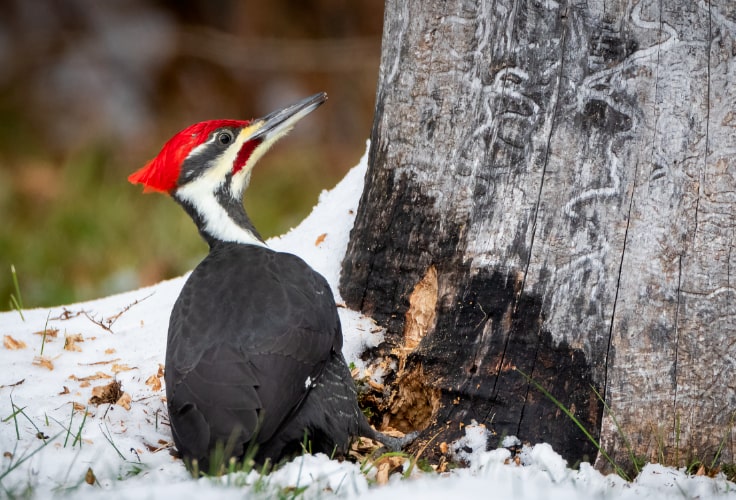
The Pileated Woodpecker is the largest woodpecker in New Hampshire and one of the most striking forest birds in the state. It measures 40 to 49 centimeters (15.7 to 19.3 inches) in length and approaches the size of a crow, with broad wings, a long neck, and a prominent flaming red crest. Plumage is mostly black, highlighted by bold white stripes along the neck and face. Males show red from the forehead to the crest and a red malar stripe, while females lack the red mustache and show a darker forehead. In flight, broad white patches on the wings and underwings are conspicuous.

In the field, Pileated Woodpeckers are often detected by sound before sight. Their loud, ringing “kuk-kuk-kuk” calls carry long distances through forested landscapes, and both sexes produce a deep, resonant drumming that slows toward the end and serves as a primary territorial signal. They climb trunks with powerful, deliberate movements and excavate large, rectangular holes in dead or dying wood while foraging. Carpenter ants form the core of the diet, supplemented by wood-boring beetle larvae, fruits, and nuts, especially in fall and winter. Feeding excavations are often so extensive that they leave large piles of wood chips at the base of trees or logs.
Pileated Woodpeckers are permanent residents throughout New Hampshire and occur in mature forests statewide. Historically uncommon to rare in parts of the state following extensive forest clearing, the species has expanded steadily with reforestation and forest maturation. It now breeds across most regions, including the southern and coastal counties where it was formerly scarce, although density has remained lower in some coastal areas compared with interior forests. The species favors deciduous, coniferous, and mixed woodlands with large standing trees and abundant dead wood for nesting and feeding. While primarily associated with extensive forest, individuals are regularly observed in suburban neighborhoods and crossing open areas between forest patches.
After significant declines during the period of heavy logging in the 19th and early 20th centuries, the Pileated Woodpecker has increased steadily in New Hampshire. Breeding Bird Atlas data documented breeding across much of the state, and long-term survey data show an average annual increase of roughly 3% in recent decades. Christmas Bird Count data also indicate rising winter numbers and broader distribution. The recovery of forest cover and the maturation of woodland stands have likely driven this increase. Today, the species is considered moderately common but thinly distributed, remaining closely tied to landscapes that support large trees and substantial dead wood.
Red-bellied Woodpecker
Melanerpes carolinus
- Identification: Medium-sized, pale woodpecker with a black-and-white barred back and red crown and nape in males (red restricted to the nape in females); the reddish wash on the belly is usually faint and hard to see.
- Where found: Year-round resident in southern and central New Hampshire, especially in hardwood and mixed forests, river valleys, suburban parks, and coastal areas; scarce north of the White Mountains.
- How to spot: Look for a pale-faced woodpecker with a bold zebra-striped back and bright red cap climbing trunks and larger branches; listen for rolling “kwirr” or “churr” calls.
- Conservation status: Least Concern (IUCN); increasing and expanding in New Hampshire since the late 20th century.

The Red-bellied Woodpecker is a relatively recent colonist and now an established resident in much of southern New Hampshire. It measures 23 to 27 centimeters (9.1 to 10.6 inches) in length and is similar in size to the Hairy Woodpecker but appears slimmer, with a pale gray face and strongly barred black-and-white back. The reddish wash on the lower belly that gives the species its name is often faint and difficult to see in the field. Males show red from the forehead to the nape, while females have red only on the back of the head and nape.

In the field, Red-bellied Woodpeckers move nimbly along trunks and larger branches, pausing frequently to scan bark for insects or nuts. They spend less time excavating deeply into wood than most other New Hampshire woodpeckers and rely heavily on surface gleaning and varied food sources. Their voice is a rolling “kwirr” or “churr” that carries far, along with shorter sharp calls during excitement or alarm. The diet includes insects, fruits, nuts, and seeds, and birds regularly visit feeders for suet, peanuts, and occasionally fruit such as oranges.
In New Hampshire, the species was unknown prior to the mid-20th century and was first confirmed in the 1960s. It is now recorded throughout the southern half of the state and has expanded northward over recent decades. Highest numbers occur in the Merrimack River valley, the Connecticut River valley, and the seacoast region, where mature hardwoods and suburban landscapes provide suitable habitat. Breeding is now documented widely south of the White Mountains, and in the 2020s small numbers have begun appearing north of the mountain notches, though distribution there remains sparse. The Red-bellied Woodpecker favors hardwood and mixed forests and tends to avoid extensive conifer-dominated stands. It is a permanent resident, with winter survival aided by feeders and milder conditions.
The Red-bellied Woodpecker has increased steadily in New Hampshire since 2000, following a gradual expansion that began in the mid-twentieth century. Christmas Bird Count data document a sharp rise in winter numbers and a widening statewide distribution. Breeding Bird Atlas data and regional surveys show continued growth, especially in hardwood and mixed forests. Proposed drivers of expansion include reforestation, greater use of winter feeders, and milder winter temperatures. Although still less numerous than Downy, Hairy, or Pileated woodpeckers in much of the state, it is now a regular and increasingly familiar component of southern New Hampshire’s birdlife.
Yellow-bellied Sapsucker
Sphyrapicus varius
- Identification: Small to medium black-and-white woodpecker with a red crown and black bib; males show a red throat, females a white throat; underparts pale with a faint yellow wash and a large white wing patch visible in flight.
- Where found: Breeds across most forested regions of New Hampshire, especially in young hardwood and mixed forests; absent as a breeder along the seacoast and lower Merrimack River valley.
- How to spot: Look for neat horizontal rows of sap wells on birch or maple trunks, or listen for its irregular, stuttering drum and nasal “mew” calls in spring.
- Conservation status: Least Concern (IUCN); stable to slightly increasing in New Hampshire, with modest northward extension of wintering birds.

The Yellow-bellied Sapsucker is New Hampshire’s only sapsucker species and a regular breeder across most forested regions of the state. It measures 18 to 22 centimeters (7.1 to 8.7 inches) in length and has a compact, slender build with a straight, pointed bill. Plumage is crisply patterned in black and white, with a red crown bordered in black, a black bib, and a bold white stripe along the side of the head. Males show a red throat, while females have a white throat. The underparts are pale with a faint yellowish wash, and a large white wing patch is visible in flight.

In the field, sapsuckers are often detected by the distinctive rows of small, evenly spaced holes drilled in living trees. They cling upright to trunks while tending sap wells, returning repeatedly to feed on sap and insects attracted to it. Their drumming is irregular and stuttering rather than steady, and males frequently drum on resonant surfaces in April and May to proclaim territory. Vocalizations include nasal “mew” and “week” notes that carry through woodland edges. Unlike most other woodpeckers in the state, they rarely excavate deeply for insects and instead capture prey from bark or occasionally by flycatching.
In New Hampshire, the Yellow-bellied Sapsucker breeds throughout most forested regions but is absent as a breeder along the seacoast and in the lower Merrimack River valley. It favors early successional and mixed forests dominated by birch, aspen, and maple, often near edges or disturbed habitats. Breeding season extends from mid-May through mid-July. Spring arrival has advanced over recent decades, with most birds arriving in early to mid-April. Fall departure generally occurs by late September, with peak migration from late September into mid-October. While most individuals leave the state for winter, small numbers now linger or overwinter nearly every year, both inland and near the coast, reflecting a gradual northward shift in winter distribution.
The Yellow-bellied Sapsucker remains a common migrant and regular breeder in New Hampshire. Breeding Bird Atlas data documented nesting across much of the state, with evidence in most priority blocks except along the coast. Long-term survey data show a modest increase in breeding numbers since the late 20th century, particularly in spruce-fir and mixed forests. Warmer winters and forest regeneration may have contributed to both increased breeding distribution and more frequent winter lingerers. Overall, the species continues to be a characteristic and ecologically important component of the state’s forest bird community.
Black-backed Woodpecker
Picoides arcticus
- Identification: Medium-sized black-and-white woodpecker with solid black upperparts, white underparts barred on the flanks, and a single white facial stripe; males show a yellow crown patch.
- Where found: Uncommon resident in the White Mountains and northward in spruce-fir forests and other areas with abundant dead conifers, including logged, burned, or insect-affected stands.
- How to spot: Search dead or dying spruce and fir for a dark woodpecker flaking bark from trunks; listen for a sharp “kyik” call or a drumming burst that trails off at the end.
- Conservation status: Least Concern (IUCN); locally uncommon and disturbance-dependent in New Hampshire, with numbers fluctuating with insect outbreaks and forest conditions.

The Black-backed Woodpecker is a boreal forest specialist at the southeastern edge of its range in New Hampshire and is largely confined to the White Mountains and the North Country. It measures 23 to 24 centimeters (9.1 to 9.4 inches) in length and has a compact, sturdy build adapted for working on conifer trunks. Plumage is mostly glossy black above with clean white underparts barred along the flanks. A narrow white facial stripe contrasts with the dark head, and males show a bright yellow crown patch, absent in females. The species is one of two three-toed woodpeckers in North America, a structural trait associated with powerful excavation in hard wood.

In the field, Black-backed Woodpeckers forage deliberately on trunks of dead or dying spruce and fir, often in logged, burned, swampy, or insect-infested areas where bark beetle larvae are abundant. In northeastern New Hampshire they have been documented feeding opportunistically on engraver beetle larvae in wind-blown trees. Foraging leaves conspicuous patches of pale sapwood where bark has been stripped away. The call is a sharp “kyik,” and drumming begins rapidly and then trails off. Individuals tend to move methodically between trunks, flying low and directly through forest openings.
In New Hampshire, the species breeds primarily from the White Mountains northward, especially in northern Coos County and the higher-elevation spruce-fir forests. It is uncommon and thinly distributed compared with earlier centuries, when extensive virgin spruce and fir supported higher numbers. Breeding evidence has been concentrated in the White Mountains, the Sandwich Range, and northern forest tracts, with regular reports from areas such as the Connecticut Lakes region and Second College Grant. The species is considered essentially non-migratory, but occasional winter irruptions send individuals south of the White Mountains, sometimes reaching central and southern parts of the state. During such events, a few birds may linger into spring or even summer, though breeding outside the northern mountains remains rare.
The Black-backed Woodpecker remains an uncommon but regular resident in northern New Hampshire. Long-term patterns suggest fluctuations tied to forest disturbance, including logging, windthrow, and insect outbreaks. Reforestation has likely stabilized breeding areas in the north, yet modern forestry practices and limited large-scale fires reduce the availability of the dead conifers this species requires. Winter invasions into southern New Hampshire have been recorded repeatedly over the past century, often following major disturbance events to the north. Overall, the species persists as a specialized and disturbance-dependent inhabitant of the state’s spruce-fir forests.
Red-headed Woodpecker
Melanerpes erythrocephalus
- Identification: Medium-sized woodpecker with a fully crimson head, black back, large white wing patches, and clean white underparts; sexes identical.
- Where found: Rare and irregular in New Hampshire, occurring mainly as a spring and fall transient statewide, with very limited and sporadic breeding records.
- How to spot: Look for bold black-and-white wings flashing in flight or listen for harsh “weah” calls; often perches conspicuously on snags, poles, or fence posts in open areas.
- Conservation status: Least Concern (IUCN); rare and local in New Hampshire, with breeding unconfirmed since 1995 and long-term regional decline in the Northeast.

The Red-headed Woodpecker is one of the most striking birds ever recorded in New Hampshire, though it is now rare and irregular in the state. It measures 19 to 24 centimeters (7.5 to 9.4 inches) in length and has a sturdy build with broad wings and a strong bill. Adults are unmistakable: the entire head, neck, and upper breast are deep crimson, sharply set off from the snowy-white belly and glossy black back. Large white wing patches create a bold checkerboard pattern in flight. Males and females are identical in appearance.
In the field, this species often perches conspicuously on dead trees, fence posts, or utility poles in open country. It frequently sallies out to catch flying insects and may forage on the ground or hammer acorns into bark crevices for storage. Its calls are loud, harsh “weah” or rolling notes, and its flight is steadier and less bounding than that of many other woodpeckers. The combination of a fully red head and flashing white wing panels makes it unlikely to be confused with any other woodpecker when seen well, though distant views can sometimes lead to misidentification with Red-bellied Woodpeckers.
In New Hampshire, the Red-headed Woodpecker has always been rare and local. Historical accounts from the 1800s describe it as irregular but more frequently encountered than today, especially in parts of the Connecticut and Merrimack River valleys and occasionally in the coastal region. Since 1950, it has occurred primarily as a rare and irregular transient, most often reported in spring from mid-May through early June and again in fall from September through October. Summer records are few, and fewer than ten documented nesting events have been recorded since 1950. The most recent confirmed breeding occurred in 1995. Winter records are very rare but include occasional individuals lingering at feeders, mostly in the southern part of the state.
The Red-headed Woodpecker remains a rare component of the state’s avifauna. Its long-term decline in the Northeast has been linked to the loss of open woodlands, removal of standing dead trees, and increased competition for nest cavities. In New Hampshire, it is best regarded as an uncommon migrant and an extremely local and sporadic breeder, with no confirmed nesting in recent decades. Any occurrence, particularly during the breeding season, is notable and often draws significant attention from observers.
American Three-toed Woodpecker
Picoides dorsalis
- Identification: Medium-sized black-and-white woodpecker with barred flanks, white outer tail feathers, and a yellow crown patch in males.
- Where found: Extremely rare in northernmost New Hampshire, historically in higher-elevation spruce-fir forests of the White Mountains and Coos County.
- How to spot: If present, look for a quiet woodpecker flaking bark from dead conifers in beetle-affected spruce-fir forest; listen for soft “pik” calls and a short drum that tapers at the end.
- Conservation status: Least Concern (IUCN); extremely rare and likely no longer a reliable breeder in New Hampshire, with no verified records since 2000.

The American Three-toed Woodpecker is one of the rarest breeding woodpeckers ever documented in New Hampshire and now ranks among the state’s most elusive species. It measures 20 to 23 centimeters (7.9 to 9.1 inches) in length and is slightly smaller than the Black-backed Woodpecker, with a compact, sturdy build. Plumage is crisply patterned in black and white, with irregular white barring across the back and fine dark barring along the flanks. Unlike its close relative, which has a solid black back and only a faint pale mark behind the eye, the American Three-toed Woodpecker shows distinct white barring on the center of the back and a clear white stripe extending from behind the eye to the neck. The outer tail feathers are white with narrow dark bars, while adult Black-backed Woodpeckers typically lack barring there. Males display a bright yellow crown patch, absent in females.

In the field, this woodpecker is quiet and deliberate. It typically forages by flaking bark from dead or dying spruce and fir, exposing pale sapwood while extracting bark beetle larvae and other wood-boring insects. Its three-toed foot structure provides added stability on conifer trunks as it works methodically upward rather than excavating deep rectangular holes. Calls are soft and relatively high-pitched, including a faint “pik,” and are longer and less metallic than those of the Black-backed Woodpecker, while the drumming is generally slower, shorter, and tapers toward the end. Because of its subdued behavior and preference for remote, high-elevation forest, it can be difficult to detect even when present.
Historically, the American Three-toed Woodpecker occurred as a very rare resident in higher-elevation spruce-fir forests of the White Mountains and northward into Coos County. Nineteenth-century accounts suggest it was most often associated with extensive virgin spruce and fir at elevations roughly between 900 and 1,200 meters (3,000 to 4,000 feet). In the 20th century, reports became increasingly scarce and largely confined to remote northern mountain areas, including the Pittsburg region and portions of the White Mountains. The New Hampshire Breeding Bird Atlas in the early 1980s documented only one probable and two possible breeding sites. There have been no verified records in the state since 2000, and the species is no longer considered a reliable breeder in New Hampshire.
The American Three-toed Woodpecker remains globally secure but is now extremely rare in the state and may be functionally extirpated as a breeding species. Its decline within New Hampshire likely reflects long-term changes in spruce-fir forest structure and the reduction of large, disturbance-driven habitat patches. As a disturbance-dependent specialist at the southern edge of its range, it appears unable to maintain a stable foothold in the limited high-elevation conifer forests that remain. Any future occurrence would most likely involve sporadic individuals rather than a reestablished breeding population.
Where and When to See Woodpeckers in New Hampshire
Finding woodpeckers in New Hampshire depends largely on forest type, elevation, and season, with different species favoring distinct parts of the state. Mature deciduous and mixed forests, forest edges, wetlands with standing dead trees, and even residential neighborhoods in the Merrimack River valley support species such as Downy, Hairy, and Pileated Woodpeckers year-round, while the spruce-fir forests of the White Mountains and the North Country host the state’s most specialized northern species.
Seasonal timing also shapes where and when to look. Yellow-bellied Sapsuckers and most Northern Flickers are most noticeable in spring and early fall migration, though small numbers may linger into winter. Black-backed Woodpeckers remain uncommon residents in northern conifer forests, while the American Three-toed Woodpecker is now extremely rare and no longer a reliable breeder. Red-headed Woodpeckers appear only sporadically, mainly during migration, and any summer record is notable. Together, these patterns reflect a woodpecker community influenced by forest structure, disturbance, and gradual shifts in distribution across New Hampshire.
For a broader perspective, see our guide to the types of woodpeckers in North America, and explore the Birds of New Hampshire and Birds of the United States pages for additional regional and national bird guides.


