
North America supports an exceptional diversity of owls, with 19 species regularly found across the United States and Canada. Most belong to the family Strigidae, with a single species representing Tytonidae, and together they occupy nearly every major ecosystem on the continent, united by silent or near-silent flight, specialized senses, and activity patterns that range from daylight to deep nocturnal hours.
This guide begins with the most widespread and familiar owls and continues toward the more localized, secretive, or habitat-restricted species. Each entry offers clear field-ready identification notes – key plumage features, vocalizations, behavior, and flight style, together with concise information on habitat, range, and conservation status. Supported by clear visual references, this ID guide helps readers recognize and better understand the owls that inhabit North America.
Great Horned Owl
Bubo virginianus
- Identification: Large, powerful owl with broad wings, prominent ear tufts, a white throat patch, and striking yellow eyes, showing a mottled mix of brown, buff, and black.
- Where found: Widespread across nearly all of North America from the Arctic treeline through the United States and into Mexico, using deserts, forests, wetlands, grasslands, and suburban landscapes.
- How to spot: Listen for deep, multi-note hoots at dusk or night, or watch for a thick-bodied owl perched on open limbs or flying with steady, powerful wingbeats near field edges.
- Conservation status: Least Concern (IUCN); populations generally stable and adaptable, though vulnerable to habitat alteration, illegal shooting, and secondary poisoning from contaminated prey.
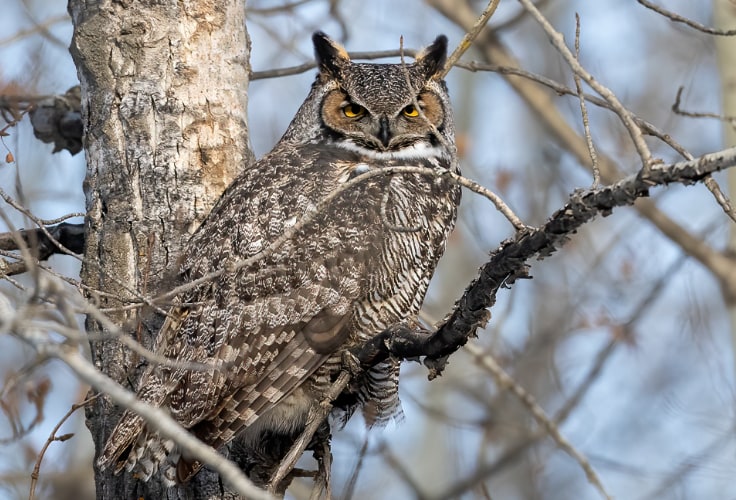
The great horned owl is the most iconic and adaptable owl in North America, thriving from the forested north to deserts, prairies, wetlands, and city parks. The species measures 46 to 63 centimeters (18.1 to 24.8 inches) in length and is a large, thick-bodied predator with a broad head, prominent ear tufts, and massive yellow eyes set within a well-defined facial disc. Its power, versatility, and ability to hunt a remarkably wide range of prey make it a dominant nocturnal raptor throughout the continent.
Adults show a heavily mottled pattern of brown, buff, gray, and black, with a white bib at the throat that stands out in low light. Facial tones vary from reddish to grayish depending on region, and overall coloration ranges from dark sooty in the Pacific Northwest to pale in the Southwest and subarctic zones. Sexes look alike in plumage, though females are larger, and individuals maintain the same appearance year-round. Juveniles resemble adults but appear softer and fluffier until their feathers mature.

In the field, great horned owls often perch upright on exposed branches, poles, or fence posts at dusk, scanning open areas for prey. Their flight is strong and deliberate, combining deep wingbeats with short glides while holding the wings nearly flat. Their deep, rhythmic hoots are one of the most familiar night sounds in North America, often delivered in a slow series of four to six notes and sometimes exchanged in duets between mates. Although primarily nocturnal perch hunters, they may hunt at dawn or dusk and occasionally during the day. Their diet includes mammals, birds, and other vertebrates, taken on the ground, from perches, or during low hunting flights over open terrain.
This species occupies an extraordinary range of habitats across the United States and Canada, from the northern taiga and tundra edges to deserts, swamps, orchards, agricultural areas, and suburban parks. It prefers landscapes that combine patches of forest or woodland with open areas where prey is more visible. Great horned owls frequently nest in abandoned raptor nests, tree cavities, cliff ledges, or human-made structures, and their tolerance of nesting near people has occasionally led to conflicts, including aggressive swoops and attacks when humans unknowingly approach active nests. Even the northernmost populations remain resident throughout the year.
Great horned owls remain common and broadly distributed, supported by their flexible habitat use and wide diet. Long-term surveys indicate stable populations across much of their range, though numbers may fluctuate locally with prey cycles. Major threats include illegal shooting, collisions, and secondary poisoning from pesticides or rodenticides ingested through contaminated prey. Despite these pressures, the species continues to thrive as one of the continent’s most successful and adaptable raptors.
Barred Owl
Strix varia
- Identification: Large gray-brown owl with a rounded head, dark eyes, a well-defined facial disc, and brown-and-white barred and streaked plumage across the head, breast, and underparts.
- Where found: Resident across forested regions of eastern North America, the upper Midwest, southern Canada, and the Pacific Northwest, favoring mature woods, swamps, riparian corridors, and mixed forests.
- How to spot: Listen at dusk or night for the distinctive “Who cooks for you?” call, or look for a broad, rounded owl gliding quietly through deep forest or roosting motionless on shaded branches.
- Conservation status: Least Concern (IUCN); populations stable or increasing, though sensitive to habitat loss in some regions and implicated in competition with threatened spotted owls in the Pacific Northwest.

The barred owl is one of the most familiar voices of North American forests, known for its resonant hooting that echoes through swamps and mature woodlands. The species measures 43 to 50 centimeters (16.9 to 19.7 inches) in length and is a large, broad-bodied owl with a rounded head lacking ear tufts, deep brown eyes, and a subtle yellow bill set within a full facial disc. Its adaptability to varied forest habitats and its tendency to vocalize frequently make it a prominent nighttime presence across much of the continent.
Adults show a pattern of gray-brown and buff across the head and back, with whitish spotting on the scapulars and wing coverts and a dark brown tail marked by pale bars. The upper breast bears horizontal brown barring that transitions to bold vertical streaks down the belly and sides. The overall impression is of a softly mottled, well-camouflaged owl that blends seamlessly into bark and deep forest shade. Sexes are similar in appearance, and plumage does not vary seasonally. Juveniles resemble adults but with less sharply defined markings and occasional downy tips remaining after fledging.

Barred owls are most often detected by sound rather than sight, using their far-carrying hoots to advertise territories and communicate with mates. Their best-known call is the rhythmic two-phrase series often rendered as “Who cooks for you? Who cooks for you-all?” – a classic vocal signature of mature forests and wooded swamps. They roost quietly in dense cover during the day and become active at dusk, moving with buoyant, silent flight among branches. Their broad vocal repertoire includes ascending hoots, contact calls, and loud, raucous caterwauling duets. As crepuscular and nocturnal hunters, they use elevated perches to watch for small mammals, amphibians, birds, and in warmer regions even reptiles and invertebrates, and may drop to the forest floor, wade into shallow water, or plunge into snow when pursuing prey.
This species inhabits a broad swath of North America’s forests. In the United States and Canada, it occupies mature deciduous, mixed, and coniferous woods from the eastern seaboard across the Great Lakes, southern boreal regions, and into the northern Rockies and Pacific Northwest, continuing south into California. It favors forests with open understory that permit easy flight, often near rivers, swamps, or riparian thickets. Barred owls nest in large tree cavities or old raptor nests within territories they defend year-round, and long-term pair bonds help them maintain these stable forest sites that offer suitable cover and hunting perches.
Barred owls remain generally numerous, with populations stable or increasing across much of their range. Their expansion westward over the past century, aided by fire suppression and tree planting, has brought them into contact with the threatened spotted owl, with which they compete and hybridize in the Pacific Northwest. Although adaptable in many wooded landscapes, barred owls depend on mature forest structure and suitable nest cavities, making them vulnerable to intensive logging and forest fragmentation. Overall, however, the species continues to thrive as a characteristic and vocal inhabitant of North American forests.
American Barn Owl
Tyto furcata
- Identification: Medium-sized owl with a pale, heart-shaped facial disc, long rounded wings, short tail, long sparsely feathered legs, and buff-and-gray upperparts contrasting with whitish underparts.
- Where found: Occurs widely across the Americas but in the United States and Canada is concentrated in open lowlands, agricultural areas, grasslands, deserts, and coastal regions, avoiding heavily forested or mountainous habitats.
- How to spot: Look for a ghostly pale owl flying low over fields at night with buoyant wingbeats, or listen for its harsh, rasping scream near barns, silos, and other quiet structures where it roosts and nests.
- Conservation status: Least Concern (global species, IUCN); populations locally stable or slightly increasing but sensitive to loss of open habitats, decline of old buildings and hollow trees, and secondary poisoning from rodenticides.

The American barn owl is the only representative of the Tytonidae family in the United States and Canada, easily recognized by its pale plumage and striking heart-shaped face. The species measures 32 to 40 centimeters (12.6 to 15.7 inches) in length and appears lanky and long-legged compared with other North American owls, with a large rounded head, no ear tufts, and long, softly rounded wings. Despite being locally common, its nocturnal habits and silent flight make it far less conspicuous than its widespread distribution might suggest.
Adults display warm buff and gray tones across the head, back, and upperwings, often overlaid with a light grayish “veil,” while the face, chest, and underwings are largely whitish. Females tend to be darker and more heavily spotted than males, though the two sexes overlap considerably. Some males are nearly unmarked white below, whereas some females show dense black spotting. The dark eyes appear small for an owl, set within a complete facial ruff. Juveniles resemble adults but may show heavier spotting or retain downy feather tips for several months.
Barn owls are most often detected by sound at night, giving a long, harsh, rasping scream rather than the hoots typical of many other owls. Their flight is buoyant and silent, with deep, slow wingbeats as they quarter low over open fields. They hunt primarily by sound, possessing the most precise auditory prey-location ability known in any tested animal. Their long legs and talons allow them to reach prey hidden in vegetation or snow, and they typically dive from low flight to capture small mammals, especially rodents, which make up the bulk of their diet.

Within the United States and Canada, American barn owls occupy open or lightly wooded landscapes – marshes, grasslands, deserts, farmlands, and mixed agricultural areas, avoiding dense forests and high mountains. They roost and nest in large cavities, often using hollow trees, cliff crevices, abandoned buildings, barns, silos, or nest boxes where available. Northern populations are sparse and localized, with breeding largely confined to southeastern Canada, the Pacific Northwest, and scattered pockets across the northern United States. Most populations are resident, though individuals at the northern limit of the range may move short distances in winter.
American barn owl populations are challenging to assess due to their secretive, nocturnal behavior, but available surveys suggest generally stable or slightly increasing trends in many regions. Habitat conversion, loss of old buildings and hollow trees, and changes in agricultural landscapes can reduce nesting opportunities and prey availability. Rodenticide exposure poses a significant threat, particularly in agricultural and suburban areas, and collisions with vehicles are common due to their low hunting flights over roadsides. Conservation measures, including nest box programs, preservation of open habitats, and reduced use of toxic rodent control, have supported population stability where implemented.
Eastern Screech-Owl
Megascops asio
- Identification: Small, stocky owl with prominent ear tufts, yellow eyes, and gray or rufous plumage marked with intricate bars and spots that provide excellent camouflage against tree bark.
- Where found: Year-round resident across wooded landscapes east of the Rocky Mountains, from southern Canada through the eastern and central United States and into northeastern Mexico.
- How to spot: Listen at night for its distinctive monotonic trills or descending whinnies, or check tree cavities and nest boxes where individuals may roost or sun at the entrance.
- Conservation status: Least Concern (IUCN); populations declining in parts of the range, with threats including habitat loss, competition for cavities, and local predation, but generally resilient due to broad ecological tolerance.

The eastern screech-owl is one of the most adaptable small owls in North America, occurring east of the Rocky Mountains in nearly any treed habitat from southern Canada to northeastern Mexico. The species measures 16 to 25 centimeters (6.3 to 9.8 inches) in length and is a compact, broad-headed owl with conspicuous ear tufts, yellow eyes, and a short, square tail. Its wide ecological tolerance makes it a familiar nocturnal resident across much of eastern North America.
Adults appear in two main color morphs, gray and rufous, with brownish intermediates occurring throughout the range. The gray morph dominates across the north and west, while the rufous morph is more common in the southeastern United States. Regardless of color, plumage is patterned with complex bars, streaks, and spots that blend perfectly with tree bark. Sexes look alike in the field, although females are slightly larger, and juveniles resemble adults but may show softer, less sharply defined markings.

Eastern screech-owls are far more often heard than seen. Their two most distinctive vocalizations – a steady, monotonic trill used for close-range communication and a descending whinny associated with territorial defense, carry clearly through wooded neighborhoods and forest edges. At night they move with rapid wingbeats through the lower canopy, making short, directed flights and occasionally hovering briefly while hunting. They forage from low perches, taking invertebrates, small vertebrates, rodents, and songbirds, and will hunt on lawns, along streets, or near porch lights where prey is abundant.
This species occupies nearly all wooded habitats east of the Rockies, including deciduous and mixed forests, riparian corridors, pine woodlands, parks, suburban yards, and ranch shelterbelts. It occurs from southern Manitoba, Ontario, and Quebec south through the eastern, central, and southeastern United States and into northeastern Mexico. Treeless plains and high mountains form natural range limits. Eastern screech-owls nest in tree cavities or nest boxes, and fledglings often climb trunks using their feet, wings, and beak before they can fly.
Population trends vary by region, with long-term surveys indicating gradual declines in portions of the range. Loss of mature trees, competition for cavities, especially with European starlings, and local predation can impact numbers. Even so, the species remains widespread and resilient, benefiting from its flexible diet, small territorial requirements, and tolerance for human presence. Well-placed nest boxes and maintenance of cavity-bearing trees help sustain local populations across suburban and rural landscapes alike.
Western Screech-Owl
Megascops kennicottii
- Identification: Small, stocky owl with prominent ear tufts, yellow eyes, and gray to brownish plumage intricately streaked and barred for bark-like camouflage.
- Where found: Resident across western North America from coastal Alaska and British Columbia south through the western United States into northwestern Mexico, mainly in wooded and riparian habitats at lower elevations.
- How to spot: Most often detected by its accelerating series of hollow hoots – likened to a bouncing ball, and by listening for songbird mobbing around daytime roosts; typically seen peering from tree cavities or nest boxes.
- Conservation status: Least Concern (IUCN); regional declines noted, especially in the Pacific Northwest, driven by habitat loss, reduced nest-site availability, and predation by expanding barred owls.

The western screech-owl is one of the most familiar small owls of the American West, widely distributed in forests, deserts, and suburban green spaces from Alaska to Mexico. It measures 19 to 26 centimeters (7.5 to 10.2 inches) in length and is compact and broad-headed, with noticeable ear tufts and a strikingly patterned plumage that blends seamlessly with tree bark. This species’ distinctive accelerating hoots – evoking the rhythm of a bouncing ball, make it easier to detect than to see, especially in densely vegetated environments.
Adults show gray or brown base coloration depending on region, with coastal Pacific Northwest birds sometimes showing richer rufous tones. Upperparts are flecked and barred, while the pale breast and belly carry dark streaks and fine horizontal markings. The face is pale and rimmed with a thin dark border, highlighting the bright yellow eyes. Plumage is generally monomorphic within each population, though females typically average slightly larger than males. Juveniles resemble adults but show softer and less crisply defined markings.
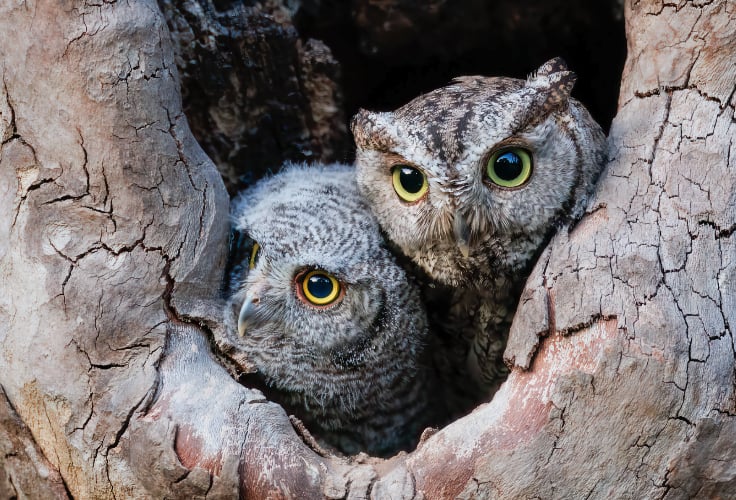
Western screech-owls are primarily heard rather than observed, especially at night when males give their hollow, accelerating hoots from concealed perches. They roost quietly by day in tree cavities or dense foliage and may be revealed when small birds gather to mob a hidden owl. Their sit-and-wait hunting style involves perching low beneath the canopy and watching for prey, which ranges from insects and worms to rodents, small birds, crayfish, and even the occasional bat. They also glean arthropods from foliage and may hawk insects or capture aquatic prey at the edges of streams.
This species occurs across western North America, including coastal Alaska, British Columbia, Washington, Oregon, California, Idaho, Montana, Utah, Nevada, Arizona, New Mexico, western Colorado, western Oklahoma, Texas’s Trans-Pecos and Edwards Plateau, and much of northern and central Mexico. They occupy a variety of wooded settings, especially riparian corridors, mesquite-lined washes, and deciduous forests – mostly at lower elevations. Western screech-owls nest in natural cavities, old holes excavated by large woodpeckers, and nest boxes, selecting territories that provide a mix of foraging cover and perch sites.
Though globally secure, western screech-owl populations show signs of localized decline. The species is particularly vulnerable in the Pacific Northwest, where expanding barred owls have increased predation pressure. Habitat loss, removal of standing dead trees, urban expansion into riparian zones, and competition for nest cavities also affect regional numbers. Nonetheless, this owl adapts reasonably well to human presence, and conservation measures such as maintaining riparian forest structure and installing nest boxes can support stable populations.
Burrowing Owl
Athene cunicularia
- Identification: Small, long-legged, ground-dwelling owl with a rounded head, bright yellow eyes, white eyebrows and throat, brown upperparts spotted with buff, and barred buff-white underparts.
- Where found: Occurs across open grasslands, deserts, prairies, and agricultural landscapes of western North America, Florida, and parts of Mexico and the Caribbean, using underground burrows for nesting.
- How to spot: Scan low mounds around burrow entrances for a small upright owl active day or night, watch for low, buoyant flights close to the ground, and listen for soft two-note cooing or raspy alarm calls.
- Conservation status: Least Concern (IUCN); regional declines in Canada, the Dakotas, Florida, and parts of the West driven by habitat loss, reduction of burrowing mammals, pesticides, and collisions.

The burrowing owl is one of North America’s most distinctive owls, notable for being active both day and night and for nesting underground in burrows rather than trees. The species measures 19 to 25 centimeters (7.5 to 9.8 inches) in length and is a small, lean-bodied owl with long, lightly feathered legs, a rounded head lacking ear tufts, and bright yellow eyes set beneath pale facial stripes. Its unusual appearance and ground-dwelling habits make it a memorable species of open grasslands and arid regions throughout the western United States, Canada, and Florida.
Adults show warm brown upperparts densely spotted with buffy white and barred buff-white underparts, creating excellent camouflage among dry vegetation and soil. A bold white throat, pale eyebrows, and a soft buffy facial ruff frame the expressive eyes. Sexes are nearly identical in appearance, though females may appear darker during the breeding season. Juveniles are easily recognized by their solid buff-colored breast and a buff wing patch, with less spotting than adults; after their preformative molt, they closely resemble adults. Plumage remains similar year-round.
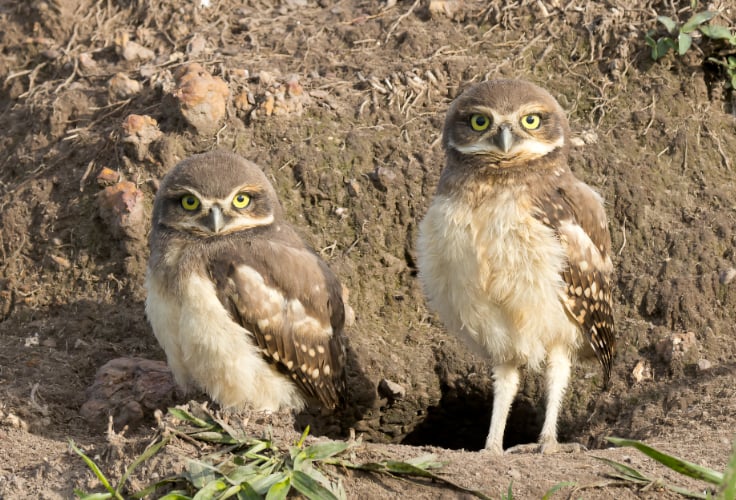
In the field, burrowing owls are most often seen standing alert on the ground or atop low perches such as fences, dirt mounds, or burrow entrances. They move with quick, jerky body motions when alarmed and fly low with slow wingbeats or short glides. Their vocal repertoire is extensive, but observers most often hear soft two-note cooing from males during pair formation or raspy calls from females and young near the nest. Their hunting behavior is highly variable: they walk, hop, or run after insects on the ground, hover over prey, or make short, direct flights to capture small mammals, birds, reptiles, or large arthropods. Activity peaks at dawn and dusk but often continues through the day and night.
Across North America, burrowing owls occupy open, treeless landscapes including native prairies, sagebrush steppe, deserts, pastures, agricultural fields, airports, golf courses, and vacant lots. They rely heavily on the burrows of prairie dogs, ground squirrels, and other fossorial mammals across the western United States and Canada, while Florida birds can excavate their own burrows. Breeding occurs from the Canadian Prairies and the northern Great Basin south through the western and central United States, parts of California, the Southwest, Texas, and Florida, extending into northern and central Mexico. Northern populations migrate to the southern United States and Mexico for winter, while birds in Florida and parts of California may remain year-round. Nesting typically occurs in underground burrows within low vegetation, often in loose colonies.
Although still widespread, burrowing owls have experienced notable regional declines. Populations in Canada, the Dakotas, Florida, and some western states have decreased due to habitat loss, agricultural intensification, fragmentation of native grasslands, and the decline of prairie dogs and ground squirrels that provide essential burrows. Additional threats include pesticide exposure, vehicle collisions, entanglement in fencing, and predation by domestic animals. Conservation efforts, such as burrow protection, habitat restoration, legal safeguards, and the installation of artificial burrows, have proven beneficial in parts of the range, offering support for this charismatic species of North America’s open landscapes.
Northern Saw-Whet Owl
Aegolius acadicus
- Identification: Very small, round-headed owl with a catlike face, bright yellow eyes, brown upperparts spotted with white, and white underparts boldly streaked with brown.
- Where found: Widespread across forests of northern and western North America, breeding from Alaska to the northern and northeastern United States and wintering southward into dense forests of the central and southern U.S.
- How to spot: Listen at night from late winter through spring for a sharp, repetitive “too-too-too” call, or watch for small songbirds mobbing a silent owl roosting low in dense conifers during the day.
- Conservation status: Least Concern (IUCN); populations broadly distributed but difficult to monitor, with localized declines linked to habitat loss, reduced mature forest structure, and diminished nesting cavities.

The northern saw-whet owl is a tiny, elusive forest owl, widely known for its piercing nighttime calls that often betray a bird otherwise nearly impossible to spot. It measures 18 to 22 centimeters (7.1 to 8.7 inches) in length and has a large, rounded head without ear tufts, a compact body, and striking yellow eyes framed by a crisp facial disc that gives it a remarkably charming appearance. Highly nocturnal and secretive, it remains hidden for most of the day and reveals its presence through its high, rhythmic calls that carry far across quiet forests in late winter and early spring.
Adults show rich brown upperparts marked with white streaks and spots across the crown, nape, wings, and tail. The facial disc is whitish above and between the eyes, grading into brown-and-white lateral streaking, and a small tuft of dark bristle-like feathers sits between the eyes. Underparts are white with bold brown streaks. Juveniles differ dramatically, lacking the adult white spotting above and showing dark brown faces with a striking Y-shaped white marking, a plain brown breast, and buff-colored belly before molting into adult-like plumage later in the season. Sexes look similar, though females average slightly larger.

Saw-whets are most easily detected by their repetitive, high-pitched “too-too-too” advertising call – a steady series of notes often given by males from January through May. These owls roost silently in dense conifers, typically close to the trunk and sometimes just above eye level. Their flight is low, quick, and maneuverable, with rapid wingbeats and bounding, swooping motions reminiscent of a woodpecker. They hunt almost exclusively at night, taking small mammals, especially mice, from low perches along forest edges and clearings. Exceptional hearing aided by a subtly asymmetrical skull allows them to locate prey with precision in dense understory vegetation.
Across North America, the species breeds in a wide array of forested habitats, from boreal and northern hardwood forests to mixed conifer-deciduous woodlands, riparian corridors, shrub-steppe with available nest cavities, and even coastal shrublands and dunes where nest boxes have been installed. They range from Alaska and British Columbia south through the Pacific Northwest, the Rockies, and the northeastern United States, extending into pockets of the Appalachians and southeastern Canada. Wintering birds occur widely across dense forests of the central and southern United States. They nest in natural cavities or abandoned woodpecker holes and readily use nest boxes, often selecting areas with mixed habitats that combine dense conifers for roosting and deciduous stands or open edges for hunting.
Northern saw-whet owls remain common and widespread across much of their range, though their elusive nature makes population trends difficult to measure. Habitat loss, reduction of mature forests, and the removal of standing dead trees have likely contributed to local declines, and some regional populations are considered of conservation concern. They have adapted well to artificial nest boxes, which help offset the loss of natural cavities. Future challenges may arise from large-scale habitat shifts associated with climate change, which could alter forest composition and affect the southern extent of their breeding range. Overall, the species remains broadly distributed but reliant on healthy forest structures and the availability of suitable nesting cavities.
Short-Eared Owl
Asio flammeus
- Identification: Medium-sized owl with a pale facial disc, black-rimmed yellow eyes, mottled brown-and-buff upperparts, streaked whitish to rusty underparts, and broad, rounded wings marked with a dark comma at the wrist.
- Where found: Occupies open habitats across northern and western North America, breeding in tundra, grasslands, prairies, shrub-steppe, and coastal marshes, and wintering widely southward into the United States and Mexico.
- How to spot: Search open fields at dawn or dusk for a buoyant, mothlike flight low over vegetation, or look for birds perched directly on the ground; listen for soft hooting during spring courtship.
- Conservation status: Least Concern (IUCN); long-term declines in some regions due to grassland loss, fragmentation, and reduced small-mammal populations, though benefited locally by habitat restoration efforts.

The short-eared owl is one of the most widely distributed owls in the world and one of the few regularly seen flying in daylight in North America. The species measures 34 to 43 centimeters (13.4 to 16.9 inches) in length and is a medium-sized owl with a rounded head, very small and often invisible ear tufts, and large yellow eyes set against a pale facial disc bordered by dark orbits. Its long, broad wings and tendency to forage on the wing over open landscapes make it a distinctive open-country owl across much of the continent.
Adult plumage is a mottled mix of brown and buff across the upperparts, blending seamlessly with dried grasses. The underparts range from whitish to warm rust tones, marked by dense vertical streaks on the breast that fade along the flanks. In flight, the pale underwing shows a conspicuous dark marking near the wrist and blackish wingtips. Females tend to appear darker and more heavily streaked than males, though plumage alone does not reliably distinguish the sexes. Juveniles resemble adults but show more dusky upperparts, reduced facial patterning, and brownish eyes.

Short-eared owls are active during the day as well as at dusk and dawn, quartering low over grasslands with buoyant, erratic wingbeats and frequent changes in direction. Their flight is agile and mothlike, aided by light wing loading that allows slow, maneuverable foraging. They hunt small mammals, especially voles, using a combination of acute hearing and low-level searching flights, and will hover briefly when pinpointing prey. During the breeding season, males give a soft, rhythmic series of hoots while displaying in flight, while bark-like or rasping calls may be heard near nests when birds defend their young.
Across North America, short-eared owls breed in open habitats from the high Arctic south through tundra, coastal marshes, prairies, shrub-steppe, and grasslands where vole and lemming populations peak. They occur across Alaska, Canada, and the northern United States, with patchy local breeding in open regions farther south. Wintering birds spread widely, appearing in suitable grasslands, fields, airport margins, and marshlands across most of the United States and into northern Mexico. Nests are placed on the ground in concealed grassy sites within expansive, treeless landscapes.
Although still widespread, short-eared owls have experienced regional declines linked to habitat loss, fragmentation, and reductions in small-mammal prey. Grassland conversion to agriculture, intensive grazing, development, and disturbance in open habitats have reduced breeding opportunities in many areas. Nevertheless, populations can fluctuate with prey cycles and may increase where grasslands are restored, including reclaimed mine lands and conservation reserve programs. Overall, the species remains relatively common but dependent on large, intact expanses of open habitat across North America.
Long-Eared Owl
Asio otus
- Identification: Medium-sized, slender owl with long, upright ear tufts, yellow eyes, a buff facial disc with white eyebrows, mottled brown-and-buff upperparts, and streaked whitish to buff underparts.
- Where found: Widely distributed across North America in forests adjacent to open grasslands, shrublands, and pasture, breeding from Canada and the northern U.S. south into scattered western and northeastern regions and wintering broadly through southern Canada, the U.S., and Mexico.
- How to spot: Listen at night in spring and early summer for long series of low hoots, or search winter roosts in dense evergreens or shelterbelts near open fields, looking for well-camouflaged birds, pellets, or whitewash.
- Conservation status: Least Concern (IUCN); populations difficult to monitor and possibly declining due to habitat loss, fragmentation, and reduction of riparian woodland and tree groves essential for roosting and nesting.

The long-eared owl is a secretive, nocturnal species distinguished by its tall, narrow ear tufts and slender profile, giving it a surprised, alert expression. The species measures 35 to 40 centimeters (13.8 to 15.7 inches) in length and is a medium-sized owl with long, rounded wings, densely feathered legs, and a compact body built for agile flight through dense vegetation. Its combination of forest roosting habits and open-country foraging makes it a characteristic owl of wooded edges across much of the continent.
Adults display a complex pattern of blacks, browns, grays, and buffs across the upperparts, including a buff patch on the upperwing near the bend of the wing. The facial disc is buff with two vertical white lines between the eyes, contrasting with black lores and a dark bill. Underparts are whitish-gray and buff with dark brown streaks and barring, and the underwing shows a small dark mark near the carpal region. Females generally appear darker and richer in tone than males. Juveniles resemble adults in the face, wings, and tail but have more uniformly dusky plumage on the head and back.

Long-eared owls are most often detected by sound rather than sight. Males give long, evenly spaced sequences of low hoo notes that carry up to a kilometer on calm nights. Near nests, both sexes produce barking, squealing, and catlike calls when disturbed. During the day they roost in dense foliage, often close to the trunk, where their cryptic plumage and narrow profile provide excellent camouflage. At dusk they emerge to hunt, coursing low over open fields in long glides punctuated by deep wingbeats. They use their acute hearing to locate small-mammal prey, occasionally hovering over likely spots or switching to perch hunting in windy conditions.
This species requires a mosaic of habitats: open areas for hunting and dense, taller vegetation for nesting and roosting. Across North America, it breeds from southeastern Yukon and northern British Columbia across much of central Canada and into the northern and interior United States, extending south along the Appalachians to Virginia and in western states into parts of the Southwest and northern Mexico. In winter, birds remain widely distributed, occupying similar combinations of open fields and wooded roost sites. Winter roosts can be communal, sometimes holding several to dozens of birds, particularly in pine stands, shelterbelts, or riparian groves.
Although long-eared owls remain fairly widespread, their populations may be declining in some regions, though trends are difficult to assess due to their elusive behavior and nomadic movements. They depend on both grassland prey populations and wooded roosting sites, making them vulnerable to the loss of riparian woodlands, isolated tree groves, and shelterbelts, especially in the arid West. Conservation measures that maintain wooded edges, preserve shelterbelts, and protect grassland habitat can support their continued presence across North America.
Northern Pygmy-Owl
Glaucidium gnoma
- Identification: Tiny, round-headed owl with yellow eyes, a long tail, brown or rufous-brown upperparts marked with white spots, streaked whitish underparts, and distinctive dark “eyespots” on the nape.
- Where found: Resident across montane forests of western North America from southern Alaska and British Columbia through the Cascades, Rockies, and mountains of the Southwest into Mexico and Central America.
- How to spot: Listen for high, evenly spaced toots or watch for mobbing songbirds around a small, upright owl perched on treetops, power lines, or exposed branches during the day.
- Conservation status: Least Concern (IUCN); populations appear stable but are vulnerable to loss of mature forest structure and standing dead trees required for nesting cavities.

The northern pygmy-owl is the most widespread of North America’s tiny owls, combining small size with bold behavior and a surprising predatory confidence. The diminutive species measures 15 to 17 centimeters (5.9 to 6.7 inches) in length and is a compact, round-headed owl with bright yellow eyes, a long tail, and short wings. Its posture is alert and upright, often making it appear disproportionately confident for its size. This species is typically found in montane forests and foothills across the western part of the continent, where it perches conspicuously to announce its presence with clear, repetitive whistles.
Adults vary from drab brown to richer rufous-brown depending on region, with small whitish spots on the crown and nape and larger white spotting on the back, scapulars, and wings. The tail is distinctly barred with thin whitish bands and often held downward while perched. The faintly defined facial disc features thick, whitish eyebrows that curve into the lores. On the back of the head, two dark oval patches bordered in white form striking “eyespots” that give the impression of a false face – an adaptation believed to deter predators and mobbing songbirds. Underparts are whitish with fine brown streaking. Juveniles resemble adults but show a gray head and reduced spotting before their first molt.

Unlike most owls, northern pygmy-owls are primarily active by day. They hunt from exposed perches, scanning the understory, canopy, and ground below in short bursts of “pause-travel” foraging. Their flight ranges from rapid, straight-line wingbeats to undulating, woodpecker-like patterns when crossing openings. These owls take a wide range of small birds and mammals – often much larger than expected for their size, as well as insects, reptiles, and occasional small snakes. They are frequently located by the commotion of chickadees, nuthatches, and other songbirds that gather to mob a perched owl. Their vocalizations include a steady series of high-pitched, evenly spaced toots used by males during territory advertisement.
Across western North America, the species occupies structurally complex montane and submontane forests with mature conifers, mixed woodlands, and forest edges. They are residents from southern Yukon, British Columbia, and southeastern Alaska through the Cascades, Sierra Nevada, and Rocky Mountains, extending into isolated “sky island” ranges of the Southwest and southward into Mexico, Guatemala, and Honduras. Northern pygmy-owls favor older stands with large-diameter trees that provide natural cavities or abandoned woodpecker holes for nesting. During winter they often move to lower elevations, where they may be found near towns, forest edges, and occasionally backyards.
Population trends for the northern pygmy-owl are difficult to assess due to their low density and secretive habits, but available data suggest overall stability. The species depends heavily on standing dead trees and existing cavities, making it sensitive to forestry practices that remove snags and reduce mature forest cover. Maintaining cavity-bearing trees and supporting healthy woodpecker populations are important components of its long-term conservation. Despite these local pressures, the species remains widespread and resilient across much of its mountainous range.
Great Gray Owl
Strix nebulosa
- Identification: Very large gray owl with a broad, rounded head, long tail, fine gray-brown barring and streaking, and a large circular facial disc marked with pale arcs and a white “bow tie.”
- Where found: Widespread across northern North America from Alaska and Canada into the northern Rockies, Cascades, and Sierra Nevada, using mature coniferous forests with nearby meadows or bogs.
- How to spot: Look for a massive gray owl perched on low or mid-level branches at meadow edges, or watch for slow, buoyant flight at dawn or dusk; listen for deep, evenly spaced hoots near breeding areas.
- Conservation status: Least Concern (IUCN); populations generally stable, with local sensitivity to habitat loss, prey fluctuations, and winter food scarcity.

The great gray owl is one of the most imposing owls in North America, celebrated for its towering height and oversized facial disc that creates a striking, almost “surprised” expression. The species measures 61 to 84 centimeters (24.0 to 33.1 inches) in length, making it the tallest owl species in the world, but is lighter than both the great horned owl and snowy owl, with its immense bulk shaped largely by dense, insulating plumage. This feathered volume helps it withstand frigid northern winters and contributes to its ghost-like presence as it moves silently through boreal and montane forests.
Adults are predominantly gray, patterned with a subtle mix of white, gray, and brown that produces finely streaked underparts and irregularly mottled upperparts. The broad facial disc shows multiple concentric rings of darker and lighter tones, with white lores, a yellow bill, and a bold white “bow tie” marking at the throat. Yellow eyes appear small relative to the bird’s size, adding to its distinctive expression. The long, wedge-shaped tail and barred gray-brown wings accentuate its large silhouette. Sexes are similar in coloration, though females are larger. Juveniles are cryptic gray and white, with softer overall contrast.
In the field, great gray owls can be surprisingly difficult to detect. They perch quietly in the shade of conifers or on exposed snags bordering meadows, often remaining motionless for long periods. Their flight is slow, deep-winged, and buoyant – described as “heron-like,” yet agile enough to slip through dense timber. Their territorial call is a series of low, evenly spaced hoots, usually given near nests. These owls hunt primarily from perches, watching and listening intently for small mammals. Their exceptional hearing allows them to locate prey beneath deep snow, and they frequently hover before plunging through crusted layers – sometimes strong enough to support a human, to seize rodents concealed below the surface.

This species inhabits mature coniferous or mixed boreal forest across much of interior Alaska and Canada, extending south into the northern Rockies, Cascade Range, and Sierra Nevada. It favors landscapes with a combination of dense timber and nearby openings such as meadows, montane grasslands, bogs, or muskeg, where prey is more accessible. Great gray owls nest in large cavities, abandoned raptor nests, broken-topped snags, or other elevated structures within forested territories. Most populations are resident or short-distance wanderers, though northern birds sometimes move irregularly southward in winter when prey is scarce.
Great Gray Owl populations are generally stable across their vast Holarctic range, though precise trends in North America are difficult to determine due to low densities, remote habitats, and their secretive nature. In the United States, they occur at the southern margins of their distribution and remain uncommon. Local fluctuations often reflect prey cycles and winter conditions, and the species can be sensitive to habitat alteration that reduces suitable forest structure or prey availability. Despite these challenges, it persists as one of the most emblematic and sought-after owls of northern and montane forests.
Snowy Owl
Bubo scandiacus
- Identification: Large white owl with yellow eyes, a rounded head, and variable dark barring that ranges from heavy on females and young birds to almost absent on older males.
- Where found: Breeds across the High Arctic of North America and winters irregularly south into southern Canada and the northern United States, using tundra, coastal fields, dunes, agricultural lands, and other open habitats.
- How to spot: Search wide-open areas for a pale figure perched on the ground or on posts and dunes, or watch for low, buoyant flights; listen for deep hoots or sharp barks near nests or territorial birds.
- Conservation status: Vulnerable (IUCN); global populations declining, tied to prey cycles and threatened by climate change, habitat change, and winter mortality risks.

The snowy owl is one of the most recognizable birds in the Northern Hemisphere and the heaviest owl species in North America. The species measures 52 to 71 centimeters (20.5 to 28.0 inches) in length and is a powerful Arctic hunter adapted to life on open tundra and sea ice. Its clean white plumage, intense yellow eyes, and broad, rounded head create an unforgettable impression, and its winter appearances across southern Canada and the northern United States often draw both birders and the general public into the field.
Adults show a striking range of plumage variation. Males become progressively whiter with age, sometimes nearly pure white, while females retain extensive dark barring across the crown, back, wings, and underparts. Younger birds of both sexes are heavily barred and spotted, a pattern that gradually lightens in subsequent years. The bill is black yet nearly hidden by long rictal bristles, and the legs and toes are densely feathered for insulation. Small ear tufts occur in both sexes, though they are usually inconspicuous and most often noted in nesting females.

Snowy owls are diurnal, often extremely so in the continuous light of the Arctic summer, and they hunt at any hour depending on hunger and weather. They perch conspicuously on the ground, hay bales, fenceposts, dunes, buildings, or ice hummocks, surveying surrounding terrain for prey. Their flight can appear slow and buoyant, though it becomes fast and direct when pursuing birds or defending territory. They produce a wide range of vocalizations: males give deep hoots used for territorial displays and courtship, females utter whistling mews, and both sexes bark or rattle sharply during nest defense. Begging calls of young are loud and persistent across the tundra, helping adults locate scattered chicks.
This species breeds across the circumpolar Arctic, including northern Alaska, the Canadian Arctic Islands, and coastal high-latitude regions of northern Canada, where nesting success closely follows lemming and vole abundance. Snowy owls select open, treeless landscapes – tundra with wet or dry substrates, coastal plains, and Arctic islands, and nest on slight rises or exposed ground. In winter they disperse widely, some remaining near breeding latitudes while others move south into southern Canada and the northern United States, especially the northern Plains, Great Lakes, New York, and New England. Irruptive years bring large numbers far beyond their usual range, sometimes reaching the Pacific Northwest, Midwest, and southeastern states.
Snowy owl populations fluctuate with prey cycles and show long-term declines across parts of their range. Their vast, remote breeding areas complicate monitoring, but available data indicate reduced numbers over recent decades. Climate-driven changes in Arctic ecosystems, shifts in prey availability, and unpredictable wintering conditions contribute to these trends. Although largely protected from direct disturbance on their high-latitude breeding grounds, snowy owls face risks during winter, including vehicle collisions, starvation, and other human-associated hazards. Still, in years of prey abundance, they can raise large broods, and their irruptive appearances remain among the most dramatic wildlife events in North America.
Northern Hawk-Owl
Surnia ulula
- Identification: Medium-sized owl with a long tail, short pointed wings, brown upperparts with white spots, a narrowly bordered facial disc, and white underparts marked by heavy brown barring.
- Where found: Occupies boreal and forest-tundra regions across Alaska and Canada, with occasional winter movements into southern Canada and the northern United States, favoring open coniferous or mixed forests near clearings or marshy areas.
- How to spot: Look for a diurnal owl perched atop prominent trees scanning for prey, or watch for fast, low glides with deep, falcon-like wingbeats over open ground.
- Conservation status: Least Concern (IUCN); populations fluctuate with small-mammal cycles and are locally affected by loss of nesting sites and perches due to forest clearing.

The northern hawk-owl is one of the most distinctive owls of the boreal forest, combining the silhouette and hunting style of a hawk with the appearance of a true owl. It measures 36 to 45 centimeters (14.2 to 17.7 inches) in length and is a medium-sized species with a long, tapered tail, short pointed wings, and a compact, thickset frame. Its diurnal habits and bold nature make it unusually easy to observe when present, and its tendency to perch conspicuously atop solitary trees gives it an unmistakably hawk-like profile.
Adults show a striking pattern of brownish-black upperparts heavily spotted and streaked with white, with pale scapular patches forming noticeable panels when the wings are folded. The facial disc is small and grayish white, bordered by a thick black outline and crossed by dark bands that extend from the eye across the hindcrown and down the nape. The crown is densely spotted with white, and the underparts are white with heavy brown barring. The long, slightly graduated tail is crossed by seven or eight pale bars, and the legs and toes are fully feathered. The bill is yellowish, and the eyes are bright yellow. Sexes look alike, and juveniles appear similar to adults with only subtle differences.

In the field, northern hawk-owls are best recognized by their behavior. They hunt chiefly by sight, often from treetops, leaning forward as they scan open ground for small mammals. Their flight is fast, direct, and low, with deep, powerful wingbeats reminiscent of a falcon. Individuals may pitch abruptly downward from a perch to sweep across clearings or hover briefly over suspected prey. Although most active during the day, they also hunt at night and at dawn or dusk. Their vocal repertoire is varied, with males giving long, trilling advertising calls during the breeding season and both sexes producing sharp screeches, trills, and rapid alarm calls near nests or fledged young.
This species spans the boreal forests and forest-tundra transition across Alaska, the Yukon, the Northwest Territories, northern British Columbia, Alberta, Saskatchewan, Manitoba, Ontario, Québec, Labrador, and Newfoundland. It occupies open or sparsely treed coniferous and mixed forests, burned areas, cutovers, boggy spruce flats, and shrub-dotted wetlands. It nests close to the tree line but can also occur farther south in years of high prey abundance or during winter irruptions, when some individuals move into southern Canada and the northern tier of the United States.
Northern hawk-owl populations are challenging to assess due to their low densities, wide distribution, and tendency to shift regionally with prey cycles. Numbers fluctuate with small-mammal booms and declines, and populations are generally considered uncommon across their range. Large-scale forest clearing can reduce suitable nesting sites and hunting perches, though the species persists across much of the boreal zone. Overall, it remains a low conservation concern, though highly dependent on healthy prey populations and intact boreal habitats.
Boreal Owl
Aegolius funereus
- Identification: Small, large-headed owl with a grayish-white facial disc bordered in brown, bright yellow eyes, brown upperparts with white spots, and white underparts streaked heavily with brown.
- Where found: Breeds across boreal and subalpine forests of Alaska and Canada and south into the northern and western mountains, using spruce, fir, aspen, and mixed woodland; sometimes wanders slightly southward in winters with low prey availability.
- How to spot: Listen on late-winter nights for the male’s rapid, hollow series of hoots, or search quietly for a small owl roosting close to tree trunks.
- Conservation status: Least Concern (IUCN); populations difficult to monitor but generally stable, though dependent on healthy small-mammal cycles and vulnerable to habitat alteration in boreal forests.

The boreal owl is one of the most elusive owls of northern forests, emerging at night from dense spruce and fir stands to hunt quietly under cover of darkness. This species measures 21 to 28 centimeters (8.3 to 11.0 inches) in length and is a small but large-headed species with a square facial appearance, a short tail, and long wings. Its nocturnal habits and tendency to change daytime roosts daily make it difficult to locate, though males advertise territories in late winter with distinctive, far-carrying trills that echo through deep forest.
Adults show brown upperparts marked with prominent white spots and blotches, including pale scapular patches visible when the wings are folded. The crown is umber-brown with many small white spots, and the facial disc is grayish white with a sharply defined dark border and raised white “eyebrows.” Underparts are cream-white with broad brown to russet streaks. The bill is yellowish, and the eyes are bright yellow. Legs and toes are heavily feathered. Juveniles differ markedly, appearing uniformly chocolate-brown above and below with a dark facial disc and simpler patterning than adults.

Boreal owls hunt primarily at night, using a sit-and-wait approach from low to mid-level perches within the forest. They move in short, direct flights between perches, often only tens of meters at a time, and attack prey with quick downward glides. Although chiefly nocturnal, they may occasionally hunt during the day, especially in northern regions where summer light is continuous. Their calls are varied: males give the rapid, staccato during courtship and territory advertisement, while both sexes use sharp screeches, soft peeping notes, and harsh hisses near the nest.
This species occupies boreal and subalpine forests across a wide transcontinental band from Alaska through Canada and into the extreme northern United States. South of this main range, it occurs locally in the Rocky Mountains, Cascade Range, and some western subalpine forests, where it inhabits stands of spruce, fir, aspen, birch, and poplar. It roosts in cavities or dense branches by day, often 4.5 to 6 meters (15-20 feet) above the ground, and relies heavily on tree cavities or nest boxes for breeding. Movements vary with prey abundance: adult males tend to remain near breeding territories year-round, while females and young birds may disperse in years of low vole densities.
Boreal owl populations are naturally difficult to assess due to the species’ nocturnality, low detectability, and broad northern distribution. It remains generally uncommon but widespread, with numbers that fluctuate along with small-mammal cycles. Habitat changes that reduce mature forest structure or cavity availability may affect local populations, yet overall the species is considered of low conservation concern and remains a characteristic nighttime predator of the boreal zone.
Flammulated Owl
Psiloscops flammeolus
- Identification: Tiny gray-brown owl with short ear tufts, a rectangular-looking head, a grayish facial area with dark borders, long pointed wings, and mottled plumage that ranges from gray to rufous.
- Where found: Breeds in mature montane pine and mixed conifer forests across the western United States, southwestern Canada, and parts of Mexico; winters in Mexico and Central America, using similar open montane forest types.
- How to spot: Listen at night for a low, repetitive hoot that sounds farther away than it is, or search for a small, well-camouflaged owl roosting in dense branches of large conifers.
- Conservation status: Least Concern (IUCN); populations appear to be declining, with concerns linked to dependence on older forests and sensitivity to habitat loss, and pesticide impacts on insect prey.

The flammulated owl is one of the smallest owl species in North America and the characteristic tiny owl of montane pine forests in the West. It measures 15 to 17 centimeters (5.9 to 6.7 inches) in length and is a compact, long-winged species with short, often barely noticeable ear tufts and a rectangular head shape. This little insect hunter is highly migratory – unusual among North American owls, and spends its breeding season in mature conifer forests before moving south to wintering grounds in Mexico and Central America.
Adults show finely patterned gray, brown, and rufous plumage, with blackish shaft streaks and crossbars that blend seamlessly with bark and foliage. The facial region is grayish-white to pale gray and bordered darkly from the small ear tufts downward, giving the suggestion of a partial facial disc. The crown is spotted with white, the wings are long and somewhat pointed, and the tail is short. Plumage varies geographically from grayer to redder birds, though distinct morphs are not recognized. The eyes are dark brown – a key distinction from the yellow-eyed small owls, and the bill is yellowish to horn colored. Juveniles resemble adults but show more uniform brownish tones.

Flammulated owls are highly nocturnal and far more often heard than seen. Males give a low-pitched, single-note hoot that is ventriloquial and surprisingly difficult to locate; the call can sound distant even when the bird is nearby. Both sexes use faint hoots, soft chatters, and sharper alarm notes near nests, escalating to shrieks or barks when threatened. These owls hunt flying and foliage-dwelling insects, locating prey visually and making short sallies or hovering attempts among the crowns and upper branches of large conifers. Their long wings permit swift, direct flight, though they maneuver less easily than many other small owls.
This species breeds in mature to old montane forests across the interior ranges of the western United States, southwestern Canada, and into northern and central Mexico. It favors open ponderosa pine, mixed conifer, and pine-oak forests with brushy understory, often in dry mountain regions. Nesting occurs in tree cavities, frequently in older stands where natural cavities or woodpecker holes are available. After the breeding season, flammulated owls migrate south to wintering grounds in Mexico and Central America, although their winter ecology remains poorly understood.
Flammulated owl populations are difficult to assess due to nocturnal habits and quiet, cryptic behavior, but available information suggests declines in parts of the range. The species shows a strong association with older forests, making it susceptible to habitat loss, selective logging, and forest structure changes. Because it feeds almost exclusively on insects, it may also be vulnerable to pesticide impacts and to changes in insect abundance. Despite these concerns, it remains widely distributed in suitable montane forests and continues to represent one of the smallest and most specialized owls of western North America.
Spotted Owl
Strix occidentalis
- Identification: Medium-sized, dark-brown owl with rounded head, no ear tufts, brown eyes, and white spotting across the head, body, wings, and underparts.
- Where found: Occurs in mature and old-growth forests of western North America from British Columbia through the Pacific Northwest, California, the Southwest, and into Mexico, with each subspecies occupying distinct regional ranges.
- How to spot: Look for a slow-moving, quietly perched owl in deep forest shade or listen at night for its four-note hoots, barks, or whistles, especially in territories within mature conifer or mixed forests.
- Conservation status: Near Threatened (IUCN); declining due to old-growth loss, habitat fragmentation, and competition and hybridization with expanding barred owl populations.

The spotted owl is one of the most closely studied owls in the world, long at the center of forest conservation debates across western North America. This species measures 40 to 48 centimeters (15.7 to 18.9 inches) in length and is a medium-sized, dark-brown forest owl with a rounded head, no ear tufts, and deep brown eyes set within broad facial discs. Its strong association with mature and old-growth forests has made it a symbol of woodland conservation and a focal species in discussions about forest management, wildlife policy, and ecological stewardship.
Adults are predominantly chocolate to chestnut brown with rounded white spots scattered across the head, back, wings, breast, and belly. The facial discs are dark brown with subtle concentric markings and pale traces forming an “X” between the eyes, and the bill is yellowish-green. The wings and tail appear darker with pale barring. Subspecies differ subtly: northern birds are darkest with the smallest white spots, California birds are intermediate, and Mexican birds are paler with larger spots. Sexes have similar plumage, though females are larger. Juveniles resemble adults but appear fluffier until their feathering matures.

Spotted owls are usually detected by sound before sight, using a wide array of hoots, barks, and whistles that carry far through dense forests. Their most familiar call is a four-note hoot, often repeated in series, used for territory advertisement, pair communication, and prey delivery at night. They move with quick wingbeats punctuated by short glides and are agile among branches, usually flying only short distances between perches. As primarily nocturnal perch hunters, they listen for prey, especially woodrats and flying squirrels, before pouncing from a low or mid-level perch. They also take arboreal prey directly from limbs and occasionally catch insects or bats on the wing.
This species inhabits mature and old-growth forests across western North America. The northern spotted owl ranges from British Columbia through Washington and Oregon into northern California, primarily in extensive old-growth conifer forests. The California subspecies occupies the Sierra Nevada, southern Cascades, and coastal ranges of California, including conifer forests and oak woodlands. The Mexican spotted owl occurs from Utah and Colorado southward through Arizona, New Mexico, western Texas, and deep into Mexico, using pine-oak forests, mixed conifer stands, and steep rocky canyons. All subspecies are resident, though some local altitudinal shifts to lower-elevation forests occur in winter. Nesting usually takes place in large tree cavities, old raptor nests, or cliffs in canyon regions.
Populations have declined across much of the range, driven primarily by the loss and fragmentation of old-growth forests, changes in forest structure from management practices, and expanding competition from barred owls. Despite decades of protection and major conservation planning efforts, declines remain evident in parts of the Pacific Northwest. Both the Northern and Mexican subspecies are federally listed as Threatened in the United States, reflecting continuing pressure on mature forest habitat. Conservation centers on preserving complex, multilayered forests, maintaining large trees and snags, and mitigating barred owl impacts where possible.
Elf Owl
Micrathene whitneyi
- Identification: Tiny, compact owl with gray-brown upperparts, pale underparts with subtle streaking, a cinnamon-buff facial disc, bold white eyebrow marks, and no ear tufts.
- Where found: Occurs in arid and semi-arid woodlands of the southwestern United States and northern and central Mexico, including deserts, thorn forests, riparian corridors, canyons, and pine-oak edges.
- How to spot: Listen at night for the rapid, puppy-like chatter song or soft calls near cavity nests, and watch for small owls foraging around blooms, foliage, or artificial lights that attract insects.
- Conservation status: Least Concern (IUCN); locally declining due to habitat loss, development, grazing, and altered riparian zones, though still common in suitable habitats and expanding in some U.S. regions.

The elf owl is the smallest owl in the world and a characteristic nocturnal presence in upland deserts, thorn forests, and wooded canyons of the southwestern United States and Mexico. This tiny species measures 12 to 14 centimeters (4.7 to 5.5 inches) in length and is a compact owl with a short tail, a rounded head, and bright yellow eyes framed by cinnamon-buff facial discs. Its abundance in suitable desert woodlands and reliance on cavity nests have made it one of the region’s most frequently encountered small raptors during warm summer nights.
Adults have gray-brown upperparts with buff mottling, a grayish-white belly, and a lightly streaked breast that varies from gray to cinnamon-brown. A prominent white eyebrow contrasts with the warm facial disc, and bold white spots line the scapulars and wing coverts. The tail shows partial buff bands. Sexes are similar in plumage, although females are slightly larger, and adults retain the same appearance throughout the year. Juveniles are mottled gray-brown with faint adult facial patterns before molting into adult-like plumage a few months after hatching.

Elf owls are strictly nocturnal and most often detected by sound. Males deliver rapid, puppy-like chatter songs from cavities to defend small territories or attract mates, while both sexes use soft contact calls and sharper alarm barks. They forage actively at night by hawking insects in direct, rapid flights, picking prey from foliage, flowers, or ground surfaces, and visiting areas illuminated by artificial light where insects congregate. Their behavior around blooms and vegetation can resemble that of small songbirds, and they may run or hop after prey on the ground. Diet consists almost entirely of arthropods, including insects and scorpions, which they handle deftly to avoid dangerous body parts.
This species occupies a wide range of warm, semi-arid habitats along the U.S.-Mexico border. In the United States it breeds locally in southern Nevada, southeastern California, Arizona, southwestern New Mexico, and parts of Texas, using desert woodlands, riparian forests, thorn scrub, and canyon habitats. In Mexico it spreads south through Sonora, Chihuahua, Coahuila, and Tamaulipas, and occurs in several isolated populations farther south, including Baja California Sur and parts of central and southern Mexico. The species nests almost exclusively in abandoned woodpecker cavities, from saguaro cacti in deserts to cavities in riparian trees and pine-oak edges, and is present in the United States mainly during summer. Wintering occurs in similar habitats farther south in Mexico.
Elf owl populations remain relatively common where intact wooded desert and riparian habitats persist. Declines have occurred in areas affected by development, agriculture, grazing, and mining, all of which reduce cavity availability and alter vegetation structure. Despite these pressures, the species occupies a broad range of habitats and has expanded in some U.S. regions in recent decades. Conservation benefits include protecting riparian corridors, reducing overgrazing, and maintaining or restoring cavity-bearing trees and large cacti in desert landscapes.
Whiskered Screech-Owl
Megascops trichopsis
- Identification: Small owl with prominent ear tufts, whisker-like facial-disc feathers, a pale yellow-olive bill, golden to orangish eyes, and finely mottled gray, brown, or rufous plumage.
- Where found: Lives in montane oak, pine-oak, and evergreen woodlands from southeastern Arizona and southwestern New Mexico through the mountains of Mexico and into northern Central America.
- How to spot: Listen at night for its low-pitched trilled songs – either even, short series of hoots or longer Morse-code-like sequences, and look for a small ear-tufted owl perched quietly near cavity nests.
- Conservation status: Least Concern (IUCN); locally threatened in parts of its range due to very limited distribution in the United States and habitat loss in some Central American regions.

The whiskered screech-owl is a small, cavity-nesting owl of mountain woodlands, known for its rapid trilled songs that ring through canyons from southeastern Arizona into northern Central America. The species measures 15 to 19 centimeters (5.9 to 7.5 inches) in length and closely resembles other small screech-owls but stands out through the fine, whisker-like feathers framing its facial disc, its pale yellow-olive bill, and its bright golden to orangish eyes. Although inconspicuous due to its nocturnal habits, it is an important montane indicator species across the Sierra Madre ranges.
Adults are usually gray with faint rusty tones, though both rufous and brownish variants occur, especially farther south in the range. The facial disc shows cinnamon and buff hues, accented by small whisker-like feather extensions and subtle mottling across the face, throat, and breast. Two rows of bold white spots mark the scapulars and wing coverts, and the toes are feathered. Females are slightly larger and may appear darker. Juveniles resemble adults but show softer, less defined facial patterns until their post-fledging molt.

Whiskered screech-owls are typically detected by voice. Their songs include short trills of evenly spaced, low-pitched hoots and longer trills or syncopated “Morse code” sequences used in territorial and pair-coordination contexts. These low-frequency calls distinguish them from the higher-pitched songs of elf owls and resemble a shortened form of the western screech-owl’s primary song. Both sexes vocalize, often in antiphonal duets near cavity entrances. At night, these owls hunt by sit-and-wait from low or mid-level perches, making quick flights, hovering over leaf litter, or diving to the ground to capture arthropods, which make up the vast majority of their diet.
This species occupies montane habitats with closed or partially closed canopies, including oak woodlands, canyon riparian forests, pine-oak forests, and evergreen woodlands. In the United States its range is limited to southeastern Arizona and extreme southwestern New Mexico, primarily in the Baboquivari, Santa Rita, Huachuca, Chiricahua, and Peloncillo mountains. In Mexico it extends widely through the Sierra Madre Occidental and Sierra Madre Oriental, southward into the Transvolcanic Belt and the highlands of Guerrero and Oaxaca. Farther south it inhabits highland forests in Guatemala, Honduras, El Salvador, and northern Nicaragua. Nesting relies on natural cavities or abandoned woodpecker holes, making cavity availability essential.
Whiskered screech-owl populations appear stable across much of their broader range but are vulnerable where montane forests are fragmented or lost. In the United States the species is considered threatened in New Mexico due to its extremely restricted distribution. In parts of Central America, habitat loss continues to reduce suitable woodland and canyon environments. Although globally secure, it remains a species of conservation interest because of its dependency on intact evergreen and pine-oak woodlands and its limited range in the United States.
Ferruginous Pygmy-Owl
Glaucidium brasilianum
- Identification: Small, diurnal owl with a round, tuftless head, long tail, bold “false eye” spots on the back of the head, and upperparts ranging from grayish-brown to cinnamon-rufous with heavily streaked whitish underparts.
- Where found: Widely distributed from extreme southern Arizona and Texas through most of Mexico, Central America, and deep into South America, using lowland forests, scrub, semi-open woodlands, riparian corridors, and suburban edges.
- How to spot: Look for a small, active owl perched low and switching perches during the day while giving persistent, whistled toots and attracting mobs of scolding small birds.
- Conservation status: Least Concern (IUCN); globally common but locally threatened in the U.S. “Cactus” population and sensitive to habitat loss, with regional declines linked to development, agriculture, and riparian degradation.

The ferruginous pygmy-owl is a small but bold and conspicuous owl widely distributed from the southern United States throughout much of the Neotropics. It measures 14 to 18 centimeters (5.5 to 7.1 inches) in length and is the largest member of the Glaucidium pygmy-owls, with a long tail, a round head, and striking dark “false eye” spots on the back of the neck. Although small enough to resemble a songbird at a glance, its active daytime behavior and insistent tooting calls make it a highly noticeable presence in lowland forests and semi-open habitats.
Adults show considerable color variation. Upperparts range from grayish-brown to cinnamon-rufous, with many intermediate forms. The crown and face bear fine white streaks, the facial disc is flecked with white and rufous, and the whitish underparts are marked with heavy dark streaks that often merge across the breast. The tail is barred with rufous and dark brown or, in some regions, dark brown with narrow white bands – though the latter pattern does not occur in the United States or in rufous morph individuals. Bold white scapular spots are visible on the upper wings. Sexes look alike, though females tend to be more rufous, and juveniles are similar but with slightly grayer crowns and softer hindneck markings.

This species is active during the day and often detected by its rhythmic bouts of whistled notes – territorial calls given repeatedly in short series separated by brief pauses. These persistent “took” or “chu” notes carry well and frequently draw flocks of small songbirds that mob the owl loudly in an effort to displace it. Ferruginous pygmy-owls hunt from low perches, making short, rapid dives to capture insects, reptiles, small mammals, and birds, occasionally taking nestlings from cavities and sometimes even seizing hummingbirds that gather at flowers or feeders. Their flight is rapid, somewhat undulating, and noticeably noisier than that of most owls, resembling the flight of woodpeckers.
Across its wide range, this species occupies a broad array of warm lowland habitats. In the United States it is found locally in southern Arizona and southern Texas, especially in desert riparian corridors, mesquite woodlands, and thorn scrub. Farther south it inhabits tropical lowlands and foothills throughout Mexico and Central America, extending into northern and central South America across forest edges, thorn scrub, savanna, riparian woodland, deciduous forest, coffee plantations, and even suburban areas. It nests in natural cavities and abandoned woodpecker holes and often occupies transitional or edge habitats where open areas meet denser vegetation.
Ferruginous pygmy-owls are globally widespread and remain common in many parts of their range, but local populations face pressures where lowland forests and riparian zones are degraded by development, agriculture, and habitat fragmentation. In the United States, the distinct “Cactus” ferruginous pygmy-owl population has experienced regional declines and has undergone multiple cycles of federal listing proposals due to its restricted distribution. Although considered of low global conservation concern, the species benefits from the protection and restoration of riparian habitats, preservation of cavity-bearing trees, and management of semi-open woodland landscapes across its northern range.
Final Notes for Owl Watching
From powerful hunters of the northern forests to tiny desert dwellers, owls represent one of the most diverse and compelling bird groups in North America. With continued practice in the field and growing familiarity with their voices and behaviors, each species becomes easier to distinguish, adding depth and enjoyment to every encounter.


