
Rhode Island supports a small but distinctive assemblage of owls, with eight species recorded in the state across the year. These include a core group of resident woodland owls that occupy forests, parks, and suburban landscapes year-round, alongside several species that appear only seasonally as migrants or winter visitors tied to open habitats and grasslands. A few owls are highly localized, restricted to specific landscapes such as coastal lowlands or islands, while others occur irregularly and may be absent in some years altogether. This guide provides identification notes and Rhode Island-specific context on habitat use, distribution, and seasonal occurrence for owls recorded in the state.
Great Horned Owl
Bubo virginianus
- Identification: Large owl with broad wings, prominent ear tufts, a white throat patch, and striking yellow eyes, showing a mottled mix of brown, buff, and black.
- Where found: Widespread and year-round across Rhode Island in wooded areas with nearby open ground, including forests, cemeteries, and suburban landscapes.
- How to spot: Listen at dusk or night for a series of three to six deep, resonant hoots, or watch for a thick-bodied owl perched openly along woodland edges.
- Conservation status: Least Concern (IUCN); considered common and adaptable in the region, with no clear evidence of decline in Rhode Island.

The Great Horned Owl is the largest native owl in Rhode Island and the most powerful nocturnal predator regularly encountered in the state. It measures 46 to 63 centimeters (18.1 to 24.8 inches) in length and has a thick-bodied, broad-chested build with a large head, prominent ear tufts, and intense yellow eyes set within a bold facial disc. Plumage is heavily mottled brown, buff, gray, and black, providing effective camouflage in wooded settings, and a contrasting white throat patch is often visible when the bird is calling or seen at close range.
In the field, Great Horned Owls are most often detected by voice rather than by sight. The call consists of a slow series of three to six deep, resonant hoots that carry long distances through forests and suburban neighborhoods at night. Individuals frequently perch upright on exposed limbs, poles, or other elevated structures while scanning for prey, and flight appears strong and deliberate, with deep wingbeats and short glides. The species hunts primarily at night but may be active at dusk or dawn, taking larger prey such as rabbits and skunks as well as birds and other vertebrates captured on the ground or during low hunting flights.
Within Rhode Island, Great Horned Owls favor wooded areas that provide cover and nesting sites, especially where forests border open ground that supports larger prey. They occur in a wide range of settings, from extensive woodlands to semi-urban environments, and have been recorded in unexpected locations such as Swan Point Cemetery, reflecting their tolerance of human-modified landscapes. The species is resident year-round in the state and does not undertake seasonal migrations, remaining on territory through winter. In Rhode Island, the Great Horned Owl is regarded as a common and well-established species, benefiting from its broad diet and flexible habitat use, though it remains susceptible locally to habitat disturbance and indirect human pressures.
Eastern Screech-Owl
Megascops asio
- Identification: Small, stocky owl with prominent ear tufts, yellow eyes, and gray or rufous plumage marked with fine bars and spots that closely resemble tree bark.
- Where found: Year-round resident across Rhode Island in open woods, parks, and suburban areas with scattered trees and cavities.
- How to spot: Listen at night for a sad, wavering descending wail or a gentle, rapidly repeated series of flute-like notes, or watch for a small owl peering from a tree cavity.
- Conservation status: Least Concern (IUCN); considered locally established and adaptable, though dependent on the availability of tree cavities in developed landscapes.
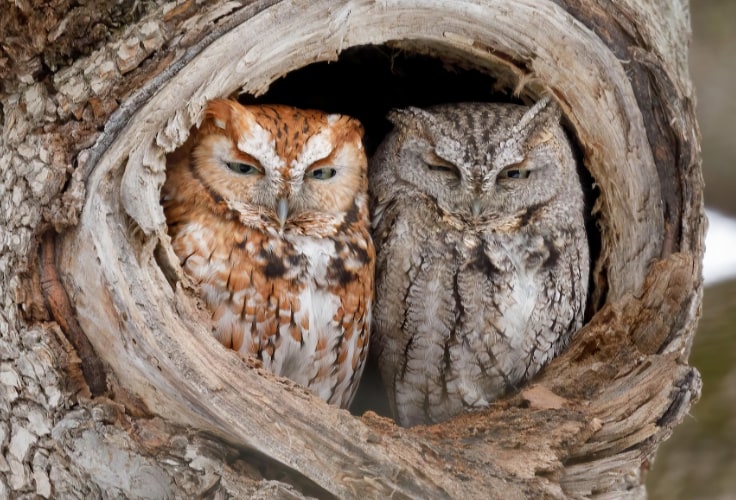
The Eastern Screech-Owl is the most regularly occurring small owl in Rhode Island and one of the most adaptable nocturnal birds in the state. The species measures 16 to 25 centimeters (6.3 to 9.8 inches) in length and has a compact body, broad head, short tail, and prominent ear tufts that give it a distinctive silhouette when perched. This owl occurs in two color forms, a gray phase and a russet red phase, both of which are well camouflaged against bark and shaded tree trunks, making perched birds surprisingly difficult to detect by sight.
In the field, Eastern Screech-Owls are far more often detected by sound than by appearance. Their vocal repertoire includes a sad, wavering descending call and a softer, rapidly repeated series of flute-like notes or barks that carry through wooded neighborhoods at night. Individuals usually hunt from low perches, making short, quick flights through the lower canopy, and they readily forage in human-altered settings such as yards and park edges. The diet is varied and includes invertebrates, small mammals, and small birds taken during brief hunting sallies.
In Rhode Island, this species lives year-round in open woodlands, parks, cemeteries, and suburban areas where mature trees provide natural cavities or nest sites. It is especially associated with mixed landscapes that combine tree cover with small open areas, allowing efficient foraging close to shelter. Eastern Screech-Owls do not migrate and remain on territory throughout the year, using the same general areas in all seasons. Within the state, the species is considered locally common where suitable tree cavities persist, but it can be limited by the removal of mature trees and competition for nesting sites in developed environments.
Barred Owl
Strix varia
- Identification: Large gray-brown owl with a rounded head, dark eyes, a well-defined facial disc, and brown-and-white barred and streaked plumage across the head, breast, and underparts.
- Where found: Year-round resident across Rhode Island in dense woodlands, especially mature forests near water such as swamps, rivers, and wet lowlands.
- How to spot: Listen at dusk or night for the familiar “Who cooks for you?” call, or look for a broad, rounded owl gliding silently through forest interiors or perched quietly in deep shade.
- Conservation status: Least Concern (IUCN); populations are increasing across much of New England, including areas adjacent to Rhode Island.

The Barred Owl is one of the most common and frequently heard owls in Rhode Island’s forests, especially in wooded areas associated with wetlands and riparian corridors. It measures 43 to 50 centimeters (16.9 to 19.7 inches) in length and has a large, broad-bodied build with a rounded head lacking ear tufts and dark brown eyes that give it a distinctly gentle expression. Plumage is gray-brown overall, with brown-and-white barring across the upper breast that transitions into strong vertical streaking on the belly and sides, creating a softly patterned appearance well suited to shaded forest interiors.
In the field, Barred Owls are most often detected by voice. Their classic two-part hooting call, commonly rendered as “Who cooks for you? Who cooks for you-all?,” carries long distances through dense woods and is frequently given from concealed perches. Although primarily active at dusk and during the night, individuals are sometimes active during daylight hours, particularly in overcast conditions. They hunt from elevated perches, watching for movement below, and use silent, buoyant flight to move through the forest while pursuing a varied diet that includes small mammals, birds, amphibians, and other vertebrates.
In Rhode Island, Barred Owls are year-round residents of dense woodlands, with a strong association with forests near water such as swamps, river floodplains, and wet forested lowlands. They favor mature or well-structured forests that allow easy movement beneath the canopy and provide large trees with cavities for nesting or roosting. Territories are maintained throughout the year, and pairs often occupy the same general area for long periods. In southern New England, including regions surrounding Rhode Island, monitoring data indicate increasing populations, suggesting the species is currently secure where suitable forest habitat remains intact.
Northern Saw-whet Owl
Aegolius acadicus
- Identification: Very small, round-headed owl with bright yellow eyes, brown upperparts spotted with white, and white underparts boldly streaked with brown.
- Where found: Migrant in Rhode Island, occurring mainly in coniferous forests and mixed woods during passage and the non-breeding season.
- How to spot: Listen at night for a softly whistled, endlessly repeated call, or look for a tiny owl roosting low in dense conifers, sometimes revealed by mobbing songbirds.
- Conservation status: Least Concern (IUCN); difficult to assess locally due to secretive habits, with dependence on intact forest structure and cavity availability.

The Northern Saw-whet Owl is the smallest owl recorded in Rhode Island and one of the most elusive. This tiny species measures 18 to 22 centimeters (7.1 to 8.7 inches) in length and has a compact body, a large rounded head without ear tufts, and striking yellow eyes set in a crisp facial disc. Plumage is rich brown above with white spotting on the crown, wings, and back, while the underparts are white with bold brown streaking, a pattern that helps break up the bird’s outline when roosting in shaded evergreens.
In the field, this species is far more often detected by sound than by sight. Its call in Rhode Island is described as a low, metallic or whistled note repeated steadily, sometimes likened to the sound of a saw being filed, and may be given for long periods at night. During the day, individuals roost silently in dense conifers, often close to the trunk and sometimes at surprisingly low heights, where they can be overlooked unless small birds give alarm calls. The owl hunts almost entirely at night, taking small mammals from low perches with quick, agile flights through the understory.
In Rhode Island, Northern Saw-whet Owls occur primarily as migrants and winter visitors, using coniferous forests and mixed woodlands as stopover and non-breeding habitat. A very small breeding presence is documented in the state, with scattered nesting records indicating occasional local breeding in suitable forested areas. The species favors dense evergreen cover for roosting, combined with nearby edges or openings for hunting. In the state, the Northern Saw-whet Owl is considered uncommon and easily overlooked, shaped by its secretive behavior and reliance on intact forest structure and cavity availability.
American Barn Owl
Tyto furcata
- Identification: Medium-sized owl with a pale, heart-shaped facial disc, long rounded wings, short tail, long sparsely feathered legs, and buff-and-gray upperparts contrasting with whitish underparts.
- Where found: Localized and mostly coastal in Rhode Island, occurring in open lowlands with farms, grasslands, salt marsh margins, and cliff faces, especially on Aquidneck Island and Block Island.
- How to spot: Look for a pale, ghostlike owl flying low over fields at night, or listen for harsh hisses, frightening screams, or clicking calls near barns, silos, and coastal bluffs.
- Conservation status: Least Concern (IUCN); listed as a Species of Greatest Conservation Need in Rhode Island due to severe local declines and highly restricted breeding distribution.

The American Barn Owl is Rhode Island’s most localized resident owl, restricted to a small number of coastal and agricultural landscapes. It measures 32 to 40 centimeters (12.6 to 15.7 inches) in length and has a slender, long-legged appearance unlike that of most other owls in the state. Plumage is warm buff and gray above, often lightly mottled or speckled, contrasting sharply with a whitish face, chest, and underparts that give the species a ghostly appearance in low light. The head is large and rounded, with no ear tufts, dark eyes set within a complete heart-shaped facial disc, and long, softly rounded wings that contribute to its buoyant flight style.
In the field, the species is most often detected by its distinctive voice. Barn owl vocalizations differ markedly from the hoots of other North American owls and include eerie hisses, harsh screams, and series of clicking or rasping sounds, often given near roosting or nesting sites. When seen, American Barn Owls typically fly low over open ground with slow, buoyant wingbeats, quartering fields and marsh edges while hunting. They rely heavily on sound to locate prey and feed primarily on small mammals, especially rodents, which are captured during low hunting flights or brief plunges into vegetation.
In Rhode Island, the American Barn Owl has a very limited and localized distribution, strongly tied to open coastal lowlands and agricultural landscapes. Current breeding and regular occurrence are concentrated on Aquidneck Island and Block Island, where farms, old buildings, silos, and sea cliffs provide suitable nesting and roosting sites. On Block Island, individuals are known to nest both in abandoned structures and in burrows excavated into coastal bluffs. On the mainland, the species is now nearly absent, with only scattered records, most occurring within about five miles of the coast. The owl is largely resident where it persists in the state, with no evidence of regular long-distance migration.
Historically, American Barn Owls expanded in Rhode Island during the early to mid-20th century, becoming fairly common in coastal towns such as Bristol, Tiverton, and Little Compton, before declining sharply by the mid-1980s as development reduced open farmland and nesting opportunities. Today, the species is listed as a Species of Greatest Conservation Need in Rhode Island, with conservation efforts focused on grassland management, wetland and salt marsh restoration, and nest-box programs, particularly on Aquidneck Island, where volunteer-led initiatives have helped maintain a small but persistent breeding population.
Short-eared Owl
Asio flammeus
- Identification: Medium-sized owl with a pale facial disc, black-rimmed yellow eyes, mottled brown-and-buff upperparts, streaked whitish to rusty underparts, and broad wings showing a dark mark at the wrist in flight.
- Where found: Winter visitor in Rhode Island, occurring mainly in open coastal habitats such as marshes, fields, and open woodlands.
- How to spot: Watch at dawn or dusk for a low, buoyant, mothlike flight over open ground, often with uneven flapping and short glides; usually silent except during courtship.
- Conservation status: Least Concern (IUCN); uncommon locally and dependent on the availability of extensive open habitats during winter.

The Short-eared Owl is an irregular but distinctive winter owl in Rhode Island, notable for its preference for open landscapes and its tendency to fly during daylight hours. It measures 34 to 43 centimeters (13.4 to 16.9 inches) in length and has a rounded head with very small, often inconspicuous ear tufts, large yellow eyes, and a pale facial disc outlined by darker markings around the eyes. The body appears slim in flight, with long, broad wings adapted for sustained low-level foraging over open terrain.
In the field, this species is most often recognized by its flight behavior. Individuals hunt by coursing low over fields, marshes, and open coastal areas with an uneven pattern of flapping and gliding, sometimes hovering briefly before dropping toward prey. Activity peaks at dawn and dusk, though birds may also be seen during the day, especially in winter. Short-eared Owls are typically silent in Rhode Island, but during courtship elsewhere they can produce a range of clucks, barks, and squeals. Their diet consists mainly of small mammals taken during low, searching flights.
In Rhode Island, the Short-eared Owl occurs as a winter visitor, with most records concentrated along the coast. It is regularly reported from places such as Sachuest Point National Wildlife Refuge in Middletown and other coastal locations that provide extensive open ground. Preferred habitats include coastal marshes, open fields, and lightly wooded open areas that support small-mammal populations. The species does not breed in the state and is present mainly from late fall through early spring. Within Rhode Island, it is considered uncommon and localized, closely tied to the preservation of large, undisturbed open habitats along the coast.
Long-eared Owl
Asio otus
- Identification: Medium-sized, slender owl with long, upright ear tufts, yellow eyes, a buff facial disc with white eyebrows, mottled brown-and-buff upperparts, and streaked whitish to buff underparts.
- Where found: Uncommon visitor in Rhode Island, occurring mainly in coniferous forests close to open fields and other open country.
- How to spot: Listen at night for a soft, dove-like, three-syllable hoot, or search dense evergreen cover near open areas for well-camouflaged roosting birds.
- Conservation status: Least Concern (IUCN); considered of conservation concern across much of New England, with local occurrence limited and irregular.

The Long-eared Owl is a secretive and infrequently encountered owl in Rhode Island, recognized by its tall ear tufts and slim, elongated profile. It measures 35 to 40 centimeters (13.8 to 15.7 inches) in length and has a compact body, long rounded wings, and densely feathered legs, features that suit agile flight through dense vegetation. Plumage is intricately patterned in browns, buffs, and grays, with a buff facial disc marked by pale vertical lines between the eyes, allowing the bird to blend closely with tree trunks and shaded foliage.
In the field, this species is far more often detected by sound than by sight. The typical call heard in Rhode Island is a soft, dove-like hoot with a three-syllable rhythm, given mainly at night. During daylight hours, Long-eared Owls roost quietly in dense conifers, often close to the trunk, where their narrow shape and cryptic coloration provide excellent concealment. At dusk they emerge to hunt, flying low over nearby open ground with long glides and slow, deep wingbeats while searching for small mammals.
In Rhode Island, the Long-eared Owl occurs as an uncommon winter visitor and migrant, favoring coniferous forests situated near open fields, grasslands, or shrublands that provide suitable hunting areas. Its presence is typically seasonal and irregular, reflecting broader movements across the northeastern United States rather than consistent local breeding. Use of the state appears limited to areas where dense evergreen cover and open foraging habitat occur in close proximity. Overall, the species remains uncommon and easily overlooked in Rhode Island and is considered of conservation concern across much of New England, with local occurrence limited and irregular due to its reliance on dense roosting cover near suitable open hunting habitat.
Snowy Owl
Bubo scandiacus
- Identification: Large white owl with yellow eyes, a rounded head, and variable dark barring that is heavy on females and young birds and often minimal on older males.
- Where found: Irregular winter visitor in Rhode Island, occurring mainly along the coastline in open habitats such as beaches, dunes, salt marshes, and coastal fields.
- How to spot: Scan wide, open coastal areas in winter for a pale owl perched on the ground, dunes, rocks, or posts, or watch for low, buoyant flights over shorelines.
- Conservation status: Vulnerable (IUCN); global populations are declining, and wintering birds in Rhode Island are susceptible to disturbance and other human-related pressures.

The Snowy Owl is the state’s most iconic winter owl, appearing as a ghostly visitor from the High Arctic during some winters. It measures 52 to 71 centimeters (20.5 to 28.0 inches) in length and is a very large, powerful owl with a broad, rounded head and long wings. Plumage is predominantly white, but most individuals show varying amounts of dark barring or spotting on the breast, back, and wings; females and younger birds are noticeably darker than adult males. Bright yellow eyes stand out against the pale face, and the legs and feet are densely feathered, giving the impression of thick “snowshoes.”
Unlike most owls, Snowy Owls are frequently active during daylight hours, especially in winter. They often perch conspicuously on the ground, low dunes, rocks, fence posts, or other exposed sites while scanning for prey, rather than hiding in cover. Flight appears slow and buoyant, with steady wingbeats when moving between perches or hunting areas. Vocalizations are infrequently heard in Rhode Island, but can include hoarse hoots, growling barks, or sharp whistles, particularly from stressed or disturbed birds. In coastal New England, wintering Snowy Owls feed heavily on birds as well as mammals, reflecting local prey availability.
In Rhode Island, Snowy Owls occur only in winter and are most often found along the coast. Regular viewing locations include Sachuest Point National Wildlife Refuge, which has a long-standing reputation as the most reliable site in the state, as well as Beavertail Point State Park, Trustom Pond National Wildlife Refuge, Camp Cronin, and shoreline areas around Misquamicut Beach, Watch Hill, and Napatree Point. Occurrence varies greatly from year to year, with some winters producing only a few individuals and others associated with broader irruptions across the Great Lakes and New England. In Rhode Island, the species is an uncommon but regular winter visitor, and its successful overwintering depends heavily on adequate prey and minimal disturbance in open coastal habitats.
Where and When to See Owls in Rhode Island
Owls can be found in Rhode Island throughout the year, but their visibility and distribution vary widely by species and season. Forest-dwelling residents such as Great Horned Owls and Barred Owls occur year-round and are most often detected by their calls at dusk and during the night in wooded areas, especially near wetlands or forest edges. Eastern Screech-Owls are also permanent residents, favoring parks, suburban neighborhoods, and open woodlands with mature trees and cavities, where their soft, descending calls are often heard on calm nights.
Other species are seasonal or irregular visitors tied closely to open habitats. Short-eared Owls and Snowy Owls appear mainly in winter, most reliably along the coast in open marshes, beaches, dunes, and fields, where they may be active during daylight hours. Northern Saw-whet Owls and Long-eared Owls are far more secretive, occurring primarily as migrants or winter visitors and favoring dense coniferous cover near open ground; they are most often detected by voice rather than sight. Across all species, late fall through early spring offers the greatest diversity of owls in the state, and patient listening, respectful distance, and attention to habitat are the keys to successful owl observation in Rhode Island.
