
Ontario supports 11 species of owls, reflecting the province’s wide range of habitats and climatic zones. These include widespread residents, highly localized boreal specialists, and rare visitors that occur only under specific conditions. This guide provides identification notes and Ontario-specific context on habitat, distribution, and seasonal occurrence for owl species found in the province.
Great Horned Owl
Bubo virginianus
- Identification: Large, powerful owl with broad wings, prominent ear tufts, a white throat patch, and striking yellow eyes, showing a mottled mix of brown, buff, and black.
- Where found: Widespread and year-round throughout Ontario, from southern agricultural and suburban landscapes to northern boreal forests near the treeline.
- How to spot: Listen for deep, multi-note hoots after dusk or watch for a thick-bodied owl perched on exposed limbs or flying with steady, deliberate wingbeats along field edges.
- Conservation status: Least Concern (IUCN); generally common, but declining in parts of southern Ontario due to habitat change and secondary poisoning.
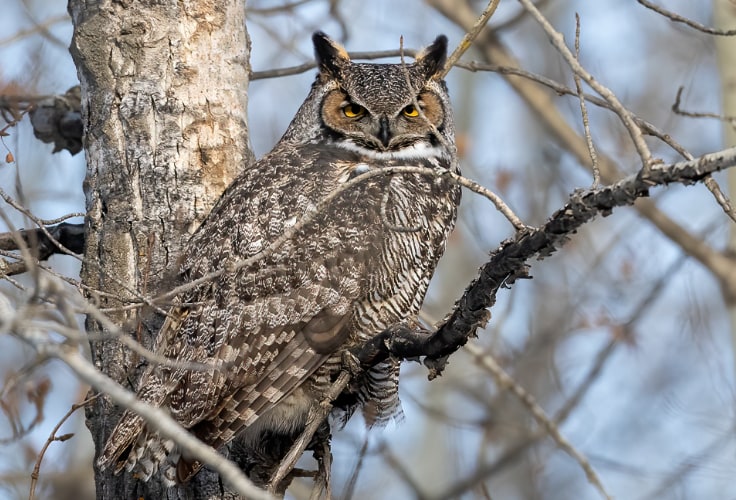
The Great Horned Owl is the most widespread and familiar large owl in Ontario and remains the species most likely to be encountered across the province. It measures 46 to 63 centimeters (18.1 to 24.8 inches) in length and shows a heavy, muscular build with a broad head, prominent ear tufts, and large yellow eyes set within a well-defined facial disc. Plumage is strongly mottled in brown, buff, gray, and black, with a crisp white throat patch that is often visible in low light. Ontario birds show relatively dark, earthy tones typical of eastern forest populations.
In the field, Great Horned Owls are often detected by sound before they are seen. Their deep, resonant hooting is a classic nighttime sound in Ontario, commonly delivered as a slow series of four to six notes and frequently heard during late winter and early spring. Individuals typically perch upright on exposed branches, utility poles, or fence posts, scanning open ground for prey. Flight is strong and purposeful, combining deep wingbeats with short glides while the wings are held nearly flat. The species hunts mainly mammals and birds, using perch-and-pounce tactics, low hunting flights, or ground strikes, and may be active at dusk, dawn, or occasionally during the day.
The species occupies an exceptionally broad range of habitats across the province. It is a permanent resident from the agricultural lowlands and suburban mosaics of the south through mixed forests, wetlands, and rocky landscapes of the Canadian Shield, extending north to the forest-tundra transition of the Hudson Bay Lowlands. Great Horned Owls favor areas that combine trees for nesting and roosting with nearby open spaces that support abundant prey. Breeding occurs throughout the province, though records become less frequent with increasing latitude, reflecting both lower densities and reduced survey coverage in remote northern regions. Individuals remain resident year-round and do not undertake seasonal migrations.
Despite its adaptability, the Great Horned Owl has shown regional declines in parts of southern Ontario over recent decades. These declines are most evident in heavily modified agricultural and developing regions, where intensification of land use reduces early-successional habitats and prey availability. Secondary poisoning from rodenticides, collisions with vehicles, and occasional persecution also contribute to local losses. In contrast, the species remains widespread and stable across much of central and northern Ontario, and its ability to use suburban landscapes with mature trees and open green spaces continues to support its persistence across the province.
Barred Owl
Strix varia
- Identification: Large gray-brown owl with a rounded head, dark eyes, a well-defined facial disc, and brown-and-white barred and streaked plumage across the head, breast, and underparts.
- Where found: Resident year-round across much of Ontario, most widespread in mixed and mature forests of central and southern regions, with sparser occurrence farther north.
- How to spot: Listen at dusk or night for the distinctive “Who cooks for you?” call, or look for a broad, rounded owl gliding quietly through forest interiors or roosting motionless on shaded branches.
- Conservation status: Least Concern (IUCN); populations increasing in Ontario overall, reflecting forest recovery, though dependent on large tracts of mature woodland.

The Barred Owl is one of the most recognizable forest owls in Ontario, best known for its far-carrying voice that resonates through wooded landscapes. The species measures 43 to 50 centimeters (16.9 to 19.7 inches) in length and has a broad, rounded body with a large head lacking ear tufts, deep brown eyes, and a pale yellow bill set within a full facial disc. Plumage is a soft mix of gray-brown and buff, with horizontal brown barring across the upper breast that transitions into bold vertical streaking on the belly and sides, creating effective camouflage against tree bark and deep forest shade.
Barred Owls are most often detected by their vocalizations rather than by sight. The classic two-part hoot, commonly rendered as “Who cooks for you? Who cooks for you-all?,” is frequently heard during evening and nighttime hours and is used in territorial defense and pair communication. Birds usually roost quietly during the day in dense cover and become active at dusk, flying with slow, buoyant wingbeats through forest corridors. They hunt primarily from elevated perches, watching for prey that includes small mammals, birds, amphibians, and other forest-dwelling animals, and may pursue prey on the ground, in shallow water, or beneath snow.
In Ontario, the Barred Owl is closely tied to extensive forest cover. It is most widespread in the mixed and deciduous-coniferous forests of central and southern Ontario, particularly across the Canadian Shield and well-forested lowlands. Occurrence becomes more scattered northward, where suitable habitat is more continuous but less frequently surveyed. The species favors mature and old forests with large trees for nesting and an open understory that allows unobstructed flight, often near swamps, rivers, or wooded wetlands. Individuals maintain territories year-round and do not migrate.
The Barred Owl has increased markedly in Ontario over recent decades, reflecting forest regeneration and the expansion of mature woodland across parts of the province. This trend contrasts with its historical scarcity in heavily cleared southern landscapes during earlier periods of intensive agriculture. Today, the species is well established and continues to spread into recovering forest regions. Its long-term success depends on the availability of large, unfragmented forests with suitable nesting cavities, making extensive logging and habitat fragmentation the primary concerns at a local scale.
Eastern Screech-Owl
Megascops asio
- Identification: Small, stocky owl with prominent ear tufts, yellow eyes, and gray or rufous plumage marked with intricate bars and spots that provide excellent camouflage against tree bark.
- Where found: Resident year-round in southern Ontario, most common south of the Canadian Shield in wooded, suburban, and edge-rich landscapes, and increasingly scarce northward.
- How to spot: Listen at night for its distinctive monotonic trills or descending whinnies, or watch for a small owl peering from tree cavities or nest boxes near wooded neighborhoods.
- Conservation status: Least Concern (IUCN); populations increasing in Ontario overall, reflecting adaptability to human-modified landscapes, though dependent on cavity availability.

The Eastern Screech-Owl is one of the smallest owls in the region and among the most adaptable raptors in North America. It measures 16 to 25 centimeters (6.3 to 9.8 inches) in length and shows a compact, broad-headed shape with prominent ear tufts, bright yellow eyes, and a short, square tail. Plumage occurs in gray and rufous color morphs, with gray predominating in Ontario, and is patterned with fine bars, streaks, and spots that closely resemble tree bark, making perched birds extremely difficult to detect by sight alone. Its tolerance of both natural and human-altered habitats makes it a familiar presence in suitable landscapes.
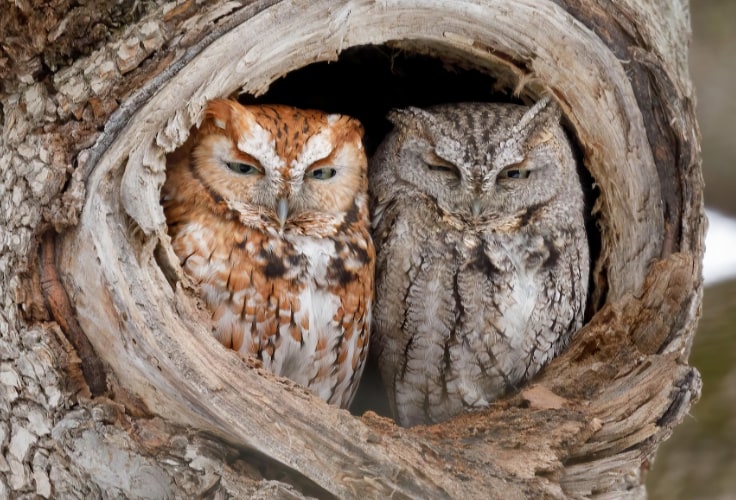
Eastern Screech-Owls are far more often heard than seen. Their most characteristic vocalizations include a steady, monotonic trill used for close-range communication and a descending whinny associated with territorial defense, both of which carry clearly through wooded neighborhoods and forest edges at night. Individuals become active at dusk and move through the lower canopy with quick, direct flights, often hunting from low perches. They feed on a wide variety of prey, including insects, small mammals, birds, and other small vertebrates, and readily exploit lawns, orchards, riparian corridors, and areas around buildings where prey is concentrated.
In Ontario, the species is largely confined to the southern part of the province. It is common south of the Canadian Shield, particularly in southwestern Ontario and along the Lake Erie and Lake Ontario corridors, where mixed woodlots, riparian trees, orchards, and suburban greenspaces provide suitable nesting and foraging conditions. Occurrence becomes increasingly local and scattered north of the Shield, with only sparse records farther into central Ontario. The Eastern Screech-Owl is a permanent resident and does not migrate, maintaining territories year-round within relatively small home ranges.
The species has shown a clear increase in Ontario over recent decades, especially across its core southern range. This positive trend is associated with its ability to use nest boxes, tolerate urban and suburban environments, and exploit a broad diet. Despite this overall increase, the Eastern Screech-Owl remains dependent on the availability of tree cavities and is vulnerable locally to loss of mature trees, competition for nesting sites, and collisions with vehicles. Continued retention of cavity-bearing trees and responsible placement of nest boxes support the long-term stability of this species in Ontario.
Northern Saw-whet Owl
Aegolius acadicus
- Identification: Very small, round-headed owl with a catlike face, bright yellow eyes, brown upperparts spotted with white, and white underparts boldly streaked with brown.
- Where found: Widespread but unevenly distributed across Ontario, breeding mainly in forested regions from the southern Shield northward, with more localized presence in the south.
- How to spot: Listen at night from late winter through spring for a sharp, repetitive “too-too-too” call, or watch for small songbirds mobbing a silent owl roosting low in dense conifers.
- Conservation status: Least Concern (IUCN); populations fluctuate regionally, with declines noted in parts of central Ontario and dependence on mature forest structure and nesting cavities.

The Northern Saw-whet Owl is the smallest owl regularly encountered in Ontario and one of the most secretive forest species in the province. This miniature species measures 18 to 22 centimeters (7.1 to 8.7 inches) in length and shows a compact body, a large rounded head without ear tufts, and striking yellow eyes set in a crisp facial disc. Plumage is rich brown above with white spotting across the crown, wings, and back, while the underparts are white with bold brown streaking, creating strong contrast at close range but excellent camouflage in forest shade. Its small size, nocturnal habits, and preference for dense cover make it far less conspicuous than larger owls.
Northern Saw-whet Owls are most often detected by sound rather than sight. The primary advertising call is a high, sharp, repetitive “too-too-too,” delivered at a steady pace and most frequently heard from late winter into early spring. During the day, individuals roost motionless in dense conifers or thick understory, often close to the trunk and sometimes just above eye level, where they may be discovered only when mobbed by small birds. Flight is quick and agile, with rapid wingbeats and low, direct movements through the understory. Hunting occurs almost entirely at night, with prey taken from low perches along forest edges, clearings, and openings.
In Ontario, the Northern Saw-whet Owl breeds across much of the province but shows a distinctly uneven distribution. It is widespread through the Southern and Northern Shield regions and extends north into boreal forest zones approaching the southern edge of James Bay. In southern Ontario, the species is more localized and generally uncommon, with the southernmost breeding records now restricted to limited areas near the north shores of Lake Erie and Lake Ontario. The owl occupies a variety of forest types but is most closely associated with coniferous and mixed forests that provide dense roosting cover and suitable cavities. Many individuals migrate south in autumn, and large numbers pass through Ontario, particularly along the Great Lakes, while some remain resident year-round.
Across the province, Northern Saw-whet Owl numbers show considerable regional and annual variation. Declines have been documented in parts of central Ontario, particularly along the southern edge of the Shield and in eastern regions, while occurrence has increased in northern areas, likely influenced by shifting prey availability and variable detection. The species is strongly tied to small-mammal cycles, and reduced prey abundance can lead to lower calling rates and reduced breeding activity. Loss of mature forest structure and standing dead trees further limits nesting opportunities. Despite these challenges, the Northern Saw-whet Owl remains widespread in Ontario, with its long-term status closely linked to forest condition, prey dynamics, and the retention of cavity-bearing trees.
Snowy Owl
Bubo scandiacus
- Identification: Large white owl with yellow eyes, a rounded head, and variable dark barring that is heaviest on females and young birds and minimal on older males.
- Where found: Winter visitor to Ontario, occurring mainly from late fall through early spring in open landscapes such as shorelines, fields, tundra-like flats, and airport grounds.
- How to spot: Scan wide, open areas for a pale owl perched on the ground, posts, or dunes, or watch for low, buoyant flights over exposed terrain.
- Conservation status: Vulnerable (IUCN); global declines linked to Arctic prey cycles, climate-driven habitat change, and elevated winter mortality.

The Snowy Owl is one of the most iconic birds to appear in Ontario and the heaviest owl species in North America. This large owl measures 52 to 71 centimeters (20.5 to 28.0 inches) in length and has a powerful, broad-bodied build adapted to life in open Arctic environments. Plumage ranges from nearly pure white in older males to heavily barred white-and-brown patterns in females and younger birds, with bright yellow eyes and a broad, rounded head creating a striking appearance. Winter incursions into Ontario often attract widespread attention, as the species is conspicuous and active by day in open settings.

Snowy Owls differ from most other owls in being strongly diurnal, especially on their Arctic breeding grounds, and they remain active by day during winter in Ontario. Individuals frequently perch in full view on the ground, shoreline rocks, hay bales, fence posts, buildings, or dunes, using elevated vantage points to scan for prey. Flight appears slow and buoyant, with deep wingbeats and long glides, though it becomes fast and direct when chasing birds or responding to disturbance. Vocalizations are rarely heard in Ontario, but include deep hoots and sharp barks associated with territorial or defensive behavior on the breeding grounds.
This species breeds across the circumpolar Arctic, nesting on open tundra and coastal plains where lemmings and voles are abundant. In Ontario, the Snowy Owl is strictly a non-breeding visitor, with regular occurrence from October through April and only rare summer records in the far north. Wintering birds are most frequently found along the Great Lakes, especially Lake Ontario and Lake Erie shorelines, as well as in extensive agricultural fields, airports, coastal dunes, and other treeless landscapes that resemble tundra. Numbers vary greatly from year to year, with some winters bringing only scattered individuals and others producing dramatic irruptions across southern Ontario.
Snowy Owl populations fluctuate widely with Arctic prey cycles and show a long-term declining trend. Monitoring is challenging due to the remoteness of breeding areas, but available evidence indicates reduced numbers over recent decades. Climate-driven changes in Arctic ecosystems, altered prey availability, and increased exposure to hazards during winter contribute to these declines. In Ontario, wintering owls face risks from vehicle collisions, starvation during prey shortages, and interactions with human infrastructure. Despite these pressures, irruptive winters remain a defining natural event, offering rare opportunities to observe this Arctic predator far south of its breeding range.
Long-eared Owl
Asio otus
- Identification: Medium-sized, slender owl with long, upright ear tufts, yellow eyes, a buff facial disc with pale eyebrows, mottled brown-and-buff upperparts, and streaked whitish to buff underparts.
- Where found: Widespread but elusive across Ontario, breeding in forested areas adjacent to open fields and wintering locally or moving south depending on prey availability.
- How to spot: Listen at night in spring for quiet, low hoots, or search dense conifers and shelterbelts in winter for roosting birds, pellets, or whitewash near open ground.
- Conservation status: Least Concern (IUCN); populations are difficult to assess, with regional variability linked to habitat change and fluctuating prey cycles.

The Long-eared Owl is one of Ontario’s most secretive owls, recognized by its tall ear tufts and slim, elongated profile. It measures 35 to 40 centimeters (13.8 to 15.7 inches) in length and shows long, rounded wings, densely feathered legs, and a compact body adapted for agile flight. Plumage is intricately patterned in browns, buffs, and grays, with a buff facial disc marked by contrasting pale vertical lines between the eyes, dark lores, and a dusky bill. The underparts appear pale with strong dark streaking, while the upperwings show a small buff patch near the bend of the wing, helping distinguish perched birds at close range.
Long-eared Owls are far more often detected by sound than by sight. During the breeding season, males give long, evenly spaced series of soft, low hoots that can carry considerable distances on calm nights. By day, individuals roost motionless in dense foliage, usually close to tree trunks, where their narrow shape and cryptic plumage make them extremely difficult to locate. At dusk and during the night, they hunt low over open ground with slow, buoyant wingbeats and long glides, using acute hearing to locate small mammals and occasionally switching between coursing flight and perch hunting.
In Ontario, this species uses a mosaic of habitats rather than extensive forest alone. It breeds across much of the province, from southern agricultural landscapes to northern forest regions, wherever dense trees or shrubs for nesting and roosting occur near open foraging areas such as fields, meadows, marsh edges, or open woodland. Occurrence is widespread but uneven, with frequent turnover at breeding sites from year to year, reflecting sensitivity to local prey abundance. In winter, many individuals leave the province, while others remain, forming communal roosts in conifer stands, shelterbelts, or riparian groves.
The Long-eared Owl remains one of the least well understood owls in Ontario due to its nocturnal habits, low detectability, and nomadic tendencies. Records suggest it is sparsely distributed wherever it occurs, with regional increases and decreases influenced by changing land use, forest cover, and vole cycles. Loss of small woodlots, hedgerows, and riparian trees reduces available nesting and roosting sites, while intensive agriculture can limit prey availability. Despite these pressures, the species continues to breed widely across Ontario, its long-term status closely tied to the maintenance of wooded cover within open landscapes.
Short-eared Owl
Asio flammeus
- Identification: Medium-sized owl with a pale facial disc, black-rimmed yellow eyes, mottled brown-and-buff upperparts, streaked whitish to rusty underparts, and broad wings marked with a dark comma at the wrist.
- Where found: Uncommon and irregular in Ontario, occurring mainly in open habitats, with breeding concentrated in the Hudson Bay Lowlands and scattered use of open areas elsewhere.
- How to spot: Watch open fields, wetlands, or tundra-like landscapes at dawn, dusk, or during the day for a buoyant, mothlike flight low over vegetation, or for birds perched directly on the ground.
- Conservation status: Least Concern (IUCN); populations have declined across Canada and Ontario, primarily due to grassland loss, habitat fragmentation, and reduced small-mammal prey.

The Short-eared Owl is one of the most distinctive open-country owls to occur in Ontario and among the few species regularly active in daylight. This species measures 34 to 43 centimeters (13.4 to 16.9 inches) in length and shows a rounded head with very small, usually inconspicuous ear tufts, large yellow eyes outlined by dark patches, and long, broad wings adapted for sustained low flight. Plumage is a mottled blend of brown and buff above, with paler underparts marked by dark vertical streaking, creating effective camouflage in grasslands and wetlands while remaining strikingly visible in flight.
Short-eared Owls are most often detected by their flight behavior rather than by voice. They hunt by coursing low over open ground with slow, buoyant wingbeats and frequent glides, often changing direction abruptly as they track prey. Individuals may hover briefly when pinpointing small mammals, especially voles, which form the bulk of their diet. Activity peaks at dawn and dusk, but birds are frequently active during the day, particularly in winter or during the breeding season. Vocalizations are infrequently heard in Ontario, though soft hoots may occur during spring courtship displays.
In Ontario, the species shows a highly uneven distribution. Breeding is most strongly associated with the Hudson Bay Lowlands, where extensive tundra-like wetlands provide suitable habitat, and occurrence elsewhere in the province is sparse and localized. Away from the far north, Short-eared Owls appear irregularly in large marshes, open agricultural landscapes, grasslands, and reclaimed or disturbed sites such as clearcuts and abandoned fields. Many individuals observed in southern Ontario are migrants or winter visitors, with movements closely tied to fluctuations in small-mammal populations. The species nests on the ground in open, treeless habitats, making site use highly sensitive to local conditions.
Short-eared Owl populations in Ontario are difficult to assess due to their nomadic behavior and low detectability, but long-term trends indicate decline. Loss and fragmentation of open habitats, changes in agricultural practices, and reductions in vole populations have reduced breeding opportunities across much of the province. While the extensive, relatively intact habitats of the Hudson Bay Lowlands continue to support the core of Ontario’s population, the species remains rare and irregular elsewhere. Its continued presence in the province depends on the conservation of large, undisturbed open landscapes and the maintenance of healthy small-mammal populations.
Great Gray Owl
Strix nebulosa
- Identification: Very large gray owl with a broad, rounded head, long tail, fine gray-brown barring and streaking, and a large circular facial disc marked with pale arcs and a white “bow tie.”
- Where found: A resident breeder across northern Ontario’s boreal forests, with irregular winter movements that occasionally bring birds south into central and southern regions.
- How to spot: Look for a massive gray owl perched on low branches along meadow or bog edges, or watch for slow, buoyant flight at dawn or dusk.
- Conservation status: Least Concern (IUCN); populations fluctuate with prey cycles and are locally sensitive to habitat change, though generally stable at broad scales.

The Great Gray Owl is Ontario’s largest owl by body length and a species many observers hope to encounter. It measures 61 to 84 centimeters (24.0 to 33.1 inches) in length and presents an imposing silhouette created by dense, insulating plumage rather than exceptional body mass. The broad, rounded head is dominated by an enormous facial disc patterned with concentric pale and dark rings, accented by white lores and a bold white throat “bow tie.” Plumage is predominantly gray with fine streaking and barring that softens the bird’s outline and allows it to blend into boreal forest shadows.
In the field, Great Gray Owls often appear calm and motionless, perching quietly on low to mid-level branches, broken snags, or forest edges overlooking open ground. Flight is slow, buoyant, and deliberate, with deep wingbeats and long glides that recall the movement of a large heron. Vocalizations are seldom heard in Ontario but include a series of low, evenly spaced hoots given near breeding territories. The species hunts primarily from perches, relying on exceptional hearing to locate small mammals beneath snow, often plunging feet-first through deep or crusted layers to seize concealed prey.
In Ontario, the Great Gray Owl is closely associated with the boreal forest zone. Breeding occurs across much of northern Ontario, particularly from the Lake Superior and Lake Huron regions northward to Hudson Bay, with the highest concentration of records in the northwest. The species favors mature coniferous or mixed forests interspersed with open habitats such as meadows, bogs, muskeg, and forest clearings that support high vole densities. During some winters, prey shortages in the north trigger southward movements, bringing individuals into the Southern Shield and, more rarely, into well-forested parts of southern Ontario.
The species remains a low-density and irregularly encountered owl in Ontario, with occurrence closely tied to prey availability. Apparent increases in some regions often coincide with irruptive years rather than sustained population growth. Loss of suitable forest structure, changes in prey populations, and disturbance near nesting areas can affect local breeding success. Despite these challenges, the Great Gray Owl continues to occupy much of its historical range in northern Ontario and persists as one of the province’s most emblematic and sought-after boreal owls.
Boreal Owl
Aegolius funereus
- Identification: Small, large-headed owl with a grayish-white facial disc bordered in brown, bright yellow eyes, brown upperparts marked with white spots, and white underparts heavily streaked with brown.
- Where found: Resident of northern Ontario’s boreal forests, occurring mainly across the Shield and rarely wandering south in years of low prey availability.
- How to spot: Listen on late-winter nights for the male’s rapid, hollow series of hoots, or search dense conifers for a small owl roosting close to tree trunks.
- Conservation status: Least Concern (IUCN); populations are difficult to assess and fluctuate with small-mammal cycles, with sensitivity to habitat alteration in boreal forests.

The Boreal Owl is one of the least frequently encountered owls in the province, occupying remote northern forests and remaining active almost exclusively at night. This elusive species measures 21 to 28 centimeters (8.3 to 11.0 inches) in length and has a compact body, a disproportionately large head, and a short tail that gives the species a square, heavy-headed appearance. Plumage is brown above with prominent white spotting on the crown, back, and wings, while the underparts are pale and boldly streaked, providing effective camouflage among spruce and fir trunks in dim forest light.
Boreal Owls are highly nocturnal and are usually detected by sound rather than sight. During late winter and early spring, males advertise territories with a rapid, hollow series of hoots that carry through dense forest at night. By day, individuals roost quietly in cavities or thick conifer cover, often close to the trunk and well hidden. Hunting is typically conducted from low to mid-level perches, with short, direct flights between trees and quick downward strikes on prey. Small mammals form the bulk of the diet, and activity levels often track fluctuations in vole abundance.
In Ontario, the species is closely tied to the boreal forest zone. Most records come from the Northern Shield, particularly in northwestern and northeastern regions where extensive coniferous and mixed forests persist. Occurrence south of this core range is sparse and irregular, with occasional records from the Southern Shield and rare winter appearances farther south during years of prey scarcity. Although a year-round resident, some individuals, especially females and young birds, may move nomadically in response to changing food availability.
The Boreal Owl remains difficult to monitor in Ontario due to its remote distribution, nocturnal habits, and early breeding season. Apparent changes in occurrence over time are often influenced by survey effort rather than true population shifts. Numbers fluctuate naturally with small-mammal cycles, and local abundance can vary widely between years. Maintenance of large tracts of mature boreal forest with abundant tree cavities is essential for the species’ continued presence, and long-term trends will remain uncertain until more comprehensive nocturnal monitoring is available.
Northern Hawk-Owl
Surnia ulula
- Identification: Medium-sized owl with a long tail, short pointed wings, brown upperparts spotted with white, a narrowly bordered facial disc, and white underparts with heavy brown barring.
- Where found: Primarily a boreal species in Ontario, most regular in the far north, with irregular winter movements into more southern parts of the province.
- How to spot: Look for a boldly perched, diurnal owl atop treetops scanning open ground, or watch for fast, low flights with deep, falcon-like wingbeats.
- Conservation status: Least Concern (IUCN); generally uncommon in Ontario, with numbers fluctuating strongly due to prey cycles and irruptive movements.

The Northern Hawk-Owl is a distinctive species in Ontario, notable for its hawk-like appearance and regular daytime activity. This unusual owl measures 36 to 45 centimeters (14.2 to 17.7 inches) in length and has a compact, thickset body, a long, tapered tail, and short, pointed wings that set it apart from most other owls in the province. Its upright posture and tendency to perch conspicuously on treetops give it a striking silhouette against open boreal landscapes. Plumage is characterized by brown upperparts with bold white spotting and strongly barred white underparts.
In the field, Northern Hawk-Owls are most readily identified by behavior. Individuals hunt primarily by sight, often during full daylight, scanning open ground from exposed perches before launching into rapid, direct flights. Their flight is fast and purposeful, with deep wingbeats reminiscent of a falcon, followed by abrupt plunges toward prey. The species feeds mainly on small mammals, especially voles and mice, and will also take birds when available. Vocalizations are varied but infrequently heard in Ontario; during the breeding season, adults may give long trills or sharp calls near nest sites, while fledged young are conspicuous by persistent begging calls.
In Ontario, the Northern Hawk-Owl is closely associated with the boreal zone. It is most regularly found in the Hudson Bay Lowlands and the Northern Shield, where it occupies open or sparsely treed coniferous forests, burns, boggy spruce flats, fens, and extensive clearcuts with grassy ground cover. Breeding occurs mainly in these northern regions, where the species nests in tree cavities near open hunting areas. South of the boreal forest, occurrences are sporadic and largely tied to winter irruptions, during which individuals may appear temporarily in central and even southern Ontario. A small number of breeding attempts have been documented well south of the typical range following such irruptive winters, but these events remain exceptional.
The species remains a relatively uncommon and irregular owl across the province. Its apparent abundance can increase dramatically during irruptive periods, followed by retreats back to far-northern regions as prey conditions stabilize. Long-term population trends are difficult to assess due to low densities, northern distribution, and strong year-to-year fluctuations. The species appears stable at a national scale and remains within conservation targets, but in Ontario it depends heavily on intact boreal habitats and healthy small-mammal populations. Large-scale forest clearing and changes to boreal landscapes may reduce suitable nesting sites and hunting perches locally, though vast northern regions continue to support the core of the provincial population.
American Barn Owl
Tyto furcata
- Identification: Medium-sized owl with a pale, heart-shaped facial disc, long rounded wings, a short tail, long sparsely feathered legs, and buff-and-gray upperparts contrasting with whitish underparts.
- Where found: Extremely rare and highly localized in Ontario, restricted to the far south of the province in open agricultural landscapes.
- How to spot: Most often detected by its harsh, rasping scream at night or by a ghostly pale owl flying low over fields near barns or other large structures.
- Conservation status: Least Concern (IUCN); Endangered in Ontario, with severe declines linked to habitat loss, loss of nesting structures, road mortality, and rodenticide exposure.

The American Barn Owl is an exceptionally rare and highly localized owl in the province, occurring only in very small numbers. This species measures 32 to 40 centimeters (12.6 to 15.7 inches) in length and has a lanky, long-legged appearance unlike that of typical forest owls. It shows a large rounded head with a distinctive heart-shaped facial disc, no ear tufts, and long, softly rounded wings adapted for slow, buoyant flight. Pale underparts and warm buff-and-gray upperparts give it a strikingly light appearance, especially noticeable in low light.
In the field, the American Barn Owl is far more often heard than seen. Its primary vocalization is a long, harsh, rasping scream rather than a hoot, a sound that does not carry far and is easily overlooked or misidentified. Flight is silent and buoyant, with deep, slow wingbeats as the owl quarters low over open ground. Hunting relies heavily on sound, and the species possesses extremely precise auditory prey detection. Small mammals, especially mice and voles, dominate the diet, captured by plunging from low flight into vegetation or along field margins.
In Ontario, the American Barn Owl occurs at the extreme northern edge of its range and is confined to the southernmost regions of the province. Historical and recent records are concentrated in open lowland landscapes associated with agriculture, particularly areas near Lake Erie and Lake Ontario. Suitable habitat includes pastures, hayfields, marsh edges, and other grassy areas that support abundant small mammals. Nesting and roosting sites are closely tied to large cavities, with birds using barns, silos, church steeples, and similar structures, as well as nest boxes where available. Most individuals recorded in Ontario are believed to be short-term residents or dispersers, and breeding attempts are rare and sporadic.
The American Barn Owl is critically vulnerable in Ontario due to its very small population and dependence on human-modified landscapes. Loss of traditional livestock barns, changes in agricultural practices that reduce grassland habitat, and increased road mortality have all contributed to its decline. Exposure to rodenticides poses an additional and significant threat, as poisoned prey can lead to secondary mortality. Despite recovery efforts such as nest box installation and outreach to landowners, the species remains extremely scarce in the province and at risk of local extirpation, with its persistence dependent on the retention of open habitats, safe nesting structures, and reduced human-related mortality.
Where and When to See Owls in Ontario
Owls occur across Ontario wherever suitable habitat and prey are available, but their distribution is strongly shaped by forest type, landscape structure, and season. Northern Ontario supports the greatest diversity of boreal species, including Great Gray Owl, Boreal Owl, Northern Hawk-Owl, and the core breeding populations of Short-eared Owl, particularly across the Canadian Shield and Hudson Bay Lowlands. These regions are best surveyed along forest edges, bog margins, clearcuts, and open muskeg, especially during winter and early spring when owls are more visible and vocal.
Central Ontario and the Southern Shield host a mix of boreal and temperate species, with Barred Owl, Great Horned Owl, Northern Saw-whet Owl, and Long-eared Owl occurring in forested landscapes that include wetlands, riparian corridors, and nearby open ground. Many species in these regions are present year-round but are most easily detected from late winter into spring, when territorial calling peaks.
Southern Ontario supports fewer species overall but offers the best opportunities to encounter Eastern Screech-Owl, Barred Owl, Great Horned Owl, and, in winter, Snowy Owl in open agricultural and coastal landscapes. Open fields, shorelines, airports, and large wetlands attract wintering Snowy Owls, while wooded suburban areas and forest edges remain productive for resident species. Rare and highly localized species, such as American Barn Owl, occur only under specific conditions and are best searched for in suitable open habitats during periods of increased movement or prey availability.
Seasonally, late winter and early spring provide the most reliable window for detecting many owls through vocal activity, while winter offers the best chance to observe irruptive species and northern visitors. Careful attention to habitat, timing, and weather conditions greatly increases the likelihood of success, and respectful observation is essential, particularly near nesting areas.


