
North Carolina supports a small but varied group of owls found across the state’s forests, wetlands, farmland, coastal marshes, and mountain ridges. Some species, such as the Great Horned Owl and Barred Owl, remain widespread year-round and are regularly heard on quiet evenings, while others occur only in specialized habitats or appear mainly during winter movements and rare irruption events. This guide highlights the owls most likely to be encountered in North Carolina and explains how habitat, season, and regional geography influence where they can be found.
Quick ID: 9 species at a glance
| Species | Length | Field mark | When present |
|---|---|---|---|
| Great Horned Owl | 46 to 63 centimeters (18.1 to 24.8 inches) | distinct white throat patch | year-round |
| Barred Owl | 43 to 50 centimeters (16.9 to 19.7 inches) | rounded head without ear tufts and large dark eyes | Year-round |
| Eastern Screech-Owl | 16 to 25 centimeters (6.3 to 9.8 inches) | prominent ear tufts | Year-round |
| American Barn Owl | 32 to 40 centimeters (12.6 to 15.7 inches) | pale, heart-shaped facial disc | Year-round |
| Short-eared Owl | 34 to 43 centimeters (13.4 to 16.9 inches) | pale facial disc, yellow eyes, mottled brown-and-buff plumage | Winter visitor (early November through late March) |
| Northern Saw-whet Owl | 18 to 22 centimeters (7.1 to 8.7 inches) | bright yellow eyes set in a well-defined facial disc | Breeds in mountains; rare winter visitor in Piedmont and Coastal Plain |
| Long-eared Owl | 35 to 40 centimeters (13.8 to 15.7 inches) | long upright ear tufts | Rare winter visitor |
| Snowy Owl | 52 to 71 centimeters (20.5 to 28.0 inches) | Large white owl with yellow eyes and variable dark barring | Irregular winter visitor, mid-November to early March |
| Burrowing Owl | 19 to 25 centimeters (7.5 to 9.8 inches) | bright yellow eyes | — |
Great Horned Owl
Bubo virginianus
- Identification: Large, thick-bodied owl with prominent ear tufts, yellow eyes, a white throat patch, and mottled brown, buff, and black plumage.
- Where found: Widespread year-round across North Carolina, occurring in pine and mixed forests, farmland, and open landscapes with scattered trees from the Coastal Plain to the mountains.
- How to spot: Listen for deep, multi-note hoots at dusk or dawn in winter, or watch for a bulky owl perched on exposed trees or poles near open fields.
- Conservation status: Least Concern (IUCN); generally stable and fairly common across North Carolina despite habitat loss and human-related threats.
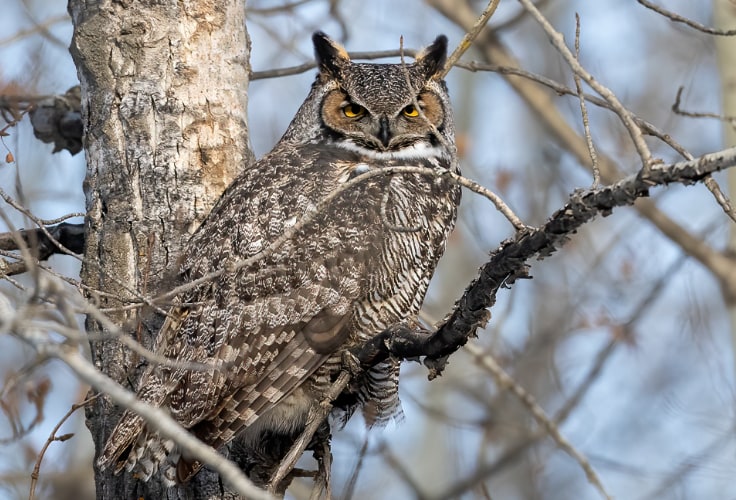
The Great Horned Owl is the largest regularly breeding owl in North Carolina and one of the most widespread nocturnal predators in the state. It measures 46 to 63 centimeters (18.1 to 24.8 inches) in length and has a thick-bodied build, broad wings, and a large head with prominent ear tufts. The plumage is heavily mottled in brown, buff, gray, and black, with a distinct white throat patch that often stands out in low light. This powerful and adaptable owl occupies a wide range of landscapes and functions as a dominant predator across much of the region.
In the field, Great Horned Owls are often detected by voice, especially during the colder months from November through March when calling peaks. Their deep, resonant hoots are typically given in a slow series and may be heard at dusk or near dawn, often in duets between mates with the female’s higher-pitched voice alternating with the male’s lower notes. Individuals perch upright on exposed snags, poles, or bare branches near open areas and hunt with steady, deliberate wingbeats over fields and forest edges. Their diet includes mammals, birds, and other vertebrates, taken from the ground or during low hunting flights.
The Great Horned Owl is a year-round resident across all three major regions of North Carolina: the Coastal Plain, Piedmont, and Mountains. It occurs statewide and has been recorded nesting in all counties. The owl favors open to medium-growth pine forests and mixed woodlands, typically in dry to mesic habitats, but it also uses agricultural landscapes, clearcuts, and suburban edges where open ground supports prey. Although it tends to avoid extensive wetlands compared to some other owl species, it is regularly found in pine stands adjacent to tidal marshes and similar habitats.
The Great Horned Owl is generally fairly common across North Carolina, with highest abundance in the Coastal Plain and more variable occurrence in the Piedmont and Mountains. Populations appear stable overall, supported by the species’ broad diet and tolerance of human-altered landscapes. Habitat loss from development reduces available nesting and hunting areas, and additional threats include collisions, illegal shooting, and secondary poisoning from contaminated prey. Despite these pressures, the species continues to persist widely across the state.
Barred Owl
Strix varia
- Identification: Large gray-brown owl with a rounded head, dark eyes, and brown-and-white barred and streaked plumage.
- Where found: Year-round across most of North Carolina in bottomland forests, swamps, riparian corridors, and wooded suburban areas, but less common in the mountains.
- How to spot: Listen for the distinctive “Who cooks for you?” call, often at dusk or even during the day, or look for a broad owl roosting quietly in dense forest near water.
- Conservation status: Least Concern (IUCN); populations stable or slightly increasing in North Carolina, with continued adaptation to suburban habitats.

The Barred Owl is one of the most characteristic and frequently heard owls of North Carolina’s wet forests and floodplains. The species measures 43 to 50 centimeters (16.9 to 19.7 inches) in length and has a broad, rounded head without ear tufts and large dark eyes set within a well-defined facial disc. The plumage is a soft mix of gray-brown and buff, with horizontal barring across the upper breast and vertical streaking below, giving the bird a strongly patterned but well-camouflaged appearance in shaded woodland habitats.
In the field, this species is most often detected by voice. Its loud, rhythmic hooting, commonly rendered as “Who cooks for you? Who cooks for you-all?,” carries well through forests and swamps. Unlike many owls, it may call during the day as well as at dusk or night. Individuals typically roost quietly in dense cover and become active in twilight or darkness, moving with smooth, silent flight through trees. Barred Owls hunt from perches and take a wide range of prey, including mammals, birds, amphibians, and reptiles, sometimes capturing prey from the forest floor or shallow water.
Within North Carolina, the Barred Owl is a permanent, non-migratory resident occurring across nearly the entire state. It is most strongly associated with bottomland forests, beaver ponds, swamps, and riparian corridors, where mature trees and nearby water provide both nesting sites and foraging habitat. The species is fairly common in the Coastal Plain, especially in large floodplains such as along the Roanoke River, and occurs in suitable habitats across the Piedmont, particularly where extensive floodplain forests remain. It is less common in the Mountains but occurs locally, even at high elevations in spruce-fir forests. In recent decades, it has increasingly occupied wooded suburban areas, especially where streams and mature trees are present.
The Barred Owl is generally stable or slightly increasing in North Carolina, aided in part by the expansion of wetland habitats such as beaver ponds and its growing use of suburban landscapes. Availability of suitable nesting cavities may limit breeding in some areas, particularly in younger forests. Major sources of mortality include vehicle collisions, especially in developed areas. Despite these pressures, the species remains a common and resilient inhabitant of forested wetlands and wooded landscapes across the state.
Eastern Screech-Owl
Megascops asio
- Identification: Small, stocky owl with ear tufts, yellow eyes, and gray or rufous plumage patterned with fine bars and spots.
- Where found: Year-round across North Carolina in pine and mixed forests, wooded residential areas, and landscapes with scattered trees and small openings.
- How to spot: Listen at night for monotonic trills or descending whinnies, often elicited by imitation or playback, or check cavities and nest boxes in wooded areas.
- Conservation status: Least Concern (IUCN); declining in North Carolina, likely due to habitat loss, development, and collisions.
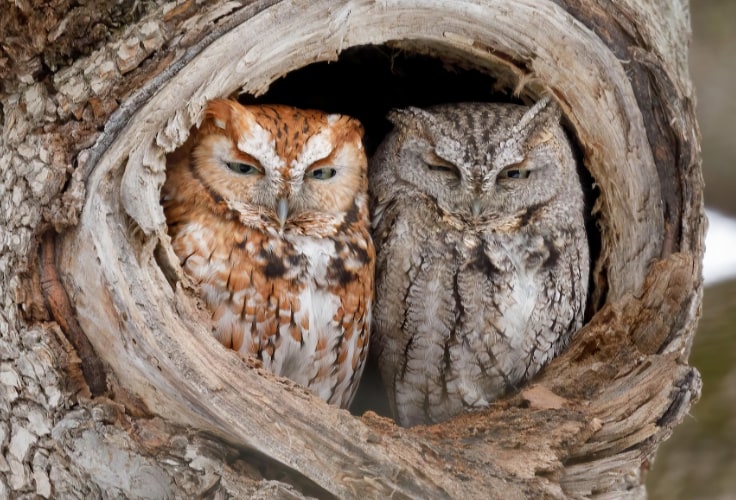
The Eastern Screech-Owl is one of the most widespread and familiar small owls in North Carolina, occurring across a wide range of wooded habitats. It measures 16 to 25 centimeters (6.3 to 9.8 inches) in length and has a compact body, broad head, short tail, and prominent ear tufts. Plumage occurs in both gray and rufous color morphs, both of which are regularly present in the state, and is intricately patterned with bars and spots that provide excellent camouflage against tree bark. This species is highly adaptable and frequently occupies both natural and human-modified landscapes.
In the field, Eastern Screech-Owls are more often detected by voice than by sight. Their main calls include a steady, monotonic trill and a descending whinny, though individuals often call infrequently without prompting and may respond more readily to imitation or playback. They are most active well after sunset or before dawn and move through the lower canopy with quick, direct flights. Individuals hunt from low perches and take a wide variety of prey, including insects, small mammals, and birds, often foraging along forest edges, yards, and openings where prey is abundant.
In North Carolina, the species is a permanent, non-migratory resident across the Coastal Plain, Piedmont, and Mountains. It is most frequent in medium-growth pine forests and mixed pine–hardwood woodlands, especially where small openings or adjacent fields provide foraging opportunities. It also occurs regularly in wooded suburban neighborhoods, where it may nest in natural cavities or nest boxes. The species is fairly common across much of the Coastal Plain and Piedmont, though generally less numerous than in the past, and is uncommon to fairly common in the Mountains, mainly below about 1,200 meters (4,000 feet).
The Eastern Screech-Owl has declined across North Carolina over recent decades, particularly in areas affected by development and loss of suitable forest habitat. Collisions with vehicles may also contribute to mortality in developed landscapes. Although still widespread, it is now generally less common than it was in the late 20th century. Its continued presence in suburban areas and use of nest boxes provide some resilience, but long-term trends suggest the importance of maintaining mature trees and cavity sites across the state.
American Barn Owl
Tyto furcata
- Identification: Medium-sized, pale owl with a heart-shaped face, dark eyes, long legs, and buff-and-gray upperparts contrasting with whitish underparts.
- Where found: Year-round across North Carolina, primarily in open farmland, coastal marshes, and other non-forested lowlands, with highest occurrence in the Coastal Plain.
- How to spot: Look for a pale owl flying low over fields or marshes at night or listen for harsh, rasping screams near barns, silos, or other nesting structures.
- Conservation status: Least Concern (IUCN); considered a species of Special Concern in North Carolina; rare and declining due to habitat loss, reduced nesting sites, and other human-related pressures.

The American Barn Owl is the most distinctive non-forest owl in North Carolina and the only representative of the Tytonidae family in the region. It measures 32 to 40 centimeters (12.6 to 15.7 inches) in length and has a slender, long-legged build with a large rounded head and a pale, heart-shaped facial disc. The upperparts are buff and gray, while the underparts are whitish, creating a striking contrast that is especially noticeable in low light. Its pale coloration and silent flight give it a ghostlike appearance over open landscapes at night.
In the field, this species is most often detected by sound or brief glimpses in flight. Its primary vocalization is a long, harsh, rasping scream rather than a hoot. Individuals hunt by flying low over fields, marshes, or open ground with slow, buoyant wingbeats, using acute hearing to locate prey. The diet consists mainly of small mammals, especially rodents, which are captured during low hunting flights. Barn Owls roost and nest in sheltered sites such as barns, silos, abandoned buildings, tree cavities, and nest boxes, and they may also use coastal structures such as duck blinds.
Within North Carolina, the American Barn Owl is a permanent resident with some seasonal movements and occurs statewide at low densities. It is most closely associated with open habitats, including farmland, grasslands, and coastal marshes, and avoids heavily forested areas. The species is most regularly encountered in the Coastal Plain, particularly along the coast and in Tidewater regions, with more scattered occurrences in the Piedmont and only rare records in mountain valleys below about 760 meters (2,500 feet). Although it likely occurs in many counties, it is now infrequently reported and remains difficult to detect due to its nocturnal habits.
The American Barn Owl has undergone a substantial decline in North Carolina over recent decades and is now considered rare across much of the state. Loss of farmland, changes in agricultural practices, and the disappearance of old barns and other nesting structures have reduced both habitat and breeding opportunities. Additional pressures may include predation and other environmental changes, though causes are not always clear. Despite these declines, some localized populations persist, particularly in coastal and agricultural regions, and the species remains an important but increasingly scarce component of the state’s open-country ecosystems.
Short-eared Owl
Asio flammeus
- Identification: Medium-sized owl with a pale facial disc, yellow eyes, mottled brown-and-buff plumage, and broad wings with a dark mark at the wrist.
- Where found: Winter visitor in North Carolina, mainly in coastal marshes and wet open fields, with rare inland occurrences.
- How to spot: Watch open marshes and fields at dusk for a buoyant, low, moth-like flight, often where Northern Harriers are present.
- Conservation status: Least Concern (IUCN); variable and generally uncommon in North Carolina, with numbers fluctuating by winter.

The Short-eared Owl is one of the few owls in North Carolina regularly seen in flight during daylight or at dusk, especially in open coastal habitats. This species measures 34 to 43 centimeters (13.4 to 16.9 inches) in length and has a rounded head with very small, often inconspicuous ear tufts and large yellow eyes set in a pale facial disc. The plumage is mottled brown and buff above, with streaked underparts, providing effective camouflage in grassy and marshy environments. Its long, broad wings and buoyant flight give it a distinctive silhouette over open terrain.
In the field, Short-eared Owls are most often detected by flight behavior. Individuals quarter low over marshes and wet fields with slow, buoyant wingbeats, often changing direction abruptly in a moth-like pattern. Activity peaks in late afternoon and at dusk, though birds may occasionally be seen during the day, especially under overcast conditions. Short-eared Owls hunt small mammals, particularly rodents, and are often found in areas where Northern Harriers are also present, sometimes flying at the same time over the same fields.
Across the state, the species is primarily a winter visitor, occurring from early November through late March. It is most regularly found in the Coastal Plain, especially in extensive brackish or freshwater marshes and wet agricultural fields along the northern coast and Tidewater region. It is less frequent along the central and southern coast and becomes rare farther inland, with scattered records in the Piedmont, often near large reservoirs or open fields. In the Mountains, the owl is extremely rare, with only a handful of records. Although breeding has been suspected or documented on rare occasions along the coast, it is not a regular breeder in the state.
The Short-eared Owl is generally uncommon in North Carolina, and its numbers vary widely from year to year, likely reflecting fluctuations in prey populations farther north. The species depends on large, open habitats, which are limited in the state, especially inland. While still observed annually, particularly in coastal marshes, it remains a localized and often unpredictable winter presence. Conservation concerns across its range include loss and fragmentation of grassland and marsh habitats, though regional population patterns are strongly influenced by broader ecological cycles.
Northern Saw-whet Owl
Aegolius acadicus
- Identification: Very small owl with a rounded head, yellow eyes, brown upperparts spotted with white, and white underparts streaked with brown.
- Where found: Breeds in high-elevation spruce-fir and mixed forests of the North Carolina mountains and occurs as a rare winter visitor in the Coastal Plain and Piedmont.
- How to spot: Listen at night in spring for a repetitive “too-too-too” call in mountain forests, or search dense cover for a well-hidden roosting bird.
- Conservation status: Least Concern (IUCN); considered Threatened in North Carolina; uncommon but regular in mountain breeding areas, with poorly known and sparse winter populations elsewhere in the state.

The Northern Saw-whet Owl is the smallest owl found in North Carolina, a specialized inhabitant of the state’s highest mountain forests. It measures 18 to 22 centimeters (7.1 to 8.7 inches) in length and has a compact body, rounded head without ear tufts, and bright yellow eyes set in a well-defined facial disc. The plumage is brown above with white spotting and pale below with bold streaking, providing effective camouflage in dense forest habitats. Its small size and secretive behavior make it difficult to observe despite its regular presence in suitable areas.
In the field, this species is most often detected by voice on its breeding grounds. Males give a steady, high-pitched “too-too-too” call in late winter and spring, often from concealed perches within dense forest. Individuals are highly nocturnal and roost quietly during the day in thick cover, typically close to the trunk. They hunt small mammals, especially shrews and mice, using low, quick flights through forest openings and edges, relying on acute hearing to locate prey in dense vegetation.
In North Carolina, the Northern Saw-whet Owl breeds in the Mountains, primarily in spruce-fir forests and mixed high-elevation woodlands above about 1,500 meters (5,000 feet), including areas along the Blue Ridge Parkway and in the Great Smoky Mountains. It is uncommon to fairly common in these habitats during the breeding season and remains present year-round at higher elevations. At lower elevations and outside the mountains, it occurs mainly as a winter visitor from roughly October through April, with scattered and often poorly documented records in the Piedmont and Coastal Plain. Wintering birds have been found in a wide range of habitats, from dense forests to coastal thickets, though their distribution and abundance are not well understood.
The Northern Saw-whet Owl is locally regular in mountain breeding habitats but remains difficult to monitor due to its secretive nature. Winter populations in the rest of the state are sparse and poorly known, with only small numbers detected in most years. Availability of suitable nesting cavities and mature forest structure likely influences breeding distribution, while winter ecology in North Carolina remains incompletely documented. Despite these uncertainties, the species persists as a characteristic but elusive component of high-elevation forest ecosystems in the state.
Long-eared Owl
Asio otus
- Identification: Medium-sized, slender owl with long upright ear tufts, yellow eyes, and mottled brown-and-buff plumage with streaked underparts.
- Where found: Rare winter visitor in North Carolina, occurring locally in dense conifers near open fields, with possible but unconfirmed breeding in the northern mountains.
- How to spot: Search dense pine or cedar stands near fields for concealed roosting birds or listen at night for low hooting calls.
- Conservation status: Least Concern (IUCN); rare and poorly known in North Carolina, with uncertain population status.

The Long-eared Owl is one of the most elusive and least frequently observed owls in North Carolina. This species measures 35 to 40 centimeters (13.8 to 15.7 inches) in length and has a slender build, long ear tufts, and a narrow profile that enhances its camouflage. The plumage is mottled in shades of brown, buff, and gray, with streaked underparts, allowing the bird to blend closely with dense vegetation. Its secretive habits and reliance on well-concealed roost sites make it difficult to detect even where it occurs.
Long-eared Owls are rarely seen and are more often inferred from roost sites or occasional nocturnal calls. During the day, individuals roost in dense stands of conifers, particularly young pines or cedars, where they remain motionless and well hidden close to the trunk. At night, they leave these roosts to hunt over nearby open fields, using low, gliding flight to search for small mammals. Vocal activity is infrequently documented in the state, but elsewhere the species gives a series of low, evenly spaced hoots during the breeding season.
Within North Carolina, the Long-eared Owl is a very rare and irregular winter visitor across all regions of the state. Most records come from the Coastal Plain and Piedmont, where birds have occasionally been found roosting in dense pine stands near open habitats. In the Mountains, it is even more scarce, with only a handful of records, though calling birds have been reported in summer at high elevations in the northern mountains, suggesting the possibility of rare or localized breeding. Winter records generally fall between November and March, and the species is considered casual in many areas.
The Long-eared Owl is extremely poorly known in North Carolina, with few records and no clear understanding of its population status. Its rarity likely reflects both genuinely low numbers and the difficulty of detecting birds that roost in dense cover and are active only at night. Preservation of dense conifer stands adjacent to open hunting areas is likely important for any individuals wintering in the state. More targeted nocturnal surveys, especially in the northern mountains, may clarify its status and possible breeding presence.
Snowy Owl
Bubo scandiacus
- Identification: Large white owl with yellow eyes and variable dark barring, ranging from heavily marked birds to nearly pure white individuals.
- Where found: Very rare and irregular winter visitor to North Carolina, occurring mainly along the immediate coast and occasionally inland during irruption years.
- How to spot: Search open coastal areas for a conspicuous white owl perched on dunes, posts, or buildings, or watch for low, steady flight during daylight.
- Conservation status: Vulnerable (IUCN); extremely rare in North Carolina, appearing only during occasional southward irruptions.

The Snowy Owl is one of the largest and most striking owls ever recorded in North Carolina, though it appears only rarely in the state. It measures 52 to 71 centimeters (20.5 to 28.0 inches) in length and has a powerful build, a broad, rounded head, and dense white plumage that varies from heavily barred to nearly pure white in adult males. Its bright yellow eyes and pale coloration make it highly conspicuous when present, especially against open coastal landscapes.
In the field, Snowy Owls are typically observed during daylight, often perched in exposed locations such as dunes, fenceposts, buildings, or open ground. They may also be seen flying low over open terrain with steady, direct wingbeats. Unlike most other owls in the region, they are strongly diurnal and can be active at any hour. Individuals are usually solitary and may remain in an area only briefly, making repeated observations at the same site uncommon.
In North Carolina, the Snowy Owl is an irregular winter visitor, appearing only during occasional irruption events when birds move south from Arctic breeding grounds. Most records come from the Coastal Plain, particularly along the Outer Banks and immediate coastal areas, where open dunes and grasslands provide suitable habitat. Inland occurrences are extremely rare but have been documented during major irruption years. The species is recorded primarily between mid-November and early March, with most observations involving single individuals.
The Snowy Owl is extremely rare in North Carolina and does not occur annually. Its appearance depends on conditions in northern breeding areas, particularly prey availability, which drives periodic southward movements. While global populations are declining, its status in North Carolina is defined primarily by its irregular occurrence rather than local threats. When present, it draws significant attention due to its rarity and striking appearance, but individuals are often transient and difficult to relocate once detected.
Burrowing Owl
Athene cunicularia
- Identification: Small, long-legged owl with yellow eyes, a rounded head, white eyebrows and throat, and brown plumage spotted and barred with buff.
- Where found: Extremely rare in North Carolina, recorded only along the immediate coast, with no accepted inland records.
- How to spot: Extremely unlikely to encounter; any individual would be found on open ground in coastal habitats, often standing upright near low mounds or exposed areas.
- Conservation status: Least Concern (IUCN); only a handful of records in North Carolina, with occurrence considered accidental.

The Burrowing Owl is an exceptional rarity in North Carolina and differs markedly from the state’s native owls because of its ground-dwelling habits. The species measures 19 to 25 centimeters (7.5 to 9.8 inches) in length and has a small, slender body with long legs, a rounded head without ear tufts, and bright yellow eyes. The plumage is brown above with buff spotting and barred below, with a pale throat and facial markings that stand out in open environments. Its terrestrial behavior and upright stance give it a distinctive appearance unlike that of forest-dwelling owls.
Burrowing Owls are typically seen standing alert on the ground or on low perches, often near burrow entrances in their normal range. The species is active during both day and night and moves with quick, jerky motions when alarmed. Individuals fly low over open terrain with shallow wingbeats and short glides. In North Carolina, however, detection relies entirely on rare chance encounters, as the species does not occur regularly and no established behavior patterns are documented within the state.
Within North Carolina, the Burrowing Owl is considered an accidental visitor, with only a few accepted records, all from the immediate coast in the Coastal Plain. These records come from barrier island and coastal sites such as dunes and open sandy areas, consistent with the species’ preference for open landscapes. There are no accepted records from the Piedmont or Mountains, and inland reports have been considered of questionable origin. The species does not breed or occur regularly in the state, and its appearance is most plausibly linked to rare dispersal from the Florida population rather than regular movement patterns.
The Burrowing Owl has no established population in North Carolina and is recorded only as an accidental species. Its rarity reflects both the state’s largely forested landscapes and its distance from the species’ primary breeding ranges in the western United States and Florida. While global populations face regional declines, conservation considerations within North Carolina are limited to documenting and verifying occasional occurrences. Each record remains notable due to the species’ rarity and distinctive ecology.
Where and When to See Owls in North Carolina
Owls in North Carolina occupy a wide range of habitats, from dense forests and wooded suburbs to open farmland and coastal marshes. Common resident species such as the Great Horned Owl, Barred Owl, and Eastern Screech-Owl can be found year-round across much of the state, each favoring slightly different environments, from open woodlands to wet bottomlands and residential areas. The best time to detect these species is during late fall and winter, when calling activity increases, especially at dusk and dawn.
More specialized species require targeted searching. The Northern Saw-whet Owl breeds in high-elevation forests of the mountains and is most detectable by its calls in spring, while small numbers also occur in winter at lower elevations. Open habitats host winter visitors such as the Short-eared Owl, best seen flying over marshes and fields at dusk, and the American Barn Owl, a rare and declining species most closely tied to farmland and coastal lowlands.
A few owls appear only irregularly or under exceptional conditions. The Snowy Owl reaches the coast during occasional winter irruptions, while the Long-eared Owl and Burrowing Owl are rare and difficult to find at any time. Overall, success in finding owls in North Carolina depends on matching the right habitat and season: forests and woodlands year-round for resident species, open coastal and agricultural landscapes in winter for rarer visitors, and high mountain forests in spring for specialized breeders.
For a broader perspective, see our guide to the types of owls in North America, and explore the Birds of North Carolina and Birds of the United States pages for additional regional and national bird guides.

Jacob Irgens-Møller Nielsen is a Danish ecologist, and birder. Apart from this he’s also an avid rock climber and photographer and enjoys bird spotting around the Wadden Sea on the Danish west coast.
Since 2017 he has been working with drones and A.I in his small business to improve the management of coastal bird habitats, by combing his knowledge of biology with new technologies to make algorithms for automatic nature mapping and bird counting. By using drones to monitor the birds and their habitats, less time is spent by humans to walk through their nesting and feeding grounds, making it a much less invasive method of mapping and counting.
He spent 2021 in an internship in a Danish NGO focusing on bird protection and media creation about birds, where he spent a lot of time in the field listening to and learning about the different coastal birds the Wadden Sea area has to offer. Being involved in multiple EU Better BirdLIFE projects, he has also spent a lot of time dealing with the bureaucracy of nature protection.
He also works for the Danish Environmental Protection Agency, where he is managing the Danish Natura 2000-areas and Bird Protection areas.


Been hearing owls almost every night and morning here in Sneads Ferry, NC. Yesterday I decided to talk a walk into the beautiful forest and wetlands behind my house and I saw an owl as he must of been startled by me and flew away. None of these owls look like the one I saw. Is there perhaps another species of owls in this area?
Commenting to myself…after many weeks of trying to get some video of this beauty, this afternoon I finally got a great video of this majestic bird. Getting to see him more clearly, it is the Great Horned Owl. Will post soon on my Youtube channel. Been a great week of getting footage this week. Spotted a big Red Tail Hawk two days earlier. It is great living in such a rich bird environment.
I live just outside Winston Salem, NC in the foothills. We rescue parrots and I try to place them in a bright room with large windows adjacent to our day to day living, currently in a sun room off our kitchen. Twice we have had an owl or owls crash into the large windows trying to get the parrots. Last night I was able to see the owl sitting on a rail to our deck after the third hit. He was huge, I would guess at least two feet higher, with a very large white head/face. It was greatly reflected in the automatic light above the window. If I had to name it, he looked like a white snowy owl. We are putting covers there to protect the owls now.