
British Columbia supports the highest diversity of owls in Canada, shaped by the province’s wide range of ecological zones spanning coastal rainforests, interior grasslands, and northern boreal forests. These include 15 regularly occurring species, ranging from widespread generalists to highly specialized forest and open-country species. This guide outlines identification, regional distribution, habitat use, and seasonal patterns for owls found across the province.
Great Horned Owl
Bubo virginianus
- Identification: Large, powerful owl with broad wings, prominent ear tufts, a white throat patch, and striking yellow eyes, with heavily mottled brown, buff, and gray plumage.
- Where found: Widespread across most of British Columbia in a wide range of habitats from open woodlands and forests to wetlands, agricultural areas, and urban environments, absent only from Haida Gwaii and alpine tundra.
- How to spot: Listen for deep, multi-note hoots at dusk or night, or watch for a thick-bodied owl perched in the open or flying with steady, powerful wingbeats over fields and forest edges.
- Conservation status: Least Concern (IUCN); common and adaptable in British Columbia, with broadly stable but locally variable and in some cases declining trends in Canada.
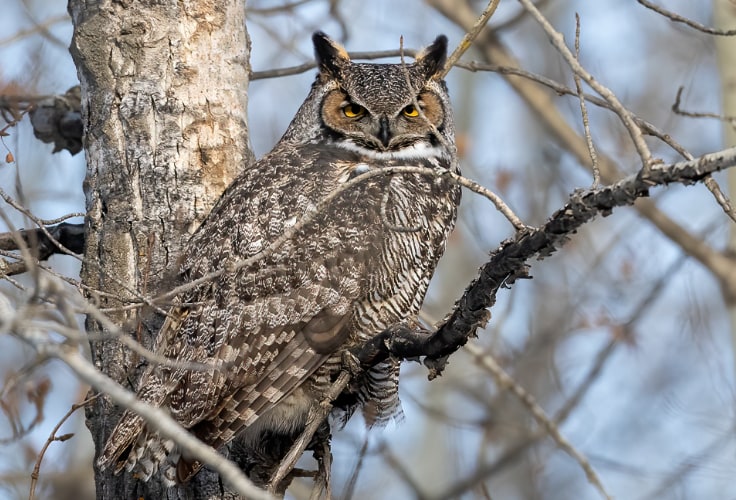
The Great Horned Owl is the most widespread and frequently encountered large owl in British Columbia, occupying nearly all terrestrial habitats across the province. It measures 46 to 63 centimeters (18.1 to 24.8 inches) in length and is a large, thick-bodied raptor with a broad head, prominent ear tufts, and large yellow eyes set in a well-defined facial disc. Its plumage is heavily mottled in shades of brown, buff, gray, and black, with a contrasting white throat patch that is often visible in low light. This combination of size, structure, and pattern makes it one of the most recognizable owls in the province.
In the field, Great Horned Owls are most often detected by voice or silhouette. Their deep, resonant hoots, typically delivered in a slow series of four to six notes, are a characteristic sound of late winter and early spring evenings across British Columbia, often given in duets by paired birds. Individuals usually perch upright on exposed branches, poles, or other elevated sites at dusk, scanning for prey. Flight is strong and deliberate, with deep wingbeats and short glides. The species is a versatile predator that takes a wide range of prey, including mammals and birds, often hunting from perches or during low flights over open ground.
In British Columbia, the Great Horned Owl breeds throughout the province at all elevations below alpine tundra and is absent only from Haida Gwaii. It occurs across all major ecoprovinces, with higher abundance in the Southern Interior, Central Interior, Boreal Plains, and Georgia Depression. The species shows a preference for more open habitats, particularly in drier biogeoclimatic zones such as Ponderosa Pine, Bunchgrass, Coastal Douglas-fir, and Interior Douglas-fir, where open woodland structure supports effective hunting. It occupies forests, woodland edges, grasslands, agricultural areas, wetlands, and urban environments. The species is resident year-round, although dispersal of juveniles can occur over longer distances. It does not build its own nest and instead uses abandoned stick nests of crows, ravens, large hawks, or herons, as well as cliff ledges and human-made structures.
The Great Horned Owl remains common and widely distributed in British Columbia, supported by its adaptability and broad diet. Long-term monitoring in Canada suggests overall declines since the mid- to late 20th century, although trends vary regionally and data are limited by the difficulty of surveying nocturnal species. In British Columbia, no immediate conservation concern is identified, but continued monitoring is recommended. Population fluctuations are often linked to prey cycles, particularly those of Snowshoe Hare, and the species’ tendency to reduce breeding effort in low-prey years can affect detectability in surveys.
Barred Owl
Strix varia
- Identification: Large gray-brown owl with a rounded head, dark eyes, a well-defined facial disc, and brown-and-white barred and streaked plumage across the body.
- Where found: Widespread across most of British Columbia in forested habitats, especially mature coniferous and mixed forests near water, absent from Haida Gwaii and scarce in the far north.
- How to spot: Listen at dusk or night for the distinctive “Who cooks for you?” call, or look for a broad, rounded owl gliding silently through forest or roosting on shaded branches.
- Conservation status: Least Concern (IUCN); increasing in Canada and British Columbia, with significant regional expansion over the past century.

The Barred Owl is one of the most conspicuous and frequently heard owls in forested regions of British Columbia, particularly in the south and along the coast. This species measures 43 to 50 centimeters (16.9 to 19.7 inches) in length and is a large, broad-bodied owl with a rounded head lacking ear tufts, dark brown eyes, and a full facial disc. Its plumage shows a gray-brown cast with bold horizontal barring across the upper breast and vertical streaking down the belly, creating a distinctive pattern that helps separate it from similar species in the province.
In the field, Barred Owls are most often detected by voice. Their loud, far-carrying hoots, commonly rendered as “Who cooks for you? Who cooks for you-all?,” are a defining sound of mature forests in British Columbia. Individuals roost quietly in dense cover during the day and become active at dusk, moving with buoyant, silent flight through the forest. They hunt primarily from elevated perches, taking small mammals such as voles, mice, and other vertebrates, and may also forage along forest edges and wet areas, with rodents dominating the diet in British Columbia.
In British Columbia, the Barred Owl is a relatively recent arrival that first appeared in the province in the early 20th century and has since expanded to occupy most forested regions. It is now found throughout the province except Haida Gwaii, with highest abundance in the Georgia Depression and other southern and coastal areas. The species occurs in coniferous and mixed forests, including Douglas-fir, Western Hemlock, spruce, and Black Cottonwood stands, often near rivers, wetlands, or riparian corridors. It is less common and more localized in the Northern Boreal Mountains and Taiga Plains. Barred Owls are year-round residents and nest in large natural cavities, broken tree tops, or occasionally old nests of other birds.
The Barred Owl has increased substantially in Canada and British Columbia over recent decades, reflecting its continued range expansion and adaptability to a variety of forested habitats. In the province, it is not considered at risk, although its expansion has had ecological consequences. Competition and hybridization with the endangered Spotted Owl in southwestern British Columbia are well documented, and predation by Barred Owls has been linked to declines of other owl species in some regions. Despite these impacts, the species itself remains secure, with stable or increasing populations supported by the availability of mature forest structure and nesting sites.
Northern Pygmy-Owl
Glaucidium gnoma
- Identification: Tiny owl with a round head, yellow eyes, a long tail, brown or rufous-brown upperparts with white spots, streaked whitish underparts, and distinctive dark “eyespots” on the nape.
- Where found: Widespread across forested regions of British Columbia, including Vancouver Island, but absent from Haida Gwaii and the Taiga Plains, and scarce along the northern mainland coast.
- How to spot: Look for a small owl perched in the open during the day or listen for evenly spaced high-pitched toots; mobbing songbirds often reveal its presence.
- Conservation status: Least Concern (IUCN); generally stable or increasing in Canada, though dependent on mature forest structure and cavity availability.

The Northern Pygmy-Owl is the smallest year-round owl in British Columbia and one of the few regularly active during the day. It measures 15 to 17 centimeters (5.9 to 6.7 inches) in length and is a compact, round-headed owl with bright yellow eyes, a relatively long tail, and short wings. Its plumage ranges from brown to rufous-brown, marked with white spotting on the upperparts and fine streaking below, with a pair of dark “eyespots” on the nape that give the impression of a false face. Its small size, upright posture, and diurnal habits make it unlike most other owls in the province.
In the field, Northern Pygmy-Owls are often detected by their behavior or by the reaction of other birds. They perch conspicuously on treetops, exposed branches, or wires, scanning for prey, and are frequently surrounded by agitated chickadees, nuthatches, and other songbirds that mob the owl. Their call is a series of clear, evenly spaced, high-pitched toots that carry through forested habitats. Unlike most other owl species, they hunt primarily by day, taking small mammals and songbirds, often striking prey nearly their own size.
In British Columbia, the Northern Pygmy-Owl is a year-round resident throughout most forested regions of the province, including Vancouver Island, but is absent from Haida Gwaii and the Taiga Plains and is rare along the northern mainland coast. It occurs across a wide range of forest types, including coniferous and mixed forests, and is generally associated with more open woodland structure. The species is found from low elevations to montane zones and may move downslope into valley bottoms during winter. Population density appears lower in the northern half of the province, and the species is less common in heavily urbanized areas such as the Lower Mainland.
The Northern Pygmy-Owl remains widespread in British Columbia, though population trends in Canada are somewhat uncertain due to limited data. Available monitoring suggests a generally stable to increasing population over recent decades. The species depends on tree cavities for nesting, particularly those created by woodpeckers, and is therefore sensitive to forestry practices that remove standing dead trees. Retention of snags and mature forest structure is important for maintaining local populations in the province.
Northern Saw-whet Owl
Aegolius acadicus
- Identification: Very small owl with a round head, bright yellow eyes, brown upperparts spotted with white, and white underparts boldly streaked with brown.
- Where found: Widespread across forested regions of southern and central British Columbia, with localized records farther north, and a distinct subspecies on Haida Gwaii.
- How to spot: Listen at night from late winter through spring for a repetitive “too-too-too” call, or look for small songbirds mobbing a well-hidden owl roosting in dense vegetation.
- Conservation status: Least Concern (IUCN); widespread but difficult to monitor, with some concern related to habitat loss and dependence on mature forest structure.

The Northern Saw-whet Owl is one of the smallest and most elusive owls in British Columbia and is likely among the most common despite being rarely seen. It measures 18 to 22 centimeters (7.1 to 8.7 inches) in length and has a large, rounded head without ear tufts, a compact body, and bright yellow eyes set in a well-defined facial disc. The brown upperparts are marked with white spotting, and the white underparts are streaked with brown, while birds on Haida Gwaii are darker overall with buffier tones below. Small size, nocturnal habits, and a tendency to remain concealed make this species difficult to observe directly.

In the field, Northern Saw-whet Owls are most often detected by their vocalizations. Males give a steady, high-pitched series of “too-too-too” notes, especially from late winter through spring, with peak calling in late February and March in southern British Columbia. During the day, individuals roost in dense coniferous or mixed vegetation, often close to the trunk and well concealed. They hunt primarily at night, taking small mammals and birds, with deer mice forming a major component of the diet in British Columbia.
In British Columbia, the Northern Saw-whet Owl occurs across most forested regions south of approximately 57th parallel, with only localized records farther north and none from the Taiga Plains. It occurs in a wide range of forest types, including coniferous, mixed, and deciduous stands, but shows a preference for older forests with openings for foraging and dense cover for roosting. The species is most common at low to moderate elevations and is often replaced by the Boreal Owl in higher and more northerly spruce-dominated forests. It nests in tree cavities, particularly those created by large woodpeckers, and readily uses nest boxes. Mainland populations are present year-round but may show short-distance seasonal movements, including dispersal in autumn, while a distinct, non-migratory subspecies occurs on Haida Gwaii.
The Northern Saw-whet Owl remains widespread in British Columbia, but population trends are difficult to assess due to its secretive nature and limitations of survey methods. Available data suggest stable or moderately increasing populations at broad scales, though confidence in these trends is low. The species depends on mature forests and standing dead trees for nesting cavities, and logging practices that remove snags or reduce forest age can negatively affect local populations. The Haida Gwaii subspecies is of particular conservation concern due to its restricted range and reliance on old-growth forest habitats.
Western Screech-Owl
Megascops kennicottii
- Identification: Small, stocky owl with prominent ear tufts, yellow eyes, and gray to brown plumage intricately streaked and barred for bark-like camouflage.
- Where found: Localized in British Columbia, common along the southern coast and patchy in interior valleys, mainly in low-elevation wooded and riparian habitats; absent from Haida Gwaii.
- How to spot: Listen at night for an accelerating series of hollow hoots likened to a bouncing ball, or watch for songbird mobbing around a well-hidden owl in dense vegetation or tree cavities.
- Conservation status: Least Concern (IUCN); declining in coastal British Columbia, with variable trends in the interior linked to habitat change and predation by Barred Owls.

The Western Screech-Owl is a small, cryptic owl of lowland forests and riparian habitats in southern British Columbia. It measures 19 to 26 centimeters (7.5 to 10.2 inches) in length and is compact and broad-headed, with prominent ear tufts and bright yellow eyes. Its plumage is finely patterned in gray or brown tones that closely resemble tree bark, providing excellent camouflage. Birds in coastal British Columbia are often darker and more brownish, while those in the southern interior are typically paler and grayer.
In the field, Western Screech-Owls are most often detected by voice. Their characteristic call is a series of hollow hoots that accelerate and then trail off, often compared to the sound of a bouncing ball. Calling is most frequent in winter and early spring. During the day, individuals roost in tree cavities or dense foliage and may be revealed by mobbing songbirds. They hunt primarily at night using a sit-and-wait strategy, taking a wide range of prey including small mammals, birds, and invertebrates, often foraging along forest edges and near water.
In British Columbia, the Western Screech-Owl is a year-round resident with a strongly localized distribution. It occurs mainly at low elevations below about 1,000 meters (3,300 feet) along the coast in the Georgia Depression and Coast and Mountains Ecoprovinces, as well as in valleys of the southern interior and Southern Interior Mountains. Coastal populations are associated with mixed forests and wooded riparian corridors, often centred on stream gullies with large deciduous trees such as Bigleaf Maple, while interior populations are closely tied to riparian woodlands dominated by Black Cottonwood, Water Birch, and Trembling Aspen. The species is absent from Haida Gwaii and becomes increasingly scarce northward. It nests in natural cavities or abandoned woodpecker holes and readily uses nest boxes.
The Western Screech-Owl shows contrasting population trends within British Columbia. Coastal populations have declined significantly since the late 20th century, likely due to a combination of habitat loss, reduced availability of nest cavities, and increased predation and competition from expanding Barred Owl populations. In contrast, interior populations appear more stable or increasing, although data remain limited. Both subspecies in the province are of conservation concern at the national level, reflecting their small population sizes and reliance on vulnerable riparian habitats. Retention and restoration of riparian woodlands and cavity-bearing trees are important for supporting this species in British Columbia.
Great Gray Owl
Strix nebulosa
- Identification: Very large gray owl with a broad, rounded head, long tail, fine gray-brown barring and streaking, and a large circular facial disc marked with pale arcs and a white “bow tie.”
- Where found: Year-round across interior British Columbia in coniferous and mixed forests with nearby meadows, wetlands, or open areas, largely absent from coastal regions and the Georgia Depression.
- How to spot: Look for a massive gray owl perched at forest edges or watch for slow, buoyant flight over meadows at dawn or dusk; listen for deep, evenly spaced hoots near breeding areas.
- Conservation status: Least Concern (IUCN); generally stable in Canada, with populations fluctuating in response to prey cycles and sensitive to habitat loss.

The Great Gray Owl is the largest owl in British Columbia in linear dimensions and one of the most distinctive, with its immense facial disc and elongated silhouette. It measures 61 to 84 centimeters (24.0 to 33.1 inches) in length and is a tall, long-tailed owl with a broad, rounded head and relatively small yellow eyes set within a prominent facial disc. Its plumage is predominantly gray with fine barring and streaking, and a bold white “bow tie” marking at the throat. Despite its size, much of its bulk comes from dense plumage, giving it a soft, imposing appearance.
In the field, Great Gray Owls are often detected by their posture and hunting behavior. Individuals perch quietly on low or mid-level branches or on exposed snags at the edges of openings, remaining motionless for long periods. Their flight is slow and buoyant, with deep wingbeats and a floating quality. They hunt primarily from perches, using exceptional hearing to locate prey beneath snow or vegetation, and may plunge through snow to capture small mammals such as voles and pocket gophers. Their vocalizations include deep, evenly spaced hoots given mainly near breeding territories.
In British Columbia, the Great Gray Owl is resident across interior regions of the province and is largely absent from coastal areas, with only rare records from the Coast and Mountains Ecoprovince and none from the Georgia Depression. It occurs mainly at mid-elevations, typically between 500 and 1,250 meters (1,640 to 4,100 feet), in coniferous and mixed forests. The species favors landscapes that combine forest cover with adjacent openings such as meadows, marshes, muskegs, or pasture, where prey is more accessible. It nests in old stick nests of large birds or on structural features such as broken tree tops or witch’s broom clumps, and maintains territories year-round.
The Great Gray Owl remains uncommon but stable in British Columbia, with population levels influenced strongly by fluctuations in prey abundance. Long-term trends in Canada are uncertain due to limited monitoring and variability in survey data, though overall stability is suggested. The primary threat in the province is habitat loss from logging, which can reduce the availability of nesting structures, roosting cover, and suitable hunting areas. Retention of mature forest structure and adjacent open foraging habitat is important for maintaining local populations.
Boreal Owl
Aegolius funereus
- Identification: Small, large-headed owl with a grayish-white facial disc bordered in brown, bright yellow eyes, brown upperparts with white spots, and white underparts heavily streaked with brown.
- Where found: Year-round across interior British Columbia in boreal and subalpine forests, largely absent from coastal regions and the Georgia Depression.
- How to spot: Listen on late-winter nights for a rapid series of hollow, staccato hoots, or search for a small owl roosting close to tree trunks in dense forest.
- Conservation status: Least Concern (IUCN); considered secure in British Columbia, though poorly monitored and dependent on mature forest structure.

The Boreal Owl is a secretive and sparsely observed owl of high-elevation and northern forests in British Columbia, where it occupies habitats often shared with few other small owls. It measures 21 to 28 centimeters (8.3 to 11.0 inches) in length and is a compact, large-headed species with a square facial appearance, short tail, and bright yellow eyes set in a pale facial disc. The brown upperparts are marked with bold white spotting, and the whitish underparts are heavily streaked with brown. Its nocturnal habits and tendency to remain concealed in dense forest make it difficult to detect.
In the field, Boreal Owls are most often detected by their vocalizations. Males give a rapid, evenly spaced series of hollow hoots during late winter and early spring, a call that carries through subalpine forests and differs from the slower, more monotonous notes of the Northern Saw-whet Owl. Individuals roost quietly during the day in dense conifers or cavities, often close to tree trunks. They hunt primarily at night from low to mid-level perches, taking small mammals and other prey with short, direct flights through the forest.
In British Columbia, the Boreal Owl is a year-round resident throughout suitable habitats of the interior, extending west to the eastern slopes of the Coast Mountains and absent as a breeder from the Georgia Depression and most coastal regions. It is most often associated with older stands of spruce and Subalpine Fir, often mixed with Trembling Aspen or Lodgepole Pine. In the southern third of the province, it occurs mainly at higher elevations, generally above 1,500 meters (4,900 feet), while in the north it can be found at lower elevations, including valley bottoms. The species nests in tree cavities, typically those created by local woodpeckers, and may also use nest boxes. It effectively replaces the Northern Saw-whet Owl at higher elevations and latitudes.
The Boreal Owl is considered secure in British Columbia and across Canada, but population trends remain poorly understood due to limited monitoring and the species’ low detectability. Available data are inconsistent, with some indications of increase and others of decline, resulting in low confidence in trend estimates. The species depends on mature forest structure and the availability of cavity-bearing trees, making it vulnerable to logging practices that remove snags and reduce habitat complexity. Continued monitoring and retention of suitable forest conditions are important for maintaining stable populations.
Long-eared Owl
Asio otus
- Identification: Medium-sized, slender owl with long upright ear tufts, yellow eyes, a buff facial disc with white eyebrows, and mottled brown-and-buff plumage with streaked underparts.
- Where found: Found mainly in interior British Columbia in woodlands and forest edges adjacent to grasslands, meadows, and wetlands, with only rare or localized records on the coast.
- How to spot: Listen at night in spring for long series of low hoots, or search dense vegetation near open areas for well-camouflaged roosting birds or signs such as pellets and whitewash.
- Conservation status: Least Concern (IUCN); likely declining in Canada, with habitat loss affecting foraging and roosting areas.

The Long-eared Owl is a slender, cryptic owl of open woodlands and forest edges in southern British Columbia, where it is more often heard than seen. It measures 35 to 40 centimeters (13.8 to 15.7 inches) in length and has a narrow body, long wings, and prominent ear tufts that give it a tall, upright appearance. The plumage is intricately patterned in shades of brown, buff, and gray, with a buff facial disc marked by pale vertical lines between the eyes and heavily streaked underparts. Its elongated shape and camouflage allow it to blend seamlessly into dense vegetation.
In the field, Long-eared Owls are usually detected by sound or by signs at roost sites. Males give long, evenly spaced series of low hoots during the breeding season, and individuals may also produce wing-clapping sounds during territorial displays. By day, they roost in dense thickets or conifer stands, often close to the trunk, where they are difficult to detect. At dusk they emerge to hunt, flying low over open ground with deep wingbeats and long glides. They feed primarily on small mammals, especially voles, occasionally taking small birds.
In British Columbia, the Long-eared Owl breeds mainly in the interior from the Boreal Plains and Sub-Boreal Interior Ecoprovinces southward, with only rare or localized records near the coast. It occupies a mosaic of habitats, using grasslands, meadows, pastures, and marshes for foraging, and adjacent thickets, copses, or forest patches for roosting and nesting. The species is most common in southern regions of the province and becomes less frequent farther north. It nests in old stick nests built by crows, magpies, or hawks and typically occurs at low to moderate elevations. The species is present year-round in British Columbia, though its secretive habits make it difficult to detect outside the breeding season.
The Long-eared Owl remains fairly widespread in British Columbia but is not well monitored, and population trends are uncertain. Available data suggest a moderate decline in Canada, likely linked to habitat loss and degradation. The species depends on both open habitats that support prey populations and wooded areas that provide roosting and nesting sites, making it vulnerable to changes that reduce grasslands, meadows, and riparian woodlands. Conservation efforts that maintain this habitat mosaic are important for sustaining populations in the province.
Short-eared Owl
Asio flammeus
- Identification: Medium-sized owl with a pale facial disc, yellow eyes bordered in black, mottled brown-and-buff upperparts, streaked whitish to rusty underparts, and broad rounded wings with a dark mark at the wrist.
- Where found: Locally distributed across British Columbia in open habitats such as grasslands, marshes, and pastures, breeding mainly in the interior and Lower Mainland and scarce along much of the coast.
- How to spot: Search open fields at dawn or dusk for buoyant, mothlike flight low over vegetation, or look for birds perched on the ground; may also be seen flying in daylight.
- Conservation status: Least Concern (IUCN); declining in Canada and British Columbia due to habitat loss and degradation of open landscapes.

The Short-eared Owl is one of the most visible owls in British Columbia and one of the few regularly active during daylight hours. It measures 34 to 43 centimeters (13.4 to 16.9 inches) in length and is a medium-sized owl with a rounded head, very small ear tufts, and long, broad wings adapted for low, buoyant flight. The pale facial disc with dark eye patches and the mottled brown-and-buff plumage provide effective camouflage in open habitats such as grasslands and marshes.
In the field, Short-eared Owls are most often detected by their distinctive flight behavior. They quarter low over open terrain with slow, buoyant wingbeats and frequent changes in direction, especially at dawn and dusk, though they may also be active during the day. Their flight has a mothlike quality and includes occasional hovering when locating prey. They hunt primarily small mammals, especially voles, and may perch directly on the ground or low vegetation between hunting bouts. During the breeding season, males give soft, rhythmic hoots during aerial display flights.
In British Columbia, the Short-eared Owl breeds locally in suitable open habitats across much of the province, particularly in the interior and in lowland areas such as the Fraser River delta, but is absent as a breeder from much of the coast outside the Lower Mainland. It occupies grasslands, old fields, marsh edges, bogs, and pastures, typically at elevations below 1,000 meters (3,300 feet). The species is a partial migrant, with some individuals present year-round while others move south or shift locally in response to prey availability. The Fraser River delta serves as a key wintering area in the province, supporting concentrations of birds in suitable open habitats.
The Short-eared Owl has undergone substantial long-term declines in Canada, including in British Columbia, primarily due to loss and degradation of grassland and wetland habitats. Conversion of open landscapes to agriculture, urban development, and changes in land use have reduced both breeding and wintering habitat. Population trends are supported by multiple monitoring programs, though confidence varies. Conservation efforts focused on protecting and restoring large, open habitats are important for stabilizing populations in the province.
Northern Hawk-Owl
Surnia ulula
- Identification: Medium-sized owl with a long tail, short pointed wings, brown upperparts with white spotting, a narrowly bordered facial disc, and white underparts heavily barred with brown.
- Where found: Uncommon resident across interior British Columbia, mainly in boreal and montane forests with openings, absent from coastal lowlands.
- How to spot: Look for a diurnal owl perched prominently atop trees or snags scanning open ground, or watch for fast, low, falcon-like flight over clearings.
- Conservation status: Least Concern (IUCN); generally stable but difficult to monitor, with populations fluctuating in response to prey availability.

The Northern Hawk-Owl is one of the most distinctive owls in British Columbia, combining the structure and behavior of a hawk with the appearance of an owl. It measures 36 to 45 centimeters (14.2 to 17.7 inches) in length and is a medium-sized species with a long, tapered tail, short pointed wings, and a compact body. The plumage is brown above with bold white spotting, while the underparts are white with heavy brown barring. A small facial disc bordered in black and bright yellow eyes complete its characteristic appearance, and its long tail and upright posture give it a hawk-like silhouette.
In the field, Northern Hawk-Owls are most often detected by their behavior. They are strongly diurnal and frequently perch in exposed positions on treetops or snags, scanning for prey. Their flight is fast, direct, and low, with deep wingbeats and a falcon-like quality. Individuals often drop from perches to pursue prey across open ground and may hover briefly before striking. They hunt primarily by sight, taking small mammals and other prey, and are often easier to observe than many other owls when present.
In British Columbia, the Northern Hawk-Owl is a year-round but nomadic resident across interior regions, including the western slopes of the Coast and Cascade Mountains, with no regular occurrence in coastal lowlands. It breeds locally in central and northern parts of the province and occurs more sparsely at higher elevations in the southern interior. The species occupies open coniferous and mixed forests, including areas affected by fire or logging, as well as forest edges near marshes and clearings. It nests in broken tree tops or cavities, often in moderately open stands. Movements are irregular and influenced by prey abundance, with some individuals dispersing or shifting locally, and occasional southward irruptions during periods of low food availability.
The Northern Hawk-Owl remains uncommon in British Columbia and is difficult to monitor due to its low density and nomadic behavior. Available data suggest generally stable populations at broad scales, though trends are uncertain. Population levels fluctuate with small-mammal cycles, and the species may not occupy the same areas consistently from year to year. Habitat changes that reduce nesting structures or alter forest composition can affect local populations, although some degree of forest disturbance may create suitable hunting conditions. Overall, the species is considered secure but reliant on intact boreal and montane ecosystems.
American Barn Owl
Tyto furcata
- Identification: Medium-sized owl with a pale, heart-shaped facial disc, dark eyes, long rounded wings, and buff-and-gray upperparts contrasting with whitish underparts.
- Where found: Localized in southern British Columbia at low elevations, especially in the Fraser Lowlands and southeastern Vancouver Island, with small populations in southern interior valleys.
- How to spot: Look for a pale owl flying low over open fields at night with buoyant wingbeats, or listen for harsh, rasping screams near barns, fields, and other quiet structures.
- Conservation status: Least Concern (IUCN); considered of conservation concern in British Columbia due to small population size and habitat loss.

The American Barn Owl is a pale, open-country owl of southern British Columbia, readily recognized by its distinctive appearance and silent flight. It measures 32 to 40 centimeters (12.6 to 15.7 inches) in length and has a slender, long-legged build with a large, rounded head and no ear tufts. The heart-shaped facial disc and softly colored plumage set it apart from all other owls in the region, with buff and gray tones above contrasting with largely whitish underparts. This combination of pale coloration and buoyant, silent flight gives it a ghostlike presence over open landscapes at night.
In the field, Barn Owls are most often detected by sound or flight. Their call is a long, harsh, rasping scream rather than a hoot, often heard around nesting or roosting sites. They fly low over open ground with slow, buoyant wingbeats, quartering fields and grasslands in search of prey. Hunting is driven primarily by sound, and they feed mainly on small mammals, especially voles and other rodents. Individuals often roost or nest in barns, abandoned buildings, bridges, hollow trees, or nest boxes, and may be encountered near agricultural areas.
In British Columbia, the Barn Owl is a localized, year-round resident restricted mainly to low-elevation areas of the Georgia Depression, including the Fraser River delta and southeastern Vancouver Island, with small, scattered populations in southern interior valleys such as the Fraser, Okanagan, and Kootenay systems. It occupies open habitats including agricultural lands, pastures, hayfields, marsh edges, and grasslands, generally in areas with mild winters and little persistent snow cover. The species relies heavily on human structures and natural cavities for nesting and is strongly associated with landscapes that support abundant rodent populations.
The Barn Owl has a small and vulnerable population in British Columbia and is considered of conservation concern. Provincial numbers are low, with a large proportion of the population concentrated in the Fraser River delta. Long-term trends suggest declines since the late twentieth century, driven by loss of foraging habitat, changes in agricultural practices, and reduction of nesting sites as traditional barns are replaced by modern structures. Additional threats include road mortality and sensitivity to harsh winter conditions. Conservation efforts such as nest box programs and protection of open habitats are important for maintaining this species in British Columbia.
Snowy Owl
Bubo scandiacus
- Identification: Large white owl with yellow eyes, a rounded head, and variable dark barring that ranges from heavy in females and young birds to nearly absent in older males.
- Where found: Irregular winter visitor to British Columbia, most often in open coastal lowlands and interior valleys, especially in the southwest.
- How to spot: Search wide-open areas for a pale owl perched on the ground, posts, or dunes, or watch for low, buoyant flight over open terrain.
- Conservation status: Vulnerable (IUCN); declining globally, with wintering numbers in British Columbia varying widely between years.

The Snowy Owl is the largest and probably most striking owl to occur in British Columbia, appearing only in winter when individuals move south from Arctic breeding grounds. It measures 52 to 71 centimeters (20.5 to 28.0 inches) in length and is a heavy-bodied owl with a broad, rounded head and powerful build. Plumage is predominantly white with varying amounts of dark barring, with adult males often appearing nearly pure white while females and younger birds retain heavier barring, creating a bold contrast against open landscapes. Its size, pale coloration, and upright posture make it unmistakable when present.

In the field, Snowy Owls are often conspicuous due to their diurnal habits. They perch in the open on the ground, driftwood, fenceposts, dunes, or other low vantage points, scanning for prey. Flight is low and buoyant with steady wingbeats, though birds can accelerate quickly when pursuing prey. In British Columbia, wintering individuals may feed heavily on birds in coastal areas, including ducks and grebes, and are often associated with shorelines, marshes, and open agricultural fields. Vocalizations are rarely heard in the province.
In British Columbia, the Snowy Owl is an irregular winter visitor, occurring mainly between October and April. Distribution varies greatly from year to year, with some winters producing only a few scattered individuals and others bringing larger irruptions. The species is most often observed in southwestern British Columbia, including the Fraser River delta, Boundary Bay, and parts of Vancouver Island, as well as in open areas of the southern interior. It occupies coastal marshes, agricultural lands, grasslands, and other treeless habitats that resemble Arctic tundra conditions. Movements are nomadic and driven largely by prey availability in the north.
The Snowy Owl has undergone significant long-term declines across its range, including in Canada, where monitoring indicates substantial population loss since 1970. Numbers fluctuate widely in response to prey cycles, particularly lemmings, making trends difficult to interpret in any given year. In British Columbia, threats during winter include starvation, collisions, and human disturbance in heavily used open landscapes. Although still regularly encountered during irruption years, the species remains of conservation concern due to ongoing declines and dependence on changing Arctic ecosystems.
Flammulated Owl
Psiloscops flammeolus
- Identification: Tiny gray-brown owl with short ear tufts, a rectangular-looking head, dark eyes, long pointed wings, and finely mottled plumage ranging from gray to rufous.
- Where found: Localized in southern and central interior British Columbia in dry, open montane conifer forests, especially Douglas-fir dominated landscapes.
- How to spot: Listen at night in spring for a low, repetitive hoot that sounds distant, or search for a small, well-camouflaged owl roosting in dense branches of large conifers.
- Conservation status: Least Concern (IUCN); considered of conservation concern in British Columbia due to habitat dependence and suspected declines.

The Flammulated Owl is the smallest migratory owl in British Columbia and a specialized inhabitant of dry interior forests. It measures 15 to 17 centimeters (5.9 to 6.7 inches) in length and is a compact, long-winged owl with a short tail, small ear tufts, and a distinctive rectangular head shape. Its plumage is finely patterned in gray, brown, and rufous tones that blend closely with bark, and its dark eyes distinguish it from most other small owls in the province. The species’ small size and cryptic appearance make it extremely difficult to detect.
In the field, Flammulated Owls are almost always detected by voice. Males give a low, single-note hoot repeated at regular intervals, a ventriloquial call that can sound farther away than it actually is. Calling in British Columbia begins in late April and peaks through May. Individuals roost quietly during the day in dense conifers and emerge at night to hunt. Unlike most North American owls, this species feeds primarily on insects, capturing prey in short flights among the canopy and upper branches of trees.
In British Columbia, the Flammulated Owl is a migratory breeder restricted to the drier interior of the province. It occurs in the Southern Interior, Central Interior, and Southern Interior Mountains Ecoprovinces, particularly in the Interior Douglas-fir biogeoclimatic zone, with additional localized records in Ponderosa Pine, Bunchgrass, and Interior Cedar-Hemlock zones. The species is typically found at elevations between 500 and 1,000 meters (1,600 to 3,300 feet), often in open, mature forests with large Douglas-fir and scattered veteran Ponderosa Pines. It nests in tree cavities, usually those excavated by woodpeckers, and may use nest boxes. Birds arrive on breeding grounds in late spring and depart by late summer, migrating to wintering areas in Mexico and Central America.
The Flammulated Owl is considered a species of conservation concern in British Columbia due to its reliance on older forest structure and cavity availability. Population trends are uncertain, but habitat loss from logging, insect outbreaks, and wildfire is believed to have reduced suitable breeding habitat. Because it feeds almost exclusively on insects, changes in insect populations may also affect local abundance. Continued monitoring and the retention of mature forest stands with cavity-bearing trees are important for maintaining populations in the province.
Burrowing Owl
Athene cunicularia
- Identification: Small, long-legged owl with a rounded head, bright yellow eyes, white eyebrows and throat, brown upperparts spotted with buff, and barred buff-white underparts.
- Where found: Very rare and localized in southern interior British Columbia, mainly in the Thompson, Nicola, and Okanagan valleys in open grassland habitats.
- How to spot: Look for a small upright owl standing on the ground or near burrow entrances, often active by day, or watch for low flights over open terrain.
- Conservation status: Least Concern (IUCN); Endangered in Canada and British Columbia, with a very small, non-self-sustaining population supported by reintroduction efforts.

The Burrowing Owl is a small, ground-dwelling owl of open grasslands in southern British Columbia, where it occurs only in very low numbers. This species measures 19 to 25 centimeters (7.5 to 9.8 inches) in length and has a slim body, long legs, and a rounded head without ear tufts. Bright yellow eyes, bold white eyebrows, and a white throat contrast with brown upperparts spotted with buff and barred underparts. Its upright posture and terrestrial habits make it unlike any other owl in the province.
In the field, Burrowing Owls are often detected by their daytime activity. Individuals stand alert on the ground, dirt mounds, or fence posts near burrow entrances, scanning their surroundings. They move with quick, jerky motions when alarmed and fly low over open ground with shallow wingbeats and short glides. Their calls include soft cooing notes and harsher alarm sounds near nests. They feed on a wide range of prey, especially small mammals such as voles and large insects, but also take birds, reptiles, and other small animals.
In British Columbia, the Burrowing Owl is a rare and localized breeder restricted to reintroduction sites in the Southern Interior, particularly in the Thompson, Nicola, and Okanagan valleys, with additional occasional records in areas such as Cache Creek and the East Kootenay. It occupies dry, open grasslands and shrub-steppe habitats, especially within the Bunchgrass biogeoclimatic zone, where it nests in underground burrows created by ground squirrels or other fossorial mammals, as well as in artificial burrows. The species was extirpated from the province by the late twentieth century but has since been re-established in small numbers through captive breeding and release programs. Most individuals are migratory, though a small proportion may remain locally through winter.
The Burrowing Owl remains one of the most threatened owl species in British Columbia, with a very small population that is not yet self-sustaining. Long-term declines across Canada have been severe, driven by habitat loss, agricultural intensification, decline of burrowing mammals, pesticide use, and collisions with vehicles. In British Columbia, ongoing recovery efforts, including captive breeding, release programs, and installation of artificial burrows, are essential for maintaining the population. Continued habitat protection and management of grassland ecosystems are critical for the species’ long-term persistence in the province.
Spotted Owl
Strix occidentalis
- Identification: Medium-sized, dark-brown owl with a rounded head, no ear tufts, dark eyes, and white spotting across the head, body, wings, and underparts.
- Where found: Occurs only in the extreme southwestern mainland of British Columbia in mature and old-growth conifer forests within the Coast and Mountains Ecoprovince.
- How to spot: Listen for a four-note hooting call at night or watch for a quietly perched owl in deep forest shade within old-growth stands.
- Conservation status: Near Threatened (IUCN); Critically Imperiled in British Columbia with a very small, declining population near extirpation.

The Spotted Owl is the rarest and most imperiled owl in British Columbia, now restricted to a very small portion of the province. It measures 40 to 48 centimeters (15.7 to 18.9 inches) in length and is a medium-sized forest owl with a rounded head, no ear tufts, and dark eyes set in broad facial discs. Its plumage is dark brown overall, marked with rounded white spots across the head, back, wings, and underparts, giving it a softly patterned appearance in low light. In British Columbia, only the Northern form occurs, which is darker and more finely spotted than southern subspecies.
In the field, Spotted Owls are typically detected by voice rather than sight. Their most characteristic call is a series of four deep hoots, often repeated at night within dense forest territories. Individuals usually perch quietly in shaded mid- to upper-canopy positions and move through the forest with short, controlled flights between trees. They are primarily nocturnal perch hunters, feeding largely on small mammals, especially Northern Flying Squirrels, along with woodrats and deer mice.
In British Columbia, the Spotted Owl is confined to the extreme southwestern mainland, where it occupies a very limited and fragmented range. It is closely tied to mature and old-growth coniferous forests, particularly within the Coastal Western Hemlock and Interior Douglas-fir biogeoclimatic zones of the Coast and Mountains Ecoprovince, with a few records extending into the southernmost Central Interior. The species is resident year-round and does not undertake long-distance movements, although it may shift locally within its territory. Nesting occurs in large tree cavities, broken-topped trees, or other structures within old-growth stands.
The Spotted Owl is critically endangered in British Columbia, with populations declining sharply over the past century. Historical estimates suggested several hundred pairs prior to European settlement, but numbers fell to fewer than 100 pairs by the late 20th century and to only a handful of individuals in recent decades. Targeted surveys indicate a severe long-term decline, and the species is now near extirpation in the province. The primary threats are the loss and fragmentation of old-growth forest habitat and increasing competition from Barred Owls. Conservation efforts include habitat protection, limited management of Barred Owls, and a provincial captive-breeding and release program aimed at rebuilding a small, connected population.
Where and When to See Owls in British Columbia
Owls occur across nearly all landscapes of British Columbia, from coastal rainforests and interior grasslands to boreal forests and alpine edges, but most species are best found by focusing on habitat and season. Forest-dependent species such as Northern Spotted Owl, Northern Saw-whet Owl, Boreal Owl, and Northern Pygmy-Owl are tied to mature coniferous and mixed forests, especially in the Coast and Mountains, Southern Interior, and northern regions. More open habitats support species like Short-eared Owl in grasslands and wetlands, while agricultural areas, valley bottoms, and suburban edges often host Great Horned Owl, Barn Owl, and Western Screech-Owl. Winter brings additional opportunities, with Snowy Owls appearing in open lowlands and coastal fields in irruption years, and Great Gray Owls becoming more visible along forest edges and clearings.
Most owls in British Columbia are resident year-round, but their detectability changes with season and behavior. Late winter and early spring offer the best opportunity to locate many species by voice, as territorial calling increases and pairs establish breeding sites. Nocturnal species are most active from dusk through the night, while Northern Pygmy-Owl and Northern Hawk Owl are regularly active during daylight hours. Searching for owls is often as much about listening as looking – learning calls, watching for mobbing songbirds, and scanning quiet forest edges or open hunting grounds can greatly improve success.
For a broader perspective, see our guide to the types of owls in North America, and explore the Birds of British Columbia and Birds of Canada pages for additional regional and national bird guides.

