
Alberta is home to a diverse range of owls, with 14 species found across the province’s varied landscapes. These include a core group of widespread resident owls, several species closely tied to boreal forests, grasslands, or parkland, and a smaller set of irregular, nomadic, or accidental visitors that appear only under specific conditions. This guide provides identification notes and Alberta-specific context on habitat use, distribution, and seasonal occurrence for owls recorded in the province.
Great Horned Owl
Bubo virginianus
- Identification: Large, powerful owl with broad wings, prominent ear tufts, a white throat patch, and striking yellow eyes, showing a mottled mix of brown, buff, and black.
- Where found: Found throughout Alberta across all natural regions, using open and fragmented landscapes with nearby trees, forest edges, parkland, grasslands, and agricultural areas.
- How to spot: Listen for deep, multi-note hoots after dusk or before dawn, or watch for a thick-bodied owl perched openly on trees, poles, or flying with steady, powerful wingbeats along field edges.
- Conservation status: Least Concern (IUCN); considered Secure in Alberta, with stable populations overall despite localized variation in detection and abundance.

The Great Horned Owl is Alberta’s official bird and the most common and familiar large owl in the province, occurring across a wide range of human-modified and natural landscapes. It measures 46 to 63 centimeters (18.1 to 24.8 inches) in length and has a heavy, thick-bodied build with broad wings, a broad head, prominent ear tufts, and large yellow eyes set in a well-defined facial disc. Plumage is a mottled mix of brown, buff, gray, and black that blends well with bark and broken woodland cover, and a white throat patch often stands out in low light, especially when the bird is calling.
In the field, Great Horned Owls are most often detected by voice rather than by sight. They are typically active for a short period after sunset and again before sunrise, when their deep, resonant hoots carry long distances across open terrain. Birds often perch upright on exposed branches, shelterbelts, poles, or fence posts while scanning for prey, then launch into strong, deliberate flight with deep wingbeats and brief glides. They are versatile hunters, taking mammals, birds, and other vertebrates, and in northern boreal parts of the province their diet can be strongly influenced by cyclic prey such as snowshoe hare.
The species is a year-round resident throughout Alberta. It occurs in all Natural Regions of the province and occupies a wide range of habitats, but it is most strongly associated with open and fragmented landscapes such as second-growth forest, aspen parkland, agricultural land, and forest-nonforest edges, particularly in the southern Boreal Forest, Parkland, and Grassland Natural Regions. Breeding takes place across Alberta, with nests placed in abandoned stick nests built by other large birds, tree cavities, cliff ledges, rock outcrops, and occasionally buildings. Alberta birds generally remain in their territories through winter, though periodic irruptive movements from Boreal and Parkland Regions have been documented during years of low prey availability.
Great Horned Owls are considered secure in Alberta, and long-term monitoring does not indicate a consistent provincial decline. Atlas data show no change in overall distribution between survey periods, and Breeding Bird Survey results suggest stable abundance at the provincial scale. Apparent declines in some northern boreal areas are likely influenced by reduced survey coverage and detectability rather than true population loss. The species’ tolerance of human-modified landscapes and broad diet continue to support its persistence across Alberta, even as local abundance may fluctuate with prey cycles and survey effort.
Northern Saw-whet Owl
Aegolius acadicus
- Identification: Very small, round-headed owl with a catlike facial expression, bright yellow eyes, brown upperparts spotted with white, and white underparts boldly streaked with brown.
- Where found: Found widely but unevenly across forested regions of Alberta, primarily where mature trees suitable for nesting cavities are present.
- How to spot: Listen at night from late winter through spring for a sharp, repetitive “too-too-too” call, or look for small songbirds mobbing a low-roosting owl in dense conifers during the day.
- Conservation status: Least Concern (IUCN); considered Secure in Alberta, though local abundance varies with habitat availability and survey coverage.

The Northern Saw-whet Owl is the most widespread small owl in Alberta and one of the most inconspicuous forest raptors in the province. It measures 18 to 22 centimeters (7.1 to 8.7 inches) in length and has a compact body, a large rounded head without ear tufts, and striking yellow eyes set in a crisp facial disc. Plumage consists of rich brown upperparts marked with white spots and streaks across the crown, wings, and back, while the underparts are white with bold brown streaking. This combination of small size, rounded shape, and patterned plumage gives the species a distinctive but easily overlooked appearance in dense forest cover.
Northern Saw-whet Owls are most often detected by sound rather than sight. During late winter and spring, males give a steady series of sharp, high-pitched notes, often rendered as a repetitive “too-too-too,” that can carry surprising distances through quiet forests at night. During the day, individuals roost silently in dense conifers, often close to the trunk and sometimes only a few meters above the ground, where they may be revealed by mobbing songbirds. Flight is low and quick, with rapid wingbeats and short, bounding movements. The species hunts primarily at night, taking small mammals, especially mice, from low perches along forest edges and small openings, relying on precise hearing to locate prey in dense understory.
In Alberta, the Northern Saw-whet Owl occurs in most forested areas of the province, with the exception of the northernmost portion of the Boreal Forest Natural Region, where suitable nesting habitat is more limited. It is evenly distributed where appropriate habitat occurs, particularly in the Foothills and Rocky Mountain Natural Regions, which provide extensive, continuous forest cover. Reporting rates are lower in the Boreal Forest, Parkland, and Grassland Natural Regions, where habitat is more fragmented or less suitable; in the Grassland Natural Region, the species is usually restricted to riparian corridors with large trees. The owl is present year-round in Alberta, but it is most frequently detected during the breeding season, and migration through central Alberta has been documented from late summer through autumn.
The Northern Saw-whet Owl is considered secure in Alberta, and atlas results indicate no change in overall provincial distribution between survey periods. Apparent increases in detections in some northwestern areas are attributed to improved nocturnal survey effort rather than true population expansion. A decline in relative abundance has been detected in the Parkland Natural Region, likely linked to ongoing loss and fragmentation of forest habitat from agricultural conversion and residential development. Provincial trend assessment is limited by low detection rates in standard surveys, but the species remains widespread and persistent where mature trees and nesting cavities are retained.
Northern Pygmy-Owl
Glaucidium gnoma
- Identification: Tiny, round-headed owl with yellow eyes, a long tail, brown or rufous-brown upperparts spotted with white, streaked whitish underparts, and distinctive dark “eyespots” on the nape.
- Where found: Found mainly in the Rocky Mountain and Foothills NRs of Alberta, with occasional records in the Boreal Forest NR.
- How to spot: Listen for a steady series of high-pitched, evenly spaced toots or watch for mobbing songbirds around a small owl perched conspicuously during daylight hours.
- Conservation status: Least Concern (IUCN); considered Sensitive in Alberta due to its small population, low detectability, and reliance on mature forest structure.

The Northern Pygmy-Owl is Alberta’s smallest owl and one of its most distinctive daylight-active raptors. This tiny species measures 15 to 17 centimeters (5.9 to 6.7 inches) in length and has a compact body, a rounded head without ear tufts, bright yellow eyes, and a relatively long tail. Plumage ranges from brown to rufous-brown above, marked with small white spots on the crown, back, and wings, while the underparts are whitish with fine brown streaking. A defining feature is the pair of dark oval “eyespots” bordered in white on the nape, which give the impression of a false face when viewed from behind.
Unlike most owls, Northern Pygmy-Owls are primarily active during the day. They hunt from exposed perches, scanning the ground, understory, and canopy in short bursts of movement followed by pauses, and their flight is quick and direct with rapid wingbeats. These owls take a wide range of prey, including small birds, mammals, insects, and occasionally reptiles. They are frequently detected by the reactions of other birds, as chickadees, nuthatches, and jays often mob a perched owl. Vocalizations consist of a steady series of high-pitched, evenly spaced toots given by males, particularly during territorial advertisement.
In Alberta, the Northern Pygmy-Owl occurs mainly in the Rocky Mountain and Foothills Natural Regions, with occasional records in the Boreal Forest Natural Region, where it represents the northeastern edge of its known range. It is associated with structurally complex forests that include mature conifers and mixedwood stands, often near forest edges. Breeding habitat in the province includes mixed conifer-hardwood forests in foothill transition zones, where nests are placed in cavities excavated by woodpeckers, most often in mature trembling aspen. The species is considered non-migratory in Alberta, with year-round residency documented and little evidence of consistent elevational or seasonal movement, although individuals are more often observed outside the breeding season when they move into towns and hunt during daylight.
The Northern Pygmy-Owl remains rare in Alberta, but no change in relative abundance has been detected in the Natural Regions where it occurs. Apparent increases in reported observations are attributed to increased observer awareness and survey effort rather than true population growth. The species’ reliance on mature forests, large-diameter trees, and standing dead wood for nesting cavities makes it potentially vulnerable to forestry practices that reduce structural complexity. Limited detection in standard surveys continues to hinder precise assessment of population trends, supporting its designation as Sensitive within the province despite overall stability where suitable habitat persists.
Barred Owl
Strix varia
- Identification: Large gray-brown owl with a rounded head, dark eyes, a well-defined facial disc, and brown-and-white barred and streaked plumage across the breast and underparts.
- Where found: Found across much of Alberta’s forested regions, especially in the Boreal Forest, Foothills, and Rocky Mountain NRs.
- How to spot: Listen at dusk or night for loud, rhythmic hooting often rendered as “Who cooks for you?,” or watch for a broad, rounded owl gliding silently through forest interiors or roosting on shaded branches.
- Conservation status: Least Concern (IUCN); considered Sensitive in Alberta due to reliance on mature and old-growth mixedwood forests.

The Barred Owl is one of the most vocal and recognizable owls in Alberta, where it is strongly associated with mature, well-structured woodland. It measures 43 to 50 centimeters (16.9 to 19.7 inches) in length and has a broad-bodied build, a rounded head without ear tufts, dark brown eyes, and a full facial disc surrounding a pale bill. Plumage is gray-brown overall, with brown-and-white barring across the upper breast that transitions into vertical streaking on the belly and flanks, creating a bold but well-camouflaged pattern suited to shaded forest interiors.
Barred Owls are most often detected by voice rather than by sight. Their best-known vocalization is a loud, rhythmic series of hoots commonly rendered as “Who cooks for you?,” often delivered at dusk or during the night and sometimes exchanged between paired birds. During daylight hours, individuals typically roost quietly in dense cover, becoming active at twilight and moving through forest stands with slow, buoyant, and nearly silent flight. They hunt primarily from elevated perches, taking small mammals, birds, amphibians, and other prey, and may drop to the forest floor or into shallow water when pursuing food.
In Alberta, the Barred Owl is distributed across much of the province’s forested landscape, with most records coming from the Boreal Forest, Foothills, and Rocky Mountain Natural Regions. It shows a clumped breeding distribution, closely tied to riparian habitats where large trees suitable for nesting are concentrated. The species relies heavily on large cavities, particularly those found in mature balsam poplar, and is frequently associated with forests near rivers, lakes, and wetlands. It is a year-round resident in Alberta, occupying stable territories throughout the year.
The Barred Owl appears fairly stable throughout Alberta, with no clear evidence of widespread population change. An apparent increase in relative abundance in parts of the Boreal Forest Natural Region is attributed largely to increased nocturnal survey effort and improved access to remote forested areas rather than to true population growth. Too few individuals are detected on standard breeding surveys to assess fine-scale trends, but the species remains widespread where suitable habitat persists. Its dependence on mature and old-growth mixedwood forests, a habitat type that is declining in Alberta, underlies its designation as Sensitive within the province despite its continued presence across large areas.
Short-eared Owl
Asio flammeus
- Identification: Medium-sized owl with a rounded head, very small ear tufts, pale facial disc with dark eye rims, yellow eyes, mottled brown-and-buff upperparts, and streaked pale underparts.
- Where found: Occurs mainly in Alberta’s Grassland NR and less commonly in the Parkland, Boreal Forest, Foothills, and Rocky Mountain NRs, using open habitats.
- How to spot: Watch for a buoyant, mothlike flight low over open fields at dawn or dusk, or look for birds perched directly on the ground; listen for soft hooting during the breeding season.
- Conservation status: Least Concern (IUCN); listed as May be at Risk in Alberta due to declines linked to loss and fragmentation of open habitats.

The Short-eared Owl is one of the most widely distributed owls in the world and one of the few species in Alberta that is frequently active in daylight. The species measures 34 to 43 centimeters (13.4 to 16.9 inches) in length and has a medium-sized, slender build with long, broad wings, a rounded head, and ear tufts that are usually not visible. Plumage is a mottled mix of brown and buff above, with pale underparts marked by vertical streaking, creating effective camouflage in grasslands and other open vegetation. In flight, the broad wings and pale underwing panels contribute to a distinctive, floating appearance.
In the field, Short-eared Owls are most often detected by their flight behavior. They hunt by quartering low over open ground with buoyant, irregular wingbeats and frequent changes in direction, often flying just above vegetation. This mothlike flight style is most evident at dawn and dusk but may also be seen during the day. The species feeds primarily on small mammals, especially voles, which are taken after low searching flights or brief hovers. During the breeding season, males give soft, rhythmic hoots during aerial display flights, while other vocalizations are generally subdued.
In Alberta, the Short-eared Owl occurs mainly in the Grassland Natural Region, where extensive open habitats provide optimal foraging and nesting conditions. It is found less frequently in the Parkland, Boreal Forest, Foothills, and Rocky Mountain Natural Regions, where suitable open areas are more patchily distributed. The species favors treeless or sparsely treed landscapes, including native grasslands, agricultural fields, wet meadows, and open marshes. Nests are placed on the ground, concealed within grasses or low vegetation. The Short-eared Owl is nomadic and partially migratory in Alberta: some individuals breed in the province and depart southward in winter, while others appear irregularly depending on prey availability, leading to marked year-to-year variation in occurrence.
Across the province, the owl shows no change in overall distribution between atlas periods, but declines in relative abundance have been detected in the Boreal Forest and Parkland Natural Regions. Conversion and fragmentation of open habitats, particularly through increased cultivation, are considered likely contributors to these declines. No clear changes in relative abundance were detected in the Grassland, Foothills, or Rocky Mountain Natural Regions. Assessment of population trends is complicated by the species’ nomadic behavior and strong dependence on fluctuating prey populations. Despite these uncertainties, concern over habitat loss and long-term declines underlies its designation as May be at Risk in Alberta.
Great Gray Owl
Strix nebulosa
- Identification: Very large gray owl with a broad, rounded head, long tail, finely barred gray-brown plumage, and a large circular facial disc marked with pale arcs and a white throat “bow tie.”
- Where found: Occurs mainly in Alberta’s Boreal Forest, Foothills, and Rocky Mountain NRs, with only rare occurrence in the Parkland and Grassland NRs.
- How to spot: Look for a massive gray owl perched low along forest edges near meadows or bogs, or watch for slow, buoyant flight at dawn or dusk; listen for deep, evenly spaced hoots near nesting areas.
- Conservation status: Least Concern (IUCN); considered Sensitive in Alberta due to natural scarcity and reliance on mature forest habitat during the breeding season.

The Great Gray Owl is the world’s tallest owl and one of the most visually striking species occurring in Alberta. It measures 61 to 84 centimeters (24.0 to 33.1 inches) in length and has an imposing appearance created by dense, insulating plumage rather than heavy body mass. The owl has a large, rounded head without ear tufts, a long tail, and a prominent facial disc that dominates the face. Plumage is predominantly gray, patterned with fine barring and streaking in gray, brown, and white, producing a soft, mottled appearance that blends well with boreal forest shadows. A bold white “bow tie” marking at the throat is often visible when the bird is alert or calling.
In the field, Great Gray Owls are often difficult to detect despite their size. They typically perch quietly on low branches, broken snags, or forest edges bordering open areas, remaining motionless for long periods. Flight is slow, deep-winged, and buoyant, allowing the bird to move silently between perches or across openings. Vocalizations are most often heard near breeding areas and consist of a series of deep, evenly spaced hoots. These owls hunt primarily from perches, listening intently for small mammals, and are capable of locating prey beneath deep snow before plunging downward to seize it.
In Alberta, this species occurs primarily in the Boreal Forest, Foothills, and Rocky Mountain Natural Regions, where extensive forest cover is interspersed with meadows, bogs, muskeg, or other natural openings. It is rare in the Parkland and Grassland Natural Regions, where suitable habitat is limited. Breeding takes place within mature forest landscapes, and nests are most often placed in stick nests originally built by hawks or ravens, though broken-topped trees and man-made platforms are occasionally used. The Great Gray Owl is a year-round resident in Alberta, with individuals generally remaining within forested regions, though irregular movements may occur in response to prey availability.
The Great Gray Owl is naturally uncommon in Alberta, and no change in overall provincial distribution has been detected between atlas periods. Apparent increases in relative abundance in parts of the Boreal Forest Natural Region are attributed primarily to increased observer access and survey coverage rather than true population growth. A decline in relative abundance has been detected in the Foothills Natural Region, where loss or alteration of mature forest habitat may be reducing breeding opportunities. The species’ low density, nocturnal behavior, and remote habitat make trend assessment difficult, and these factors, combined with its dependence on mature forests, underpin its classification as Sensitive within the province.
Northern Hawk-Owl
Surnia ulula
- Identification: Medium-sized owl with a long tail, short pointed wings, brown upperparts marked with white spots, a narrowly bordered facial disc, and white underparts with heavy brown barring.
- Where found: Occurs mainly in Alberta’s Boreal Forest NR, with occasional records in the Foothills, Parkland, and Rocky Mountain NRs, and rare occurrence in the Grassland NR.
- How to spot: Look for a diurnal owl perched prominently atop trees scanning for prey, or watch for fast, low flights with deep, hawk-like wingbeats over open ground.
- Conservation status: Least Concern (IUCN); considered Secure in Alberta, though naturally uncommon and dependent on mature forest structure and intact hunting habitat.

The Northern Hawk-Owl is one of Alberta’s most distinctive boreal owls, combining owl features with a hawk-like silhouette and hunting style. It measures 36 to 45 centimeters (14.2 to 17.7 inches) in length and has a compact body, short pointed wings, and a long, tapered tail that gives it an elongated profile when perched. Plumage is boldly patterned, with dark brown upperparts heavily spotted with white and white underparts crossed by strong brown barring. The facial disc is small and pale, sharply outlined in black, contributing to the species’ crisp, high-contrast appearance against boreal forest backgrounds.
Northern Hawk-Owls are primarily active during the day and are often detected by their behavior and distinctive flight. They hunt mainly by sight, perching on treetops or other elevated lookouts while scanning open areas for small mammals. From these perches they launch fast, direct flights, dropping low over clearings with deep, powerful wingbeats and abrupt turns. Although diurnal, they may also hunt at dawn, dusk, or during the night. Vocalizations are most often heard during the breeding season and include long, trilling advertising calls as well as sharper alarm notes given near nests or young.
In Alberta, the Northern Hawk-Owl is found mainly in the Boreal Forest Natural Region, where it occupies open or sparsely treed coniferous and mixed forests, burned areas, cutovers, boggy spruce flats, and forest edges near wetlands or clearings. It occurs less frequently in the Foothills, Parkland, and Rocky Mountain Natural Regions and is rare in the Grassland Natural Region, where suitable habitat is limited. The species is a year-round resident in Alberta, but individuals may shift locally or move southward in fall and winter to areas with higher prey densities, leading to irregular winter concentrations and year-to-year variation in occurrence.
The Northern Hawk-Owl is naturally uncommon in Alberta, and no change in overall provincial distribution has been detected between atlas periods. Apparent declines in relative abundance have been noted in parts of the Boreal Forest Natural Region, though these patterns are difficult to interpret with confidence given the species’ low densities, nomadic tendencies, and uneven survey coverage. Too few records exist from standard breeding surveys to assess long-term trends reliably. Although the species was previously considered Sensitive in Alberta, more recent provincial assessments list it as Secure, reflecting its continued presence across boreal habitats and the absence of clear evidence for sustained population decline, while recognizing its ongoing reliance on mature forest structure and intact hunting landscapes.
Boreal Owl
Aegolius funereus
- Identification: Small, large-headed owl with a grayish-white facial disc bordered in brown, bright yellow eyes, brown upperparts spotted with white, and white underparts heavily streaked with brown.
- Where found: Occurs mainly in Alberta’s Boreal Forest NR, and also in the Rocky Mountain, Foothills, and Parkland NRs where mature forest is present.
- How to spot: Listen on late-winter nights for a rapid, hollow series of hoots, or search quietly for a small owl roosting close to tree trunks in dense forest.
- Conservation status: Least Concern (IUCN); considered Secure in Alberta, though difficult to monitor due to nocturnal habits and low detectability.

The Boreal Owl is one of Alberta’s most secretive forest owls and a characteristic resident of mature northern woodland. The species measures 21 to 28 centimeters (8.3 to 11.0 inches) in length and has a compact body with a disproportionately large, square-faced head, a short tail, and relatively long wings. Plumage consists of brown upperparts marked with prominent white spots and pale scapular patches, while the underparts are cream-white with broad brown to russet streaking. The facial disc is grayish white with a sharply defined dark border and raised pale “eyebrows,” giving the species a distinctive, alert expression in low light.
Boreal Owls are primarily nocturnal and are most often detected by voice rather than by sight. During late winter, males advertise territories with a rapid, hollow series of hoots that can carry long distances through dense forest at night. During the day, individuals roost quietly against tree trunks or within dense branches, often changing roost sites frequently. Hunting is usually done from low to mid-level perches within the forest, with short, direct flights used to capture small mammals. Although chiefly nocturnal, they may occasionally be active during daylight hours, particularly in northern areas with extended summer light.
In the province, Boreal Owls are found mainly in the Boreal Forest Natural Region, with additional occurrences in the Rocky Mountain, Foothills, and Parkland Natural Regions where suitable forest structure exists. Highest densities have been recorded in the northern Rocky Mountain Natural Region and in the northern portion of the province, areas characterized by extensive mature forest. The species relies on older stands with large trees, using cavities created by woodpeckers or fungal decay for nesting. It is a year-round resident in Alberta, with no regular migration, though local movements may occur in response to prey availability.
The species is considered Secure in Alberta, and no change in overall provincial distribution has been detected between atlas periods. Apparent increases in relative abundance in the Boreal Forest Natural Region are thought to reflect a combination of improved survey coverage and increased availability of suitable nesting cavities, rather than clear population growth. Too few records exist from standard breeding surveys to assess long-term trends reliably, and population fluctuations are likely influenced by small-mammal cycles. Despite these uncertainties, the Boreal Owl remains widespread in suitable habitat and persists as a stable component of Alberta’s boreal forest owl community.
Long-eared Owl
Asio otus
- Identification: Medium-sized, slender owl with long, upright ear tufts, yellow eyes, a buff facial disc with white eyebrows, mottled brown-and-buff upperparts, and streaked whitish to buff underparts.
- Where found: Widespread but sparsely distributed across Alberta in fragmented landscapes with dense woodland patches near open fields, including the Boreal Forest, Parkland, Grassland, Foothills, and Rocky Mountain NRs.
- How to spot: Most often detected by sound at night in spring, or by locating well-camouflaged birds roosting communally in dense trees or shelterbelts near open hunting areas.
- Conservation status: Least Concern (IUCN); considered Secure in Alberta, though difficult to monitor and detected at low densities across most of the province.

The Long-eared Owl is a rarely observed breeding species in Alberta, occurring at low density and often going undetected even where suitable habitat is present. It measures 35 to 40 centimeters (13.8 to 15.7 inches) in length and has a slim, lightly built body with long, rounded wings, densely feathered legs, and conspicuously long ear tufts. Plumage is mottled brown, buff, and gray above, with a buff facial disc marked by contrasting white eyebrows and dark lores, while the underparts are pale with dark vertical streaking. This narrow profile and cryptic coloration allow the species to blend closely with dense foliage, making daytime detection challenging.
In the field, Long-eared Owls are most reliably detected by their voice. During the breeding season, males produce long series of evenly spaced, low hoots that carry well on calm nights, while birds near nests may give barking or squealing calls when disturbed. During daylight hours, individuals roost quietly in dense trees or shrubs, often close to trunks, relying on camouflage and stillness. At dusk and during the night, they hunt over open areas using low, buoyant flight with long glides and deep wingbeats, taking small mammals located primarily by sound.
In Alberta, the Long-eared Owl occurs at low density but across a broad range of Natural Regions, including the Boreal Forest, Parkland, Grassland, Foothills, and Rocky Mountain regions. It favors fragmented landscapes that combine dense woodland patches for roosting and nesting with adjacent open areas for foraging. The species is frequently associated with agricultural areas where shelterbelts, riparian groves, or forest patches have been retained. Breeding has been documented widely, though the full extent of its distribution in the Boreal Forest Natural Region remains poorly understood due to limited detectability. Most Alberta birds are migratory, leaving the province outside the breeding season, though small numbers may remain in suitable winter habitat farther south.
Long-eared Owls are considered Secure in Alberta, but their true abundance and trends remain difficult to assess. Atlas data indicate generally stable distribution across most Natural Regions, with no clear changes detected in the Boreal Forest, Foothills, or Grassland regions. A decline in relative abundance was noted in the Parkland Natural Region, though this may partly reflect changes in survey methodology rather than true population loss. Habitat alteration, including continued forest fragmentation and loss of shelterbelts or riparian woodlands, may reduce local suitability. Due to the species’ nocturnal behavior and low detection rates, further targeted monitoring is needed to clarify population trends within the province.
Snowy Owl
Bubo scandiacus
- Identification: Large white owl with yellow eyes, a rounded head, and variable dark barring that is heavy in females and young birds and reduced or nearly absent in older males.
- Where found: Irregular winter visitor across much of Alberta, especially in open prairie and agricultural landscapes, with most records between late autumn and early spring.
- How to spot: Search wide, open fields for a pale owl perched on the ground, fence posts, or other low structures, or watch for low, buoyant hunting flights during daylight hours.
- Conservation status: Vulnerable (IUCN); considered Secure in Alberta, though winter numbers vary widely between years and long-term declines are documented at national and global scales.

The Snowy Owl is Alberta’s most conspicuous winter owl and among the largest owls encountered in the province during the non-breeding season. It measures 52 to 71 centimeters (20.5 to 28.0 inches) in length and has a powerful, broad-bodied build with long wings and a rounded head lacking prominent ear tufts. Plumage appears white at a distance but shows varying degrees of dark barring and spotting, with females and younger birds heavily marked and adult males often much paler. The legs and toes are densely feathered, an adaptation to Arctic conditions that remains evident in wintering birds.
Unlike most owls, Snowy Owls are strongly diurnal, especially in winter, and are often active throughout the day. In Alberta they typically hunt using a sit-and-wait strategy, perching for long periods while scanning open ground for prey, then dropping or flying low to capture it. Flight appears slow and buoyant when quartering fields but becomes fast and direct during pursuit. Winter diet in southern Alberta consists primarily of small mammals, especially deer mice and voles, supplemented opportunistically by larger prey such as ground squirrels and birds. Vocalizations are infrequent on the wintering grounds, and most birds are detected visually rather than by sound.
In Alberta, the Snowy Owl occurs exclusively as a winter visitor, nesting across the High Arctic tundra and dispersing south in winter, with the province lying within the core wintering range on the northern Great Plains. Occurrence is highly variable from year to year, with numbers influenced by prey availability and conditions on the breeding grounds. Most Alberta records fall between October and April, with arrivals typically beginning in late autumn and departures by early spring. Within the province, Snowy Owls strongly favor open, flat landscapes that resemble tundra, including stubble fields, summer-fallow, hayfields, pasture, native grassland, and open agricultural land. Wintering birds are most frequently recorded in southern and central Alberta, particularly across the open plains east and southeast of Calgary, as well as in parts of the Parkland and Peace River regions where large expanses of treeless farmland and grassland are present.
Despite dramatic fluctuations in winter abundance, Snowy Owls are currently considered Secure within the province. Atlas data and regional studies indicate a patchy but recurring winter presence rather than sustained local decline. However, broader monitoring programs document significant long-term decreases in the Canadian and global population, likely driven by climate-related changes in Arctic ecosystems and high mortality during winter dispersal. In Alberta, wintering birds face risks from vehicle collisions, infrastructure, and human disturbance in open landscapes. Because the species does not breed in the province and occurs irregularly, Alberta-level trends remain difficult to quantify, and conservation assessments rely heavily on national and continental data.
Burrowing Owl
Athene cunicularia
- Identification: Small, long-legged, ground-dwelling owl with a rounded head, bright yellow eyes, white eyebrows and throat, brown upperparts spotted with buff, and barred buff-white underparts.
- Where found: Restricted in Alberta to native and modified grasslands of the Grassland NR, where it occupies open terrain with active or abandoned mammal burrows.
- How to spot: Look for a small upright owl standing near burrow entrances or on low mounds, active by day or night, and watch for low, direct flights close to the ground.
- Conservation status: Least Concern (IUCN); listed as At Risk in Alberta, with a very small and declining provincial population.

The Burrowing Owl is an imperiled breeding owl in Alberta, now restricted to a limited portion of the province’s native prairie. This species measures 19 to 25 centimeters (7.5 to 9.8 inches) in length and has a small, lightly built body with long, sparsely feathered legs, a rounded head lacking ear tufts, and bright yellow eyes set beneath pale facial stripes. Plumage is warm brown above with buff spotting and barred buff-white below, while a bold white throat and eyebrows give the bird a wide-eyed, alert expression well suited to open grassland settings.
In the field, Burrowing Owls are most often encountered standing upright at burrow entrances or on nearby mounds, fence posts, or other low perches, where they bob or make quick, jerky movements when alarmed. Flight is typically low and direct, with shallow wingbeats and short glides close to the ground. The species is active both day and night, with activity often peaking at dawn and dusk. It uses a wide range of hunting techniques, including running or hopping after insects, hovering briefly, or making short flights to capture small mammals, birds, reptiles, and large arthropods.
In Alberta, the Burrowing Owl occurs only in the Grassland Natural Region and does not breed elsewhere in the province. Its distribution has contracted since earlier atlas surveys, with most recent records concentrated in the northeastern portion of the Grassland Region, while the southeastern portion supports relatively few observations. The species relies on open, treeless landscapes such as native prairie, grazed pasture, and agricultural land, but is strongly dependent on underground burrows excavated by mammals such as Richardson’s Ground Squirrel and American Badger. Burrowing Owls are migratory in Alberta, typically arriving in April and departing by October, with wintering occurring in the southern United States and Mexico.
The Burrowing Owl population in Alberta is very small and remains difficult to monitor accurately due to low numbers and detection challenges. Targeted surveys and national assessments indicate severe long-term declines, with major losses occurring during the late twentieth century and continued reductions in recent decades. Habitat degradation in the Grassland Natural Region, loss of fossorial mammals that create nesting burrows, agricultural intensification, and other land-use changes are the primary threats within the province. Despite conservation efforts including habitat protection, stewardship, and artificial burrow programs, the species remains At Risk in Alberta, and sustained recovery will require long-term, coordinated management of both grassland habitat and burrow-providing mammals.
Western Screech-Owl
Megascops kennicottii
- Identification: Small, stocky owl with prominent ear tufts, yellow eyes, and gray to brownish plumage intricately streaked and barred for bark-like camouflage.
- Where found: Rare and irregular species in Alberta, recorded mainly in the southwestern and southern parts of the province in wooded and riparian habitats.
- How to spot: Most often detected by its accelerating series of hollow hoots, likened to a bouncing ball, or by locating daytime roosts revealed by mobbing songbirds.
- Conservation status: Least Concern (IUCN); considered accidental or vagrant in Alberta, with very few confirmed records and uncertain status in the province.

The Western Screech-Owl is a small woodland owl that occurs only rarely in Alberta, where it represents the extreme northeastern edge of the species’ broader western range. It measures 19 to 26 centimeters (7.5 to 10.2 inches) in length and has a compact, broad-headed build with noticeable ear tufts and bright yellow eyes. Plumage is finely patterned in shades of gray or brown, with intricate streaking and barring that closely resembles tree bark, allowing the owl to remain well concealed when roosting in cavities or dense foliage.
When present, Western Screech-Owls are more often detected by sound than by sight. Males produce a distinctive accelerating series of hollow hoots that carry through wooded habitats at night, while daytime roosting birds may be revealed when small songbirds gather to mob them. Individuals typically roost in tree cavities or dense vegetation and hunt using a sit-and-wait strategy, taking insects, small mammals, birds, and other small prey from low perches beneath the canopy.

In Alberta, records of Western Screech-Owl are very limited and localized. Most observations come from the southwestern and southern parts of the province, including areas near the Rocky Mountain foothills and along the southern border. The species is closely associated with wooded and riparian habitats at lower elevations, similar to those it occupies farther west in British Columbia and the northwestern United States. While evidence of adults with young has been reported in extreme southwestern Alberta, including Waterton Lakes National Park, the extent to which the species breeds regularly in the province remains uncertain. Province occurrences may reflect occasional dispersal events or a gradual northward and eastward expansion documented elsewhere along the eastern slopes of the Rocky Mountains.
Because of the extremely small number of records, the status and abundance of Western Screech-Owl in Alberta cannot be reliably assessed. The species is not known to be established widely in the province, and its occurrence is considered irregular. At broader scales, Western Screech-Owl populations show mixed regional trends in Canada, with declines documented in coastal populations and more stable or increasing trends in some interior regions. In Alberta, continued monitoring and careful documentation of future records will be necessary to determine whether the species remains an occasional visitor or is in the early stages of local establishment.
Eastern Screech-Owl
Megascops asio
- Identification: Small, stocky owl with prominent ear tufts, yellow eyes, and gray or brownish plumage marked with intricate bars and spots that provide excellent camouflage against tree bark.
- Where found: Rare and irregular species in Alberta, recorded primarily in the extreme southeastern part of the province in wooded riparian and urban parkland settings.
- How to spot: Most often detected by its monotonic trill or descending whinny at night, or by locating birds roosting at the entrance of tree cavities in mature deciduous trees.
- Conservation status: Least Concern (IUCN); considered accidental or vagrant in Alberta, with very few confirmed records and no established provincial population.
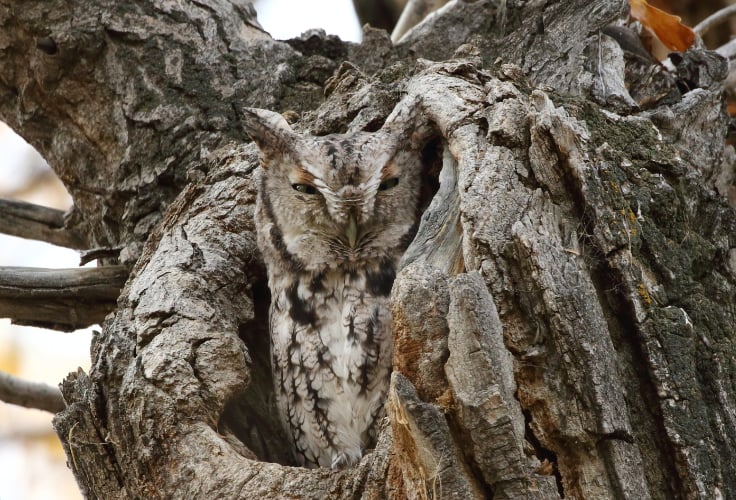
The Eastern Screech-Owl is a small woodland owl that occurs only sporadically in Alberta, where it lies well beyond the core of its established Canadian range. It measures 16 to 25 centimeters (6.3 to 9.8 inches) in length and has a compact, broad-headed build with conspicuous ear tufts, yellow eyes, and a short tail. Alberta birds documented to date show gray or brownish intermediate plumage, consistent with the western subspecies group that predominates in the northern Great Plains, in which the rufous morph is uncommon. The finely barred and streaked plumage closely resembles tree bark, making the species difficult to detect when roosting.
When present, Eastern Screech-Owls are far more often detected by sound than by sight. Their most characteristic vocalizations include a steady monotonic trill used in close-range communication and a descending whinny associated with territorial or alarm contexts. Individuals roost quietly during the day in tree cavities, particularly in large cottonwoods and other mature deciduous trees, and may sit partially exposed at the cavity entrance. Foraging occurs mostly at night and involves short, direct flights from low perches to capture insects, small mammals, birds, and other small prey.
In Alberta, records are concentrated in the extreme southeast of the province, particularly in and around the city of Medicine Hat. Documented observations include wooded riparian parkland such as Strathcona Island Park, Police Point Park, as well as nearby urban and river-valley habitats and areas around Lethbridge. These locations share structural features typical of the species’ core range farther east, including mature deciduous trees, cavity availability, and sheltered riparian corridors. Alberta occurrences are believed to represent irregular dispersal events, potentially linked to the broader northward and westward range expansion documented elsewhere in central Canada and the northern Great Plains.
Because records in Alberta remain extremely limited, the status of Eastern Screech-Owl in the province cannot be reliably assessed. There is no evidence of an established or self-sustaining population, and breeding has not been confirmed. At the national scale, Eastern Screech-Owls show increasing population trends in Canada, particularly in Ontario and Manitoba, but Alberta lies well outside the species’ recognized breeding range. Continued documentation of sightings, vocal records, and potential breeding evidence will be necessary to determine whether the species remains an occasional vagrant or is in the early stages of localized establishment in southeastern Alberta.
American Barn Owl
Tyto furcata
- Identification: Medium-sized owl with a pale, heart-shaped facial disc, long rounded wings, short tail, long sparsely feathered legs, and buff-and-gray upperparts contrasting with whitish underparts.
- Where found: A very rare and irregular visitor in Alberta, recorded sporadically in open agricultural and lowland landscapes, mainly in southern and central parts of the province.
- How to spot: Most often encountered as a ghostly pale owl flying low over open fields at night, or discovered roosting quietly in barns or other agricultural structures.
- Conservation status: Least Concern (IUCN); considered accidental or vagrant in Alberta, with no evidence of a breeding population in the province.

The American Barn Owl is a milestone species for Alberta birders, representing a highly unusual occurrence well outside its established range. It is the only North American owl belonging to the Tytonidae family, making it structurally and behaviorally distinct from all other owl species. It measures 32 to 40 centimeters (12.6 to 15.7 inches) in length and has a lanky, long-legged appearance with a large rounded head, no ear tufts, and long, softly rounded wings. The distinctive heart-shaped facial disc, pale overall coloration, and buoyant flight give the species a ghostly appearance that makes it unmistakable when encountered, even briefly.
American Barn Owls are usually detected when flying low over open ground with slow, buoyant wingbeats, often following roadsides or field edges while hunting. Their vocalizations are infrequent but include a long, harsh, rasping scream rather than hoots. The species hunts primarily by sound, using exceptionally precise auditory localization to capture small mammals, especially rodents, which form the bulk of its diet. During daylight hours, individuals roost quietly in dark, sheltered sites such as barns, sheds, or other agricultural buildings.
In Alberta, the American Barn Owl occurs only as a rare vagrant. Records are scattered and infrequent, with most observations coming from southern and central parts of the province. Documented occurrences include areas around Calgary, locations south of Edmonton, and agricultural regions extending as far north as Wetaskiwin and Bashaw. These records typically involve single birds using pole barns or similar structures in open farmland, mirroring habitat use in the species’ core range farther south and west. Alberta lies far beyond the regular Canadian distribution, which is otherwise restricted to southwestern British Columbia and a very small population in southern Ontario.
Because occurrences in Alberta are extremely rare and irregular, population status cannot be assessed at the provincial level. There is no evidence of an established or self-sustaining population, and all records are treated as accidental. At the national scale, Canadian Barn Owl populations are small and geographically restricted, with western birds in British Columbia remaining at low but stable levels. Alberta records are best interpreted as sporadic dispersal events, likely involving wandering individuals rather than any sustained range expansion into the province.
Where and When to See Owls in Alberta
Owls occur across Alberta in every season, though their distribution and detectability vary strongly with habitat and time of year. Forest-dwelling species such as Boreal Owl, Northern Saw-whet Owl, Barred Owl, Great Gray Owl, and Northern Hawk Owl are most closely tied to the Boreal Forest, Foothills, and montane regions, where mature coniferous or mixedwood stands provide nesting cavities, cover, and prey. In contrast, open-country owls, including Short-eared Owl, Burrowing Owl, Snowy Owl, and Long-eared Owl, are associated with grasslands, parkland, agricultural landscapes, and other open or fragmented terrain, particularly in southern and central Alberta.
Seasonality plays a major role in owl detection. Late winter and early spring are often the best times to hear territorial vocalizations from resident forest owls, while spring and summer bring breeding activity for grassland and parkland species. Autumn and winter see the arrival of migrants and nomadic visitors from the north, most notably Snowy Owls and, in some years, irruptive movements of Northern Hawk-Owls and Great Gray Owls. Many species are present year-round but are easiest to detect during short seasonal windows when calling activity, hunting behavior, or seasonal movements increase detectability. Understanding Alberta’s broad ecological regions, combined with awareness of seasonal patterns, offers the most reliable framework for finding owls in the province, whether listening for a distant hoot in boreal forest or scanning open prairie under winter skies.

