
Updated August 27, 2026
Quick ID: 18 species at a glance
| Species | Length | Field mark | When present |
|---|---|---|---|
| California Condor | Up to 134 cm (52.8 in) | Exceptionally long, broad wings, relatively small head, and short, broad tail | — |
| Trumpeter Swan | Up to 183 cm (72.0 in) | Heavy body, long straight neck, and broad wings | Breeds in spring/summer, winters on ice-free waters or year-round |
| Whooping Crane | 132 centimeters (52.0 inches) | Towering stature, long legs, and broad wings | — |
| American White Pelican | Up to 165 cm (65.0 in) | Longest bill of any North American bird | — |
| Golden Eagle | Up to 99 cm (39.0 in) | Heavy body, long broad wings, relatively small head, and long tail | Year-round in western US; winter in southern Canada, US, and northern Mexico |
| Bald Eagle | Up to 96 cm (37.8 in) | White head and tail | Year-round in milder coastal regions; migrates south in winter |
| Great Blue Heron | 97 to 137 centimeters (38.2 to 53.9 inches) | long neck, long legs, broad rounded wings, and a powerful dagger-like bill | year-round in southern regions; migrates south in winter |
| Sandhill Crane | 120 centimeters (47.2 inches) | bulky body, a slender neck, long legs, and exceptionally broad wings | Breeds in wetlands... with migratory populations wintering mainly in the southern United States and… |
| Wild Turkey | 110 to 115 centimeters (43.3 to 45.3 inches) | large fan-shaped tail | largely nonmigratory |
| Wood Stork | Standing height: As tall as 115 cm (45.3 in) | heavy downcurved bill | breeds mainly in Florida, Georgia, and South Carolina; dispersing widely outside the breeding season |
| Canada Goose | 76 to 115 centimeters (29.9 to 45.3 inches) | black neck with a white chinstrap | year-round |
| Short-tailed Albatross | Up to 94 cm (37.0 in) | Large pink bill | — |
| Brown Pelican | Up to 137 cm (53.9 in) | Enormous expandable throat pouch | Year-round |
| Magnificent Frigatebird | Up to 114 cm (44.9 in) | Remarkably long, narrow wings and deeply forked tail | Year-round (widespread) |
| American Flamingo | 120 to 145 centimeters (47.2 to 57.1 inches) | striking pink plumage | largely resident |
| Turkey Vulture | Up to 81 cm (31.9 in) | Wings held in a shallow V-shaped dihedral | Northern populations migrate south for the winter |
| Mute Swan | Up to 170 cm (66.9 in) | Long neck usually carried in a graceful S-curve | Year-round (established populations) |
| Jabiru | 122 to 140 centimeters (48.0 to 55.1 inches) | enormous heavy bill | — |
North America supports an impressive variety of giant birds, from towering cranes and heavyweight swans to broad-winged raptors, pelicans, and ocean-going seabirds. Some rank among the continent’s tallest, heaviest, or longest-winged species, while others stand out through their familiar presence, unusual proportions, or exceptional rarity. This guide explores the largest birds recorded across the United States and Canada, comparing their size, flight, ecology, distribution, and conservation while highlighting both established residents and remarkable visitors.
California Condor
Gymnogyps californianus
- Wingspan: As wide as 305 cm (120.1 in).
- Weight: As heavy as 14.1 kg (31.1 lb).
- Body length: Up to 134 cm (52.8 in).
- Where found: Reintroduced populations occur in California, Arizona, and southern Utah, where the species inhabits mountains, grasslands, woodlands, and coastal areas while foraging over a wide range of open landscapes.
- Conservation status: Critically Endangered (IUCN); numbers are increasing through intensive recovery efforts, but lead poisoning and a slow reproductive rate continue to hinder recovery.

The California Condor is the largest land bird in North America and the continent’s biggest vulture. Adults measure 117 to 134 centimeters (46.1 to 52.8 inches) in body length, weigh 7.9 to 9.9 kilograms (17.4 to 21.8 pounds), and have a wingspan of 260 to 290 centimeters (102.4 to 114.2 inches). Exceptionally large males have reached a verified 305 centimeters (120.1 inches) in wingspan and 14.1 kilograms (31.1 pounds) in weight, although larger wingspans have been reported without verification. Its enormous size and expansive wings make it the most impressive soaring bird in North American avifauna.

The California Condor combines a bulky body with exceptionally long, broad wings, a relatively small head, and a short, broad tail that together create an efficient soaring design. It rarely flaps except during takeoff and landing, instead spending long periods gliding on thermals and ridge updrafts with steady, powerful flight. The species depends on open landscapes where it can locate carrion visually, relying heavily on deer and other large mammal carcasses, and often follows the activity of Turkey Vultures, Golden Eagles, and Common Ravens to find food. On the ground, it walks and runs surprisingly well despite its size, while its broad wings and heavy build give it a commanding presence around carcasses.
Today, wild California Condors occur only in reintroduced populations in central and southern California, northern Arizona, and southern Utah, although the species formerly ranged much more widely across western North America and even into southern Canada. Condors forage across grasslands, oak savannas, coastal areas, mountain forests, and high meadows, sometimes traveling long distances between feeding areas and nesting sites. They nest primarily in caves and crevices on steep cliff faces in mountainous terrain, although large cavities in giant trees have occasionally been used. Their great size makes launching into flight difficult, so they typically use elevated perches and rugged terrain that provide favorable air currents for soaring.
The California Condor remains one of North America’s greatest conservation success stories, although its recovery is far from complete. After the population fell to just 22 surviving individuals, the species persisted only through captive breeding until reintroductions began in 1992. Today, the total population exceeds 600 birds, with roughly 400 living in the wild, and numbers continue to rise as released birds survive and wild pairs successfully raise young. Recovery remains heavily dependent on human management because condors reproduce very slowly, producing only a single egg every one or two years, while lead poisoning from ammunition fragments in carcasses continues to be the principal obstacle to establishing fully self-sustaining wild populations.
Trumpeter Swan
Cygnus buccinator
- Wingspan: As wide as 305 cm (120.1 in).
- Weight: As heavy as 17.2 kg (37.9 lb).
- Body length: Up to 183 cm (72.0 in).
- Where found: Breeds across Alaska, Canada, and parts of the northern United States, wintering on ice-free lakes, rivers, estuaries, and other wetlands across much of western and central North America.
- Conservation status: Least Concern (IUCN); populations continue to increase following a remarkable recovery, although lead poisoning, habitat loss, and human disturbance remain ongoing concerns.

The Trumpeter Swan is the largest native waterfowl and the heaviest flying bird in North America. Adults typically measure 138 to 158 centimeters (54.3 to 62.2 inches) in body length, weigh 7.7 to 12.7 kilograms (17.0 to 28.0 pounds), and have a wingspan of 180 to 240 centimeters (70.9 to 94.5 inches). Exceptionally large males have reached 183 centimeters (72.0 inches) in length, 305 centimeters (120.1 inches) in wingspan, and 17.2 kilograms (37.9 pounds) in weight. Its immense size, powerful build, and long neck make it one of the most imposing waterbirds in the United States and Canada.

The Trumpeter Swan has a heavy body, long straight neck, and broad wings that provide powerful but deliberate flight. Its great mass requires a long running start across open water before takeoff, with strong wingbeats and slapping feet generating enough speed to become airborne. The species feeds primarily on submerged and emergent aquatic vegetation by reaching below the surface or tipping forward in shallow water, although it also forages in agricultural fields for spilled grain and crops. Its large size allows it to dominate most other waterfowl, including territorial encounters with Canada Geese and even similarly sized Mute Swans, while its loud, resonant trumpeting calls carry long distances and inspired its common name.
The Trumpeter Swan breeds across much of Alaska, western and central Canada, and parts of the northern United States, with restored populations now nesting throughout portions of the Midwest, Great Lakes region, and Northern Rockies. It favors freshwater marshes, shallow lakes, ponds, rivers, beaver wetlands, and other productive wetlands with abundant aquatic vegetation and relatively little human disturbance. Large nests are built on muskrat or beaver lodges, islands, or elevated vegetation close to shallow water. Many northern populations migrate to ice-free rivers, lakes, estuaries, and coastal waters in winter, while others remain year-round where open water and food remain available.
The Trumpeter Swan represents one of North America’s greatest wildlife recovery successes. After the population declined to as few as 69 known individuals by 1935 because of unregulated hunting, legal protection, habitat conservation, and widespread restoration programs allowed the species to recover across much of its former range. Populations continue to increase, and reintroduction efforts have restored breeding birds to many parts of the United States and Canada. Lead poisoning, habitat loss, collisions with power lines, and disturbance at nesting sites remain important threats, but coordinated management continues to support the long-term recovery of this iconic swan.
Whooping Crane
Grus americana
- Wingspan: Up to 235 cm (92.5 in).
- Weight: As heavy as 7.9 kg (17.4 lb).
- Standing height: As tall as 160 cm (63.0 in).
- Where found: Breeds primarily in northern Canada, with reintroduced populations in parts of the United States, and winters mainly along the Texas Gulf Coast and other managed reintroduction areas.
- Conservation status: Endangered (IUCN); numbers continue to increase through intensive conservation, but the species remains dependent on active management and reintroduction programs.

The Whooping Crane is the tallest bird in North America and one of the continent’s largest flying birds. Adults average about 132 centimeters (52.0 inches) in body length, stand 120 to 150 centimeters (47.2 to 59.1 inches) tall, weigh 6.0 to 7.9 kilograms (13.2 to 17.4 pounds), and have a wingspan of 200 to 235 centimeters (78.7 to 92.5 inches). Very tall individuals may reach 160 centimeters (63.0 inches) in height. Its towering stature, long legs, and broad wings create one of the most striking silhouettes in North American birdlife.
The Whooping Crane moves with slow, deliberate steps through wetlands, probing and gleaning for food rather than stalking prey like a heron. It feeds on a wide variety of aquatic animals, insects, amphibians, small reptiles, plant tubers, grains, and berries, with the diet changing seasonally. During migration it combines steady flapping with soaring and gliding to conserve energy over long distances. Its loud bugling calls, amplified by an exceptionally elongated trachea coiled within the breastbone, carry over great distances and gave the species its common name.
The only naturally self-sustaining population breeds in the wetlands of Wood Buffalo National Park in Canada’s Northwest Territories and adjacent Alberta before migrating to winter along the Texas Gulf Coast at and around Aransas National Wildlife Refuge. Additional reintroduced populations occur in Wisconsin, Louisiana, and other parts of the United States. The species breeds in shallow freshwater marshes interspersed with grassy openings and scattered trees, uses broad river valleys and wetlands as migration stopovers, and winters primarily in coastal marshes, estuaries, and nearby agricultural fields.
The Whooping Crane has recovered from one of the most severe population declines recorded for any North American bird. After the population fell to just 21-22 individuals in the 1940s, decades of captive breeding, habitat protection, and carefully managed reintroduction programs have increased the total population to more than 800 birds, with over 700 currently living in the wild. Even so, only one wild population is fully self-sustaining, and threats including power-line collisions, habitat loss, severe weather, and occasional shooting mean the species continues to depend on intensive conservation across the United States and Canada.
American White Pelican
Pelecanus erythrorhynchos
- Wingspan: As wide as 300 cm (118.1 in).
- Weight: As heavy as 13.6 kg (30.0 lb).
- Body length: Up to 165 cm (65.0 in).
- Where found: Breeds across the interior of western and central North America, primarily in the United States and Canada, and winters along the Pacific Coast, Gulf Coast, and other ice-free coastal and inland wetlands.
- Conservation status: Least Concern (IUCN); populations have recovered across much of their range, although disturbance at breeding colonies, wetland alteration, and conflicts at aquaculture facilities remain important concerns.

The American White Pelican is one of the largest birds in North America and has the second-largest average wingspan on the continent after the California Condor. It measures 127 to 165 centimeters (50.0 to 65.0 inches) in body length, weighs 4.5 to 9.0 kilograms (9.9 to 19.8 pounds), and has a wingspan of 244 to 290 centimeters (96.1 to 114.2 inches). Exceptionally large individuals have reached a wingspan of 300 centimeters (118.1 inches) and a weight of 13.6 kilograms (30.0 pounds). The species also possesses the longest bill of any North American bird, reaching up to 39 centimeters (15.4 inches) in large males.
The American White Pelican combines a heavy body, broad wings, long neck, and enormous bill with an efficient soaring flight that allows it to travel great distances while expending relatively little energy. It often glides on thermals in long lines or V-shaped formations, alternating slow, deliberate wingbeats with extended periods of soaring. Unlike plunge-diving pelicans, it feeds from the water’s surface by scooping fish and other aquatic prey into its expandable pouch while swimming. Groups frequently cooperate to herd fish into shallow water, where synchronized feeding increases hunting success. Despite its immense size, the species swims strongly, walks surprisingly well, and usually remains silent away from breeding colonies.
The American White Pelican breeds primarily on isolated islands in shallow freshwater lakes and wetlands across the interior of western and central Canada and the United States, from British Columbia and the Prairie Provinces south through the northern Great Plains, Great Basin, and parts of the western states. Breeding colonies are typically located on predator-free islands, while adults often travel many kilometers to forage in nearby lakes, rivers, and marshes. Most populations migrate south as northern waters freeze, wintering mainly along the Pacific Coast, Gulf Coast, estuaries, coastal bays, inland lakes, and major river systems with open water. Large flocks are also regularly found in California’s Central Valley, the Salton Sea, and the lower Colorado River region during the nonbreeding season.
The American White Pelican has recovered substantially from declines during the mid-20th century and is now considered secure across much of its North American range. Legal protection, reduced persecution, and improved wetland conservation have contributed to increasing populations, although the species still breeds at relatively few colony sites. Because nesting birds are highly sensitive to disturbance, repeated human activity can cause colonies to abandon nests, reducing breeding success. Water-level changes that flood or dry nesting islands, continued loss of shallow wetland habitat, and conflicts with aquaculture operations also remain important management challenges for this impressive colonial waterbird.
Golden Eagle
Aquila chrysaetos
- Wingspan: As wide as 255 cm (100.4 in).
- Weight: As heavy as 7.7 kg (17.0 lb).
- Body length: Up to 99 cm (39.0 in).
- Where found: Breeds across Alaska, Canada, and much of western North America in open and mountainous habitats, with northern birds wintering across southern Canada, the United States, and northern Mexico.
- Conservation status: Least Concern (IUCN); North American populations are broadly stable, but collisions, electrocution, poisoning, habitat alteration, and other human-related mortality remain significant threats.

The Golden Eagle is North America’s largest eagle of open landscapes. Adults measure 70 to 99 centimeters (27.6 to 39.0 inches) in body length, weigh 2.5 to 6.5 kilograms (5.5 to 14.3 pounds), and have a wingspan of 185 to 222 centimeters (72.8 to 87.4 inches). Females are larger than males, and an exceptionally large wild female was documented with a wingspan of 255 centimeters (100.4 inches). North American birds are generally somewhat smaller than their Eurasian relatives, but a female captured and released in Wyoming weighed 7.7 kilograms (17.0 pounds), making it the heaviest authenticated wild Golden Eagle on record.

The Golden Eagle has a heavy body, long broad wings, a relatively small head, and a long tail that together produce a powerful but highly efficient aerial hunter. It usually soars or glides with its wings raised in a shallow “V” and the primary feathers widely spread, using thermal and ridge updrafts to remain airborne with little flapping. The species hunts from soaring flight, low contour flight, or elevated perches, taking prey mainly on or near the ground. Its strong feet and large talons allow it to capture hares, ground squirrels, birds, and other medium-sized animals, while its size also gives it an advantage at carcasses, where it can displace many avian and mammalian scavengers.
The Golden Eagle breeds across most of Alaska and Canada and throughout much of the western United States, extending south into Mexico. It occupies tundra, shrub-steppe, grasslands, deserts, farmland, open woodland, and mountainous terrain, especially landscapes with cliffs, ridges, or other topographic relief that provide nesting sites and favorable soaring conditions. Pairs usually build large stick nests on cliff ledges, although trees and human-made structures are also used in some regions. Eagles from northern Canada and Alaska may migrate thousands of kilometers south for winter, while many birds breeding in the western United States remain near their territories throughout the year. Smaller numbers from eastern Canada winter through the Appalachians and other parts of the eastern United States.
Golden Eagle populations appear broadly stable in North America, and the species remains widespread across suitable western and northern habitats. Legal protection in the United States prohibits killing the birds or damaging their eggs and nests, but human activity continues to account for much recorded mortality. Eagles are killed by vehicle and structure collisions, wind turbines, electrocution on power poles, poisoning, and lead fragments consumed in carrion. Urban expansion, agricultural development, altered wildfire patterns, and the loss or degradation of open hunting habitat also reduce the quality of nesting and foraging areas, particularly in parts of the western United States.
Bald Eagle
Haliaeetus leucocephalus
- Wingspan: As wide as 244 cm (96.1 in).
- Weight: As heavy as 7.4 kg (16.3 lb).
- Body length: Up to 96 cm (37.8 in).
- Where found: Breeds near lakes, rivers, reservoirs, wetlands, and coastlines throughout most of Canada and the United States, with many northern birds wintering farther south wherever open water and abundant food remain available.
- Conservation status: Least Concern (IUCN); populations have rebounded dramatically across North America, although lead poisoning, collisions, habitat loss, and pollution continue to pose ongoing threats.

The Bald Eagle is the national bird of the United States and North America’s largest sea eagle. Adults measure 71 to 96 centimeters (28.0 to 37.8 inches) in body length, weigh 3.0 to 6.3 kilograms (6.6 to 13.9 pounds), and have a wingspan of 168 to 244 centimeters (66.1 to 96.1 inches). Females are about 25% larger than males, with the biggest birds occurring in Alaska and Canada. Exceptionally large Alaskan females may weigh more than 7 kilograms (15.4 pounds), and one authenticated individual reached 7.4 kilograms (16.3 pounds). A historical record from New York describes an adult Bald Eagle that reportedly weighed 8.2 kilograms (18.1 pounds), although this measurement has not been independently authenticated using modern standards.

The Bald Eagle combines a heavy body, large head, broad wings, and powerful feet into an efficient predator and scavenger closely associated with water. It usually flies with slow, deliberate wingbeats before transitioning into long periods of soaring and gliding on flat-held wings. Fish make up most of its diet, but it also captures waterfowl and mammals, feeds extensively on carrion, and frequently steals prey from Ospreys, herons, and other birds. Large gatherings may form at rich food sources during winter, where competition is intense and larger individuals often dominate feeding sites through their size and strength.
The Bald Eagle breeds throughout most of Alaska, Canada, and every state in the contiguous United States, nesting wherever large bodies of water are bordered by mature forests or suitable cliffs. It favors lakes, rivers, reservoirs, marshes, estuaries, and coastal shorelines that provide abundant fish and tall trees for nesting and perching. Pairs construct enormous stick nests that are among the largest of any bird, adding fresh material year after year. The largest nest ever recorded measured 2.9 meters (9.5 feet) across, 6.1 meters (20 feet) deep, and was found near St. Petersburg, Florida. Northern populations migrate south as lakes and rivers freeze, while many birds in milder coastal regions remain near their breeding territories throughout the year.
The Bald Eagle is one of North America’s greatest conservation success stories. After severe declines caused by persecution, habitat loss, and widespread reproductive failure linked to DDT, legal protection, the banning of the pesticide, and habitat conservation allowed populations to recover across nearly the entire historic range. The species was removed from the U.S. Endangered Species List in 2007, and breeding populations continue to thrive throughout much of the continent. Today, the principal threats include lead poisoning from ammunition, collisions with vehicles and human-made structures, shoreline development, and environmental contamination, although the species remains secure over most of its range.
Great Blue Heron
Ardea herodias
- Wingspan: As wide as 201 cm (79.1 in).
- Weight: As heavy as 2.5 kg (5.5 lb).
- Standing height: As tall as 160 cm (63.0 in).
- Where found: Breeds across most of the United States and southern Canada in wetlands, lakes, rivers, marshes, estuaries, and coastal habitats, with northern populations migrating south while many southern birds remain year-round.
- Conservation status: Least Concern (IUCN); populations are generally stable, although wetland loss, human disturbance at nesting colonies, and pollution continue to affect some regional populations.

The Great Blue Heron is the largest heron in North America and one of the continent’s tallest birds. This species measures 97 to 137 centimeters (38.2 to 53.9 inches) in body length, weighs 2.1 to 2.5 kilograms (4.6 to 5.5 pounds), and has a wingspan of 167 to 201 centimeters (65.7 to 79.1 inches). Standing height typically ranges from 115 to 138 centimeters (45.3 to 54.3 inches), while exceptionally tall individuals may reach 150 to 160 centimeters (59.1 to 63.0 inches) with the neck fully extended, rivaling some Whooping Cranes in height. Its towering stature, long legs, and elongated neck make it one of the most imposing wading birds in the United States and Canada.
The Great Blue Heron combines a long neck, long legs, broad rounded wings, and a powerful dagger-like bill into a body perfectly adapted for hunting in shallow water. It usually forages alone, walking slowly with deliberate strides or standing motionless before striking prey with a lightning-fast thrust of the neck. Fish make up most of its diet, although it also catches amphibians, reptiles, mammals, birds, and invertebrates. In flight, it folds its neck into a tight S-shape while its long legs trail behind, and its deep, slow wingbeats create one of the most recognizable silhouettes of any North American bird.
The Great Blue Heron breeds across most of the United States, southern Canada, and southeastern Alaska, occupying an exceptional variety of freshwater and coastal wetlands. It nests in colonies known as heronries, where large stick nests are built high in trees or other elevated sites near productive feeding areas. The species forages in marshes, estuaries, lakes, rivers, ponds, shorelines, and coastal shallows, but also hunts in grasslands, agricultural fields, and even urban areas where suitable prey is available. Northern populations migrate south as waters freeze, while many birds along the Pacific Coast, the Gulf Coast, and southern Atlantic states remain throughout the year.
The Great Blue Heron remains widespread and common across much of North America, and overall populations have remained stable while increasing in parts of the United States. Its adaptability has allowed it to thrive in a wide range of natural and human-modified landscapes, although successful breeding depends on relatively undisturbed nesting colonies and healthy wetland ecosystems. Habitat loss, disturbance from logging, boating, and other human activities, together with pollution and declining water quality, continue to affect some populations. Regional declines have also occurred in southern Florida, where environmental contaminants are believed to have contributed to reduced breeding success.
Sandhill Crane
Antigone canadensis
- Wingspan: As wide as 230 cm (90.6 in).
- Weight: As heavy as 5.4 kg (11.9 lb).
- Standing height: Up to 150 cm (59.1 in).
- Where found: Breeds in wetlands, grasslands, and prairies from Alaska and northern Canada across parts of the United States, with migratory populations wintering mainly in the southern United States and northern Mexico.
- Conservation status: Least Concern (IUCN); most populations are stable or increasing, but isolated non-migratory populations remain vulnerable to wetland and grassland loss.

The Sandhill Crane is one of the tallest and most conspicuous large birds in North America. Adults average 120 centimeters (47.2 inches) in body length, stand 100 to 120 centimeters (39.4 to 47.2 inches) tall, weigh 3.4 to 4.9 kilograms (7.5 to 10.8 pounds), and have a wingspan of 180 to 200 centimeters (70.9 to 78.7 inches). Males of the Greater Sandhill Crane subspecies can weigh at least 5.4 kilograms (11.9 pounds), span as much as 230 centimeters (90.6 inches), and stand 136 to 150 centimeters (53.5 to 59.1 inches) tall, approaching the height of a Whooping Crane. Size varies substantially across the species, with the smallest forms breeding in the Arctic and the largest breeding mainly in the northern United States.
The Sandhill Crane has a bulky body, a slender neck, long legs, and exceptionally broad wings that support both powerful flapping flight and high-altitude migration. It walks steadily through wetlands and open fields while searching for grains, seeds, invertebrates, and other food, rather than stalking prey in open water like a heron. Migrating cranes often circle upward on rising air before traveling in large flocks, while their long legs trail behind and their necks remain extended in flight. Their great size also makes adults formidable when threatened, as they can spread their wings, stab with the bill, leap, and kick at predators. Loud rolling calls produced by an elongated trachea can carry for long distances and frequently reveal approaching flocks before the birds become visible.
Sandhill Cranes breed widely from Alaska and Arctic Canada across central Canada, the Great Lakes region, the northern Great Plains, the Rocky Mountains, and parts of the western United States. Smaller non-migratory populations occur in Florida, southeastern Georgia, and coastal Mississippi. The species uses open freshwater marshes, bogs, sedge meadows, wet prairies, grasslands, pine savannas, and agricultural landscapes, with pairs nesting on the ground in or near shallow wetlands. Migratory populations gather at traditional staging areas before continuing to wintering grounds in California, the southern Great Plains, Texas, New Mexico, Arizona, the southeastern United States, and northern Mexico. Large flocks commonly feed in fields and grasslands by day and roost in shallow water at night.
Most Sandhill Crane populations are numerous and have increased in both abundance and distribution, allowing the species to recolonize parts of the northern and eastern United States where it had previously disappeared. This overall recovery masks serious concerns for several isolated populations. The Mississippi Sandhill Crane remains endangered after much of its wet pine-savanna habitat was converted or degraded, while the non-migratory Florida population also faces continued habitat pressure. Sandhill Cranes reproduce slowly because pairs usually raise no more than one young to fledging each year, which limits their ability to recover rapidly from losses. Long-term conservation therefore depends on protecting breeding wetlands, open grasslands, migration staging sites, and the major wintering areas where enormous flocks concentrate.
Wild Turkey
Meleagris gallopavo
- Wingspan: As wide as 144 cm (56.7 in).
- Weight: As heavy as 17.1 kg (37.6 lb).
- Standing height: As tall as 120 cm (47.2 in).
- Where found: Widespread across most of the United States and southern Canada in mature forests, woodlands, and forest edges interspersed with fields, with many populations restored through successful reintroduction programs.
- Conservation status: Least Concern (IUCN); populations have recovered dramatically across North America through conservation and management, although healthy forest habitats remain essential to their long-term success.

The Wild Turkey is the largest native game bird in North America and one of the continent’s heaviest flying birds. It measures 110 to 115 centimeters (43.3 to 45.3 inches) in body length, stands 76 to 102 centimeters (29.9 to 40.2 inches) tall, weighs 3.6 to 9.5 kilograms (7.9 to 20.9 pounds), and has a wingspan of 125 to 144 centimeters (49.2 to 56.7 inches). Mature males can grow to about 120 centimeters (47.2 inches) tall, and the heaviest verified wild gobbler, recorded in Kentucky, weighed an astonishing 17.1 kilograms (37.6 pounds).
The Wild Turkey combines a heavy body with long, powerful legs, broad rounded wings, and a large fan-shaped tail that together suit a life spent mostly on the ground. It walks constantly while foraging, scratching through leaf litter with its strong feet to uncover nuts, seeds, berries, insects, and other small food items, and it usually chooses to run rather than fly when escaping danger. Despite its weight, it is capable of explosive takeoffs and surprisingly strong flight over short distances, reaching high speeds before gliding to safety, while running speeds can approach 40 kilometers per hour (25 miles per hour). During spring, displaying males inflate their iridescent plumage, spread the tail into a broad fan, lower their wings, and deliver loud gobbling calls that carry over long distances.
Wild Turkeys occur across most of the contiguous United States and extend into southern Canada, where established populations occupy parts of British Columbia, Alberta, Saskatchewan, Manitoba, Ontario, and Quebec. They inhabit mature deciduous and mixed forests, especially those containing oaks, hickories, or beeches, together with adjacent clearings, grasslands, agricultural fields, and woodland edges that provide abundant food. The species is largely nonmigratory, although local seasonal movements occur in response to food availability and weather. At night, turkeys fly into large trees to roost, while nesting takes place on the ground beneath dense vegetation.
The Wild Turkey represents one of North America’s greatest wildlife restoration success stories. Unregulated hunting and widespread habitat loss caused severe declines during the nineteenth and early 20th centuries, eliminating the species from large portions of its former range. Modern restoration programs using wild-caught birds, combined with habitat management and regulated hunting, allowed populations to recover across nearly all suitable habitat and re-establish the species in many areas where it had disappeared. Today, Wild Turkeys remain abundant throughout most of their range, and continued conservation focuses on maintaining healthy forests, productive woodland openings, and sustainable management of this iconic game bird.
Wood Stork
Mycteria americana
- Wingspan: As wide as 175 cm (68.9 in).
- Weight: As heavy as 3.1 kg (6.8 lb).
- Standing height: As tall as 115 cm (45.3 in).
- Where found: In the United States, breeds mainly in Florida, Georgia, and South Carolina, inhabiting freshwater and coastal wetlands, swamps, marshes, ponds, and estuaries while dispersing widely outside the breeding season.
- Conservation status: Least Concern (IUCN); the recovered Southeast U.S. population was delisted under the U.S. Endangered Species Act in 2026, although the species remains dependent on healthy wetland ecosystems.
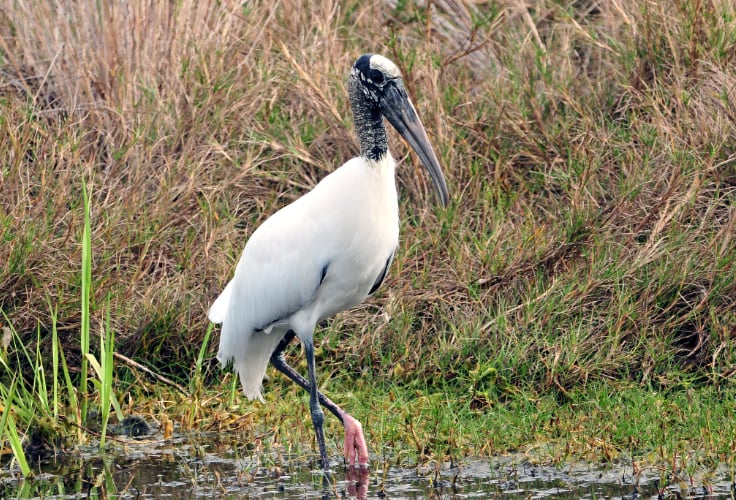
The Wood Stork is the only stork native to the United States and one of North America’s largest wading birds. The species stands 85 to 115 centimeters (33.5 to 45.3 inches) tall, weighs 2.0 to 3.1 kilograms (4.4 to 6.8 pounds), and has a wingspan of 150 to 175 centimeters (59.1 to 68.9 inches). Its imposing size, long legs, heavy downcurved bill, and broad wings give it a distinctive silhouette among the continent’s wetland birds.
The Wood Stork combines a heavy body, long neck, and thick, slightly decurved bill with broad wings that allow both efficient flapping flight and effortless soaring on thermals. Unlike herons that rely primarily on sight, it feeds mainly by touch, slowly walking through shallow water with its bill held open until it snaps shut almost instantly when prey makes contact. Fish form the bulk of its diet, although it also catches crustaceans, amphibians, and other aquatic animals. Wood Storks often forage in groups or single-file lines, and when traveling longer distances they soar high above the landscape with the neck and legs fully extended, conserving energy in much the same way as vultures.
In the United States, the Wood Stork breeds primarily in Florida, coastal Georgia, and South Carolina, although breeding locations shift as wetland conditions change from year to year. Colonies are established in trees standing over freshwater swamps, flooded forests, or tidal wetlands, where surrounding water helps protect nests from terrestrial predators. The species feeds in shallow marshes, swamps, ponds, tidal creeks, flooded agricultural fields, and other wetlands where receding water concentrates fish. Rather than undertaking regular long-distance migrations, Wood Storks disperse widely after breeding and move in response to changing water levels and food availability, with many birds shifting south into Florida during winter.
Wood Stork populations remain stable overall, but the species depends on healthy wetland ecosystems with predictable seasonal water levels for successful breeding. The recovery of the southeastern U.S. distinct population segment led to its delisting under the Endangered Species Act in 2026, followed by long-term post-delisting monitoring. Nevertheless, drainage projects, water diversion, and other alterations of natural wetlands can still reduce feeding opportunities and disrupt nesting. Low water levels may also expose colonies to increased predation by mammals, while poor foraging conditions can cause birds to abandon nesting attempts altogether. Continued wetland conservation and careful water management remain essential for maintaining healthy breeding populations across the southeastern United States.
Canada Goose
Branta canadensis
- Wingspan: As wide as 224 cm (88.2 in).
- Weight: As heavy as 10.9 kg (24.0 lb).
- Body length: Up to 115 cm (45.3 in).
- Where found: Widespread across North America in wetlands, lakes, rivers, marshes, farmland, parks, and urban areas, breeding from the Arctic to the southern United States.
- Conservation status: Least Concern (IUCN); populations are abundant and continue to thrive, aided by habitat adaptation and successful management.

The Canada Goose is one of North America’s largest and most familiar waterfowl. It measures 76 to 115 centimeters (29.9 to 45.3 inches) in body length, weighs 2.4 to 9.0 kilograms (5.3 to 19.8 pounds), and has a wingspan of 127 to 170 centimeters (50.0 to 66.9 inches). An exceptionally large male of the Giant Canada Goose subspecies weighed 10.9 kilograms (24.0 pounds) and had a wingspan of 224 centimeters (88.2 inches), making it the largest wild goose ever recorded. Its impressive size, powerful build, and unmistakable black neck with a white chinstrap make it one of the continent’s most recognizable birds.
The Canada Goose is a strong walker, swimmer, and flier, equally at home on land and water. It grazes efficiently on grasses and other vegetation, tips forward to reach submerged aquatic plants, and readily feeds in agricultural fields where grains become an important food source. During migration, flocks travel in familiar V-shaped formations, maintaining constant vocal contact while covering great distances with powerful, steady wingbeats. Although large subspecies are less migratory than their smaller northern relatives, all are capable of rapid takeoffs from land or water and long-distance flights between breeding and wintering grounds.
The Canada Goose breeds across an enormous range extending from the Arctic tundra and boreal forests of Alaska and Canada south through much of the United States. It nests near lakes, ponds, rivers, marshes, and wetlands, selecting sites that provide a clear view of approaching predators and easy access to water. Today, the species also breeds successfully in parks, reservoirs, golf courses, and suburban neighborhoods following widespread reintroductions and natural range expansion. Wintering birds occupy wetlands, estuaries, reservoirs, rivers, and agricultural landscapes throughout much of the United States and northern Mexico, while many resident populations no longer migrate at all.
Canada Goose populations have increased dramatically over the past century following conservation efforts, regulated hunting, and successful reintroduction programs, making it one of North America’s greatest waterfowl conservation success stories. Its remarkable adaptability has allowed many populations to flourish in landscapes heavily influenced by people, where manicured lawns, parks, reservoirs, and agricultural fields provide abundant food and nesting habitat. In some urban areas, these thriving populations have become a management challenge because of conflicts with people and hazards around airports. Despite these local issues, the species remains abundant across its range and is considered secure for the foreseeable future.
Short-tailed Albatross
Phoebastria albatrus
- Wingspan: As wide as 240 cm (94.5 in).
- Weight: As heavy as 7.5 kg (16.5 lb).
- Body length: Up to 94 cm (37.0 in).
- Where found: Breeds mainly on islands south of Japan and disperses across the North Pacific, occurring regularly in Alaskan waters and more rarely offshore from British Columbia to California.
- Conservation status: Vulnerable (IUCN); populations are increasing after a near-extinction-level decline, but fishery bycatch, oil pollution, volcanic activity, and concentration at a few breeding colonies remain major concerns.

The Short-tailed Albatross is the largest seabird regularly found in North American waters. Adults measure 80 to 94 centimeters (31.5 to 37.0 inches) in body length, weigh 5.1 to 7.5 kilograms (11.2 to 16.5 pounds), and have a wingspan of 213 to 240 centimeters (83.9 to 94.5 inches). Individuals exceeding 300 centimeters (118.1 inches) in wingspan and 11 kilograms (24.3 pounds) in weight have been reported, but these exceptional claims remain unverified. Its combination of immense wings, heavy body, and enormous bill distinguishes it from the other albatrosses encountered off Alaska, Canada, and the western United States.

The Short-tailed Albatross has long, broad wings adapted for efficient travel across vast stretches of ocean, where it glides for extended periods while searching for food near the surface. Adults are predominantly white with black wings and tail, while juveniles are dark brown and gradually acquire paler plumage as they mature; all ages have a particularly large pink bill. The species feeds mainly on squid, fish, flying-fish eggs, and crustaceans, often scavenging around fishing vessels and taking discarded offal. Its substantial size allows it to dominate other seabirds at feeding concentrations, while its broad wings make sustained flight over the open North Pacific far less energetically demanding than continuous flapping.
The Short-tailed Albatross breeds almost entirely on remote islands south of Japan, especially Torishima and islands of the Senkaku group, with occasional nesting attempts and successful breeding recorded farther east in Hawaii. After breeding, birds disperse widely across the northern Pacific, and many travel into the Gulf of Alaska, the Aleutian Islands, and the Bering Sea. The species occurs regularly in Alaskan waters, particularly from spring through summer, but remains rare farther south along the coasts of British Columbia, Washington, Oregon, and California. It is a fully pelagic bird away from breeding colonies and is most often associated with productive continental-shelf waters and areas of strong upwelling.
The Short-tailed Albatross has recovered gradually after commercial feather hunting reduced a population once numbering in the millions to the brink of extinction. Legal protection, habitat management, artificial colony attraction, and chick-translocation projects have supported steady population growth and encouraged the establishment of additional breeding sites. The species nevertheless remains vulnerable because most breeding birds are concentrated on only a few islands, including an active volcanic island exposed to eruptions, erosion, and severe storms. Fishery bycatch, oil-based contaminants, introduced rodents, and the tendency of birds to gather in predictable feeding areas continue to threaten the long-term security of the recovering population.
Brown Pelican
Pelecanus occidentalis
- Wingspan: As wide as 228 cm (89.8 in).
- Weight: As heavy as 5 kg (11.0 lb).
- Body length: Up to 137 cm (53.9 in).
- Where found: Occurs along the Atlantic, Gulf, and Pacific coasts of the United States, inhabiting marine shores, estuaries, bays, coastal wetlands, and nearby offshore islands, with only occasional use of inland waters.
- Conservation status: Least Concern (IUCN); populations have recovered strongly from pesticide-related declines, although oil spills, fishing gear, and disturbance at nesting colonies remain important threats.

The Brown Pelican is the coastal counterpart of the American White Pelican and one of the largest birds in North America. This species measures 100 to 137 centimeters (39.4 to 53.9 inches) in body length, weighs 2 to 5 kilograms (4.4 to 11.0 pounds), and has a wingspan of 200 to 228 centimeters (78.7 to 89.8 inches). Although noticeably smaller than its inland relative, it remains an impressive bird with a bill reaching nearly 38 centimeters (15.0 inches) in length and an enormous expandable throat pouch used for catching fish.
The Brown Pelican has a heavy body, long neck, and broad wings that provide efficient, energy-saving flight over coastal waters. It commonly glides low above the ocean in lines or V-formations, taking advantage of air currents generated by waves, cliffs, and coastal updrafts while alternating slow, powerful wingbeats with extended glides. Unlike the American White Pelican, which feeds mainly from the water’s surface, the Brown Pelican captures fish by plunge-diving from heights of up to 20 meters (65.6 feet), stunning prey with the impact before scooping it into its expandable pouch. Extensive air sacs beneath the skin cushion these high-speed dives and prevent the bird from fully submerging, allowing it to return quickly to the surface and drain the water before swallowing its catch.
The Brown Pelican occurs along the Atlantic, Gulf, and Pacific coasts of the United States, extending north to Maryland on the Atlantic coast and central California on the Pacific coast. Most populations remain close to their breeding areas throughout the year, although some undertake postbreeding movements along the coast and a few birds reach southern British Columbia or inland waters such as California’s Salton Sea. The species inhabits warm coastal environments, including beaches, estuaries, bays, lagoons, and continental shelf waters, where it usually forages within 20 kilometers (12.4 miles) of shore. It nests colonially on predator-free offshore islands, barrier islands, mangrove islets, and other isolated coastal sites that provide safe nesting habitat close to productive fishing grounds.
The Brown Pelican is one of North America’s best-known conservation success stories. Populations collapsed during the mid-20th century after pesticides, particularly DDT and endrin, caused widespread breeding failure and direct mortality, leading to federal protection and extensive recovery efforts. Following the ban on DDT, habitat protection, and reintroduction programs in parts of its former range, numbers increased steadily and the species was removed from the U.S. Endangered Species List in 2009. Today, oil spills, entanglement in fishing gear, disturbance at breeding colonies, and ongoing degradation of coastal habitats remain the principal human-related threats to this widespread seabird.
Magnificent Frigatebird
Fregata magnificens
- Wingspan: As wide as 244 cm (96.1 in).
- Weight: As heavy as 1.9 kg (4.2 lb).
- Body length: Up to 114 cm (44.9 in).
- Where found: Occurs along the tropical and subtropical Atlantic, Gulf, and Pacific coasts of the Americas, reaching the southern United States, where it inhabits coastal waters, offshore islands, lagoons, and nearby open ocean.
- Conservation status: Least Concern (IUCN); populations remain widespread, but some breeding colonies have declined because of coastal development, overfishing, introduced predators, and storm impacts.

The Magnificent Frigatebird has one of the longest wingspans of any bird in North America despite weighing far less than the continent’s largest birds. Adults measure 89 to 114 centimeters (35.0 to 44.9 inches) in body length, weigh 1 to 1.9 kilograms (2.2 to 4.2 pounds), and have a wingspan of 217 to 244 centimeters (85.4 to 96.1 inches). Its remarkably long, narrow wings and deeply forked tail create one of the most distinctive flight silhouettes over North American coasts. Unlike similarly wide-winged seabirds, its lightweight build is specialized almost entirely for life in the air.

The Magnificent Frigatebird is among the most accomplished aerial birds in the world, often soaring for hours with only occasional slow, deep wingbeats. It rarely lands on the water because its plumage is not waterproof, instead capturing flying fish, squid, and other prey by snatching them from the ocean’s surface without getting wet. The species is equally famous for kleptoparasitism, pursuing pelicans, boobies, tropicbirds, gulls, and other seabirds until they disgorge their catch, which the frigatebird deftly snatches before it reaches the sea. Its extremely short legs and small feet make walking virtually impossible, so it spends most of its life either in flight or perched on trees, shrubs, posts, or other elevated structures.
In the United States, the Magnificent Frigatebird breeds only in the Dry Tortugas of southern Florida, although it occurs regularly along the Gulf Coast, southern Atlantic Coast, Caribbean, and tropical Pacific coast of Mexico. Wandering birds frequently appear far beyond their normal range after storms, occasionally reaching California, Arizona, or even more northern states and Canadian provinces. The species nests colonially on predator-free offshore islands, using mangroves, low scrub, and small trees close to productive coastal waters. Outside the breeding season, it ranges widely over warm coastal and offshore waters, often remaining airborne for extended periods while searching for food.
The Magnificent Frigatebird remains widespread across the tropical Americas, but several breeding colonies have disappeared following coastal development and increasing human disturbance. Nesting success may also be reduced by introduced predators on breeding islands, overfishing that lowers prey availability, and powerful hurricanes that damage nesting habitat and colonies. Because the species depends on relatively few secure nesting sites and raises its young slowly, protecting undisturbed breeding islands and healthy marine ecosystems remains important for its long-term conservation.
American Flamingo
Phoenicopterus ruber
- Wingspan: As wide as 165 cm (65.0 in).
- Weight: As heavy as 4.1 kg (9.0 lb).
- Standing height: As tall as 152 cm (59.9 in).
- Where found: Occurs mainly in the Caribbean, the Yucatán Peninsula of Mexico, and the northern coast of South America, with regular occurrences in southern Florida and occasional dispersal to other parts of the United States.
- Conservation status: Least Concern (IUCN); habitat loss, wetland degradation, pollution, and climate change continue to threaten important breeding and feeding areas.

The American Flamingo is one of the most unmistakable large birds in North America and also among its tallest, owing to its exceptionally long legs and elongated neck. It measures 120 to 145 centimeters (47.2 to 57.1 inches) in body length, weighs 2.1 to 4.1 kilograms (4.6 to 9.0 pounds), and has a wingspan of 140 to 165 centimeters (55.1 to 65.0 inches). Standing birds can reach approximately 152 centimeters (59.9 inches) in height, making them taller than most herons and cranes. The species’ striking pink plumage, towering silhouette, and elongated proportions make it among the continent’s most distinctive large waterbirds.
The American Flamingo is highly specialized for feeding in shallow saline waters. It walks slowly through lagoons with its head inverted beneath the surface, sweeping its uniquely bent bill from side to side to filter tiny crustaceans and other aquatic organisms through densely packed lamellae. Large flocks often feed in synchronized groups, a behavior that improves vigilance and helps birds locate productive feeding areas while reducing competition between individuals. In flight, flamingos travel in loose lines with steady wingbeats and outstretched necks and legs, producing loud honking calls that are often compared to those of geese.
In North America, the American Flamingo occurs primarily on the Yucatán Peninsula of Mexico and throughout the Caribbean, with increasing numbers recorded in southern Florida. It inhabits shallow coastal lagoons, salt pans, estuaries, mudflats, and other saline or hypersaline wetlands where abundant invertebrates support its specialized feeding strategy. Breeding colonies are established on isolated mudflats and shallow coastal wetlands, where pairs construct distinctive cone-shaped mud nests that elevate a single egg above fluctuating water levels. Although the species is largely resident, it is highly dispersive, and hurricanes occasionally carry birds far beyond their normal range, resulting in remarkable appearances across much of the eastern United States.
The American Flamingo remains widespread across its tropical range, but many colonies face increasing pressure from human activity. Coastal development, tourism, salt extraction, pollution, and the degradation of wetlands continue to reduce the quality of feeding and nesting habitats. Climate change poses an additional long-term challenge by altering rainfall patterns, water levels, and salinity in the shallow wetlands on which the species depends. Protecting large coastal wetland complexes and minimizing disturbance at breeding colonies remain important priorities for maintaining healthy populations throughout the region.
Turkey Vulture
Cathartes aura
- Wingspan: As wide as 200 cm (78.7 in).
- Weight: As heavy as 2.2 kg (4.9 lb).
- Body length: Up to 81 cm (31.9 in).
- Where found: Breeds across most of the United States and southern Canada in a wide variety of open and semi-open habitats, with northern populations migrating south for the winter.
- Conservation status: Least Concern (IUCN); populations have increased across much of North America, although lead poisoning, poisoning of carcasses, and human persecution remain localized threats.

The Turkey Vulture is the most familiar large soaring scavenger across much of the United States and southern Canada. Adults measure 64 to 81 centimeters (25.2 to 31.9 inches) in body length, weigh 1.4 to 2.2 kilograms (3.1 to 4.9 pounds), and have a wingspan of 150 to 200 centimeters (59.1 to 78.7 inches). Although lighter than its broad wings suggest, its long wings, soaring flight, and habit of circling overhead make it appear much larger in the sky. It is one of the most frequently encountered large birds in North America, especially over open landscapes where rising air currents support effortless flight.

The Turkey Vulture is superbly adapted for energy-efficient soaring. It typically flies with its wings held in a shallow V-shaped dihedral, rocking gently from side to side while searching for food with only occasional wingbeats. Unlike most birds of prey, it relies heavily on an exceptionally well-developed sense of smell to locate carrion, allowing it to detect carcasses concealed beneath forest canopies or dense vegetation. Once food is found, its hooked bill is well suited for tearing soft tissue, although it often depends on larger scavengers or mammals to open the hides of large carcasses. Despite its imposing appearance in flight, it is generally less aggressive than the Black Vulture and often yields to that species at feeding sites.
The Turkey Vulture occupies one of the broadest distributions of any bird in the Americas. It breeds across most of the continental United States and extends into southern Canada from British Columbia to the Maritime provinces, while northern populations migrate to the southern United States, Mexico, Central America, and South America during winter. The species inhabits an extraordinary variety of landscapes, including forests, grasslands, farmland, deserts, mountains, wetlands, suburbs, and coastlines wherever suitable soaring conditions and food are available. It nests in sheltered natural cavities such as caves, rock crevices, hollow logs, and abandoned buildings, laying its eggs directly on the ground without constructing a conventional nest.
The Turkey Vulture is one of North America’s most successful large birds, and its populations have increased steadily over recent decades as legal protection and changing landscapes have benefited the species. Although no longer affected by the severe pesticide-related declines experienced during the DDT era, it remains vulnerable to lead poisoning from ammunition fragments in carcasses and gut piles, as well as intentional poisoning and persecution based on the mistaken belief that it spreads disease. By rapidly consuming carrion, Turkey Vultures provide an important ecological service that helps recycle nutrients and reduce the spread of disease across natural and human-modified landscapes.
Mute Swan
Cygnus olor
- Wingspan: As wide as 238 cm (93.7 in).
- Weight: As heavy as 15.7 kg (34.6 lb).
- Body length: Up to 170 cm (66.9 in).
- Where found: Introduced populations are established in the Northeast, Mid-Atlantic, Great Lakes region, southwestern British Columbia, and parts of California, where they inhabit lakes, ponds, marshes, slow rivers, estuaries, and sheltered coastal waters.
- Conservation status: Least Concern (IUCN); North American populations are established and generally secure, but their effects on native waterbirds and aquatic vegetation have prompted control programs in several regions.

The Mute Swan is the second-largest waterfowl species in North America after the native Trumpeter Swan, although large males can equal or exceed male Trumpeter Swans in mass. It measures 127 to 152 centimeters (50.0 to 59.8 inches) in body length, weighs 5.5 to 14.3 kilograms (12.1 to 31.5 pounds), and has a wingspan of 208 to 238 centimeters (81.9 to 93.7 inches). Exceptional individuals may reach 170 centimeters (66.9 inches) in length, while especially large males can weigh 15.7 kilograms (34.6 pounds). One extraordinary Polish cob reportedly weighed 22.5 kilograms (49.6 pounds), the greatest verified weight recorded for a flying bird, although whether such a heavy individual could still become airborne has been questioned.
The Mute Swan combines a massive body with short legs, broad wings, and a long neck usually carried in a graceful S-curve. Its great weight requires a running takeoff across land or water, and birds may reach about 48 kilometers per hour (30 miles per hour) while accelerating to gain lift before flying at speeds of up to 88.5 kilometers per hour (55 miles per hour). The species feeds mainly on submerged aquatic vegetation by dipping its long neck or upending in water deeper than most other dabbling waterfowl can reach. Mute Swans are strongly territorial during breeding and may swim toward intruders with their wings raised, although most confrontations involve displays or brief displacement rather than serious attacks. Their enduring pair bonds have also made swans famous as symbols of lifelong fidelity, even though mate changes occasionally occur.
The Mute Swan is not native to North America but became established after birds imported from Eurasia for ornamental ponds, estates, parks, and zoos escaped or were released. Large populations now occur along the Atlantic Coast from Massachusetts to Virginia, around Lakes Erie and Ontario in southern Ontario, and across much of Michigan, with smaller established populations elsewhere in the Great Lakes region, southwestern British Columbia, Pennsylvania, and central California. The species occupies shallow lakes, marshes, ponds, reservoirs, canals, slow-flowing rivers, estuaries, and sheltered coastal waters with abundant aquatic vegetation. Most North American birds make only short seasonal movements, although freezing conditions may force them toward ice-free coastal waters, rivers, and larger lakes.
The Mute Swan presents an unusual conservation problem in North America because its populations are secure, but its non-native status and ecological effects create management concerns. Dense populations can uproot large quantities of aquatic vegetation, occupy breeding territories used by native waterbirds, and displace other species from nesting and feeding areas. Wildlife agencies have therefore used egg addling, removal, and other population-control measures in parts of the Atlantic, Central, and Pacific flyways, including areas where managers are restoring native Trumpeter Swans. Collisions with power lines and other structures, lead poisoning from fishing weights and spent ammunition, and public controversy surrounding control programs remain additional management challenges.
Jabiru
Jabiru mycteria
- Wingspan: As wide as 280 cm (110.2 in).
- Weight: As heavy as 8.1 kg (17.9 lb).
- Standing height: Up to 153 cm (60.2 in).
- Where found: Breeds from southern Mexico through Central America and much of South America; in the United States it is an exceptionally rare visitor, recorded primarily in Texas, with isolated records elsewhere in the South.
- Conservation status: Least Concern (IUCN); secure across much of South America, although habitat loss has caused declines in parts of Central America.

The Jabiru is one of the largest birds ever recorded in the United States, despite occurring there only as an exceptional vagrant. It measures 122 to 140 centimeters (48.0 to 55.1 inches) in body length, weighs 4.3 to 8.1 kilograms (9.5 to 17.9 pounds), and has a wingspan of 230 to 260 centimeters (90.6 to 102.4 inches). Large males may stand up to 153 centimeters (60.2 inches) tall and attain an impressive wingspan of 280 centimeters (110.2 inches). The species is the tallest flying bird in Central and South America, while its wingspan is surpassed there only by the Andean Condor. Males are about 25% larger than females, making the Jabiru one of the most sexually dimorphic storks.
The Jabiru combines exceptional height with long legs, a massive neck, and an enormous heavy bill that is well suited for capturing large aquatic prey. It forages by striding through shallow wetlands, repeatedly probing and splashing its bill through the water to locate fish, frogs, snakes, young caimans, turtles, and other prey by touch as well as sight. During the dry season, groups may feed together and even help concentrate fish in shrinking pools, while solitary foraging is more common during wetter periods. Although powerful in flight, the Jabiru usually travels with slow, steady wingbeats interspersed with soaring, taking advantage of rising air currents much like North America’s large storks and vultures.
The Jabiru breeds in large freshwater wetlands from southern Mexico through Central America and across much of tropical South America, occupying marshes, floodplains, savannas, lagoons, riverbanks, and seasonally flooded grasslands. Local movements are closely tied to rainfall and changing water levels, with birds shifting between wetlands as feeding conditions change throughout the year. In the United States, the species is only an accidental visitor. Most records have come from Texas, with a few additional observations in Oklahoma, Mississippi, and Louisiana, making any encounter a remarkable event for birders seeking the continent’s largest birds.
The Jabiru remains widespread and locally common across much of South America, particularly in extensive wetland systems such as the Pantanal, where large populations persist. However, numbers have declined substantially in parts of Central America because of wetland loss, habitat degradation, and increasing isolation of breeding populations. Protected areas and wetland conservation have helped maintain small regional populations, but preserving large, healthy floodplain ecosystems remains essential for the species’ long-term future.
North America’s Avian Giants
North America’s largest birds range from familiar residents seen across everyday landscapes to rare giants recorded only on exceptional occasions. Their size supports many different ways of life, from soaring and long-distance migration to deep-water feeding, powerful hunting, and life in expansive wetlands and coastal habitats. Together, these species show that avian size is defined not by a single measurement, but by a remarkable variety of heights, weights, wingspans, and ecological adaptations.

Raeesah Habib is a South African conservationist and freelance writer. She completed a diploma in nature conservation in 2016 through the University of South Africa (UNISA). During her internship, she spent a year working with wattled cranes on the Wattled Crane Recovery Programme (WCRP).
The program aims to prevent the local extinction of the wattled crane in Southern Africa through the release of captive-reared individuals into critically endangered wild populations across the country. During her time at the research facility, she was also responsible for the general monitoring and husbandry of other magnificent species, including blue cranes and secretary birds.
Following her internship, she was fortunate to have worked in some spectacular wilderness areas across the country, including the Cradle of Humankind, the Kruger National Park, and the northern Zululand. As a wildlife monitor, her responsibilities included conducting bird point counts. Birds surveys are a useful means to collect data on the avian populations in an area. The data helps researchers gain an understanding of population trends and ecosystem health.
When not in the field, Rae enjoys writing to share her passion, knowledge, and experiences with others.