
Florida is a focal area for ibises in the eastern United States, with five species documented across the state’s varied wetlands. These range from the widespread white ibis to the locally breeding glossy ibis and the rare white-faced ibis, along with two additional species encountered only under unusual circumstances. This guide provides identification notes and Florida-specific context on habitat, distribution, seasonal timing, and status for every ibis recorded in the state.
White Ibis
Eudocimus albus
- Identification: Medium-large white ibis with black wingtips, a long pink decurved bill, and pink legs; adults have pale blue eyes and bare facial skin that deepens in color seasonally.
- Where found: Widespread across Florida year-round, especially in shallow freshwater marshes, coastal wetlands, mangroves, flooded pastures, and increasingly in urban parks and lawns in southern parts of the state.
- How to spot: Look for large flocks walking steadily through shallow water while probing with curved bills; listen for coarse “hunk-hunk-hunk” calls from flying or roosting birds.
- Conservation status: Least Concern (IUCN); in Florida, populations fluctuate locally and remain sensitive to wetland alteration and water management.

The white ibis is a highly recognizable wading bird in Florida and has become a strong symbol of the state’s wetlands and their conservation. This species measures 56 to 68 centimeters (22.0 to 26.8 inches) in length and shows an almost entirely white body contrasted by black wingtips visible mainly in flight. Adults have a long, strongly decurved bill and long legs, both typically pink to reddish in color depending on season, with pale blue eyes set in bare facial skin. Juveniles differ noticeably, appearing brown above and white below with streaking on the neck and duller orange-pink bills and legs.

White ibises forage by walking steadily through shallow water or soft mud while probing continuously with the bill held partly open. This tactile feeding style sets them apart from herons that stalk prey visually, and it makes their movement across wetlands appear constant and deliberate. Birds often feed shoulder to shoulder in dense flocks and may leap over one another as groups advance across feeding grounds. In flight, white ibises travel in cohesive flocks, usually forming loose V-shaped lines or long skeins, with rapid wingbeats alternating with short glides. Their most frequent vocalization is a coarse, repeated “hunk-hunk-hunk,” especially given in flight or near colonies.
In Florida, white ibises occur statewide and use a wide range of wetland habitats, shifting locations in response to rainfall and water depth. They forage most often in shallow freshwater marshes, wet prairies, sawgrass ponds, flooded pastures, and marsh edges, as well as in mangrove-lined streams, tidal wetlands, and coastal lagoons. During winter and the wet season, many birds move between interior freshwater wetlands and coastal habitats, while in southern Florida they increasingly forage on lawns, golf courses, and urban parks when wetlands become too deep. Nesting can occur in any month when feeding conditions are suitable, though most breeding activity falls between spring and summer, with colonies concentrated in central and southern Florida, especially in the Everglades region.
Although white ibises remain numerous and widely distributed in Florida, their local abundance varies greatly from year to year due to the species’ nomadic movements and shifting colony locations. Long-term declines in parts of southern Florida have been linked to altered hydrologic regimes, wetland loss, and changes in water management that reduce the availability of shallow foraging habitat. At the same time, recent increases in some areas and the species’ growing use of urban landscapes show a degree of adaptability. Continued protection and restoration of natural wetland systems remain critical for maintaining stable breeding and foraging conditions for this iconic Florida wader.
Glossy Ibis
Plegadis falcinellus
- Identification: Medium-sized dark ibis with a long curved bill; adults show rich chestnut body plumage with metallic green, bronze, and purple gloss, appearing almost black at a distance.
- Where found: Local and irregular across Florida, most often in shallow freshwater marshes, wet prairies, and flooded fields, with scattered records statewide.
- How to spot: Look for dark ibises walking slowly and probing in shallow wetlands, often in small flocks; in flight, note the outstretched neck and legs and steady wingbeats.
- Conservation status: Least Concern (IUCN); in Florida, numbers fluctuate and the species remains uncommon and locally distributed.

The glossy ibis is a distinctive but often overlooked ibis in Florida, where its dark plumage and patchy distribution make it less conspicuous than lighter-colored wading birds. This species measures 48 to 66 centimeters (18.9 to 26.0 inches) in length and has a compact body, long neck, long legs, and a slender, decurved bill. Breeding adults show rich chestnut tones on the head, neck, and underparts, contrasted by glossy metallic green, bronze, and purple on the wings and back. Outside the breeding season, plumage becomes duller with fine pale streaking on the head and neck. Immatures appear browner overall, with variable pale markings on the face and neck.

Glossy ibises forage primarily by tactile probing, walking slowly through shallow water or soft mud while repeatedly inserting the bill into the substrate. This steady, methodical feeding behavior often occurs in small, cohesive flocks, sometimes mixed with other wading birds. Birds may completely submerge the bill or sweep it side to side while searching for invertebrate prey. In flight, glossy ibises hold the neck and legs fully extended and fly with purposeful wingbeats interspersed with short glides. Flocks often form loose V-shaped or diagonal lines, and individuals occasionally circle high before descending toward feeding or roosting sites. Vocalizations are generally subdued, consisting of grunts or croaking notes most often heard near colonies.
In Florida, glossy ibises occur irregularly across much of the state and show a strong preference for shallow freshwater habitats. They forage most frequently in marshes, wet prairies, river-edge wetlands, flooded pastures, and agricultural fields with moist soils, and they use brackish wetlands, mudflats, and mangroves less consistently. Breeding occurs locally, primarily from central Florida southward, with nesting typically beginning in spring and extending into early summer. The species nests in mixed-species colonies over water, using sawgrass, shrubs, or low woody vegetation, and may shift colony locations frequently from year to year.
Glossy ibis numbers in Florida have fluctuated markedly over time, reflecting the species’ nomadic tendencies and sensitivity to wetland conditions. Although the species expanded its range in North America during the 20th century, more recent surveys indicate declines in parts of Florida, likely linked to freshwater wetland drainage and altered hydrology. The species remains generally uncommon in the state and is easily overlooked due to its dark coloration and tendency to nest in small numbers within larger colonies. Continued maintenance of shallow freshwater wetlands is important for supporting Florida’s variable and locally breeding glossy ibis population.
White-Faced Ibis
Plegadis chihi
- Identification: Medium-sized dark ibis with a long decurved bill; breeding adults show a red eye and facial skin bordered by a sharp white facial band.
- Where found: Rare and irregular in Florida, occurring primarily as a post-breeding wanderer in marshes, wet fields, and other shallow wetlands.
- How to spot: Look for a dark ibis in mixed or single-species flocks; close views may reveal the white facial border and red eye in breeding-plumaged adults, distinguishing it from glossy ibis.
- Conservation status: Least Concern (IUCN); in Florida, occurrences reflect long-distance dispersal rather than a stable population.

The white-faced ibis is a rare and irregular visitor to Florida, where it appears as a long-distance disperser far outside its primary western breeding range. This species measures 46 to 56 centimeters (18.1 to 22.0 inches) in length and has a long neck, long legs, and a slender, strongly decurved bill. At a distance, the plumage appears dark maroon-brown to nearly black. In breeding plumage, adults show rich chestnut-maroon body coloration with metallic green and bronze sheen on the wings, along with a reddish eye and bare facial skin bordered by a distinctive white band that fully encircles the back of the eye. Non-breeding adults and immatures are duller brown overall and lack the white facial border.
White-faced ibises forage by walking steadily through shallow water or moist soil while probing with the bill, locating prey primarily by touch. This tactile feeding style resembles that of other ibises and includes probing, groping, and sweeping motions of the bill through mud or water. Birds usually feed in flocks, sometimes numbering in the hundreds in core parts of the range, though Florida observations typically involve much smaller groups. In flight, the species flies strongly and directly with rapid wingbeats alternating with glides, holding the neck and legs fully outstretched. Flocks often form loose V-shaped lines or long skeins, and birds may soar on thermals or perform abrupt dives before landing.
In Florida, white-faced ibises occur sporadically and are best interpreted as post-breeding dispersers rather than residents. Records are associated mainly with shallow freshwater marshes, wet prairies, flooded fields, and other open wetlands that resemble habitats used elsewhere in the species’ range. Movements into Florida most often follow the breeding season, when adults and subadults wander widely across North America. There is no evidence of regular breeding in the state, and occurrences are unpredictable from year to year.
The rarity of the white-faced ibis in Florida reflects its western-centered distribution and highly mobile nature rather than local habitat limitation alone. Although the species has expanded and fluctuated in parts of North America over time, Florida records remain infrequent and localized. Individuals are likely overlooked among flocks of darker ibises unless seen well, particularly when the diagnostic white facial border is visible. Florida observations therefore represent exceptional dispersal events rather than a sustained or increasing presence in the state.
African Sacred Ibis
Threskiornis aethiopicus
- Identification: Very large ibis with a thick, strongly curved black bill, bare black head and neck, white body, black trailing edge to the wings, and shaggy black plumes on the rump.
- Where found: Non-native and formerly free-flying in southern Florida, primarily near urban areas, wetlands, and refuges in the Everglades region.
- How to spot: Look for a white ibis-like bird much larger than native ibises, with a fully black head and neck and a black trailing edge visible along the wings in flight.
- Conservation status: Least Concern (IUCN); in Florida, treated as an invasive species and subject to eradication efforts.

The African sacred ibis is a non-native species in Florida that was formerly present as a free-flying and locally breeding bird following accidental releases in the early 1990s. This large ibis measures 65 to 89 centimeters (25.6 to 35.0 inches) in length and is noticeably bulkier than native ibises. Adults show a white body contrasted by a bare black head and neck, black bill, black legs and feet, and a distinctive black trailing edge to the wings. During the breeding season, shaggy black ornamental plumes develop on the rump and inner wings. Immatures differ by having feathered, mottled black-and-white heads and necks, which increases the risk of confusion with other large white wading birds.
African sacred ibises forage primarily by walking slowly through shallow water, mud, or short vegetation while probing and pecking for prey. They feed opportunistically on a wide range of items, including insects, crustaceans, worms, small vertebrates, eggs, carrion, and refuse, and often forage in small groups that may grow into larger aggregations. In flight, the species travels with steady wingbeats interspersed with short glides, usually forming loose lines or irregular flocks. Vocalizations are generally limited away from breeding colonies, where a variety of squeals, croaks, and moaning calls may be heard.
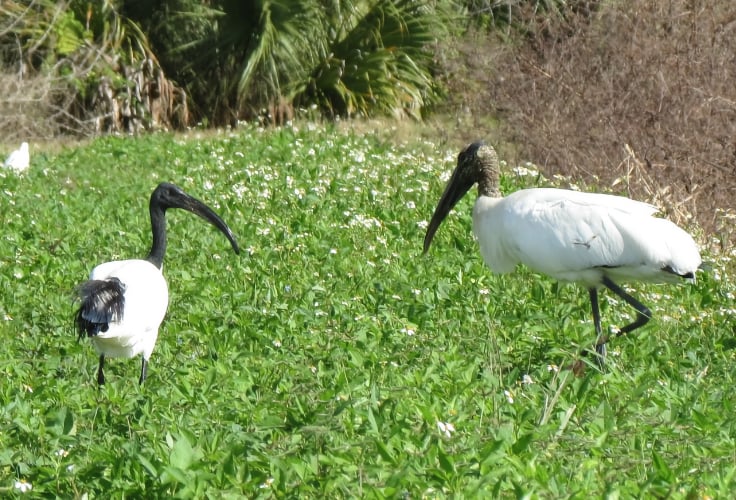
In Florida, free-flying African sacred ibises were first documented after Hurricane Andrew in 1992, when individuals escaped from the Miami Metro Zoo and possibly from private collections. Birds remained concentrated in southern Florida, including Everglades National Park and nearby refuges, where limited breeding was confirmed in the mid-2000s. The species used a wide range of habitats, including marshes, estuaries, urban retention ponds, agricultural fields, and areas near human activity, mirroring its adaptability in other introduced regions worldwide.
Due to concerns over competition with native wading birds, predation on eggs and chicks, and the potential for rapid population growth, coordinated eradication efforts were undertaken by state and federal agencies. By the late 2000s, most free-flying birds in Florida had been removed, and the species is believed to have been largely eradicated from the wild in the state, though occasional unconfirmed reports continue to surface. As a result, the African sacred ibis remains relevant in Florida bird identification primarily as a formerly present invasive species and as a potential source of confusion with native ibises and the endangered wood stork.
Scarlet Ibis
Eudocimus ruber
- Identification: Large, striking ibis with intense scarlet-red plumage and black wingtips; hybrids with white ibis appear pink to orange and show mixed coloration.
- Where found: Not a regular Florida species; known from historical introduction attempts, hybrid individuals, and rare unusual sightings rather than a natural population.
- How to spot: Any bright red or pink ibis in Florida warrants careful scrutiny; look for intermediate coloration and mixed traits suggesting hybrid origin.
- Conservation status: Least Concern (IUCN); in Florida, occurrences are tied to introduction and hybridization rather than natural range expansion.

The scarlet ibis is an exceptionally rare sight in Florida, typically involving birds of hybrid origin rather than naturally occurring pure individuals. Adults are unmistakable in pure plumage, measuring 55 to 76 centimeters (21.7 to 29.9 inches) in length and appearing entirely vivid scarlet red, with black tips to the outer flight feathers, a long drooping bill, and tall reddish legs. Immature birds are much duller, with brownish head and neck streaking, gray-brown upperparts, and extensive white below, often mottled with pink.
Scarlet ibises hybridize readily with white ibises, producing birds that range from pale pink to salmon or orange, often with uneven coloration across the body. This hybridization was first documented in Florida following an introduction attempt at Greynolds Park in North Miami Beach in 1961, when scarlet ibis eggs from Trinidad were placed into white ibis nests. The introduced birds did not establish a lasting population, but hybrid offspring were subsequently observed in coastal Florida and occasionally farther north. These hybrid birds, sometimes referred to informally as “pink ibises,” can persist for years within flocks of white ibises and complicate field identification.

In their native range, scarlet ibises forage by walking slowly through shallow water or exposed mud, probing with the bill while feeding in cohesive flocks. Similar behavior has been noted in Florida among hybrid individuals associating with white ibis flocks, particularly in coastal wetlands, mangroves, and open mudflats. Flight is direct and purposeful, with flocks forming loose V-shapes or irregular skeins that alternate between flapping and gliding. Vocalizations are generally subdued and rarely provide useful field clues in Florida observations.
State records of scarlet ibis-like birds are best interpreted in the context of historical introduction, escape from captivity, and hybridization rather than natural dispersal. Although historical accounts from the nineteenth century suggest the possibility of rare natural vagrancy along the Gulf Coast, virtually all modern records in the southeastern United States involve introduced birds or their hybrid descendants. As a result, the scarlet ibis remains an exceptional and irregular presence in Florida, with sightings representing biological curiosities rather than evidence of an expanding or established range.
Where and When to See Ibises in Florida
Across the state of Florida, ibises are most reliably found in shallow wetlands where water levels concentrate prey, including freshwater marshes, wet prairies, flooded pastures, and coastal estuaries. The white ibis is present year-round and often easiest to observe during periods of falling water, while glossy ibises are more localized and may be overlooked without careful scanning of mixed wading-bird flocks. Rare species appear unpredictably and typically require close attention to habitat conditions, seasonal movements, and subtle identification details. Careful observation of plumage, structure, and behavior, combined with an understanding of Florida’s dynamic wetland systems, greatly increases the chance of encountering and correctly identifying ibises across the state.


