
Nebraska is the crane capital of North America, hosting one of the world’s greatest wildlife migrations each spring. More than a million Sandhill Cranes gather along the Platte River Valley to rest and refuel before continuing to their northern breeding grounds, creating an unforgettable spectacle that attracts birders and photographers from around the world. Alongside these vast flocks, the state also serves as an important migration stopover for the endangered Whooping Crane, while exceptional Eurasian visitors such as the Common Crane and Hooded Crane have produced some of North America’s most remarkable vagrant records. This guide covers all four crane species recorded in Nebraska, with practical identification tips, seasonal occurrence, habitats, and the best places to see them.
Quick ID: 4 species at a glance
| Species | Length | Field mark | When present |
|---|---|---|---|
| Sandhill Crane | 100 to 120 centimeters (39.4 to 47.2 inches) | bare red crown in adults | — |
| Whooping Crane | 120 to 150 centimeters (47.2 to 59.1 inches) | black wingtips visible in flight | spring and fall migration |
| Common Crane | 95 to 120 centimeters (37.4 to 47.2 inches) | broad white stripe running from behind the eye down the side of the neck | rare spring visitor (early March to early April) |
| Hooded Crane | 91 to 100 centimeters (35.8 to 39.4 inches) | fully white neck and head, contrasting dark facial area | spring |
Sandhill Crane
Antigone canadensis
- Identification: Large gray crane with long legs and neck, broad wings, a drooping feathered bustle over the tail, pale cheek, and a bare red crown in adults.
- Where found: Abundant during spring migration along the central Platte River Valley, with smaller numbers elsewhere statewide and rare local breeding in wetlands, wet meadows, and marshes.
- How to spot: Look for tall cranes feeding in cornfields and wet meadows by day, gathering on broad river channels at night, or flying in large calling flocks with necks and legs fully extended.
- Conservation status: Least Concern (IUCN); increasing in Nebraska, where major spring concentrations remain dependent on open river roosts, wet meadows, and nearby agricultural feeding areas.

The Sandhill Crane is Nebraska’s most abundant crane and one of the state’s most celebrated migratory birds. The species measures 100 to 120 centimeters (39.4 to 47.2 inches) in height and has a wingspan of around 200 centimeters (78.7 inches). Its long legs, elongated neck, broad wings, and upright posture make it conspicuous in open landscapes. Adults are mostly gray, although many show rusty or cinnamon staining on the upperparts. A pale cheek contrasts with the gray neck, and bare red skin covers the crown and forehead. Elongated inner wing feathers droop over the short tail to form a distinctive feathered bustle.

Sandhill Cranes are often detected first by their loud, rolling trumpeting calls, which carry over long distances and are frequently heard from migrating or roosting flocks. Birds forage by walking slowly through cornfields, pastures, wet meadows, and shallow wetlands, where they probe the ground or pick food from the surface. Their diet includes waste grain, seeds, plant material, invertebrates, and small vertebrates. During migration, flocks fly with steady wingbeats and with the neck and legs fully extended. Along the Platte River, cranes feed mainly in surrounding agricultural fields and meadows during the day before gathering on broad, shallow river channels to roost at night.
The Sandhill Crane is an abundant spring and fall migrant in central Nebraska, common in the west, and less numerous in the east. The largest spring concentrations occur in the Platte and North Platte River valleys, especially between Grand Island and Lexington, with major gatherings also occurring near North Platte, Hershey, Lewellen, and Lake Minatare. Birds begin arriving as early as late January, numbers usually peak during March, and most depart by the end of April. Spring migrants use shallow river channels for roosting and nearby cornfields, pasture, and wet meadows for feeding. Fall migration begins in late August and peaks mainly in October, when birds move through the state more quickly and form smaller, more widely scattered concentrations. The species is also a rare local breeder statewide. Confirmed nesting has occurred in the Rainwater Basin and at scattered wetland sites in counties including Sioux, Morrill, Rock, Scotts Bluff, Knox, Saunders, and Lincoln. Small but increasing numbers also winter regularly in the central Platte River Valley, particularly during mild winters.
Sandhill Crane numbers are increasing in Nebraska, and the central Platte River Valley supports one of the continent’s most important spring staging concentrations. The species disappeared as a regular breeder by the early twentieth century after unregulated hunting and habitat loss, but nesting resumed during the 1990s and has since been documented at scattered sites across the state. Variable water levels limit regular breeding in some wetlands, particularly in the Rainwater Basin. The major migratory population remains dependent on a connected landscape of open river channels, wet meadows, and agricultural feeding areas. Water development, woody vegetation encroachment, conversion of wet meadows, declining waste-corn availability, and changes in farming practices continue to alter crane distribution and foraging patterns. Mechanical clearing and habitat management help maintain the broad, unobstructed river channels that cranes require for safe nighttime roosting.
Whooping Crane
Grus americana
- Identification: Very large white crane with a long neck and legs, broad wings, black wingtips visible in flight, and a red crown with dark facial bristles in adults.
- Where found: Occurs locally during spring and fall migration through central Nebraska, especially along the central Platte River, Rainwater Basin, Loup River system, and other shallow wetland stopovers.
- How to spot: Search among Sandhill Crane flocks for a much taller white bird, and in flight look for the fully extended neck, trailing legs, broad wings, and contrasting black primaries.
- Conservation status: Endangered (IUCN); state- and federally listed as Endangered in Nebraska, where migration habitat remains vulnerable to wetland loss, river alteration, disturbance, power lines, and wind-energy development.

The Whooping Crane is the rarest of Nebraska’s two native cranes and the tallest bird found in North America. It stands 120 to 150 centimeters (47.2 to 59.1 inches) tall, with exceptional individuals occasionally reaching about 160 centimeters (63 inches), and has a wingspan of roughly 230 centimeters (91 inches). Adults are almost entirely white, with a long neck, long dark legs, broad wings, and a pronounced feathered bustle at the rear. Bare red skin covers the crown, while sparse dark facial bristles and a darker patch on the nape create a distinctive head pattern. The black primaries remain hidden when the wings are folded but form conspicuous black wingtips in flight.

Whooping Cranes usually occur alone, in pairs, or in small family groups, often among much larger flocks of Sandhill Cranes. Their greater height, white plumage, and slower, stately movements usually make them conspicuous at close range. Birds forage by walking through shallow wetlands, river flats, and agricultural fields, where they probe, browse, and glean a varied diet of plant and animal material. Flight is powerful but unhurried, with the neck and legs held fully extended, and migrating birds frequently soar or glide between periods of shallow wingbeats. Loud whooping or bugling calls may carry over long distances, although Nebraska migrants are often first detected visually during stopovers.
The Whooping Crane is a locally rare but regular spring and fall migrant through central Nebraska and a rare casual visitor elsewhere in the state. Most birds belong to the Aransas-Wood Buffalo population, which travels between breeding wetlands in northwestern Canada and wintering areas on the Texas coast. Spring passage occurs mainly from late March through mid-April, while fall migration peaks from late October into early November. The central Platte River Valley supports the largest share of Nebraska records, particularly the stretch between Shelton and Lexington that has been designated as critical habitat. Other regularly used areas include Rainwater Basin wetlands, the Loup River system, the Central Table Playas, the Sandhills, and the middle Niobrara River Valley. Birds roost mainly in open river channels and shallow wetlands and feed in wetlands and nearby agricultural fields. Most stop for only a few days, although individuals may remain longer in the Rainwater Basin. Rare summer records usually involve non-breeding immatures, and there is no evidence that the species has ever nested in Nebraska.
Whooping Cranes remain extremely scarce in Nebraska despite the long-term recovery of the wild migratory population from near-extinction. Their migration corridor through the Great Plains has gradually shifted east, and spring passage has also become earlier over recent decades. Nebraska stopover habitat remains essential because migrants depend on wide, unobstructed river channels, shallow wetlands, open views, and nearby feeding areas. River narrowing, vegetation encroachment, wetland loss, human disturbance, and collisions with power lines continue to threaten suitable habitat and individual birds. Wind-energy development presents an additional concern because cranes avoid areas near turbines, reducing the amount of usable habitat within the migration corridor. Federal and state agencies closely track reported sightings, protect designated critical habitat along the Platte River, and coordinate conservation across major migration stopovers.
Common Crane
Grus grus
- Identification: Large slate-gray crane with black primaries, a black head and neck, a bold white stripe from behind the eye down the nape, and a small red crown patch.
- Where found: Occurs as a rare spring visitor to central and western Nebraska, where it is almost always found among migrating Sandhill Cranes in the Platte River Valley.
- How to spot: Carefully scan Sandhill Crane flocks for a gray crane with a black head and neck, a broad white nape stripe, and high-pitched rolling calls.
- Conservation status: Least Concern (IUCN); globally stable and increasing, but in Nebraska it remains an exceptionally rare visitor, with most records concentrated along the Platte River during spring migration.

The Common Crane is a widespread Eurasian species that occurs in Nebraska as a rare spring visitor. Most state records involve single birds accompanying migrating Sandhill Cranes through the Platte River Valley. It measures 95 to 120 centimeters (37.4 to 47.2 inches) in length and has a wingspan of about 200 centimeters (78.7 inches). Its overall shape closely resembles a Sandhill Crane, with a long neck, long legs, and an upright stance, but adults are slate gray with a distinctive black head and neck, a broad white stripe running from behind the eye down the side of the neck, and a small red patch on the crown.

Finding a Common Crane in Nebraska usually means locating it within large flocks of Sandhill Cranes. At a distance, its size and posture closely match those of Sandhill Cranes, making careful study of the head pattern essential. The bold white nape stripe and dark head readily separate it from Sandhill Cranes, while its gray body distinguishes it from the white-plumaged Whooping Crane. Birds forage in agricultural fields, wet meadows, and shallow wetlands alongside Sandhill Cranes, feeding on plant material and small animal prey. Their loud rolling, trumpeting calls can also help reveal their presence when birds are in flight.
In Nebraska, the Common Crane is a rare but increasingly regular spring migrant, with nearly all records occurring between early March and early April. Most sightings come from the central and western Platte River Valley, particularly around Hershey, North Platte, Rowe Sanctuary, Gibbon, Kearney, Alda, and Lewellen, although occasional birds have also been found at Clear Creek Marshes and other nearby wetlands. Nearly every individual associates closely with Sandhill Crane staging flocks, often remaining at a stopover site for several days before continuing north. Winter records are exceptional and involve birds remaining with wintering Sandhill Cranes, while there are no confirmed breeding records in the state.
Nebraska has produced the majority of documented North American records of the Common Crane, making the state one of the continent’s most reliable places to encounter this exceptional visitor. Recent springs have produced multiple individuals, suggesting that the species may occur more regularly than previously recognized, although determining the actual number of birds is difficult because individuals move between Sandhill Crane concentrations. Careful documentation remains important because escaped birds have occurred elsewhere in North America, but Nebraska records are generally regarded as involving naturally occurring vagrants that have joined migrating Sandhill Cranes.
Hooded Crane
Grus monacha
- Identification: Medium-sized gray crane with a fully white neck and head, contrasting dark facial area, a small red bare-skin patch on the forecrown, and black primaries.
- Where found: Occurs accidentally in Nebraska, with the state’s only accepted record involving a single bird that remained with Sandhill Cranes along the central Platte River in Hall County during spring.
- How to spot: Search Sandhill Crane flocks for a smaller gray crane with a striking white head and neck, lacking the red crown of Sandhill Crane and the all-white body of Whooping Crane.
- Conservation status: Vulnerable (IUCN); an exceptionally rare visitor to North America, with Nebraska’s only accepted record considered to represent a naturally occurring vagrant.
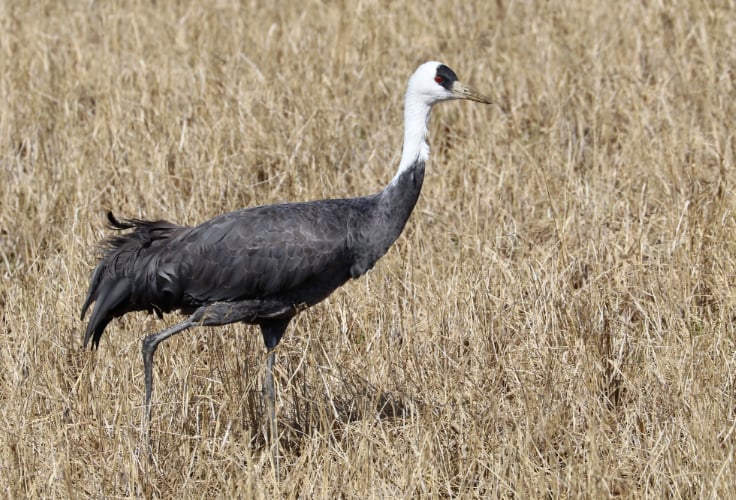
The Hooded Crane is one of the rarest birds ever recorded in Nebraska and one of the state’s most remarkable crane discoveries. This species measures 91 to 100 centimeters (35.8 to 39.4 inches) in length and has a wingspan of about 180 centimeters (70.9 inches). It is noticeably smaller and more compact than Nebraska’s native cranes. Adults are mostly gray with black primaries, while the white head and neck form a distinctive hood that contrasts sharply with the dark face and the small red patch on the forecrown.

Like other cranes, the Hooded Crane walks deliberately while foraging in fields and shallow wetlands, probing and picking food from the ground. In Nebraska, the principal challenge is finding one among thousands of Sandhill Cranes rather than identifying it once seen well. The combination of a gray body with a completely white head and neck readily separates it from Sandhill Crane, while its gray plumage distinguishes it from the predominantly white Whooping Crane. Loud rolling calls are characteristic of the species but are seldom useful during such exceptional North American occurrences.
The Hooded Crane has no regular range in North America and is known in Nebraska from a single accepted record. One adult was discovered in Hall County on 25 March 2011, where it remained with staging Sandhill Cranes along the central Platte River until 11 April. The bird foraged in agricultural fields adjacent to the Platte River and attracted observers from across North America during its prolonged stay. Although its origin was initially questioned, an extensive review found no evidence of captive provenance, and the record was accepted onto the Official List of the Birds of Nebraska.
The Hooded Crane remains an accidental visitor in Nebraska, and any future occurrence would be considered an exceptional ornithological event. The 2011 record became one of the most carefully evaluated crane records in North America because of questions surrounding its origin. Although the Nebraska record was accepted as a natural vagrant, the American Birding Association initially declined to add the species to its checklist based on the 2010–2012 records. That changed after a wild Hooded Crane was documented in Alaska in 2020, providing convincing evidence that the species is capable of reaching North America naturally. Today, the Nebraska bird is regarded as part of this pattern of exceptional long-distance vagrancy.
Where and When to See Cranes in Nebraska
Nebraska is one of the world’s premier destinations for crane watching, thanks to the spectacular spring migration along the Platte River. From late February through mid-April, more than a million Sandhill Cranes gather in the central Platte River Valley to rest and feed before continuing north, with peak numbers typically occurring throughout March. This is also the best time to look for rarer species such as Whooping Crane, while exceptional Eurasian visitors including Common Crane and Hooded Crane have all been discovered among these vast Sandhill Crane flocks.
The best viewing opportunities occur at sunrise and sunset, when cranes leave or return to their shallow river roosts in immense, noisy flocks. During the day, they disperse into nearby cornfields, wet meadows, and wetlands to feed. Guided tours and designated viewing areas allow visitors to observe the migration without disturbing the birds, while careful scanning of the large congregations can occasionally reward observers with one of Nebraska’s famous rare crane sightings.
Key Viewing Spots
- Rowe Sanctuary (Gibbon, Buffalo County) – Nebraska’s premier crane-watching destination, offering guided sunrise and sunset tours overlooking major Platte River roosts.
- Crane Trust Nature & Visitor Center (Wood River, Hall County) – Excellent public trails, educational exhibits, and access to one of the Platte Valley’s largest staging areas.
- Fort Kearny State Recreation Area & Platte River Bridge – Popular public viewpoints for watching cranes depart and return to their river roosts.
- Plautz Crane Viewing Deck (Shelton, Buffalo County) – A well-known observation site for sunrise and sunset flights during peak migration.
- North Platte River Valley (North Platte/Hershey, Lincoln County) – Outstanding western viewing area with guided blind tours and public observation sites during spring migration.
- Rainwater Basin Wetlands – An important stopover region, especially for Whooping Cranes, offering productive wetland habitat away from the main Platte River corridor.
For a broader perspective, see our guide to the types of cranes in North America, and explore the Birds of Nebraska and Birds of the United States pages for additional regional and national bird guides.

Raeesah Habib is a South African conservationist and freelance writer. She completed a diploma in nature conservation in 2016 through the University of South Africa (UNISA). During her internship, she spent a year working with wattled cranes on the Wattled Crane Recovery Programme (WCRP).
The program aims to prevent the local extinction of the wattled crane in Southern Africa through the release of captive-reared individuals into critically endangered wild populations across the country. During her time at the research facility, she was also responsible for the general monitoring and husbandry of other magnificent species, including blue cranes and secretary birds.
Following her internship, she was fortunate to have worked in some spectacular wilderness areas across the country, including the Cradle of Humankind, the Kruger National Park, and the northern Zululand. As a wildlife monitor, her responsibilities included conducting bird point counts. Birds surveys are a useful means to collect data on the avian populations in an area. The data helps researchers gain an understanding of population trends and ecosystem health.
When not in the field, Rae enjoys writing to share her passion, knowledge, and experiences with others.


