
South Carolina supports a diverse community of birds of prey, from widespread species such as Red-tailed Hawk, Turkey Vulture, and Barred Owl to elegant coastal specialists including Swallow-tailed Kite and Mississippi Kite. The state’s extensive forested wetlands, tidal marshes, river systems, pine woodlands, farmland, and coastal habitats provide ideal conditions for raptors with a wide range of hunting strategies, from soaring scavengers and aerial insect hunters to woodland ambush predators and fish-eating specialists. Seasonal movements further enrich this diversity, with winter visitors such as Northern Harrier and American Kestrel joining resident species, while migrating hawks pass through the state each spring and fall. This guide highlights the most characteristic and regularly encountered birds of prey in South Carolina, focusing on identification, habitat, and seasonal occurrence across the state’s varied landscapes.
Quick ID: 15 species at a glance
| Species | Length | Field mark | When present |
|---|---|---|---|
| Red-tailed Hawk | 45 to 65 centimeters (17.7 to 25.6 inches) | reddish-orange tail in adults | year-round |
| Turkey Vulture | 64 to 81 centimeters (25.2 to 31.9 inches) | featherless red head in adults | year-round |
| Osprey | 54 to 58 centimeters (21.3 to 22.8 inches) | white head with a bold dark eye stripe | — |
| Bald Eagle | 71 to 96 centimeters (28.0 to 37.8 inches) | white head and tail contrasting with a dark brown body | year-round |
| Black Vulture | 60 to 68 centimeters (23.6 to 26.8 inches) | conspicuous white patches near the wingtips visible in flight | year-round |
| Red-shouldered Hawk | 43 to 61 centimeters (16.9 to 24.0 inches) | pale translucent crescents visible near the wingtips in flight | year-round |
| Barred Owl | 43 to 50 centimeters (16.9 to 19.7 inches) | brown-and-white barred and streaked plumage | year-round |
| Great Horned Owl | 46 to 63 centimeters (18.1 to 24.8 inches) | prominent ear tufts | year-round |
| Cooper's Hawk | 37 to 45 centimeters (14.6 to 17.7 inches) | blue-gray upperparts and rufous-barred underparts in adults | year-round |
| American Kestrel | 22 to 31 centimeters (8.7 to 12.2 inches) | bold black facial markings | winter and migration |
| Eastern Screech-Owl | 16 to 25 centimeters (6.3 to 9.8 inches) | prominent ear tufts | year-round |
| Mississippi Kite | 34 to 37 centimeters (13.4 to 14.6 inches) | striking red eyes | summer (March through October) |
| Broad-winged Hawk | 34 to 44 centimeters (13.4 to 17.3 inches) | short tail marked by bold black-and-white bands | — |
| Swallow-tailed Kite | 50 to 64 centimeters (19.7 to 25.2 inches) | deeply forked tail | summer |
| Northern Harrier | 46 to 50 centimeters (18.1 to 19.7 inches) | conspicuous white rump patch | winter and migration |
Red-tailed Hawk
Buteo jamaicensis
- Identification: Large, stout hawk with broad, rounded wings, a short, wide tail, a white chest, a dark-streaked belly band, and a reddish-orange tail in adults.
- Where found: Widespread year-round across South Carolina in farmland, forest clearings, highway edges, and other open landscapes with trees, poles, or snags for perching.
- How to spot: Look for a bulky hawk perched beside roads or soaring in slow, broad circles, then dropping or diving onto rodents and other prey.
- Conservation status: Least Concern (IUCN); abundant across South Carolina and more numerous in fall and winter, though roadside hunting exposes many birds to vehicle collisions.

The Red-tailed Hawk is the most common and widespread diurnal raptor in South Carolina and the state’s principal large open-country hawk. It measures 45 to 65 centimeters (17.7 to 25.6 inches) in length and has a wingspan of 114 to 133 centimeters (44.9 to 52.4 inches). The species has a stout body, broad, rounded wings, and a short, wide tail, giving it a bulkier and more powerful silhouette than the slimmer Red-shouldered Hawk or Broad-winged Hawk. Adults typically show a white chest, a dark-streaked belly band, chocolate-brown marks along the leading edge of the underwing, and a reddish-orange tail. Younger birds lack the red tail but usually retain the pale chest and belly band.

Red-tailed Hawks are often detected perched upright on utility poles, roadside snags, fence posts, or isolated trees, or soaring in slow, broad circles over open ground. They hunt mainly by scanning from elevated perches and gliding or diving down onto prey, but they may also hover briefly before dropping. Small mammals such as voles, mice, rats, rabbits, and squirrels form much of the diet, while birds, reptiles, amphibians, and large insects are also taken. Their familiar call is a loud, hoarse scream that may be heard around nesting areas or from birds soaring overhead.
The Red-tailed Hawk is a fairly common to abundant permanent resident throughout South Carolina and occurs in open habitats across the state. It is especially typical of farm fields, forest clearings, highway margins, and other human-altered landscapes that combine open hunting ground with telephone poles, tall trees, or snags. Migrants from farther north increase numbers during fall and winter, and concentrations can be especially noticeable across the Coastal Plain. The species remains secure and widespread in South Carolina, but many individuals are struck by vehicles while hunting along roadsides, where litter and other food waste attract rodents close to traffic.
Turkey Vulture
Cathartes aura
- Identification: Large dark vulture with long, broad wings, a relatively long tail, a featherless red head in adults, and silvery underwings contrasting with darker wing coverts.
- Where found: Widespread year-round across South Carolina in forests, swamps, farmland, highways, and other open or semi-open habitats, with additional migrants arriving in winter.
- How to spot: Look for birds soaring with wings held in a shallow “V,” rocking from side to side with few wingbeats as they glide low over the landscape searching for carrion.
- Conservation status: Least Concern (IUCN); common throughout South Carolina, though roosting birds avoid heavily urbanized areas.

The Turkey Vulture is one of the most frequently encountered birds of prey in South Carolina and the state’s most widespread obligate scavenger, providing an essential ecological service by removing animal carcasses from the landscape. Adults measure 64 to 81 centimeters (25.2 to 31.9 inches) in length and have a wingspan of 150 to 200 centimeters (59.1 to 78.7 inches). The species has long, broad wings, a relatively small head, and a long tail that creates a buoyant, eagle-like silhouette in flight. Adults are dark brown to blackish overall, with silvery flight feathers contrasting against darker wing coverts below and a featherless red head with a pale hooked bill.

Turkey Vultures are most easily recognized by their distinctive soaring flight. They glide for long periods on thermals with their wings held in a shallow “V,” rocking from side to side and rarely flapping except during takeoff or landing. The species feeds almost entirely on carrion and uses both keen eyesight and a highly developed sense of smell to locate carcasses, even beneath dense forest cover. Individuals often circle together as they narrow in on food, and disturbed birds may rise heavily from roadsides where they have been feeding. Turkey Vultures are generally silent but may produce hisses or low grunts at carcasses or nest sites.
The Turkey Vulture is a fairly common to common permanent resident throughout South Carolina, although numbers increase during fall and winter as migrants arrive from farther north. It occupies a wide variety of habitats, including forests, wooded swamps, farmland, highways, and other open or semi-open landscapes where carrion is readily available, while nesting in sheltered sites such as hollow logs, rock ledges, abandoned burrows, and other secluded recesses rather than building stick nests. In South Carolina, roosts are frequently associated with wooded wetlands and moderately fragmented landscapes and are less common near heavily urbanized areas. The species remains widespread and secure across the state, although changes in waste management have reduced some traditional food sources, making road-killed animals and other human-associated carrion increasingly important.
Osprey
Pandion haliaetus
- Identification: Large fish-eating raptor with long, angled wings, brown upperparts, mostly white underparts, a white head with a bold dark eye stripe, and dark wrist patches beneath the wings.
- Where found: Widespread during summer along the South Carolina coast and occurs near rivers, lakes, reservoirs, estuaries, and other fish-bearing waters; migrants appear statewide during spring and fall.
- How to spot: Look for steady flight with slightly bowed wings over water, hovering before plunging feet-first to catch fish and carrying prey head-first in its talons.
- Conservation status: Least Concern (IUCN); breeding populations have recovered strongly following the ban on persistent pesticides and remain well established along the South Carolina coast.

The Osprey is South Carolina’s most familiar fish-eating bird of prey and a highly specialized predator of coastal and inland waters. Adults measure 54 to 58 centimeters (21.3 to 22.8 inches) in length and have a wingspan of 150 to 180 centimeters (59.1 to 70.9 inches). The species has long, relatively narrow wings, a slim body, long legs, and a small head that create a distinctive angular silhouette in flight. Adults are dark brown above and mostly white below, with a white head marked by a bold dark eye stripe and largely white underwings highlighted by contrasting dark wrist patches.

Ospreys are most easily identified by their flight and fishing behavior. They fly with steady, rowing wingbeats while holding their wings in a slightly bowed, M-shaped profile, frequently circling or hovering above the water before plunging feet-first to seize live fish. Fish make up almost the entire diet, and captured prey is typically carried head-first to reduce air resistance during flight. Around nesting areas, birds often give clear, whistling calls, especially during the breeding season.
The Osprey breeds in good numbers along the South Carolina coast, where it nests in tall dead trees, stumps standing in water, navigation markers, nesting platforms, and other elevated structures close to productive fishing areas. Many pairs return to the same bulky stick nest each year, often by early March, and breeding birds may nest in loose colonies where habitat is favorable. During spring and fall migration, Ospreys occur regularly at lakes, reservoirs, rivers, and other inland waters across the state, although they become uncommon during winter. South Carolina’s breeding population has increased substantially since the late 20th century following the recovery from pesticide-related declines, and the species remains one of the state’s most successful conservation stories.
Bald Eagle
Haliaeetus leucocephalus
- Identification: Very large eagle with broad wings, a heavy body, a massive hooked beak, and in adults a striking white head and tail contrasting with a dark brown body.
- Where found: Occurs year-round near South Carolina’s rivers, lakes, reservoirs, marshes, and coastal waterways, with the greatest breeding concentrations in the Lower Coastal Plain.
- How to spot: Look for slow, powerful wingbeats, long periods of soaring with flat wings, and birds perched in tall trees near water or flying low over rivers and marshes in search of fish.
- Conservation status: Least Concern (IUCN); populations have recovered strongly in South Carolina following historic declines and continue to increase across much of the state.

The Bald Eagle is the state’s largest regularly occurring bird of prey and one of the most iconic apex predators, closely associated with large bodies of water. It measures 71 to 96 centimeters (28.0 to 37.8 inches) in length and has a wingspan of 168 to 244 centimeters (66.1 to 96 inches), although the resident birds in South Carolina are generally smaller than their northern counterparts. The species has a heavy body, broad wings, a large head, and a massive hooked beak that create a powerful silhouette in flight. Adults are unmistakable, with a dark brown body contrasting sharply against a white head and tail, while immature birds remain mostly dark brown with irregular white mottling until they gradually acquire adult plumage.

Bald Eagles are usually identified by their size and deliberate flight. They fly with slow, powerful wingbeats and frequently soar on broad, level wings while searching for food over rivers, lakes, marshes, and coastal waters. Fish form the bulk of the diet and are captured from the water’s surface or stolen from Ospreys, although carrion, waterfowl, injured ducks, rabbits, and other small mammals are also taken, particularly during winter. Around nesting territories they give a series of high-pitched, gull-like calls that contrast with their imposing appearance.
The Bald Eagle is a year-round resident throughout much of South Carolina, nesting in tall live pines along the coast and beside major rivers, lakes, reservoirs, and impounded marshes. The state’s highest breeding densities occur in the Lower Coastal Plain, particularly within the ACE Basin, one of South Carolina’s most important nesting areas. Many adults and juveniles migrate north after the breeding season, while additional northern birds arrive during winter, when both resident and migratory populations occur together. The Bald Eagle has made a remarkable recovery in South Carolina following severe declines caused by DDT and other human impacts, and it is now regularly encountered across suitable aquatic habitats while continuing to benefit from long-term conservation efforts.
Black Vulture
Coragyps atratus
- Identification: Medium-sized black vulture with broad wings, a very short tail, a bare gray-black head, and conspicuous white patches near the wingtips visible in flight.
- Where found: Widespread across the Lower Coastal Plain of South Carolina, especially in the southeastern part of the state, with smaller numbers inland in the Piedmont.
- How to spot: Look for compact vultures soaring high with flat wings, alternating strong wingbeats with short glides, and often feeding or roosting in groups.
- Conservation status: Least Concern (IUCN); common across coastal South Carolina, with populations remaining abundant and continuing to expand in eastern North America.

The Black Vulture is another one of South Carolina’s two resident vultures and an important social scavenger that is especially common across the coastal portion of the state. Adults measure 60 to 68 centimeters (23.6 to 26.8 inches) in length and have a wingspan of 137 to 150 centimeters (53.9 to 59.1 inches). The species has broad wings, a very short, square-tipped tail, and a relatively small bare head, creating a compact silhouette that readily distinguishes it from the longer-winged Turkey Vulture. Adults are entirely black, with a wrinkled gray-black head and bright whitish patches near the outer primaries that are prominent from below during flight.

Black Vultures are most easily identified by their flight style and highly social behavior. They soar on flat wings but flap more frequently than Turkey Vultures, alternating strong wingbeats with short glides and often flying higher above the ground during the middle of the day. Unlike Turkey Vultures, they locate carrion primarily by sight and by following other scavengers rather than relying on smell. The species feeds mainly on the carcasses of large mammals and frequently gathers in groups at feeding sites, where it can displace other vultures through its aggressive behavior. Vocalizations are limited to grunts, hisses, and short barking sounds given mainly at carcasses or roosts.
The Black Vulture is most numerous in the Lower Coastal Plain of South Carolina, particularly in the southeastern part of the state, becoming less common in the Piedmont and rare in the mountains. It nests in secluded places such as hollow logs, dense thickets, abandoned buildings, caves, and other sheltered sites, while foraging over a variety of landscapes. Within the state, birds favor wooded wetlands throughout the year, use forests more frequently during summer than winter, and commonly gather at cattle farms and other locations where large animal carcasses are available. The species remains common across its core range in South Carolina and continues to benefit from its adaptability and efficient social foraging behavior, contributing to the broader population expansion seen across eastern North America.
Red-shouldered Hawk
Buteo lineatus
- Identification: Medium-sized hawk with broad, rounded wings, a relatively long, boldly banded tail, richly reddish barred underparts, and pale translucent crescents visible near the wingtips in flight.
- Where found: Widespread year-round in wooded wetlands, river corridors, and nearby farmland across the South Carolina Coastal Plain, becoming less common in the Piedmont.
- How to spot: Listen for its repeated, whistled “kee-aah” calls, or watch for a slim buteo soaring over forests with pale wing crescents flashing in flight.
- Conservation status: Least Concern (IUCN); populations have increased in South Carolina over recent decades, although the species remains dependent on mature forested wetlands.

The Red-shouldered Hawk is the state’s characteristic woodland hawk and a specialized predator of forests, swamps, and river floodplains. It measures 43 to 61 centimeters (16.9 to 24.0 inches) in length and has a wingspan of 94 to 111 centimeters (37.0 to 43.7 inches). The species has broad, rounded wings and a relatively long tail, giving it a slimmer appearance than the larger Red-tailed Hawk. Adults show richly reddish barred underparts, rusty upperwing coverts, and a boldly banded tail, while pale translucent crescents near the wingtips provide an important field mark in flight.

Red-shouldered Hawks are often heard before they are seen. Their clear, repeated “kee-aah” calls carry through wooded wetlands, especially during the breeding season, and frequently reveal their presence. They soar above forests with wings held nearly flat, circle over the canopy, and glide with slightly raised wrists before dropping from concealed perches to capture prey. Small mammals, reptiles, amphibians, birds, crayfish, and other aquatic or terrestrial prey form the bulk of the diet, reflecting the species’ close association with wet forest habitats.
The Red-shouldered Hawk is a fairly common year-round resident across the South Carolina Coastal Plain, where it occupies bottomland forests, wooded swamps, river corridors, and nearby farmland. It becomes uncommon in the Piedmont and is rare in the mountains, where extensive wet woodland habitat is limited. Nests are built high in large trees within mature forests, usually close to water. Although historical forest loss reduced populations across parts of the eastern United States, surveys indicate that the South Carolina population has increased over recent decades. The species remains a regular inhabitant of suitable forested wetlands but continues to depend on the conservation of mature woodland and riparian habitats.
Barred Owl
Strix varia
- Identification: Large gray-brown owl with a rounded head, dark eyes, a well-defined facial disc, and brown-and-white barred and streaked plumage.
- Where found: Widespread year-round throughout South Carolina in swamps, river bottoms, and moist woodlands.
- How to spot: Listen for its familiar “Who cooks for you?” call shortly after sunset or before dawn, or look for a broad, rounded owl perched quietly or gliding silently through mature forests.
- Conservation status: Least Concern (IUCN); common across South Carolina, though dependent on mature forests and vulnerable to habitat fragmentation.

The Barred Owl is South Carolina’s best-known woodland owl and one of the state’s most important nocturnal predators. The species measures 43 to 50 centimeters (16.9 to 19.7 inches) in length and has a broad body, a rounded head without ear tufts, dark brown eyes, and a well-developed facial disc. Its gray-brown plumage is marked with brown-and-white barring across the upper breast that changes to bold vertical streaking on the belly and sides, providing excellent camouflage among tree trunks and shaded woodland interiors.
Barred Owls are usually detected by voice rather than by sight. Their familiar “Who cooks for you? Who cooks for you-all?” call carries through swamps and river-bottom forests, with vocal activity peaking shortly after sunset and again before dawn. The species hunts mainly from dusk through the night, moving silently through the forest or watching from elevated perches before dropping onto prey. Small mammals form much of the diet, but amphibians, reptiles, birds, crayfish, and other invertebrates are also taken, particularly in the wet woodland habitats the species favors.
The Barred Owl is a fairly common permanent resident throughout South Carolina, occupying swamps, river bottoms, moist hardwood forests, and other mature woodlands with dense canopy cover. It nests primarily in large tree cavities or abandoned stick nests and may also occur in wooded suburban landscapes where mature trees remain. The species remains common across the state, but its dependence on extensive, older forests makes it sensitive to habitat loss and forest fragmentation, and it continues to serve as an important indicator of healthy woodland ecosystems.
Great Horned Owl
Bubo virginianus
- Identification: Large, powerful owl with broad wings, prominent ear tufts, bright yellow eyes, a white throat patch, and heavily mottled brown, buff, gray, and black plumage.
- Where found: Occurs year-round in dry woodlands throughout South Carolina, occupying forests, woodland edges, farmland, and other landscapes with scattered open hunting areas.
- How to spot: Listen for its deep, resonant hoots at dusk or night, or look for a thick-bodied owl perched on exposed branches or flying with slow, powerful wingbeats over woodland edges.
- Conservation status: Least Concern (IUCN); populations remain generally stable in South Carolina, though habitat alteration and secondary poisoning continue to pose localized threats.
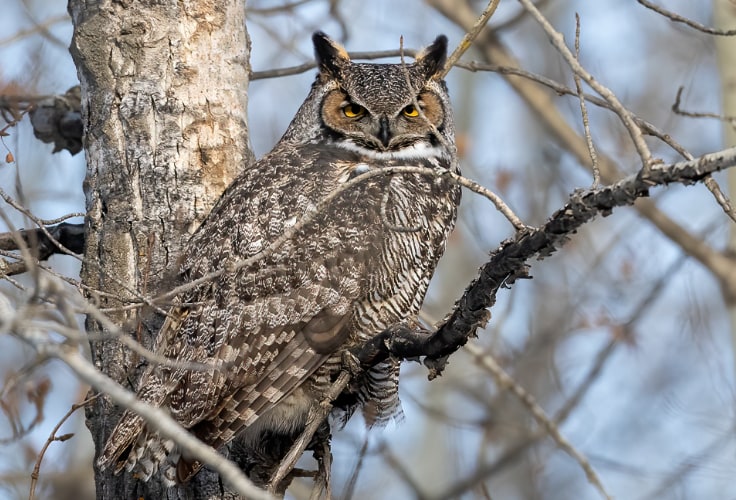
The Great Horned Owl is the largest nocturnal predator in South Carolina, a huge resident owl, capable of hunting a remarkably wide variety of prey. It measures 46 to 63 centimeters (18.1 to 24.8 inches) in length and has a broad body, powerful build, prominent ear tufts, and large yellow eyes set within a well-defined facial disc. Adults are heavily mottled in brown, buff, gray, and black, with a conspicuous white throat patch that often stands out when the bird calls or stretches.
Great Horned Owls are usually detected by their deep, rhythmic hoots, which carry long distances through woodlands after dusk and during the night. They hunt primarily from elevated perches, watching woodland edges, fields, and other open areas before launching powerful, silent attacks on prey. Their flight combines deep wingbeats with short glides, creating a strong, deliberate silhouette. The species feeds on a broad range of mammals and birds, along with reptiles and other vertebrates, making it one of South Carolina’s most versatile avian predators.
The Great Horned Owl is an uncommon to fairly common year-round resident throughout South Carolina, where it favors dry woodlands interspersed with open hunting habitat. Rather than building substantial nests of its own, it usually occupies abandoned nests constructed by hawks, crows, Ospreys, or even Bald Eagles, while occasionally using tree cavities or other elevated sites. The species remains widespread across the state because of its adaptability and broad diet, although habitat alteration and secondary poisoning from contaminated prey continue to present localized challenges.
Cooper’s Hawk
Astur cooperii
- Identification: Medium-sized woodland hawk with short, rounded wings, a long, rounded tail, blue-gray upperparts and rufous-barred underparts in adults, and brown-streaked underparts in juveniles.
- Where found: Occurs year-round in South Carolina in mature forests, woodland edges, and suburban neighborhoods; rare as a breeder.
- How to spot: Watch for a fast, agile hawk flying with a flap-flap-glide pattern or darting low through trees and around bird feeders in pursuit of songbirds.
- Conservation status: Least Concern (IUCN); populations have recovered strongly across North America, though the species remains uncommon in South Carolina.

The Cooper’s Hawk is one of South Carolina’s most agile woodland predators and is best known for its speed and maneuverability while hunting birds. It measures 37 to 45 centimeters (14.6 to 17.7 inches) in length and has a wingspan of 62 to 90 centimeters (24.4 to 35.4 inches). The species has the classic accipiter shape, with short, rounded wings, a long, rounded tail, and a relatively large head that projects well beyond the wings in flight. Adults are blue-gray above with warm rufous barring below, while juveniles are brown above with crisp brown streaking across the whitish underparts.

Cooper’s Hawks are most often detected by their fast, purposeful flight through woodland edges and residential areas. They typically fly with several quick wingbeats followed by a short glide and readily weave between trees, shrubs, and buildings while pursuing prey. Small and medium-sized birds, particularly songbirds and doves, make up most of the diet, and individuals frequently hunt around backyard bird feeders where prey gathers. Near the nest, adults give repeated, sharp “cak-cak-cak” alarm calls, although wintering birds are more often encountered silently.
The Cooper’s Hawk is an uncommon winter resident throughout South Carolina, with only rare breeding records in the state. During the non-breeding season, it occupies mature forests, woodland edges, parks, and suburban neighborhoods where abundant bird populations provide reliable hunting opportunities. Although the species has adapted well to human-altered landscapes and has recovered strongly across North America, it remains much less common in South Carolina than many resident hawks and is encountered most often during migration and the winter months.
American Kestrel
Falco sparverius
- Identification: Small, slender falcon with long pointed wings, a relatively long tail, warm rufous upperparts, pale underparts, bold black facial markings, and blue-gray wings in males.
- Where found: Occurs across South Carolina during winter and migration in open fields, farmland, grasslands, roadsides, and other open habitats; rare as a breeder.
- How to spot: Look for birds perched on utility wires or fence posts along roadsides, often wagging the tail while scanning for prey, or hovering into the wind above open fields.
- Conservation status: Least Concern (IUCN); considered a Species of Highest Conservation Priority in South Carolina because of continuing population declines.
The American Kestrel is the smallest falcon in South Carolina, most often encountered during migration and the winter months in open landscapes. The species measures 22 to 31 centimeters (8.7 to 12.2 inches) in length and has a wingspan of 51 to 61 centimeters (20.1 to 24.0 inches). Its slim body, long pointed wings, relatively long tail, and bold facial markings create a distinctive silhouette. Adult males have blue-gray wings and a rufous back, while females are predominantly rufous above with heavy black barring.
American Kestrels usually hunt from exposed perches such as utility wires, fence posts, or isolated trees, dropping quickly onto prey after carefully scanning the ground. They also hover into the wind above fields with rapid wingbeats while keeping the head remarkably steady. Grasshoppers and other large insects make up much of the diet, although mice, small birds, and lizards are also taken. Birds are often seen wagging their tails while perched, and their rapid, repeated “killy” calls frequently reveal their presence before they are seen.
The American Kestrel is fairly common to common across South Carolina during fall migration and winter but rare as a breeding species. It occupies farmland, grasslands, pastures, roadsides, airports, and other open habitats where scattered perches and nesting cavities are available. The species nests in natural tree cavities, abandoned woodpecker holes, and nest boxes rather than constructing its own nest. Although still a regular winter visitor, the species has experienced widespread long-term declines across North America and is recognized as a species of highest conservation priority in South Carolina because of continuing population losses associated with habitat change and the reduction of suitable nesting sites.
Eastern Screech-Owl
Megascops asio
- Identification: Small, stocky owl with prominent ear tufts, yellow eyes, and finely patterned gray or rufous plumage that provides exceptional camouflage against tree bark.
- Where found: Occurs year-round throughout South Carolina in woodlands, suburban neighborhoods, parks, and other wooded habitats, especially where mature trees provide nesting cavities.
- How to spot: Listen at night for its distinctive trills and descending whinnies, or watch for birds roosting in tree cavities or nest boxes during the day.
- Conservation status: Least Concern (IUCN); common in South Carolina but vulnerable to the loss of mature trees and nesting cavities.
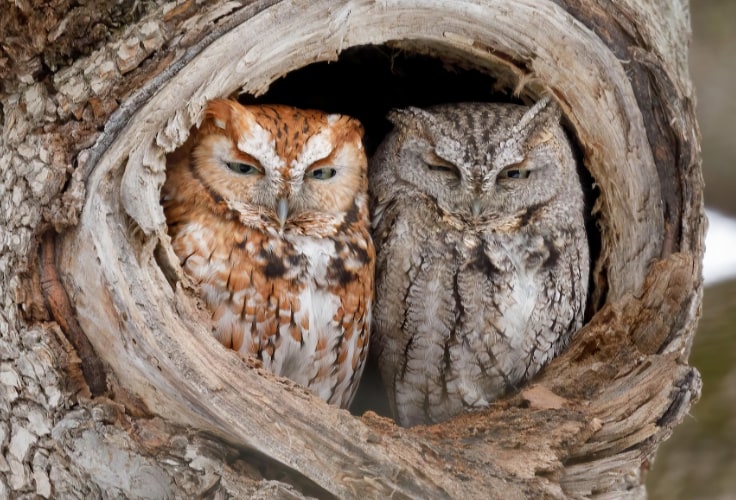
The Eastern Screech-Owl is the smallest bird of prey in South Carolina and one of the state’s most adaptable owls, occupying wooded habitats from forests to suburban neighborhoods. It measures 16 to 25 centimeters (6.3 to 9.8 inches) in length and has a compact body, prominent ear tufts, bright yellow eyes, and a short, square tail. Adults occur in both gray and rufous color morphs, with the rufous form encountered more frequently in South Carolina. Regardless of color, the finely barred and streaked plumage provides outstanding camouflage against tree bark.
Eastern Screech-Owls are much more often heard than seen. Their most familiar calls include a soft, monotone trill and a descending whinny that carry through neighborhoods and woodlands after dark. They hunt from low perches or by making short, agile flights through the lower canopy, feeding on large insects, small mammals, reptiles, amphibians, and small birds. During daylight, individuals often remain concealed inside natural tree cavities or nest boxes, occasionally appearing at the entrance to bask in the sun.
The Eastern Screech-Owl is a fairly common to common permanent resident throughout South Carolina, where it occupies woodlands, forest edges, parks, suburban neighborhoods, and other treed habitats, with a preference for areas containing mature trees and nesting cavities. It nests naturally in tree cavities and readily uses nest boxes where available. Although the species remains widespread because of its adaptability and varied diet, the removal of mature trees and competition for nesting cavities, particularly from European Starlings, can reduce local breeding opportunities.
Mississippi Kite
Ictinia mississippiensis
- Identification: Medium-sized, slender raptor with long pointed wings, a fairly long square-tipped tail, pale gray underparts, darker gray upperparts, and striking red eyes.
- Where found: Occurs across the Upper and Lower Coastal Plain of South Carolina during summer, especially in river-bottom forests, farmland, and open woodlands; scarce inland and absent from much of the northeastern coast.
- How to spot: Watch for graceful soaring and acrobatic flight above fields or forests, where birds frequently catch flying insects on the wing while giving soft, whistled “phee-phew” calls.
- Conservation status: Least Concern (IUCN); populations are stable or increasing, and the species remains a regular summer breeder across much of South Carolina’s Coastal Plain.

The Mississippi Kite is one of South Carolina’s most graceful birds of prey, spending much of the breeding season soaring effortlessly above forests, farmland, and river valleys in search of prey. It measures 34 to 37 centimeters (13.4 to 14.6 inches) in length and has a wingspan of 88 to 112 centimeters (34.6 to 44.1 inches). Its slim body, long pointed wings, relatively long square-tipped tail, and streamlined shape make it exceptionally well adapted for agile aerial flight. Adults are predominantly gray, with paler gray underparts, darker upperparts, black flight feathers and tail, and distinctive red eyes.

Mississippi Kites are most easily recognized by their buoyant, elegant flight. They spend long periods soaring, gliding, and making swift aerial turns while capturing prey in midair. Large flying insects, particularly dragonflies, cicadas, and grasshoppers, make up most of the diet, although small reptiles, frogs, birds, and bats are also taken occasionally. Birds often hunt singly or in loose groups, and their soft, two-note “phee-phew” whistles are most often heard around nesting territories during the breeding season.
In South Carolina, the Mississippi Kite is a fairly common summer resident from March through October, breeding throughout the Upper and Lower Coastal Plain but largely absent from the northeastern coast and uncommon farther inland. It favors river-bottom hardwood forests, riparian woodlands, farmland, and other open landscapes with scattered trees, while also nesting in parks and residential areas in some locations. The species migrates to South America after the breeding season. Once reduced by habitat loss and persecution, Mississippi Kite populations have recovered well and remain stable across South Carolina, reflecting the species’ ability to adapt to a variety of breeding habitats.
Broad-winged Hawk
Buteo platypterus
- Identification: Small, compact buteo with broad wings, a short tail marked by bold black-and-white bands, and adults showing warm rufous barring below.
- Where found: Occurs in the Upstate and Piedmont of South Carolina during summer, becoming rare toward the Coastal Plain; absent during winter except for occasional lingering individuals.
- How to spot: Most easily seen during migration in soaring flocks or kettles, or heard giving a high, piercing two-part whistle above forest canopies during the breeding season.
- Conservation status: Least Concern (IUCN); populations are generally stable, though the species depends on large, unfragmented forests for successful breeding.

The Broad-winged Hawk is South Carolina’s smallest breeding buteo and a secretive forest raptor that is often noticed only during migration. It measures 34 to 44 centimeters (13.4 to 17.3 inches) in length and has a wingspan of 81 to 100 centimeters (31.9 to 39.4 inches). Its compact body, broad wings, relatively large head, and short tail give it a stocky appearance in flight. Adults have brown upperparts, finely barred rufous underparts, and a distinctive tail marked by broad black-and-white bands that remains one of the species’ best field marks.

Broad-winged Hawks spend much of the breeding season beneath or just above the forest canopy, where they hunt quietly from concealed perches before dropping onto prey in short, rapid attacks. Their diet includes small mammals, amphibians, reptiles, insects, and small birds. They are usually detected by their high, piercing two-part whistle rather than by sight. During migration, however, they become highly conspicuous as hundreds or even thousands of birds gather into soaring kettles that drift south on rising columns of warm air.
In South Carolina, the Broad-winged Hawk is an uncommon summer resident that breeds primarily in the forested Upstate and Piedmont, becoming increasingly scarce toward the Coastal Plain. After the breeding season, nearly the entire population migrates to Central and South America, leaving the state by mid-autumn and returning in spring. The species depends on extensive tracts of mature deciduous and mixed forest for nesting, making it sensitive to forest fragmentation despite its generally stable overall population.
Swallow-tailed Kite
Elanoides forficatus
- Identification: Large, slender kite with long pointed wings, a deeply forked tail, and striking black-and-white plumage.
- Where found: Occurs in the South Carolina Coastal Plain during summer, breeding in extensive forested wetlands, river bottoms, and cypress swamps, particularly from the Santee River southward.
- How to spot: Look for graceful soaring with very few wingbeats, constant tail adjustments, and low flights above forests and wetlands while capturing prey in midair.
- Conservation status: Least Concern (IUCN); listed as Endangered in South Carolina, where conservation focuses on protecting large wetland forests and nesting habitat.

The Swallow-tailed Kite is one of the most elegant birds of prey in South Carolina, spending much of the breeding season soaring above forested wetlands and river systems with remarkable agility. This species measures 50 to 64 centimeters (19.7 to 25.2 inches) in length and has a wingspan of 112 to 130 centimeters (44.1 to 51.2 inches). Its slim body, long pointed wings, and deeply forked tail create one of the most distinctive silhouettes of any North American raptor. Adults show a striking contrast of brilliant white underparts and head with glossy black wings, back, and tail.

Swallow-tailed Kites spend most daylight hours in effortless flight, soaring, gliding, and making graceful turns with constant adjustments of the deeply forked tail. They capture nearly all of their prey on the wing, feeding primarily on large insects as well as frogs, lizards, snakes, nestling birds, and other small vertebrates. Birds rarely perch while actively foraging, and their clear, whistled calls are heard most often around nesting territories.
In South Carolina, the Swallow-tailed Kite is an uncommon summer resident of the Outer Coastal Plain, closely associated with large tracts of forested wetlands, hardwood swamps, and cypress forests. Important breeding areas include the Francis Marion National Forest and the lower Savannah, Santee, Edisto, Black, and Great Pee Dee river systems. The species typically arrives in March and departs by late August or early autumn, migrating to South America for the winter. It nests high in dominant pines or bald cypress growing within or along wetland forests. Although populations have recovered from historical declines, the species remains listed as Endangered in South Carolina, where the protection of extensive wetland forests and mature nesting trees is essential to its continued recovery.
Northern Harrier
Circus hudsonius
- Identification: Slender, long-winged hawk with a long tail, conspicuous white rump patch, owl-like facial disk, and wings held in a pronounced V during flight.
- Where found: Occurs across South Carolina during winter and migration, most numerous in coastal marshes but also in grasslands, agricultural fields, wet meadows, and other open habitats.
- How to spot: Watch for low, buoyant flight over marshes or fields with wings held in a strong “V,” frequent tilting glides, and a conspicuous white rump patch.
- Conservation status: Least Concern (IUCN); populations have declined across North America because of wetland loss and agricultural intensification, though the species remains a regular winter visitor to South Carolina.

The Northern Harrier is one of the state’s most distinctive winter raptors, hunting low over open landscapes with remarkable agility. It measures 46 to 50 centimeters (18.1 to 19.7 inches) in length and has a wingspan of 102 to 118 centimeters (40.2 to 46.5 inches). Its slim body, long wings, long tail, and conspicuous white rump patch create an unmistakable silhouette. Adult males are gray above and whitish below with black wingtips, while females and immature birds are brown with buffy, streaked underparts.

Northern Harriers are most easily recognized by their slow, buoyant flight just above grasses and marsh vegetation. They hold their wings in a pronounced V-shape while weaving back and forth over fields, freshwater wetlands, and salt marshes in search of prey. Unlike most North American hawks, they rely on both keen eyesight and their owl-like facial disk to locate small animals concealed beneath vegetation. Small mammals form the bulk of the diet, although birds, reptiles, and amphibians are also taken. Wintering birds are usually quiet, with vocalizations heard primarily on the breeding grounds.
The Northern Harrier is an uncommon winter resident throughout South Carolina, mainly found across the state’s extensive coastal marshes, where it patrols tidal wetlands and adjacent grasslands. Smaller numbers winter in inland agricultural fields, wet meadows, pastures, and managed grasslands, while migration brings increased numbers during spring and fall. Because it depends on large expanses of open habitat, the species is vulnerable to the loss of wetlands and grasslands across its range. Continued protection of marshes, native grasslands, and other open landscapes remains important for sustaining wintering populations in South Carolina.
Where and When to See Birds of Prey in South Carolina
South Carolina offers excellent opportunities to observe birds of prey throughout the year, from resident hawks and owls in forests and suburban neighborhoods to seasonal migrants passing over the state each spring and fall. Coastal marshes and forested wetlands support specialties such as Swallow-tailed Kites, Mississippi Kites, Northern Harriers, and Ospreys, while woodlands, farmland, and open fields are home to Red-tailed Hawks, Cooper’s Hawks, American Kestrels, and other familiar raptors. Visiting a variety of habitats in different seasons and watching the skies during migration provides the best chance to appreciate the full diversity of South Carolina’s impressive birds of prey.
For a broader perspective, explore our guide to the types of birds of prey, and visit the Birds of South Carolina and Birds of the United States pages for additional regional and national bird guides.

Raeesah Habib is a South African conservationist and freelance writer. She completed a diploma in nature conservation in 2016 through the University of South Africa (UNISA). During her internship, she spent a year working with wattled cranes on the Wattled Crane Recovery Programme (WCRP).
The program aims to prevent the local extinction of the wattled crane in Southern Africa through the release of captive-reared individuals into critically endangered wild populations across the country. During her time at the research facility, she was also responsible for the general monitoring and husbandry of other magnificent species, including blue cranes and secretary birds.
Following her internship, she was fortunate to have worked in some spectacular wilderness areas across the country, including the Cradle of Humankind, the Kruger National Park, and the northern Zululand. As a wildlife monitor, her responsibilities included conducting bird point counts. Birds surveys are a useful means to collect data on the avian populations in an area. The data helps researchers gain an understanding of population trends and ecosystem health.
When not in the field, Rae enjoys writing to share her passion, knowledge, and experiences with others.


