
Florida supports an exceptional variety of large birds across its extensive coastlines, shallow bays, freshwater wetlands, lakes, prairies, forests, and subtropical landscapes. Some rank among the tallest birds, while others stand out through immense wingspans, substantial weight, or specialized soaring flight. This guide highlights the largest birds that live year-round, winter, breed, or occur naturally in Florida, with a focus on their size, ecology, and distribution across the state.
Quick ID: 12 species at a glance
| Species | Length | Field mark | When present |
|---|---|---|---|
| American White Pelican | Up to 165 cm (65.0 in) | Longest bill of any North American bird | Winter visitor, late fall through early spring |
| Whooping Crane | 132 centimeters (52.0 inches) | Towering stature, long legs, and broad wings | Winter |
| Sandhill Crane | 120 centimeters (47.2 inches) | bulky body, slender neck, long legs, and exceptionally broad wings | year-round |
| Wild Turkey | 110 to 115 centimeters (43.3 to 45.3 inches) | large fan-shaped tail | year-round |
| Brown Pelican | Up to 137 cm (53.9 in) | Enormous bill can reach nearly 38 centimeters (15.0 inches) in length | Widespread year-round |
| Magnificent Frigatebird | Up to 114 cm (44.9 in) | Extremely long, narrow wings and deeply forked tail | Especially during summer |
| Bald Eagle | Up to 96 cm (37.8 in) | Broad, flat-held wings | Year-round |
| Canada Goose | Up to 115 cm (45.3 in) | Heavy body, long neck, broad wings, and strong legs | Year-round |
| Great Blue Heron | 97 to 137 centimeters (38.2 to 53.9 inches) | extremely long legs and neck with broad rounded wings and a powerful dagger-like bill | year-round |
| American Flamingo | 120 to 145 centimeters (47.2 to 57.1 inches) | pink plumage, extremely long legs | year-round |
| Wood Stork | Standing height: As tall as 115 cm (45.3 in) | heavy downcurved bill | Breeds late Nov–early Mar (South FL) or Feb–Mar (Central/North FL); disperses after |
| Turkey Vulture | Up to 81 cm (31.9 in) | Long wings held in a shallow V-shaped dihedral | Year-round |
American White Pelican
Pelecanus erythrorhynchos
- Wingspan: As wide as 300 cm (118.1 in).
- Weight: As heavy as 13.6 kg (30.0 lb).
- Body length: Up to 165 cm (65.0 in).
- Where found: Widespread across Florida during winter, with most adults present from late fall through early spring and some non-breeding birds remaining through summer.
- Conservation status: Least Concern (IUCN); a regular and often abundant winter visitor in Florida.

The American White Pelican is the largest bird that occurs regularly in Florida, with an enormous wingspan that also places it among the state’s broadest-winged species. Adults measure 127 to 165 centimeters (50.0 to 65.0 inches) in body length, weigh 4.5 to 9.0 kilograms (9.9 to 19.8 pounds), and span 244 to 290 centimeters (96.1 to 114.2 inches) across the wings. Exceptionally large individuals have reached a wingspan of 300 centimeters (118.1 inches) and a weight of 13.6 kilograms (30.0 pounds). The species also possesses the longest bill of any North American bird, reaching up to 39 centimeters (15.4 inches) in large males.
The American White Pelican combines a heavy body, broad wings, long neck, and enormous bill with an efficient soaring flight that makes its great size especially conspicuous. It often glides on thermals in lines or V-shaped formations, alternating slow, deliberate wingbeats with extended periods of soaring. Unlike plunge-diving pelicans, it feeds from the water’s surface by scooping fish and other aquatic prey into its expandable pouch while swimming, and groups frequently cooperate to herd fish into shallow water. Its immense size, broad soaring wings, and conspicuous group flight make large winter flocks particularly easy to recognize in Florida.
American White Pelicans are regular and often abundant winter visitors to Florida rather than breeding residents, as healthy adults spend the summer at breeding colonies on interior lakes in western Canada and the northwestern United States. Most birds arrive in Florida during late fall, around October or November, remain through winter, and depart by March or early April. Some nonbreeding birds, including juveniles, remain in the state through summer, but the species differs from the resident Brown Pelican in its strongly seasonal adult presence. Florida therefore serves principally as wintering habitat for this exceptionally large waterbird.
Whooping Crane
Grus americana
- Wingspan: Up to 235 cm (92.5 in).
- Weight: As heavy as 7.9 kg (17.4 lb).
- Standing height: As tall as 160 cm (63.0 in).
- Where found: Occurs rarely in Florida in very small numbers, primarily in shallow wetlands and open grasslands.
- Conservation status: Endangered (IUCN); federally and state Endangered, with Florida playing an important role in long-term reintroduction efforts despite the failure of its experimental resident population to become self-sustaining.

The Whooping Crane is the tallest bird to occur in Florida and one of the state’s largest flying birds, although it is far rarer than other avian giants. The species averages about 132 centimeters (52.0 inches) in body length, stands 120 to 150 centimeters (47.2 to 59.1 inches) tall, weighs 6.0 to 7.9 kilograms (13.2 to 17.4 pounds), and has a wingspan of 200 to 235 centimeters (78.7 to 92.5 inches). Very tall individuals may reach 160 centimeters (63.0 inches) in height. Its towering stature, long legs, and broad wings give the Whooping Crane an unmistakably large profile both on the ground and in flight.
The Whooping Crane walks with slow, deliberate steps through wetlands and open habitats while probing and gleaning for a varied diet of aquatic animals, insects, amphibians, small reptiles, plant tubers, grains, and berries. Its broad wings support steady flapping flight as well as soaring and gliding, which help conserve energy during long-distance migration. The long neck remains extended and the legs trail well behind the body in flight, emphasizing the species’ exceptional proportions. Loud bugling calls, amplified by an elongated trachea coiled within the breastbone, carry over great distances and provide another conspicuous sign of this exceptionally tall crane.
Whooping Cranes occurred naturally in Florida until the 1930s, and the state later became an important part of efforts to restore the species to the eastern United States. Biologists released 289 captive-raised birds in central Florida from 1993 through 2004 in an attempt to establish a non-migratory population, but poor survival and reproduction prevented the flock from becoming self-sustaining and releases were discontinued; remaining birds have since been transferred to support the Louisiana population. Florida also served as a winter destination for birds from the reintroduced eastern migratory population, including young cranes taught the Wisconsin-to-Florida route by ultralight aircraft between 2001 and 2017. Within the state, Whooping Cranes use shallow marshes, open grasslands, and wetlands on large cattle ranches. The species remains exceptionally rare and dependent on intensive conservation, but Florida has played an extraordinary role in attempts to restore this endangered crane to its former eastern range.
Sandhill Crane
Antigone canadensis
- Wingspan: As wide as 230 cm (90.6 in).
- Weight: As heavy as 5.4 kg (11.9 lb).
- Standing height: Up to 150 cm (59.1 in).
- Where found: Widespread year-round across peninsular Florida in freshwater marshes, prairies, and pastures, with resident birds joined by much larger numbers of migratory cranes in winter.
- Conservation status: Least Concern (IUCN); Threatened in Florida, with wetland drainage and conversion of prairie remaining the principal threats.

The Sandhill Crane is the second tallest bird in Florida, surpassed in standing height only by the much rarer Whooping Crane. State resident Sandhill Cranes average about 120 centimeters (47.2 inches) in body length, stand 100 to 120 centimeters (39.4 to 47.2 inches) tall, weigh 3.4 to 4.9 kilograms (7.5 to 10.8 pounds), and have a wingspan of 180 to 200 centimeters (70.9 to 78.7 inches). Large males of the Greater Sandhill Crane, the larger subspecies that joins Florida’s resident birds in winter, can weigh at least 5.4 kilograms (11.9 pounds), span as much as 230 centimeters (90.6 inches), and stand up to 150 centimeters (59.1 inches) tall.
The Sandhill Crane has a bulky body, slender neck, long legs, and exceptionally broad wings suited to powerful flapping flight and long-distance migration. Birds walk steadily through wetlands, prairies, pastures, and other open habitats while searching for grains, seeds, invertebrates, and other food. Migratory cranes often circle upward on rising air before continuing their journeys, with the neck extended and long legs trailing behind in flight. Their great size also makes adults formidable when threatened, while loud, rolling calls produced by an elongated trachea carry over long distances and often reveal cranes before they become visible.
Within the state, Sandhill Cranes occur year-round across peninsular Florida north to the Okefenokee Swamp region of southern Georgia, with the largest concentrations in Florida’s Kissimmee and DeSoto prairie regions and lower numbers toward the northern and southern limits of the range. Resident birds favor freshwater marshes, wet and dry prairies, pastures, ponds, and low emergent wetlands, and pairs build broad vegetation nests in shallow water; nesting can begin in late December and continue into June. The resident population of about 4,000 to 5,000 birds is joined by roughly 25,000 Greater Sandhill Cranes each winter, with migrants arriving from late October into December and departing mainly from late February through early April. Florida’s resident population faces continued pressure from wetland drainage and conversion of prairie for development or agriculture, although cranes have also shown some ability to use isolated wetlands in increasingly developed landscapes.
Wild Turkey
Meleagris gallopavo
- Wingspan: As wide as 144 cm (56.7 in).
- Weight: As heavy as 17.1 kg (37.6 lb).
- Standing height: As tall as 120 cm (47.2 in).
- Where found: Widespread year-round across most of Florida in forests, woodlands, swamps, and other wooded habitats interspersed with openings, but largely absent from the Keys and far southern Everglades.
- Conservation status: Least Concern (IUCN); Florida’s population recovered strongly after historical overhunting through management and restocking programs.

The Wild Turkey is the heaviest regularly occurring bird in Florida and one of the state’s largest birds capable of flight. It measures 110 to 115 centimeters (43.3 to 45.3 inches) in body length, stands 76 to 102 centimeters (29.9 to 40.2 inches) tall, weighs 3.6 to 9.5 kilograms (7.9 to 20.9 pounds), and has a wingspan of 125 to 144 centimeters (49.2 to 56.7 inches). Largest males can stand about 120 centimeters (47.2 inches) tall, while the heaviest verified wild gobbler, recorded outside Florida, weighed 17.1 kilograms (37.6 pounds).
The Wild Turkey combines a heavy body with long, powerful legs, broad rounded wings, and a large fan-shaped tail, proportions well suited to a life spent primarily on the ground. Birds walk through forests and openings while foraging and scratch through leaf litter with strong feet to uncover nuts, seeds, berries, insects, and other small food items. Despite their substantial weight, turkeys can launch into explosive flight when threatened and use their broad wings for powerful short-distance flights, including flights into large trees where they roost at night. Displaying males emphasize their considerable size by spreading the tail into a broad fan, lowering the wings, and inflating their plumage while delivering loud gobbling calls.
Wild Turkeys occur throughout most of Florida wherever suitable wooded habitat remains, although they are generally absent from heavily urbanized parts of southeastern Florida, the far southern Everglades, and the Keys. The endemic Florida or Osceola Wild Turkey occurs only in peninsular Florida, while the Eastern Wild Turkey occupies northern Florida and the Panhandle, with the two forms interbreeding in northern parts of the peninsula. Florida birds use hardwood and cypress swamps, hammocks, mixed hardwood-pine forests, pine flatwoods, turkey oak ridges, prairie edges, and seasonally flooded sloughs, ponds, and marshes, with dense low vegetation providing nesting cover and more open grassy areas important for broods. Overhunting reduced the state population to an estimated 26,000 birds by 1946, but management and restocking helped produce a strong recovery, with an estimated 100,000 Wild Turkeys present by 1970.
Brown Pelican
Pelecanus occidentalis
- Wingspan: As wide as 228 cm (89.8 in).
- Weight: As heavy as 5 kg (11.0 lb).
- Body length: Up to 137 cm (53.9 in).
- Where found: Widespread year-round along both Florida coasts in beaches, bays, estuaries, mangrove islands, sandbars, and other nearshore habitats, with occasional inland occurrence.
- Conservation status: Least Concern (IUCN); Florida’s breeding population recovered from historical pesticide impacts, although productive coastal waters and protected nesting sites remain important.

The Brown Pelican is one of Florida’s largest and most familiar coastal birds, although it is considerably smaller and lighter than the American White Pelican that winters in the state. Adults measure 100 to 137 centimeters (39.4 to 53.9 inches) in body length, weigh 2 to 5 kilograms (4.4 to 11.0 pounds), and have a wingspan of 200 to 228 centimeters (78.7 to 89.8 inches). The enormous bill can reach nearly 38 centimeters (15.0 inches) in length and supports an expandable throat pouch used to capture fish.
The Brown Pelican combines a heavy body, long neck, and broad wings with efficient flight adapted to life along Florida’s extensive coastline. Birds commonly glide low above the water, often in lines or V-formations, and alternate slow, powerful wingbeats with long glides. Unlike American White Pelicans, they capture fish by plunge-diving from heights of up to 20 meters (65.6 feet), with air sacs beneath the skin cushioning the impact and helping the birds return rapidly to the surface. Their large size, long bill, low flight over the water, and dramatic dives make Brown Pelicans conspicuous around Florida beaches, bays, estuaries, and fishing areas.
Brown Pelicans occur throughout the year along Florida’s Atlantic and Gulf coasts, while additional migrants from farther north increase numbers during winter and occasional birds appear on large inland waters. Breeding colonies extend from the Port Orange area on the Atlantic coast south through Florida Bay and the Lower Keys, then north along the Gulf Coast into the Panhandle, with mangrove islets serving as particularly important nesting habitat; birds also use barrier islands, estuarine islands, and vegetated dredge-spoil islands. Colonies range from a few dozen to several hundred pairs, and birds usually build bulky stick nests in trees, while an unusual inland colony was established at Lake Okeechobee in the early 1990s. Florida’s breeding population increased considerably after historical pesticide impacts, and the species was removed from the state list in 2017, although its continued success depends on protected nesting and roosting sites and productive coastal fisheries.
Magnificent Frigatebird
Fregata magnificens
- Wingspan: As wide as 244 cm (96.1 in).
- Weight: As heavy as 1.9 kg (4.2 lb).
- Body length: Up to 114 cm (44.9 in).
- Where found: Occurs along both Florida coasts and through the Keys, especially during summer, with birds roosting on coastal islands and the state’s breeding population concentrated in the Dry Tortugas.
- Conservation status: Least Concern (IUCN); the Dry Tortugas support the only regular nesting colony in the continental United States, following the loss of the former Marquesas Keys colony.

The Magnificent Frigatebird is one of Florida’s longest-winged birds, with an exceptional wingspan relative to its remarkably low body weight. This species measures 89 to 114 centimeters (35.0 to 44.9 inches) in body length, weighs 1 to 1.9 kilograms (2.2 to 4.2 pounds), and has a wingspan of 217 to 244 centimeters (85.4 to 96.1 inches). Its extremely long, narrow wings and deeply forked tail create a distinctive silhouette, while the lightweight build contrasts sharply with the much heavier pelicans and cranes that reach similar or even smaller wingspans.
The Magnificent Frigatebird spends much of its life in the air, where its immense wings provide highly efficient soaring flight with only occasional slow, deep wingbeats. Birds rarely land on the water and instead take squid, flying fish, and other prey directly from the sea surface while remaining airborne. They also pursue other seabirds and force them to disgorge food, then capture the released prey in flight. Extremely short legs and small feet provide little ability to walk, so frigatebirds typically remain either airborne or perched on trees and shrubs, and their combination of vast wings, forked tail, and effortless soaring makes them conspicuous above Florida’s tropical and subtropical coasts.
Magnificent Frigatebirds occur along both Florida coasts and through the Keys, with numbers highest in summer and much lower in winter; summer birds are especially numerous around southern Florida, although roosting birds occur on islands as far north as Cedar Key. Florida nesting takes place in red mangroves, where birds construct crude stick platforms, and the state has exceptional importance because the Dry Tortugas support the only regular breeding colony in the continental United States. Florida’s first confirmed colony was discovered at the Marquesas Keys in 1969 and reached as many as about 250 nesting pairs during the 1970s, but numbers later declined as disturbance increased; nesting began in the Dry Tortugas in 1988 and the former Marquesas colony subsequently disappeared. The concentration of breeding birds at a single Florida site makes protection of undisturbed mangrove nesting habitat particularly important.
Bald Eagle
Haliaeetus leucocephalus
- Wingspan: As wide as 244 cm (96.1 in).
- Weight: As heavy as 7.4 kg (16.3 lb).
- Body length: Up to 96 cm (37.8 in).
- Where found: Widespread year-round around Florida’s coasts, rivers, lakes, and marshes, with particularly dense nesting populations from the lower St. Johns River to Lake Okeechobee and along the Gulf Coast.
- Conservation status: Least Concern (IUCN); Florida supports the densest population outside Alaska, and the state population is considered stable despite continued habitat loss, collisions, and exposure to rodenticides.

The Bald Eagle is the largest regularly occurring raptor in Florida and one of the state’s most iconic birds of prey. Adults measure 71 to 96 centimeters (28.0 to 37.8 inches) in body length, weigh 3.0 to 6.3 kilograms (6.6 to 13.9 pounds), and have a wingspan of 168 to 244 centimeters (66.1 to 96.1 inches). Females are about 25% larger than males, although Florida birds are generally smaller than those found in Alaska and Canada, where exceptionally large individuals can exceed 7 kilograms (15.4 pounds), with one authenticated female reaching 7.4 kilograms (16.3 pounds).
The Bald Eagle combines a heavy body, large head, broad wings, and powerful feet into an imposing predator and scavenger closely associated with water. Birds use slow, deliberate wingbeats and long periods of soaring and gliding on broad, flat-held wings, while their strong feet and large talons allow them to seize fish and other prey. Fish make up most of the diet, but Bald Eagles also capture waterfowl and mammals, feed extensively on carrion, and steal prey from Ospreys, herons, and other birds. Their substantial size and strength provide an advantage during competition for food and make soaring adults particularly conspicuous above Florida’s lakes, rivers, marshes, and coastlines.
Bald Eagles occur widely across Florida, with especially dense nesting populations in Central Florida’s wetland systems from the lower St. Johns River south to Lake Okeechobee and along the Gulf Coast. Pairs typically nest near large bodies of water in tall living pines or cypresses, although hardwoods are sometimes used and mangroves provide nesting sites in extreme South Florida; nests may remain active for 15 years or more, and the largest Bald Eagle nest ever recorded was found near St. Petersburg and measured 2.9 meters (9.5 feet) across and 6.1 meters (20 feet) deep. Many birds leave the state after the breeding season in late summer, while others remain year-round. Florida supports the densest Bald Eagle population of any state outside Alaska, and the population is considered stable, although shoreline habitat loss, collisions, and exposure to rodenticides remain important threats.
Canada Goose
Branta canadensis
- Wingspan: As wide as 224 cm (88.2 in).
- Weight: As heavy as 10.9 kg (24.0 lb).
- Body length: Up to 115 cm (45.3 in).
- Where found: Occurs year-round in parts of Florida, especially the northern half of the state, around lakes, ponds, parks, golf courses, and other grassy areas near permanent water.
- Conservation status: Least Concern (IUCN); Florida’s resident population has expanded considerably, with breeding now established in numerous counties and several major urban areas.

The Canada Goose is one of Florida’s largest waterfowl, and the state’s established resident birds belong primarily to the Giant Canada Goose, the largest subspecies. Adults measure 76 to 115 centimeters (29.9 to 45.3 inches) in body length, weigh 2.4 to 9.0 kilograms (5.3 to 19.8 pounds), and have a wingspan of 127 to 170 centimeters (50.0 to 66.9 inches). An exceptionally large male Giant Canada Goose weighed 10.9 kilograms (24.0 pounds) and had a wingspan of 224 centimeters (88.2 inches), representing the largest documented dimensions for the species.
The Canada Goose combines a heavy body, long neck, broad wings, and strong legs with the ability to walk, swim, and fly efficiently. Its bill is well suited to grazing, and birds commonly feed on grasses and seeds around open areas while also reaching aquatic vegetation in shallow water. Florida’s resident geese do not undertake the long seasonal migrations characteristic of many northern populations, but their broad wings support strong flights between feeding, roosting, and breeding areas. Their large size, powerful build, and preference for open grassy landscapes make them particularly conspicuous around parks, golf courses, ponds, and other developed areas.
Canada Geese now breed across scattered parts of Florida following releases of Giant Canada Geese during the 1960s and 1970s, which established non-migratory populations primarily across the northern half of the state. Breeding has been documented in counties including Leon, Alachua, Marion, Volusia, Santa Rosa, Manatee, Seminole, and Miami-Dade, with particularly strong concentrations in parts of northern and central Florida; populations have also expanded around Jacksonville, St. Petersburg, Clearwater, Orlando, and the Panhandle. Birds favor permanent water bordered by open grassy areas and readily occupy lakes, ponds, parks, golf courses, and other suburban or urban habitats, while wintering Canada Geese from a migratory subspecies also reach northwestern Florida. Florida breeding records have increased substantially in recent decades, indicating a continuing expansion of the state’s established Canada Goose population.
Great Blue Heron
Ardea herodias
- Wingspan: As wide as 201 cm (79.1 in).
- Weight: As heavy as 2.5 kg (5.5 lb).
- Standing height: As tall as 160 cm (63.0 in).
- Where found: Widespread year-round throughout Florida in freshwater and coastal wetlands, including marshes, lakes, ponds, canals, estuaries, and shorelines, with lower numbers in the Panhandle.
- Conservation status: Least Concern (IUCN); remains a common Florida breeder, with its distribution closely tied to the availability of suitable wetland habitat.

The Great Blue Heron is Florida’s largest heron and one of the tallest birds regularly found in the state, with Florida birds representing some of the tallest forms of the species. Adults measure 97 to 137 centimeters (38.2 to 53.9 inches) in body length, weigh 2.1 to 2.5 kilograms (4.6 to 5.5 pounds), and have a wingspan of 167 to 201 centimeters (65.7 to 79.1 inches). Standing height typically ranges from 115 to 138 centimeters (45.3 to 54.3 inches), while exceptionally tall individuals may reach 150 to 160 centimeters (59.1 to 63.0 inches) with the neck fully extended. Southern Florida also supports the distinctive all-white Great White Heron form, adding an unusual regional variation to this exceptionally large wading bird.
The Great Blue Heron combines extremely long legs and neck with broad rounded wings and a powerful dagger-like bill, proportions that allow such a tall bird to hunt effectively in shallow water. It usually forages alone and walks with slow, deliberate strides or remains motionless before driving its bill rapidly at fish, crustaceans, amphibians, snakes, rodents, and other prey. In flight, the long neck folds into a compact S-shape while the legs extend well behind the body, and broad wings produce deep, measured wingbeats. Its towering profile when standing and massive, slow-flapping silhouette in flight make the species conspicuous even among Florida’s many large wading birds.
Great Blue Herons are permanent residents throughout Florida and exploit almost every type of wetland, from freshwater marshes, lakes, ponds, and canals to estuaries and coastal shallows, with occasional use of upland habitats. They remain common breeders across the state but are considerably less numerous in the Panhandle than across the peninsula, while additional birds increase Florida numbers from October through April. Most birds nest colonially, often alongside other wading birds, Brown Pelicans, Anhingas, and Double-crested Cormorants, and build large stick nests in bushes or trees from near ground level to as high as 30 meters (100 feet); birds in the central Everglades are unusual in nesting predominantly as solitary pairs. The Florida breeding range has remained broadly stable, and the species continues to be common wherever suitable wetland habitat persists.
American Flamingo
Phoenicopterus ruber
- Wingspan: As wide as 165 cm (65.0 in).
- Weight: As heavy as 4.1 kg (9.0 lb).
- Standing height: As tall as 152 cm (59.9 in).
- Where found: Occurs mainly in southern Florida around the Everglades, Florida Bay, Biscayne Bay, and the Florida Keys, with occasional birds elsewhere along the coast and in wetlands north of the Everglades.
- Conservation status: Least Concern (IUCN); native but still scarce in Florida, where more than 100 wild birds remained after the exceptional 2023 influx and small numbers now occur year-round.

The American Flamingo is one of Florida’s tallest birds, capable of standing nearly as high as a Great Blue Heron. The species measures 120 to 145 centimeters (47.2 to 57.1 inches) in body length, weighs 2.1 to 4.1 kilograms (4.6 to 9.0 pounds), and has a wingspan of 140 to 165 centimeters (55.1 to 65.0 inches). Standing birds can reach approximately 152 centimeters (59.9 inches) in height, with exceptionally long legs and an elongated neck accounting for much of this stature. These extreme proportions create a towering but slender profile unlike that of Florida’s heavier cranes, pelicans, and other large waterbirds.
The American Flamingo is highly specialized for feeding while wading through shallow saline wetlands. Birds walk slowly with the head inverted beneath the surface and sweep the bent bill from side to side to filter small crustaceans and other aquatic organisms through densely packed lamellae. Large flocks often forage together, while birds in flight extend both the long neck and legs and travel with steady wingbeats, emphasizing their remarkable length. Their pink plumage, extremely long legs, extended flight profile, and loud honking calls make flamingos unmistakable among Florida’s large wading birds.
American Flamingos have been recorded along much of Florida’s coast, but more than 95% of observations outside the captive Hialeah population have come from the Everglades, Biscayne Bay, and the Florida Keys; birds also increasingly use shallow treatment wetlands along the northern edge of the Everglades. The species was historically native to Florida but largely disappeared around the turn of the 20th century, while growing evidence shows that at least some modern birds reach the state naturally from populations elsewhere in the region. Hurricane Idalia produced an exceptional influx in 2023, and more than 100 wild flamingos remained in Florida during the 2024 census, while small numbers continue to live year-round in the state. Florida still supports only a tiny fraction of the global population, but the persistence of these wild birds has renewed the species’ presence in its former Florida range.
Wood Stork
Mycteria americana
- Wingspan: As wide as 175 cm (68.9 in).
- Weight: As heavy as 3.1 kg (6.8 lb).
- Standing height: As tall as 115 cm (45.3 in).
- Where found: Breeds widely across peninsular Florida in swamps, sloughs, mangroves, and cypress wetlands, while foraging in shallow freshwater and estuarine marshes and dispersing widely after breeding.
- Conservation status: Least Concern (IUCN); the southeastern U.S. population was delisted under the Endangered Species Act in 2026, although altered wetland hydrology has caused major historical declines in South Florida.
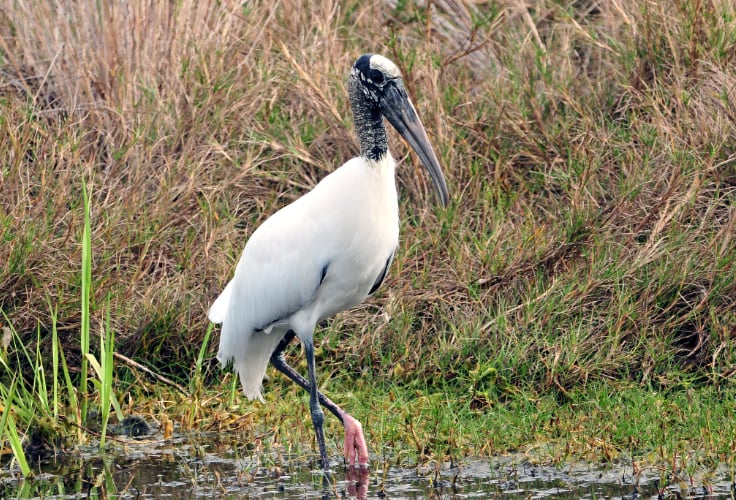
The Wood Stork is Florida’s only native stork and one of the state’s largest wading birds, with a tall frame and broad wings that rival those of many much heavier birds. Adults stand 85 to 115 centimeters (33.5 to 45.3 inches) tall, weigh 2.0 to 3.1 kilograms (4.4 to 6.8 pounds), and have a wingspan of 150 to 175 centimeters (59.1 to 68.9 inches). Its long legs, heavy downcurved bill, and substantial body give the species an imposing profile on the ground, while the broad wings make it appear even larger in flight.
The Wood Stork combines a heavy body, long neck, thick slightly decurved bill, and broad wings with adaptations for both shallow-water feeding and efficient long-distance flight. Birds forage mainly by touch, walking slowly through water less than about 25 to 30 centimeters (10 to 12 inches) deep with the bill held open until contact with prey triggers a rapid snap shut. Fish form the bulk of the diet, although other aquatic animals are also taken, and groups often forage together where falling water levels concentrate prey. Wood Storks use rising air to soar high above Florida’s wetlands with the neck and legs fully extended, allowing these large birds to travel efficiently between widely separated feeding and nesting areas.
Wood Storks breed in colonies across much of peninsular Florida, north to parts of Columbia, Baker, and Duval counties, while historical and occasional breeding has extended into the Big Bend region; they do not breed in the Keys. Colonies occur in mixed hardwood swamps, sloughs, mangroves, and cypress domes and strands, where birds typically build large stick nests in trees standing over water, sometimes in colonies of 100 to 500 nests. South Florida colonies generally form from late November through early March, while those in Central and North Florida typically form from February into March, and adults and young disperse widely after breeding. The South Florida breeding population declined by more than 90% between the late 1940s and late 1960s as wetland loss and altered flooding and drying cycles reduced feeding conditions, while later expansion into Central and North Florida contributed to broader regional recovery and eventual federal delisting in 2026.
Turkey Vulture
Cathartes aura
- Wingspan: As wide as 200 cm (78.7 in).
- Weight: As heavy as 2.2 kg (4.9 lb).
- Body length: Up to 81 cm (31.9 in).
- Where found: Widespread year-round throughout Florida, including the Florida Keys, across open and wooded landscapes, with additional migrants passing through the state in fall and spring.
- Conservation status: Least Concern (IUCN); remains a common and widespread breeding resident throughout Florida.

The Turkey Vulture is the most common bird of prey in Florida and the state’s most familiar large soaring species. Adults measure 64 to 81 centimeters (25.2 to 31.9 inches) in body length, weigh 1.4 to 2.2 kilograms (3.1 to 4.9 pounds), and have a wingspan of 150 to 200 centimeters (59.1 to 78.7 inches). Its relatively low weight contrasts with its long, broad wings, which create the impression of a much heavier bird in flight and allow it to remain aloft for extended periods with little effort.
The Turkey Vulture is superbly adapted for energy-efficient soaring and typically holds its long wings in a shallow V-shaped dihedral while rocking gently from side to side with only occasional wingbeats. Birds use this effortless flight to cover large areas in search of carrion and rely heavily on an exceptionally developed sense of smell to locate carcasses, including food hidden beneath forest cover or dense vegetation. The hooked bill tears soft tissue, although Turkey Vultures may depend on larger scavengers to open tougher carcasses and often yield to the more aggressive Black Vulture at feeding sites. Their broad wings and characteristic rocking flight make them easy to recognize as they circle above Florida’s varied landscapes.
Turkey Vultures are permanent residents throughout Florida, including the Florida Keys, and breeding occurs across nearly the entire state wherever suitable nesting cover is available. Florida birds nest chiefly in dense stands of saw palmetto within or near open pine woods and in fallen hollow logs, with caves, rock ledges, and abandoned buildings also used occasionally; the intensively farmed Everglades Agricultural Area appears to support fewer breeders because suitable nesting habitat is limited. Resident birds are joined by migrants from farther north, with conspicuous southward movements from September through December and spring passage from March through May. The species remains a common and widespread Florida breeder, although its tendency to travel several miles from nesting sites can make the true breeding distribution difficult to document.
Florida’s Biggest Birds
Florida’s avian giants represent several very different ways of being large. American White Pelicans combine broad wings with substantial mass, Great Blue Herons and Sandhill Cranes achieve their size through towering proportions, and Magnificent Frigatebirds pair an enormous wingspan with remarkably little weight. Most of the birds covered here are native species that occur naturally and regularly in Florida, and many, including Brown Pelicans, Wood Storks, Turkey Vultures, and Great Blue Herons, are familiar sights across suitable parts of the state.
Two enormous swans were excluded from the main list because neither represents a normal native component of Florida’s birdlife. The introduced Mute Swan would rank near the top by size and has bred in the state, including the well-known managed population at Lake Morton in Lakeland, but is currently classified as a non-established exotic. Trumpeter Swans are native to North America but occur only exceptionally in Florida, with some records complicated by birds from reintroduced populations farther north; captive birds also occur in public collections such as the mixed swan population at Lake Eola Park in Orlando. Keeping these species separate allows the main list to focus on large native birds that occur naturally and regularly in Florida.
For a broader perspective, discover the largest birds in North America, and explore the Birds of Florida and Birds of the United States pages for additional regional and national bird guides.

Raeesah Habib is a South African conservationist and freelance writer. She completed a diploma in nature conservation in 2016 through the University of South Africa (UNISA). During her internship, she spent a year working with wattled cranes on the Wattled Crane Recovery Programme (WCRP).
The program aims to prevent the local extinction of the wattled crane in Southern Africa through the release of captive-reared individuals into critically endangered wild populations across the country. During her time at the research facility, she was also responsible for the general monitoring and husbandry of other magnificent species, including blue cranes and secretary birds.
Following her internship, she was fortunate to have worked in some spectacular wilderness areas across the country, including the Cradle of Humankind, the Kruger National Park, and the northern Zululand. As a wildlife monitor, her responsibilities included conducting bird point counts. Birds surveys are a useful means to collect data on the avian populations in an area. The data helps researchers gain an understanding of population trends and ecosystem health.
When not in the field, Rae enjoys writing to share her passion, knowledge, and experiences with others.