
Alabama supports two regularly occurring eagle species, each associated with different habitats and seasonal patterns across the state. The Bald Eagle is the more widespread and regularly observed species, occurring near large rivers, reservoirs, lakes, wetlands, and coastal waterways throughout the year, with the largest concentrations forming during winter. The Golden Eagle is far less common and appears mainly from late fall through winter, primarily over mountainous, forested, and other remote upland landscapes in northeastern Alabama. This guide provides identification notes, seasonal patterns, regional distribution, and key locations for observing eagles in Alabama.
Quick ID: 2 species at a glance
| Species | Length | Field mark |
|---|---|---|
| Bald Eagle | 71 to 96 centimeters (28.0 to 37.8 inches) | white head and tail contrasting sharply with a dark brown body and wings |
| Golden Eagle | 70 to 99 centimeters (27.6 to 39.0 inches) | golden feathers on the nape |
Bald Eagle
Haliaeetus leucocephalus
- Identification: Very large eagle with a heavy body, broad wings, and in adults a white head and tail contrasting sharply with a dark brown body and wings.
- Where found: Occurs statewide in Alabama near large rivers, reservoirs, lakes, wetlands, and coastal waterways, with strongest concentrations in the Tennessee Valley and other major river systems.
- How to spot: Look for slow, powerful wingbeats, long periods of soaring with wings held flat, and conspicuous perching in tall trees near water, especially in winter.
- Conservation status: Least Concern (IUCN); populations have recovered and continue to increase in Alabama following past declines and reintroduction efforts.

The Bald Eagle is the most familiar and regularly observed eagle in Alabama and one of the state’s largest raptors. Adults measure 71 to 96 centimeters (28.0 to 37.8 inches) in length, with a wingspan of 168 to 244 centimeters (66.1 to 96 inches). The species has a heavy body, broad wings, a large head, and a massive hooked beak that create a powerful profile in flight and at rest. Adult birds show a dark brown body and wings set off by a bright white head and tail, while immature birds appear mostly dark with irregular white mottling and lack the clean white head pattern of adults.
In the field, Bald Eagles are usually detected by their size and flight style. They fly with slow, deliberate, powerful wingbeats and frequently soar or glide with broad wings held flat in a straight horizontal line. Birds often perch high in dead trees along shorelines or soar above rivers and reservoirs while searching for food. The species feeds opportunistically, taking fish, waterfowl, and other aquatic prey while also scavenging carrion when available. Winter concentrations can be especially noticeable around major lakes and reservoirs, where multiple birds may gather in suitable feeding areas.

In Alabama, Bald Eagles occur statewide but remain concentrated near large rivers, reservoirs, lakes, and coastal waterways. Breeding distribution is localized but expanding, with most confirmed nesting records occurring in the Tennessee Valley, Piedmont, Interior Plateau, and Southeastern Plains regions. Important concentration areas include Pickwick Lake in northwestern Alabama and Guntersville Lake along the Tennessee River, where wintering birds are especially well known. The species is fairly common during winter, spring, and fall in the Tennessee Valley region but less numerous elsewhere in the state. Some birds remain year-round, although numbers increase noticeably during winter as migrants arrive from farther north.
The Bald Eagle has undergone a major recovery in Alabama after severe declines caused largely by DDT contamination and other human pressures during the mid-20th century. The species disappeared as a regular breeder in the state before reintroduction efforts began in the 1980s, and the first confirmed successful modern nest was documented in 1991. Since then, nesting populations have expanded steadily, and nests have now been recorded across much of Alabama. Although populations continue to improve, Bald Eagles remain vulnerable to localized threats including habitat disturbance, shoreline development, environmental pollution, and lead exposure.
Golden Eagle
Aquila chrysaetos
- Identification: Very large dark-brown eagle with long, broad wings, a relatively small head, and a long tail; adults show golden feathers on the nape, and younger birds often show white in the wings and tail.
- Where found: Occurs rarely across Alabama during the cooler months, primarily in mountainous, forested, and other open upland landscapes, especially in the northeastern part of the state.
- How to spot: Watch for solitary birds or pairs soaring and gliding with wings held in a slight “V,” often maneuvering over ridges, valleys, and other open terrain.
- Conservation status: Least Concern (IUCN); considered a species of high conservation concern in Alabama, where it occurs as a rare winter visitor from eastern Canada.

The Golden Eagle is the less frequently encountered of Alabama’s two eagle species and is most often associated with remote upland landscapes in winter. Adults measure 70 to 99 centimeters (27.6 to 39.0 inches) in length and have a wingspan of 185 to 222 centimeters (72.8 to 87.4 inches). The species has a heavy body, long, broad wings, and a noticeably long tail that projects beyond the body in flight, often giving the bird a small-headed appearance at a distance. Adults are mostly dark brown with golden feathers on the rear of the crown and nape, while younger birds frequently show contrasting white patches in the wings and tail.
In the field, Golden Eagles are most often identified by their flight profile and behavior. Birds are usually seen alone or in pairs soaring and gliding for long periods over ridges, hills, valleys, and other broken terrain. In soaring flight, the wings are commonly held in a slight dihedral or shallow “V,” with the primary feathers spread into distinct finger-like tips. Flapping flight is relatively infrequent and consists of deep, steady wingbeats interspersed with glides. The species hunts mainly on or near the ground and also scavenges carrion during winter. In Alabama, Golden Eagles are most often encountered over remote upland landscapes and large forested tracts during the cooler months.

In Alabama, the Golden Eagle is a rare but regular late-fall-through-winter visitor and does not breed in the state. Most birds belong to the smaller eastern population that breeds in eastern Canada and migrates south along the Appalachian region during winter. Occurrence is scattered statewide but appears strongest in northeastern Alabama, especially in mountainous and forested areas associated with the southern Appalachians and adjacent uplands. Recent observations and monitoring records have documented birds in locations such as Talladega National Forest, Coosa Wildlife Management Area, and other remote upland sites, with most records occurring between December and March. Wintering birds may also appear near open agricultural areas, reservoirs, and locations with concentrations of waterfowl or carrion.
Golden Eagles remain rare in Alabama and are considered a species of high conservation concern within the state. Monitoring efforts conducted in partnership with other Appalachian states since 2012 have improved understanding of winter distribution, migration corridors, and habitat use of the eastern population. Human activity remains the primary source of mortality across North America, including collisions with structures and vehicles, poisoning, lead exposure, and habitat alteration. The small size of the eastern population and the species’ naturally low density in the Southeast make continued monitoring especially important in Alabama.
Distinguishing Bald and Golden Eagles in the Field
Immature Golden Eagles are most often confused with immature and subadult Bald Eagles, since both lack the striking white head and tail of adults and may appear mostly dark at a distance.
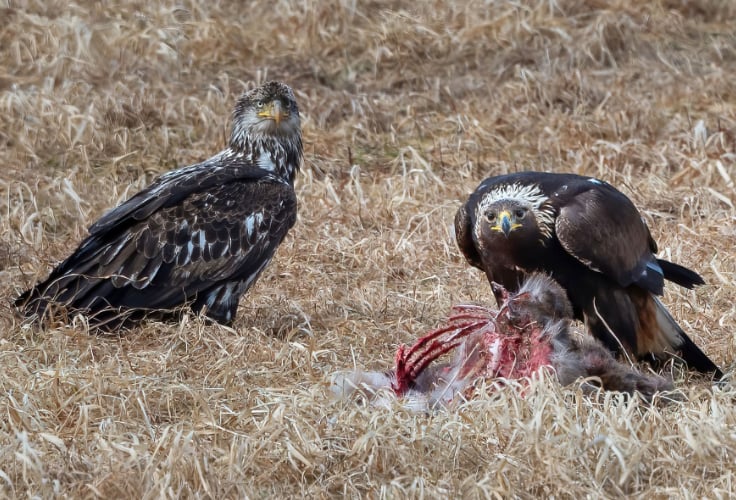
Structure is usually the most reliable way to separate them. The Bald Eagle has a larger, more projecting head and a massive beak that extends prominently beyond the body in flight, whereas the Golden Eagle appears smaller-headed and more streamlined. In flight, the head of a Bald Eagle projects clearly forward, while the head of a Golden Eagle appears shorter and less prominent. Bald Eagle also shows unfeathered lower legs, while Golden Eagle has fully feathered tarsi.

Plumage provides additional clues. Immature Bald Eagles show irregular white mottling across the body, underwing coverts, and tail, often creating a blotchy or uneven appearance. The Golden Eagle lacks white on the body and instead shows white mostly confined to the base of the flight feathers and tail, forming cleaner and more sharply defined patches.

At a distance, Golden Eagles can also be confused with vultures and large buteo hawks. The Turkey Vulture is smaller, holds its wings in a deeper dihedral or “V,” and rocks noticeably from side to side while soaring, with underwings that appear darker along the leading edge and paler behind. The Golden Eagle soars more steadily, with a shallower wing angle and little or no rocking except in strong winds. Large buteos are smaller and broader-winged, lacking the long-winged, long-tailed proportions typical of an eagle. Careful attention to wing shape, tail length, posture, and overall flight style is often essential when identifying distant birds.
Where and When to See Eagles in Alabama
Eagles in Alabama are most closely associated with large rivers, reservoirs, wetlands, and remote upland landscapes. Bald Eagles are the more widespread and regularly observed species, occurring year-round near major waterways across the state, with the largest concentrations forming during winter along the Tennessee River system and major lakes such as Guntersville and Pickwick. Golden Eagles are far rarer and occur mainly from late fall through winter, most often over mountainous and forested uplands in northeastern Alabama.
Winter is generally the best season for eagle watching in Alabama, when both species are most detectable and migrant birds increase overall numbers. Careful scanning of shorelines, open water, ridges, and soaring birds above valleys and reservoirs offers the best chance of finding eagles in the state.
Key Eagle Viewing Locations in Alabama
- Lake Guntersville and Lake Guntersville State Park – Alabama’s best-known Bald Eagle viewing area, especially during winter.
- Pickwick Lake near Waterloo – Important winter concentration area for Bald Eagles in northwestern Alabama.
- Talladega National Forest – One of the more reliable regions for winter Golden Eagle observations in northeastern Alabama.
- Coosa Wildlife Management Area – Regularly monitored upland habitat for wintering Golden Eagles.
- Tennessee River Valley – Broad regional hotspot for Bald Eagles, especially around reservoirs and open water.
- Eufaula National Wildlife Refuge – Large wetland and river system that occasionally supports Bald Eagles during migration and winter.
- Turkey Creek Nature Preserve – Local site with periodic winter Golden Eagle records in central Alabama.
For a broader perspective, see our guide to the types of eagles in North America, and explore the Birds of Alabama and Birds of the United States pages for additional regional and national bird guides.

Raeesah Habib is a South African conservationist and freelance writer. She completed a diploma in nature conservation in 2016 through the University of South Africa (UNISA). During her internship, she spent a year working with wattled cranes on the Wattled Crane Recovery Programme (WCRP).
The program aims to prevent the local extinction of the wattled crane in Southern Africa through the release of captive-reared individuals into critically endangered wild populations across the country. During her time at the research facility, she was also responsible for the general monitoring and husbandry of other magnificent species, including blue cranes and secretary birds.
Following her internship, she was fortunate to have worked in some spectacular wilderness areas across the country, including the Cradle of Humankind, the Kruger National Park, and the northern Zululand. As a wildlife monitor, her responsibilities included conducting bird point counts. Birds surveys are a useful means to collect data on the avian populations in an area. The data helps researchers gain an understanding of population trends and ecosystem health.
When not in the field, Rae enjoys writing to share her passion, knowledge, and experiences with others.


