
Nova Scotia hosts a small but intriguing group of owls, with eight species occurring regularly across the province. These range from common residents such as the Barred Owl and Great Horned Owl to more elusive species associated with wetlands, barrens, and northern forests. In addition to these regular species, several other owls have appeared only as rare vagrants or are known in Nova Scotia from a handful of historical records.
What owls are in Nova Scotia?
Nova Scotia hosts eight regularly found owl species, including the Barred Owl, Great Horned Owl, Long-eared Owl, and Boreal Owl.
Quick ID: 8 species at a glance
| Species | Length | Field mark | When present |
|---|---|---|---|
| Barred Owl | 43 to 50 centimeters (16.9 to 19.7 inches) | dark eyes | Year-round |
| Great Horned Owl | 46 to 63 centimeters (18.1 to 24.8 inches) | prominent ear tufts | Year-round |
| Northern Saw-whet Owl | 18 to 22 centimeters (7.1 to 8.7 inches) | bright yellow eyes | Year-round |
| Short-eared Owl | 34 to 43 centimeters (13.4 to 16.9 inches) | broad wings marked with a dark comma at the wrist | primarily present during the warmer months |
| Snowy Owl | 52 to 71 centimeters (20.5 to 28.0 inches) | Large white owl with yellow eyes, a rounded head, and variable dark barring | Winter visitor |
| Long-eared Owl | 35 to 40 centimeters (13.8 to 15.7 inches) | long upright ear tufts | spring |
| Boreal Owl | 21 to 28 centimeters (8.3 to 11.0 inches) | bright yellow eyes | late winter |
| Northern Hawk Owl | 36 to 45 centimeters (14.2 to 17.7 inches) | long, tapered tail and relatively short pointed wings | winter |
Barred Owl
Strix varia
- Identification: Large gray-brown owl with a rounded head, dark eyes, a full facial disc, and brown-and-white barring and streaking across the underparts.
- Where found: Year-round across Nova Scotia in mature deciduous and mixed forests, especially in landscapes with large trees that provide nesting cavities.
- How to spot: Listen at night in late winter and early spring for the classic “Who cooks for you?” call, or look for a broad-winged owl roosting quietly in dense forest cover.
- Conservation status: Least Concern (IUCN); widely established in Nova Scotia and the Maritimes, with long-term increases reported in broader Canadian monitoring.

The Barred Owl is Nova Scotia’s most familiar forest owl and the species most likely to be heard by residents in wooded landscapes. It measures 43 to 50 centimeters (16.9 to 19.7 inches) in length and shows a large, broad-bodied shape with a rounded head that lacks ear tufts. The face looks full and softly outlined by a well-defined facial disc, and the eyes appear dark in contrast to the yellow eyes typical of many other owls. Plumage is gray-brown overall, with brown-and-white barring and streaking that blends strongly into shaded trunks and forest interiors.
The species is usually detected by voice rather than sight, but calling in Nova Scotia is strongly seasonal. The best-known pattern is the two-part hooting series often rendered as “Who cooks for you? Who cooks for you-all?” and this call is most often heard just prior to and during the nesting season, with peak calling reported in late March to April. Barred Owls are largely nocturnal hunters and spend daylight hours roosting quietly in dense cover, often in thick evergreens. They hunt from perches and take a broad mix of prey, including small mammals and other vertebrates, and may also forage along wet woods and shallow water where prey is accessible.
The Barred Owl is widespread across Nova Scotia, which lies near the northern edge of the species’ eastern range. It occurs year-round in wooded landscapes throughout the province, though it appears less frequent in highland regions such as the Cape Breton Highlands, where large cavity-bearing trees are scarcer. The species favors mature deciduous and mixed forests, including spruce-fir-deciduous mixtures where large hardwoods provide suitable nesting cavities. Nest sites are typically located in hollow hardwood trees, although Barred Owls will also use nest boxes when they are large enough.
The Barred Owl is well established in Nova Scotia and remains a characteristic resident of mature woods. The species is common across the Maritimes despite its reliance on large nesting cavities, and monitoring across Canada indicates strong long-term increases. The main regional vulnerability is the loss of mature forest structure and large trees that provide suitable cavities, because stands must be at least partially mature to support nesting. Nest boxes can provide durable nesting sites when large natural cavities are limited, and documented reuse of nest boxes over many years shows that stable territories can persist where suitable sites remain available.
Great Horned Owl
Bubo virginianus
- Identification: Large, powerful owl with broad wings, prominent ear tufts, a white throat patch, and striking yellow eyes, with mottled brown, buff, and black plumage.
- Where found: Year-round across Nova Scotia in wooded landscapes that include nearby open areas such as farmland, wetlands, and forest edges.
- How to spot: Listen for deep, low hoots at dusk or night, or watch for a thick-bodied owl perched on exposed branches, poles, or other elevated sites near open ground.
- Conservation status: Least Concern (IUCN); a widespread resident in Nova Scotia, though long-term monitoring in Canada indicates moderate population declines.
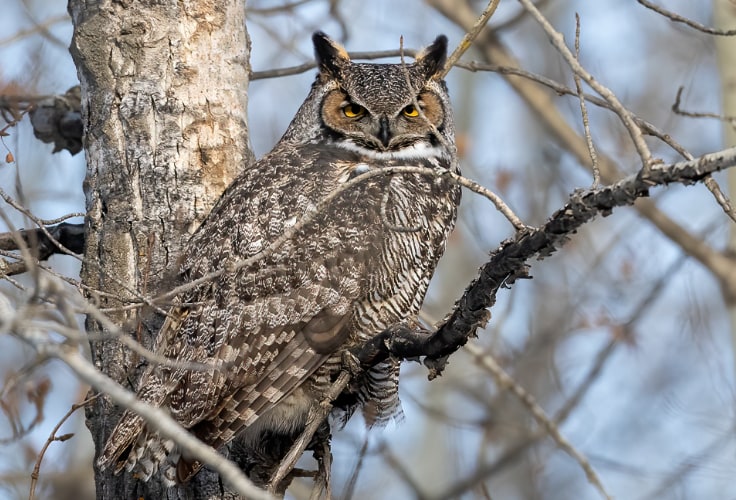
The Great Horned Owl is one of the most powerful and widely recognized owls in Nova Scotia and the province’s largest resident owl. It measures 46 to 63 centimeters (18.1 to 24.8 inches) in length and has a large, thick-bodied build with a broad head and prominent ear tufts that give the species its distinctive silhouette. The eyes are bright yellow, and the plumage forms a complex pattern of brown, buff, gray, and black, with a pale throat patch that often becomes visible when the bird calls.
The species is often detected by voice. Its typical call is a series of four or five deep, low-pitched hoots that carry well through still night air and differ clearly from the distinctive call of the Barred Owl. Great Horned Owls usually hunt from elevated perches at dusk or night, watching open areas for prey before dropping down in a powerful strike. Their flight is strong and deliberate, combining steady wingbeats with short glides. The diet is extremely varied and includes mammals, birds, and other vertebrates, and individuals are capable of taking relatively large prey such as snowshoe hares and even porcupines.
In Nova Scotia, the Great Horned Owl occurs across much of the province and occupies wooded landscapes of many kinds. It is found in forests, woodlots, and mixed rural landscapes where patches of woodland are interspersed with open areas used for hunting. The species nests in large trees, usually in abandoned stick nests built by other birds, but it may also use tree cavities, cliff ledges, or other elevated sites when suitable locations are available. It remains present throughout the year, though numbers may fluctuate locally during fall and winter as individuals from farther north move southward in search of food.
The Great Horned Owl remains a regular breeding resident in Nova Scotia, and atlas comparisons across the Maritimes show a largely stable distribution with localized declines in some regions. Across Canada, long-term monitoring indicates an overall decline since the 1970s, although the rate of decline varies among regions. Habitat change, persecution, and secondary poisoning from rodenticides represent documented threats. Despite these pressures, the species remains widespread across the province due to its flexible habitat use and broad diet.
Northern Saw-whet Owl
Aegolius acadicus
- Identification: Very small owl with a rounded head, bright yellow eyes, brown upperparts spotted with white, and white underparts streaked with brown.
- Where found: Year-round in forested landscapes across Nova Scotia, particularly in mixed and varied woodland habitats that provide nesting cavities.
- How to spot: Listen at night in late winter and spring for a steady series of sharp “too-too-too” notes, or watch for small songbirds mobbing a quietly roosting owl in dense trees.
- Conservation status: Least Concern (IUCN); widespread in the Maritimes and southern Canada, though population trends remain difficult to measure because of the species’ secretive habits.

The Northern Saw-whet Owl is the smallest and one of the most easily overlooked owls in Nova Scotia. This species measures 18 to 22 centimeters (7.1 to 8.7 inches) in length and has a compact body with a large, rounded head that lacks ear tufts. The eyes are bright yellow, and the plumage forms a rich brown pattern marked with white spots on the upperparts and bold brown streaks on the white underparts. The facial disc appears pale and neatly defined, giving the bird a distinctive, alert expression despite its tiny size.
This miniature owl is highly nocturnal and secretive, and most detections come from its vocalizations rather than direct observation. Males give a repetitive series of clear, high-pitched notes often described as “too-too-too,” a call delivered steadily for long periods during the breeding season. During daylight hours the owls usually roost quietly in dense foliage, often close to the trunk of a tree, where their small size and mottled plumage make them difficult to notice. They hunt almost entirely at night, taking small mammals, especially mice, from low perches along forest edges, openings, and woodland clearings.
In Nova Scotia, the Northern Saw-whet Owl occurs across much of the province in a wide variety of forest habitats. It occupies mixed and deciduous woodlands as well as conifer stands, particularly in landscapes where forests of different types and ages occur together. The species nests in cavities, most often abandoned woodpecker holes in trees, and it may also use nest boxes where they are available. It remains present throughout the year, although some individuals migrate or wander through the region in autumn and early winter, and occasional winter appearances near farms, villages, or towns may reflect birds displaced from typical forest habitats during periods of severe cold.
The Northern Saw-whet Owl is considered widespread across the Maritimes but is seldom encountered because of its small size and nocturnal behavior. Atlas work in the region indicates a broad distribution and increased detection relative to earlier survey periods, though much of this change likely reflects improved survey effort rather than population growth. Across Canada, monitoring suggests that population trends remain uncertain, with different programs showing both increases and declines over recent decades. Habitat loss, reduction of mature forest structure, and the removal of standing dead trees that provide nesting cavities remain the principal long-term concerns for the species.
Short-eared Owl
Asio flammeus
- Identification: Medium-sized owl with a pale facial disc, yellow eyes rimmed in black, mottled brown-and-buff upperparts, streaked pale underparts, and broad wings marked with a dark comma at the wrist.
- Where found: Occurs in open landscapes of Nova Scotia, including coastal barrens, shrublands, marshy grasslands, and other treeless or sparsely wooded habitats.
- How to spot: Look for buoyant, mothlike flight low over open fields or marshes at dusk or dawn, or for birds perched directly on the ground.
- Conservation status: Least Concern (IUCN); uncommon and locally distributed in the Maritimes, with long-term declines across Canada linked to habitat change and reduced prey populations.

The Short-eared Owl is one of the few owls in Nova Scotia regularly seen flying in daylight and is a distinctive hunter of open landscapes. It measures 34 to 43 centimeters (13.4 to 16.9 inches) in length and has a medium-sized build with long, broad wings and a rounded head bearing very small ear tufts that are usually not visible. The facial disc appears pale and contrasts with large yellow eyes bordered by dark markings. Plumage is mottled brown and buff above, while the underparts are pale with strong streaking on the breast, creating a pattern that blends well with dried grasses and coastal vegetation.
In the field, the Short-eared Owl is most often detected by its flight. The species quarters slowly over grasslands, marshes, and barrens with buoyant, mothlike wingbeats and frequent changes in direction. Hunting birds fly low above the vegetation while listening for prey and may hover briefly before dropping to the ground. Activity peaks at dusk and dawn, though birds may also be seen during daylight hours. This owl feeds mainly on small mammals, especially voles and mice, and nests on the ground in concealed grassy sites within open habitats.
In Nova Scotia, the Short-eared Owl occurs in scattered open habitats across the province and is never numerous. It is most closely associated with shrublands and other open landscapes, including coastal barrens, uncultivated grasslands, and marshy fields, often near wetlands or along the edges of woodland. Most breeding-season records come from open lowland areas such as the Grand Pré marshes and regions near the New Brunswick border, while other observations are scattered along the Atlantic coast. The species is primarily present during the warmer months, with only small numbers recorded in winter, mainly in the southwestern counties of the province.
The Short-eared Owl remains sparsely distributed in the Maritimes and has experienced long-term declines across much of Canada. National monitoring indicates a substantial population decrease since the 1970s, reflecting broader reductions across its North American range. Habitat loss, grassland conversion, disturbance in open landscapes, and pesticide use all contribute to these trends. Because the species nests directly on the ground, agricultural machinery and other human activities can also destroy nests. Despite these pressures, suitable open habitats such as coastal barrens and marshlands continue to support small breeding populations in the region.
Snowy Owl
Bubo scandiacus
- Identification: Large white owl with yellow eyes, a rounded head, and variable dark barring that may be heavy or nearly absent depending on the individual.
- Where found: Winter visitor to open landscapes of Nova Scotia, especially coastal barrens, dunes, fields, and other treeless areas near the shore.
- How to spot: Scan wide-open coastal terrain for a conspicuous white owl perched on the ground, rocks, dunes, or posts, or watch for low flights over open ground during daylight.
- Conservation status: Vulnerable (IUCN); global populations declining, with winter occurrences in Nova Scotia varying widely depending on conditions in the Arctic.

The Snowy Owl is a large Arctic species that appears in Nova Scotia mainly as an irregular winter visitor, typically in open coastal landscapes. It measures 52 to 71 centimeters (20.5 to 28.0 inches) in length and has a powerful build with a broad, rounded head and intense yellow eyes. Plumage appears mostly white at a distance, often marked with dark barring across the body and wings that varies widely among individuals. The combination of white coloration, large size, and open-country habits makes the species unmistakable when present.
Unlike most owls, the Snowy Owl is frequently active during the day and is often detected visually rather than by sound. Individuals typically perch conspicuously on the ground, rocks, dunes, fence posts, or other exposed vantage points while scanning for prey. Their flight is strong but buoyant, usually low over open ground with steady wingbeats and long glides. Snowy Owls hunt a variety of prey during winter, including small mammals and birds, and they rely on open terrain where prey can be easily detected.
In Nova Scotia, the Snowy Owl occurs mainly as a winter visitor and appears irregularly from year to year. Birds are most often found in open coastal landscapes such as barrens, meadows, and dune systems, and they are rarely recorded far inland. Most individuals arrive between mid-November and early winter, and numbers vary widely depending on conditions on the Arctic breeding grounds. During some winters only a few birds are reported, while in irruption years larger numbers appear across suitable coastal habitats.
The Snowy Owl remains an irregular but well-known winter visitor to Nova Scotia. Across Canada, long-term monitoring indicates a substantial population decline since the 1970s, and the species is considered globally vulnerable. Changes in Arctic ecosystems that affect prey populations, along with winter mortality from collisions with vehicles and infrastructure, represent significant threats. Despite these concerns, periodic southward movements continue to bring Snowy Owls into Atlantic Canada during winters when food shortages in the Arctic trigger wider dispersal.
Long-eared Owl
Asio otus
- Identification: Medium-sized, slender owl with long upright ear tufts, yellow eyes, a buff facial disc with pale eyebrow-like markings, mottled brown-and-buff upperparts, and streaked pale underparts.
- Where found: Occurs in small numbers across forested regions of Nova Scotia, especially where dense spruce or other woodland cover lies near open hunting areas.
- How to spot: Listen on calm spring nights for the male’s low, single-note hoots, or search dense evergreen stands for well-camouflaged roosting birds.
- Conservation status: Least Concern (IUCN); uncommon in Nova Scotia and the Maritimes, with population trends difficult to assess because the species is secretive and poorly monitored.

The Long-eared Owl is one of the most secretive owls in Nova Scotia and is rarely encountered despite occurring across much of the province in suitable forest habitats. It measures 35 to 40 centimeters (13.8 to 15.7 inches) in length and has a slender build with long, upright ear tufts that give the head a narrow, elongated shape. The facial disc appears buff with pale markings above the eyes, and the eyes are bright yellow. Plumage is mottled brown and buff above, with pale underparts marked by dark streaks, creating strong camouflage against bark and dense foliage.
This species is highly nocturnal and is usually detected by voice rather than sight. Males give a low, evenly spaced hoot during the breeding season, a simple one-note call that can carry over long distances on calm nights. During the day the owl roosts quietly in dense evergreen cover, often close to the trunk where its narrow posture and cryptic plumage help it blend into the branches. At dusk it emerges to hunt over nearby open areas, flying low above fields or wetlands while listening for prey. Like many owls of open landscapes, it feeds mainly on small mammals, especially mice and voles.
In Nova Scotia, the Long-eared Owl occurs in small numbers across forested parts of the province, near the northeastern edge of its North American range. Records are scattered but widespread, with many from lowland regions where forest stands occur near wetlands such as fens, beaver ponds, or other open feeding areas. Atlas data suggest an association with older spruce stands in Nova Scotia, though the species nests in a variety of woodland types across the Maritimes. It tends to avoid the highest upland and highland regions but occurs across much of the mainland and parts of Cape Breton where suitable forest mosaics exist.
The Long-eared Owl remains relatively uncommon in Nova Scotia and across the Maritimes, and its secretive habits make population trends difficult to evaluate. Regional atlas work found the species evenly but sparsely distributed, and increases in some survey records likely reflect improved search effort rather than real population growth. National monitoring also indicates that the species is poorly sampled by many surveys because of its nocturnal behavior. Maintaining forest edges and wooded cover near open hunting habitat is considered important for supporting the species where it occurs.
Boreal Owl
Aegolius funereus
- Identification: Small owl with a large rounded head, bright yellow eyes, a grayish-white facial disc bordered in brown, brown upperparts spotted with white, and pale underparts heavily streaked with brown.
- Where found: Occurs rarely in Nova Scotia, mainly in boreal-like habitats of the Cape Breton Highlands and occasionally along coastal regions.
- How to spot: Listen on late-winter nights for the male’s rapid, hollow series of hoots, or search dense conifer forest for a small owl roosting close to tree trunks.
- Conservation status: Least Concern (IUCN); extremely scarce in Nova Scotia and the Maritimes, with population trends difficult to determine because the species is poorly monitored.

The Boreal Owl is one of the rarest and least observed owls in Nova Scotia, occurring near the southern edge of its broader boreal distribution. It measures 21 to 28 centimeters (8.3 to 11.0 inches) in length and has a compact, large-headed appearance with a short tail and relatively long wings. The facial disc appears pale grayish white and is bordered by darker brown, with bright yellow eyes and pale “eyebrow” markings above them. Plumage is brown above with prominent white spots and blotches, while the underparts are pale with strong brown streaking, creating effective camouflage in conifer forests.
This owl is highly nocturnal and rarely encountered in daylight. Males advertise territories during late winter with a rapid, hollow series of evenly spaced hoots that can carry through still forest air. Once nesting begins, calling declines sharply, making the species even harder to detect. During the day Boreal Owls roost quietly in dense branches or cavities, often close to tree trunks where their cryptic plumage blends into the bark. They hunt mainly from perches at night, capturing small mammals such as mice and voles in short downward glides through the forest.
In Nova Scotia, the Boreal Owl occurs very rarely and mainly in boreal-like habitats of the Cape Breton Highlands. Atlas surveys reported only scattered observations in the province, including one confirmed nest in the northern Cape Breton Highlands. A few additional detections have come from coastal areas, but records remain extremely limited. Across the Maritimes the species is similarly sparse and occurs near the southern limit of its breeding range, appearing primarily in colder highland forests and other boreal-type environments.
The Boreal Owl remains extremely uncommon in Nova Scotia and across the Maritimes, and its true abundance is difficult to assess. Increased records in recent atlas work likely reflect greater survey effort rather than real population change. At the national scale, monitoring programs provide limited data because the species occurs mainly in remote northern forests and is difficult to detect. As a result, population trends remain uncertain, though the species continues to persist across its broad boreal range.
Northern Hawk-Owl
Surnia ulula
- Identification: Medium-sized owl with a long tail, short pointed wings, brown upperparts spotted with white, a small pale facial disc, and white underparts marked by heavy brown barring.
- Where found: Occurs only as a rare visitor to Nova Scotia, usually during winter movements from northern boreal regions.
- How to spot: Watch open barrens or fields for a diurnal owl perched upright on exposed treetops or posts scanning for prey.
- Conservation status: Least Concern (IUCN); extremely rare in Nova Scotia, appearing only as an occasional visitor from northern breeding areas.

The Northern Hawk-Owl is a distinctive northern species that appears only rarely in Nova Scotia. It measures 36 to 45 centimeters (14.2 to 17.7 inches) in length and has a compact, medium-sized build with a long, tapered tail and relatively short pointed wings. The facial disc is small and pale with a dark border, and the eyes are bright yellow. Plumage is brown above with white spotting, while the underparts are white with bold brown barring. Its upright posture and long tail give it a hawk-like silhouette unlike that of most owls.
Unlike most North American owls, this species hunts mainly during daylight hours. Individuals typically perch conspicuously on the tops of trees or other elevated lookouts, leaning forward as they scan open ground for prey. When hunting, the owl launches into fast, direct flights across open terrain with strong wingbeats and low glides reminiscent of a falcon. It feeds primarily on small mammals and occasionally birds, dropping quickly from a perch when prey is detected.
In Nova Scotia, the Northern Hawk-Owl occurs only as a rare and irregular visitor. Most records involve single birds appearing during winter movements when prey shortages in northern boreal forests drive individuals southward. Sightings have been scattered across the province, including historical records near Halifax, Wolfville, and New Glasgow, as well as occasional coastal observations such as Brier Island. The species does not breed in the province and has not been recorded nesting in recent regional surveys.
The Northern Hawk-Owl remains an extremely rare visitor in Nova Scotia, with only scattered records over many decades. Most occurrences likely represent birds moving south from boreal breeding areas during periods of low prey availability. Because these movements are irregular, the species may be absent for many years and then appear briefly during invasion events. Its global population is considered stable, and its rare appearance in Nova Scotia reflects its primarily northern distribution rather than regional conservation concerns.
Rare and Accidental Owls in Nova Scotia
A few additional owl species have been recorded in Nova Scotia only rarely, usually as isolated vagrants far outside their normal ranges. One of the most notable recent examples is the Burrowing Owl, a species of western grasslands that appeared in several observations in 2024. Most reports came from the Shelburne area, particularly around the Blanche Peninsula and Eel Bay, with earlier provincial records including Halifax in 2017 and Duncan’s Cove on the Chebucto Peninsula. Such occurrences likely involve birds wandering far from their typical prairie breeding range.

Other species are known only from a handful of historical records. The American Barn Owl has been documented only a few times in Nova Scotia, including early specimens from Yarmouth and Guysborough counties and later observations in Amherst and Lower Argyle. The Great Gray Owl, a large boreal species of northern forests, is represented by only a few historical records in the province, including a well-documented observation near Berwick in 1976. A single 19th-century specimen suggests that the Eastern Screech-Owl may also have appeared once in Nova Scotia, though the species has never been confirmed as part of the province’s modern avifauna.
For a broader perspective, see our guide to the types of owls in North America, and visit the Birds of Nova Scotia and Birds of Canada pages for additional regional and national bird guides.

Raeesah Habib is a South African conservationist and freelance writer. She completed a diploma in nature conservation in 2016 through the University of South Africa (UNISA). During her internship, she spent a year working with wattled cranes on the Wattled Crane Recovery Programme (WCRP).
The program aims to prevent the local extinction of the wattled crane in Southern Africa through the release of captive-reared individuals into critically endangered wild populations across the country. During her time at the research facility, she was also responsible for the general monitoring and husbandry of other magnificent species, including blue cranes and secretary birds.
Following her internship, she was fortunate to have worked in some spectacular wilderness areas across the country, including the Cradle of Humankind, the Kruger National Park, and the northern Zululand. As a wildlife monitor, her responsibilities included conducting bird point counts. Birds surveys are a useful means to collect data on the avian populations in an area. The data helps researchers gain an understanding of population trends and ecosystem health.
When not in the field, Rae enjoys writing to share her passion, knowledge, and experiences with others.
