
British Columbia supports one of the richest woodpecker communities in Canada, reflecting the province’s exceptional range of habitats, from coastal temperate rainforests to dry interior pine woodlands and northern boreal plains. Twelve species breed regularly in the province, joined by two occasional visitors recorded in recent decades. This guide provides identification notes and BC-specific context on habitat use, regional distribution, and seasonal occurrence for woodpeckers found across the province.
Quick ID: 14 species at a glance
| Species | Length | Field mark | When present |
|---|---|---|---|
| Northern Flicker | 28 to 31 centimeters (11.0 to 12.2 inches) | conspicuous white rump in flight | rare or absent in northern British Columbia in winter; common in southern valleys |
| Downy Woodpecker | 14 to 17 centimeters (5.5 to 6.7 inches) | broad white back stripe | Year-round resident |
| Hairy Woodpecker | 18 to 26 centimeters (7.1 to 10.2 inches) | long, robust bill nearly as long as the head | Year-round resident |
| Pileated Woodpecker | 40 to 49 centimeters (15.7 to 19.3 inches) | prominent red crest | Year-round resident |
| Red-breasted Sapsucker | 20 to 22 centimeters (7.9 to 8.7 inches) | bright red head and breast | resident along the coast and migratory in the interior |
| American Three-toed Woodpecker | 20 to 23 centimeters (7.9 to 9.1 inches) | three toes on each foot | Year-round resident |
| Black-backed Woodpecker | 23 to 24 centimeters (9.1 to 9.4 inches) | solid black upperparts contrasting sharply with clean white underparts | year-round |
| Yellow-bellied Sapsucker | 18 to 22 centimeters (7.1 to 8.7 inches) | large white wing patch | migratory and largely absent in winter |
| Red-naped Sapsucker | 19 to 21 centimeters (7.5 to 8.3 inches) | red crown, red nape, and large white wing patch | short-distance migrant; arrives late March, departs late August to mid-September |
| Williamson's Sapsucker | 21 to 25 centimeters (8.3 to 9.8 inches) | Males glossy black with red throat, large white wing patch, white rump, and yellow belly | Mid- to late March to late September; migratory and absent in winter |
| Lewis's Woodpecker | 26 to 28 centimeters (10.2 to 11.0 inches) | dark red face and pink to salmon-colored belly | partly migratory, with small numbers wintering in the southern Okanagan |
| White-headed Woodpecker | 21 to 23 centimeters (8.3 to 9.1 inches) | entirely white head and neck contrasting with glossy black body | year-round |
| Acorn Woodpecker | 19 to 23 centimeters (7.5 to 9.1 inches) | bright red crown, white forehead, black facial mask | spring and early summer, with one winter record |
| Red-headed Woodpecker | 19 to 24 centimeters (7.5 to 9.4 inches) | fully crimson head, glossy black back, large white wing patches, and clean white underparts | June and July, with a few in September |
Northern Flicker
Colaptes auratus
- Identification: Large brownish woodpecker with barred back, spotted underparts, bold black breast crescent, bright red or yellow flight feather shafts, and a conspicuous white rump in flight.
- Where found: Widespread across most of British Columbia in open woodlands, forest edges, parklands, and urban areas, with sparser distribution in northern mountains.
- How to spot: Look for a woodpecker feeding on the ground or flying in a bounding pattern that flashes bright underwings and a white rump; listen for loud “wick-wick-wick” calls.
- Conservation status: Least Concern (IUCN); common in British Columbia but showing long-term population declines in Canada.

The Northern Flicker is the most widespread and frequently encountered woodpecker in British Columbia and the only species regularly seen feeding on the ground. It measures 28 to 31 centimeters (11.0 to 12.2 inches) in length and has a slightly curved bill and sleek brown plumage. The back is barred, the underparts are spotted, and a bold black crescent marks the upper breast. Two main forms occur in the province: the Red-shafted and Yellow-shafted flickers. The Red-shafted form predominates south and west of the Rocky Mountain contact zone, while the Yellow-shafted form occurs north and east of it. They differ in the color of the flight feather shafts, which are red or yellow respectively. Males show a distinct malar stripe, red in the western form and black in the eastern form, while females lack this marking. Hybrids are frequent in southern British Columbia, particularly near the contact zone.

In the field, Northern Flickers are often detected by behavior and voice. Individuals walk or hop on open ground while probing for ants, which form the bulk of the diet, along with beetles and other insects. The species flies in a strong, undulating pattern with alternating flaps and glides, flashing bright red or yellow underwings and a gleaming white rump in flight. Its loud, ringing “wick-wick-wick” call carries over long distances, especially in spring. Drumming is steady and resonant and is used for territorial advertisement. Unlike many woodpeckers in North America, this species relies heavily on ground foraging rather than tree trunks.
Within British Columbia, the Northern Flicker breeds in every ecoprovince and almost every biogeoclimatic zone. It is most common in the Southern Interior and Central Interior ecoprovinces, especially in the Interior Douglas-fir, Ponderosa Pine, and Bunchgrass zones, where open forests and valley bottoms provide both nesting sites and foraging habitat. The species is more sparsely distributed in the Northern Boreal Mountains and Coast and Mountains ecoprovinces. It occupies forest edges, open woodlands, parklands, agricultural landscapes, and wooded urban neighborhoods. Northern Flickers are short-distance migrants. The species becomes rare or absent in northern British Columbia in winter, while large numbers winter in the valleys of southern British Columbia at lower elevations. Spring arrival occurs in southern parts of the province by early March and later in the north, with fall migration beginning in late August and continuing through October.
The Northern Flicker remains common in British Columbia, but long-term monitoring in Canada indicates an overall decline since 1970. Provincial trends are variable, with some regions showing small increases and others small decreases. Competition with European Starlings for nest cavities contributes to local declines. The species nests primarily in decaying or dead Trembling Aspen and depends on the availability of both suitable cavity trees and open foraging habitat. As a primary cavity excavator, it plays a key ecological role in supporting many other cavity-nesting birds in the province. Continued retention of dead and decaying trees in managed forests is important for maintaining stable populations in British Columbia.
Downy Woodpecker
Dryobates pubescens
- Identification: Very small black-and-white woodpecker with a broad white back stripe, checkered wings, and a small red nape patch on males; bill short and stubby.
- Where found: Year-round resident across most of British Columbia in deciduous and mixed woodlands, riparian areas, burns, and suburban habitats, though sparse in the far north and northern coast.
- How to spot: Listen for a sharp “pik” call or descending whinny and watch for a tiny black-and-white bird moving along thin branches or visiting suet feeders.
- Conservation status: Least Concern (IUCN); common in British Columbia but showing recent regional declines despite overall long-term stability in Canada.

The Downy Woodpecker is the smallest regularly occurring woodpecker in British Columbia and one of the most familiar species in wooded neighborhoods and parks. It measures 14 to 17 centimeters (5.5 to 6.7 inches) in length and has a compact build with a short, chisel-like bill. Plumage shows a crisp black-and-white pattern with a broad white stripe down the back, spotted black wings, and bold white facial stripes separated by a black ear patch. Underparts are plain white. Males show a small red patch on the nape, which females lack.

In the field, Downy Woodpeckers move with short hops along trunks and slender branches, often foraging on small limbs that larger woodpeckers ignore. The species frequently joins mixed flocks of chickadees and nuthatches in winter and readily visits suet feeders in residential areas. Flight is undulating, with alternating flaps and glides. Vocalizations include a sharp, high “pik” call and a descending whinny, and drumming consists of short, rapid bursts used in territorial display. The diet consists mainly of insects and larvae gleaned from bark, supplemented by seeds and suet, particularly in winter.
In British Columbia, the Downy Woodpecker breeds across most of the province but is very sparsely distributed in the far north and along the northern coast. It has been rarely observed on Haida Gwaii and was not recorded there during the atlas period. The species is most frequently encountered in the Georgia Depression, Southern Interior, and Southern Interior Mountains ecoprovinces, particularly in valley systems and lower elevations. The species occupies open deciduous and mixed woodlands, especially riparian areas, and also uses forest burns, logged sites, and suburban habitats. It prefers dead deciduous trees for nesting, with most nests placed in aspen, alder, cottonwood, and other broadleaf species.
The Downy Woodpecker remains widespread and common across British Columbia, but recent monitoring indicates moderate declines in parts of the province. Long-term Canadian data suggest overall stability or modest increases since the 1970s, though trends in central and southern interior British Columbia show more consistent decreases. Provincial monitoring has also detected declining trends in recent decades. Despite these patterns, the species continues to be adaptable, and there are few documented threats beyond localized habitat loss and the removal of dead nesting trees. Continued retention of dead deciduous trees in managed landscapes will support stable breeding populations in the province.
Hairy Woodpecker
Leuconotopicus villosus
- Identification: Medium-sized black-and-white woodpecker with a broad white back stripe, clean white underparts, and a long, robust bill nearly as long as the head; males show a red patch on the nape.
- Where found: Year-round resident across most forested regions of British Columbia, most widespread in the southern two-thirds of the province and present on Haida Gwaii.
- How to spot: Look for a sharply patterned black-and-white bird climbing main trunks and large branches with deliberate hops; listen for a loud “peek” call and steady drumming.
- Conservation status: Least Concern (IUCN); increasing overall in British Columbia, though slight declines are noted in parts of the southern interior and the Haida Gwaii subspecies is provincially Blue-listed.

The Hairy Woodpecker is a widespread and familiar forest woodpecker in British Columbia and is the larger counterpart to the Downy Woodpecker. It measures 18 to 26 centimeters (7.1 to 10.2 inches) in length and has a sturdy frame with a long, chisel-shaped bill. Plumage is sharply patterned in black and white, with a broad white stripe down the back, spotted black wings, bold facial striping, and clean white underparts. Males show a red patch on the nape, which females lack. Compared with the Downy Woodpecker, the Hairy Woodpecker appears bulkier, shows a proportionately much longer bill nearly equal to the length of the head, and lacks black spotting on the outer tail feathers.

In the field, Hairy Woodpeckers climb with short, deliberate hops up trunks and along large branches, seldom using the thin outer twigs favored by Downy Woodpeckers. The species supports itself with stiff tail feathers while hammering forcefully on bark and exposed wood. Flight is undulating, with alternating flaps and glides. Vocalizations include a sharp, explosive “peek” call and a harsher descending whinny, and drumming consists of steady bursts used in territorial display. The diet consists mainly of wood-boring insects and larvae extracted from trunks and branches, supplemented by some fruit and seeds.
Within British Columbia, the Hairy Woodpecker is a resident breeder across most of the province, particularly throughout the southern two-thirds. It occurs in all ecoprovinces, with especially high probability of observation in the Southern Interior and Coast and Mountains ecoprovinces, including Haida Gwaii. A distinct insular subspecies is resident on Haida Gwaii. The species occupies a broad elevational range, from coastal lowlands to montane forests, and shows no strong elevation preference within that span. It is found in coniferous, deciduous, and mixed forests, particularly along forest edges, and nests primarily in large dead stubs or in living trees with fungal decay. In western North America, including British Columbia, aspen is used extensively for nesting. Some individuals breeding at higher elevations disperse locally to lower elevations during winter.
The Hairy Woodpecker remains common and secure in British Columbia. National monitoring indicates a substantial long-term increase since the early 1970s, and provincial data show overall growth, although slight long-term declines have been recorded in parts of the southern interior. The Haida Gwaii subspecies is provincially Blue-listed because of its restricted range and limited ecological information. There are few immediate threats at a broad scale, but loss of large dead trees and forest fragmentation can reduce suitable nesting and foraging habitat. Retention of mature forests and standing deadwood remains important for sustaining stable populations across the province.
Pileated Woodpecker
Dryocopus pileatus
- Identification: Very large black woodpecker with bold white neck stripes and a prominent red crest; males show a red malar stripe, and broad white underwings are visible in flight.
- Where found: Year-round resident across much of British Columbia, most widespread in the southern half of the province in mature forests with large trees and abundant dead wood.
- How to spot: Look for a crow-sized black woodpecker excavating large rectangular holes in logs or trunks; listen for loud “kuk-kuk-kuk” calls and deep, resonant drumming.
- Conservation status: Least Concern (IUCN); stable to increasing in British Columbia, benefiting locally from forest regeneration and insect outbreaks.

The Pileated Woodpecker is the largest woodpecker in British Columbia and one of the most conspicuous residents of mature forests. It measures 40 to 49 centimeters (15.7 to 19.3 inches) in length and approaches the size of a crow. The species has a long neck, broad wings, and a powerful, chisel-shaped bill nearly the length of the head. Plumage is mostly black, with bold white stripes running from the bill down the sides of the neck and large white patches on the underwings. Both sexes show a prominent red crest, and males have an additional red malar stripe, which females lack.

In the field, Pileated Woodpeckers are most often detected by sound. Their loud, ringing “kuk-kuk-kuk” calls carry far through forested valleys, and their slow, resonant drumming is deeper and more powerful than that of smaller woodpeckers. The species excavates large, rectangular holes in rotting trunks and fallen logs while foraging. Its primary prey consists of carpenter ants and woodboring beetle larvae, supplemented by other insects and seasonal fruit. Individuals climb with strong, deliberate movements along large trunks and branches and may also forage on downed wood.
In British Columbia, the Pileated Woodpecker is a widespread resident breeder, more common in the southern half of the province. Breeding has been confirmed in nearly all ecoprovinces, with only limited evidence from the Northern Boreal Mountains. The species is absent from the central and northern coasts, including Haida Gwaii. It is most frequently encountered in valley systems and on interior plateaus, particularly at lower elevations where large-diameter trees are available for nesting and roosting. Interior mixed forests and the drier forests of the Coastal Douglas-fir zone support relatively high abundance, while wetter coastal forests tend to hold lower densities. In interior forests, large live Trembling Aspen with signs of decay are frequently selected for nesting, whereas western populations use a variety of large coniferous and deciduous trees, including snags and deteriorating live trees.
The Pileated Woodpecker appears stable or increasing across much of British Columbia. National monitoring shows a strong long-term increase since the 1970s, and provincial trends are generally positive, with notable increases recorded in regions affected by Mountain Pine Beetle outbreaks where dead wood became more abundant. The species depends on mature forest structure, large trees, and plentiful snags and downed logs. Retention of older forest stands and deadwood is important for maintaining healthy populations, as these features support both nesting sites and the carpenter ant populations on which the species relies.
Red-breasted Sapsucker
Sphyrapicus ruber
- Identification: Medium-sized woodpecker with a bright red head and breast, black-and-white patterned back, bold white wing patch, and pale underparts washed yellow on the belly.
- Where found: Widespread in coastal and interior British Columbia, breeding mainly in coniferous and mixed forests, resident along the coast and migratory in the interior.
- How to spot: Listen for irregular, stuttering drumming or a nasal squeal, and look for neat horizontal rows of sap wells on trunks in forested habitats.
- Conservation status: Least Concern (IUCN); populations increasing in Canada and generally stable or increasing in British Columbia, though subject to short-term fluctuations.

The Red-breasted Sapsucker is the most widespread and frequently encountered sapsucker in coastal British Columbia and a characteristic woodpecker of Pacific forests. It measures 20 to 22 centimeters (7.9 to 8.7 inches) in length and has a sturdy build with a straight, pointed bill. Plumage is striking, with the entire head and upper breast deep red, interrupted only by a small pale mark in front of the eye. The back is black with white mottling, the wings show a bold vertical white patch, and the underparts are pale with a yellowish wash across the belly. Both sexes appear alike.
In the field, Red-breasted Sapsuckers climb trunks and large branches with deliberate movements, pausing to probe or drill. The species excavates neat, horizontal rows of sap wells in both deciduous and coniferous trees and returns repeatedly to feed on sap and the insects attracted to it. Calls include nasal, drawn-out squeal notes and short chattering exchanges between mates. Drumming is irregular and stuttering, often accelerating and then slowing unevenly. In addition to sap, Red-breasted Sapsuckers consume insects and other arthropods, which are especially important during the breeding season.
Within British Columbia, the species is widely distributed through the Coast Mountains and on larger coastal islands from south to north, extending eastward across the Interior Plateau into the Rocky Mountain Trench. Breeding has been confirmed from low coastal forests to interior spruce-dominated stands. Coastal populations are largely resident, while interior populations are fully migratory, departing breeding areas by late summer and increasing along the coast in early autumn. Spring movement into interior breeding areas occurs by late March, with peak migration through April and into May. The Red-breasted Sapsucker favors mature coniferous and mixed forests, particularly Western Hemlock and Douglas-fir forests at lower elevations, and is often found near water. It also uses orchards, forest edges, burns, and riparian woodlands. Nest cavities are most often excavated in deciduous trees, including aspen, alder, and cottonwood.
The Red-breasted Sapsucker appears secure in British Columbia. National monitoring indicates a substantial long-term increase since 1970, and trends in both coastal and interior British Columbia are positive overall. Populations may fluctuate markedly between years, and occasional winter mortality can occur during prolonged cold periods when sap resources are limited. The species benefits from mixed forest landscapes but may be affected locally by removal of large trees and snags or by changes in forest composition. Continued monitoring is warranted, particularly in areas where hybrid zones with other sapsuckers occur and where forest structure is changing.
American Three-toed Woodpecker
Picoides dorsalis
- Identification: Medium-sized black-and-white woodpecker with barred flanks, white outer tail feathers, and a yellow crown patch in males; one of the few woodpeckers with three toes.
- Where found: Year-round resident across interior British Columbia in boreal, sub-boreal, and montane conifer forests, especially in spruce and Lodgepole Pine stands affected by fire or bark beetles.
- How to spot: Look for a quiet woodpecker flaking bark from dead or beetle-killed conifers; listen for soft tapping and faint “pik” calls rather than loud drumming.
- Conservation status: Least Concern (IUCN); no major provincial conservation concern, though national trends are uncertain and habitat is affected by salvage logging and pest management.

The American Three-toed Woodpecker is a characteristic specialist of interior conifer forests and breeds farther north than any other woodpecker in the province. It measures 20 to 23 centimeters (7.9 to 9.1 inches) in length and has a compact, sturdy build with a strong neck and bill. The species has three toes on each foot, a distinctive trait among North American woodpeckers. Plumage is sharply patterned in black and white, with black upperparts barred and spotted with white and white underparts marked by fine black barring along the flanks. The head shows bold white facial stripes on a mostly black background, and males display a bright yellow crown patch that females lack. The outer tail feathers are white with narrow black bars.

In the field, this species is typically quiet and methodical. Individuals often begin foraging low on a trunk and work slowly upward, flaking bark from dead or dying conifers rather than excavating deep rectangular holes. Freshly exposed pale wood on beetle-killed trees is often the first sign of its presence. The diet in British Columbia consists primarily of Mountain Pine Beetle larvae, especially during outbreaks, with most foraging observations recorded in Lodgepole Pine stands. Calls are soft and include faint “pik” notes, and drumming is relatively subdued compared with larger species of woodpecker.
Within the province, the American Three-toed Woodpecker breeds widely across the interior but is sparsely distributed within and west of the Coast Mountains. It is most frequently encountered in the Sub-boreal Interior ecoprovince and adjacent interior regions, where spruce-dominated forests and mixed conifer stands provide suitable habitat. The species occupies boreal, sub-boreal, and subalpine conifer forests, particularly in the Sub-boreal Spruce, Sub-boreal Pine-Spruce, and Montane Spruce biogeoclimatic zones. Most interior breeding observations occur at mid-elevations in coniferous landscapes, though the species ranges from lower foothills to higher montane forests. Breeding has also been confirmed on Vancouver Island and in the lower Skeena River valley, though coastal records remain sparse. The species is resident year-round but may shift locally in response to insect outbreaks or recent burns.
The American Three-toed Woodpecker is not currently considered at risk in British Columbia, and provincial survey data suggest stable or increasing trends, although reliability is limited by patchy coverage. National trend estimates are conflicting and of low confidence, reflecting the woodpecker’s remote distribution and shifting response to disturbance. The species benefits from natural disturbances such as fire and mountain pine beetle outbreaks but may be negatively affected by salvage logging, rapid cutting rotations, and pest control measures that remove beetle-infested trees. Retention of beetle-killed and partially decayed conifers within managed forests is important for maintaining suitable foraging and nesting habitat in British Columbia.
Black-backed Woodpecker
Picoides arcticus
- Identification: Medium-sized black-and-white woodpecker with solid black upperparts, white underparts barred on the flanks, a single white facial stripe, and three toes; males show a yellow crown patch.
- Where found: Year-round resident across interior British Columbia in boreal and upper-elevation conifer forests, especially in recently burned or insect-infested stands.
- How to spot: Search recently burned forests for a dark woodpecker flaking bark from charred trunks; listen for a sharp “kyik” call and drumming that fades at the end.
- Conservation status: Least Concern (IUCN); generally stable in Canada but potentially affected in British Columbia by fire suppression and post-fire salvage logging.

The Black-backed Woodpecker is a disturbance specialist of interior British Columbia and is most closely associated with burned conifer forests. It measures 23 to 24 centimeters (9.1 to 9.4 inches) in length and has a compact, sturdy build. Plumage is strikingly dark above, with glossy black upperparts contrasting sharply with clean white underparts barred along the flanks. A single white facial stripe runs from the bill toward the neck, and the outer tail feathers are white. Males show a bright yellow patch on the crown, which females lack. The species has three toes on each foot, a trait shared only with the American Three-toed Woodpecker in North America. It differs by its solid black back, darker head pattern with minimal white behind the eye, and largely unbarred white outer tail feathers.

In the field, Black-backed Woodpeckers are quiet and deliberate. They forage by flaking bark from recently burned or beetle-infested conifers, often exposing pale sapwood on charred trunks. Their primary prey consists of wood-boring beetle larvae that colonize fire-killed trees. Individuals typically move methodically from trunk to trunk, flying low and directly through forest openings. The call is a sharp “kyik” or clipped double note, and drumming begins rapidly and then trails off toward the end, similar to that of the American Three-toed Woodpecker but generally louder and more forceful.
In British Columbia, the Black-backed Woodpecker is relatively widespread across interior ecoprovinces but remains sparse west of the Coast Mountains. The probability of observation is low throughout most of the province, with slightly higher occurrence in the Omineca Mountains and northern Rocky Mountain Trench within the Sub-boreal Interior and Northern Boreal Mountains ecoprovinces. The species is largely associated with boreal and upper-elevation conifer forests dominated by spruce, Douglas-fir, Subalpine Fir, and Western Hemlock. Highest occurrence is typically recorded in spruce-dominated biogeoclimatic zones and at mid-elevations in interior mountain landscapes. Recent burns and stands affected by bark beetles provide essential habitat. Nests are excavated in living or dead conifers, including spruce, Douglas-fir, Western Larch, Western Redcedar, and pines. The species is resident year-round but may shift locally in response to fire or insect outbreaks.
The Black-backed Woodpecker is not currently considered at risk in British Columbia, and national monitoring suggests little overall change since 1970, although trend estimates vary in reliability. Canada holds a very high proportion of the global population. In British Columbia, conservation concerns focus primarily on habitat management. Fire suppression and post-fire salvage logging can reduce the availability of recently burned stands and standing dead trees that support feeding and nesting. Retaining portions of fire-killed forest within managed landscapes is considered important for sustaining populations of this disturbance-dependent species.
Yellow-bellied Sapsucker
Sphyrapicus varius
- Identification: Small to medium black-and-white woodpecker with a red crown, pale yellowish underparts, bold facial pattern, and a large white wing patch; males show a red throat.
- Where found: Breeds in northeastern and northern British Columbia in boreal and sub-boreal forests, especially in deciduous and mixed stands; migratory and largely absent in winter.
- How to spot: Look for neat horizontal rows of sap wells on aspen or birch trunks and listen for nasal “mew” calls or irregular, stuttering drumming.
- Conservation status: Least Concern (IUCN); stable in Canada and well established in northeastern British Columbia.

The Yellow-bellied Sapsucker is one of four regularly occurring sapsuckers in British Columbia and is primarily a species of the province’s northeastern boreal forests. It measures 18 to 22 centimeters (7.1 to 8.7 inches) in length and has a compact, slender build with a straight, pointed bill. Plumage shows a crisp black-and-white pattern with a red crown bordered in black, a bold white stripe along the side of the head, and a large white wing patch visible in flight. Underparts are buffy to pale yellowish, and males show a red throat.

In the field, the Yellow-bellied Sapsucker is often detected by its distinctive feeding sign. Individuals drill and maintain orderly rows of sap wells in the bark of deciduous trees, particularly Trembling Aspen and birch, and return repeatedly to feed on sap. The flight is bounding and undulating. Vocalizations include nasal “mew” calls and contact notes, and drumming is irregular and stuttering rather than evenly paced. In addition to sap, the species feeds on insects and occasionally fruit, and it excavates nesting cavities in deciduous trees, especially aspen and poplar.
In the province, the Yellow-bellied Sapsucker is widespread east of the Rocky Mountains in the Boreal and Taiga Plains ecoprovinces, where the Peace, Fort Nelson, and Liard River lowlands form the core of its provincial range. It also occurs more sparsely across northern British Columbia, with breeding documented southwest to the Nechako Plateau and the upper Skeena River drainage, and northwest to the Atlin Lake area. The highest abundance occurs in the White and Black Spruce biogeoclimatic zone. The species is strongly migratory and departs the province in autumn, wintering far to the south.
The Yellow-bellied Sapsucker is stable across its Canadian breeding range, and there are no documented management concerns in British Columbia. The species is well adapted to early seral forests and regenerating cut-over areas, which provide suitable breeding habitat. As a primary cavity excavator, it plays an important ecological role in boreal forest bird communities. Continued availability of young deciduous stands and cavity-bearing trees supports stable populations in northeastern British Columbia.
Red-naped Sapsucker
Sphyrapicus nuchalis
- Identification: Medium-sized black-and-white woodpecker with red crown, red nape, and large white wing patch; males show a fully red throat, females a white-and-red throat.
- Where found: Breeds widely across southern and central interior British Columbia in mixed and deciduous forests east of the Coast Mountains; a short-distance migrant that departs most of the province in winter.
- How to spot: Look for tidy horizontal rows of sap wells in aspen or birch and listen for harsh nasal weep calls and slow, irregular drumming.
- Conservation status: Least Concern (IUCN); stable or gradually increasing in Canada, with British Columbia holding a significant share of the global population.

The Red-naped Sapsucker is the characteristic sapsucker of British Columbia’s southern interior forests and a key cavity-excavating species in the province. It measures 19 to 21 centimeters (7.5 to 8.3 inches) in length and shows bold black-and-white patterning with vivid red on the crown and nape. The face is crisply marked with white stripes bordering a dark facial stripe, and a large white patch is visible on the wing in flight. The underparts are washed with pale buff or yellow. Males show a fully red throat bordered in black, while females show white on the chin and upper throat with variable red below.

In the field, this woodpecker species is most easily detected by its feeding sign. Individuals drill and defend orderly rows of sap wells, especially in Trembling Aspen and birch, and return frequently to feed on sap and insects attracted to it. The flight is bounding and undulating. Vocalizations include harsh, nasal weep or squealing calls, and drumming is slow and irregular rather than evenly spaced. During the breeding season, birds often cling upright to trunks or forage along larger branches, using stiff tail feathers for support.
Within British Columbia, the Red-naped Sapsucker is widespread across the Southern Interior and Central Interior ecoprovinces, mostly east of the Coast Mountains and south of approximately 53 degrees north. It also occurs at lower elevations in the Southern Interior Mountains ecoprovince and may extend northward along drier interior forests, including areas near the Nechako River. Highest abundance occurs in the Interior Douglas-fir and Interior Cedar-Hemlock biogeoclimatic zones, and locally in the Sub-boreal Spruce zone. The species favors deciduous groves and riparian woodlands within mixed forests, excavating most nest cavities in Trembling Aspen. It is a short-distance migrant, arriving in British Columbia as early as late March, with main spring movement in April, and departing between late August and mid-September.
The Red-naped Sapsucker is considered stable or gradually increasing across its Canadian breeding range, although regional trends vary within British Columbia. Some south-central areas show moderate long-term declines, while central interior regions show increases. The province supports some of the highest Breeding Bird Survey counts for the species and therefore carries significant global responsibility. Local extirpations may occur where riparian deciduous habitats are lost. As a keystone cavity excavator, this species provides nesting sites for many other forest birds, and retention of deciduous stands, especially aspen groves, remains important for maintaining healthy populations.
Williamson’s Sapsucker
Sphyrapicus thyroideus
- Identification: Medium-sized woodpecker; males glossy black with red throat, large white wing patch, white rump, and yellow belly; females are brownish with barred upperparts and pale rump.
- Where found: Breeds locally in southern interior British Columbia in mature montane conifer forests, especially those with Western Larch; migratory and absent in winter.
- How to spot: Watch for a sharply contrasting pair on trunks in open montane forests, listen for the ringing “chyaah” call and steady drumming, and look for rectangular sap wells on conifers.
- Conservation status: Least Concern (IUCN); listed as Endangered in Canada due to small population size and loss of mature montane forest habitat.

The Williamson’s Sapsucker is one of the most distinctive woodpeckers in British Columbia’s southern interior mountains and is notable for the striking difference between the sexes. It measures 21 to 25 centimeters (8.3 to 9.8 inches) in length and has a compact body with a medium-length bill and stiff tail used for bracing against trunks. Adult males are glossy black with a vivid red throat, bold white wing patch, white rump, and bright yellow belly. Females are strongly barred in brown, black, and white, with a pale rump and yellowish underparts.

In the field, the Williamson’s Sapsucker forages mainly on live conifers. It clings vertically to trunks and drills rectangular or horizontal rows of sap wells, returning repeatedly to feed. In British Columbia, foraging observations show a strong reliance on ants gleaned from Douglas-fir and other conifers, with sap feeding and pecking for sub-bark insects also common. The flight is undulating. The sharp, ringing “chyaah” call is the most frequently heard vocalization during the breeding season, and drumming is steady and rhythmic.
In British Columbia, the species breeds in three disjunct areas of the southern interior: the northern Cascade Mountains, the plateau linking the Okanagan and Boundary regions in the Southern Interior ecoprovince, and the southern Purcell Mountains in the Southern Interior Mountains ecoprovince. The breeding range extends from the United States border north to approximately Hat Creek, Scottie Creek, and Barriere, and east to the Rocky Mountain Trench near Grand Forks. The Williamson’s Sapsucker is closely associated with mature montane conifer forests that contain Western Larch, often mixed with Douglas-fir, Lodgepole Pine, and Trembling Aspen. It is migratory, arriving in southern British Columbia mainly from mid- to late March and departing by late September, with no overwintering records in the province.
The Williamson’s Sapsucker has a small and localized population in Canada and is listed as Endangered under the Species at Risk Act. Although its provincial range has expanded slightly in recent decades, the mature montane forests it depends upon, especially those containing Western Larch, continue to decline due to forestry activities and related habitat loss. The population size in Canada is small, and there are no comprehensive long-term monitoring data to determine precise trends. Provincial recovery planning includes habitat protection measures and retention of suitable live trees in core nesting areas. Continued conservation of mature conifer stands in southern interior British Columbia is essential for maintaining this specialized woodpecker.
Lewis’s Woodpecker
Melanerpes lewis
- Identification: Medium-sized dark greenish-black woodpecker with a gray collar, dark red face, and pink belly; long wings and tail give a crowlike silhouette in flight.
- Where found: Breeds in the dry valleys of southern interior British Columbia, especially in open Ponderosa Pine and Interior Douglas-fir forests and riparian cottonwood stands; partly migratory, with small numbers wintering in the southern Okanagan.
- How to spot: Watch for a dark, crowlike bird flying with slow, deep wingbeats and gliding between perches, often sallying out to catch insects in midair.
- Conservation status: Least Concern (IUCN); assessed as Threatened in Canada, with long-term declines followed by a recent partial rebound.

The Lewis’s Woodpecker is the most unusual woodpecker in British Columbia and is immediately recognizable by its crowlike flight and distinctive coloration. It measures 26 to 28 centimeters (10.2 to 11.0 inches) in length and has long, pointed wings and a strong tail used for climbing. Adults show dark greenish-black upperparts, a silvery gray collar across the upper breast, a dark red face, and a pink to salmon-colored belly. The overall silhouette is sleek and buoyant in flight, unlike that of most other woodpeckers in the province.
In the field, this species often perches upright on exposed snags, fence posts, or wires and launches short aerial sallies to catch flying insects. It also gleans from bark surfaces and stores acorns and other mast in crevices during late summer and autumn. The flight is slow and buoyant, with deep, steady wingbeats and frequent glides. Calls include harsh “churr” notes and sharper “yick” alarms, and birds drum and vocalize most actively during the breeding season. Nests are placed in cavities in both live and dead trees, including Ponderosa Pine and Black Cottonwood, as well as occasionally in wooden power poles.
In British Columbia, the primary range is in the dry southern interior valleys. The core of the provincial population occurs in the central and southern Okanagan and Similkameen valleys, the Thompson-Nicola and middle Fraser valleys, and the Southern Rocky Mountain Trench. Breeding extends north to approximately Williams Lake and west toward the Lillooet Range near Lytton, but there is no recent evidence of breeding in coastal regions. Atlas records are almost entirely from lower elevations within the Ponderosa Pine, Interior Douglas-fir, and Bunchgrass biogeoclimatic zones. The species favors open Ponderosa Pine woodland, recent burns, sparsely treed grassy slopes, and riparian strips of Black Cottonwood with exposed snags. It is partly migratory, with fall movements peaking from late August to early September and most birds departing by late September. Small numbers winter in the southern Okanagan Valley between Vaseux Lake and Summerland.
The Lewis’s Woodpecker has experienced substantial long-term declines in Canada, with Breeding Bird Survey data showing a marked decrease from 1970 to the early 2000s followed by a recent rebound. The Canadian population remains small, representing a very small proportion of the global total. In British Columbia, the breeding population is concentrated in a limited area and is subject to pressures from habitat loss, including removal of large Ponderosa Pine, loss of riparian cottonwood stands, and changes in fire regimes. A provincial management plan and Wildlife Habitat Areas have been established to support recovery. Continued retention of open pine woodlands, burned forests, and standing snags is essential for maintaining stable populations in the province.
White-headed Woodpecker
Leuconotopicus albolarvatus
- Identification: Medium-sized glossy black woodpecker with an entirely white head and neck and bold white wing patches; males show a small red crown patch.
- Where found: Very rare breeder in the southern Okanagan Valley of British Columbia in dry, open forests of mature Ponderosa Pine; generally resident when present.
- How to spot: Look for a striking black bird with a bright white head moving along large Ponderosa Pine trunks or cones and listen for soft “pee-dink” calls and light drumming.
- Conservation status: Least Concern (IUCN); listed as Endangered in Canada due to extremely small population size and ongoing loss of mature Ponderosa Pine habitat.

The White-headed Woodpecker is one of the rarest and most localized woodpeckers in British Columbia and occurs at the northern edge of its range. The species measures 21 to 23 centimeters (8.3 to 9.1 inches) in length and has a compact build with a short, sharp bill and straight-backed posture. The plumage is unmistakable: the head and neck are entirely white, contrasting sharply with the glossy black body and bold white wing patches. Males show a small red patch on the rear crown, which females lack.
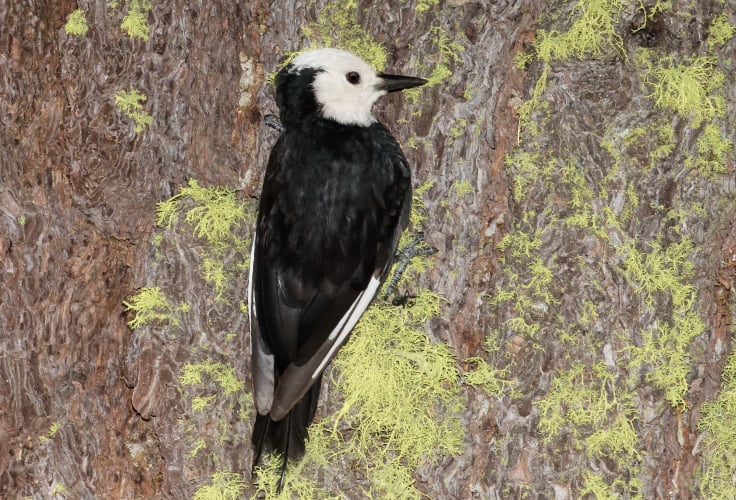
In the field, the White-headed Woodpecker is most often seen on large Ponderosa Pine trunks and branches. Individuals hitch upward in short movements and frequently cling to cones while extracting seeds. The diet in British Columbia is closely tied to Ponderosa Pine seeds, supplemented by insects obtained by flaking bark or probing shallowly into wood. Calls are soft and include a sharp “pee-dink” note and short rattling series, and drumming is light compared to many other woodpeckers. When present, birds may remain in suitable habitat year-round if adequate food resources are available.
Within the province, the White-headed Woodpecker is known to breed only in the southern Okanagan Valley. Historical and recent records indicate occasional observations in other dry interior valleys, including the Similkameen and Kettle valleys and the Kootenays, but confirmed breeding remains extremely limited. Atlas data include only probable breeding in a single square and no confirmed breeding during the atlas period. The species is dependent on dry, open forests dominated by mature Ponderosa Pine, particularly stands that produce large cones and contain large-diameter snags or live trees with advanced heart rot for nesting. There are no confirmed overwintering records outside the southern Okanagan, and numbers are very small.
The White-headed Woodpecker has an extremely small population in Canada, likely fewer than ten pairs in most years, and is listed as Endangered under the Species at Risk Act. The primary threat in British Columbia is the continued loss of mature Ponderosa Pine through forest harvesting, urban development, firewood collection, wildfire, and Mountain Pine Beetle impacts. The rarity and irregular occurrence of this species make monitoring difficult, and there are no reliable long-term trend data for the Canadian population. Protection and retention of mature Ponderosa Pine stands are essential for any continued breeding presence in the province.
Acorn Woodpecker
Melanerpes formicivorus
- Identification: Medium-sized glossy black-and-white woodpecker with a bright red crown, white forehead, black facial mask, pale eyes, and white rump and wing patches; females show a black band between the white forehead and red crown.
- Where found: Accidental in British Columbia, with rare records primarily from the southern interior and occasionally the southwest coast; no confirmed breeding in the province.
- How to spot: Look for a bold, clown-faced woodpecker giving loud “waka-waka” calls and, if present for any length of time, tending granary trees or posts filled with stored acorns.
- Conservation status: Least Concern (IUCN); globally stable, though occurrences in British Columbia are irregular and likely tied to food availability.

The Acorn Woodpecker is a striking and highly social species that appears only rarely in British Columbia. It measures 19 to 23 centimeters (7.5 to 9.1 inches) in length and shows a bold black-and-white pattern with a bright red crown, white forehead, black facial mask, and pale eye. The white rump and large white wing patches are conspicuous in flight. Females show a narrow black band separating the white forehead from the red crown, a useful field mark when birds are observed closely.

In its normal range, this species moves in noisy groups and feeds heavily on acorns, insects, and fruit, storing acorns in drilled “granary trees.” British Columbia records involve single birds or small groups rather than established family groups. When present, individuals may remain in one area for days or weeks, especially if reliable nut crops or feeders are available. Observers should watch for trees, fence posts, or poles riddled with holes containing acorns, which indicate prolonged use of a site. Vocalizations include loud, parrotlike “waka-waka” calls that carry over distance.
In British Columbia, the Acorn Woodpecker is classified as an accidental species. Fewer than twenty provincial records have been documented, most from the southern interior including areas such as Princeton, Manning Provincial Park, Merritt, Hope, and near Oliver, with occasional records from the southwest coast, including Maple Ridge and Abbotsford. Most records involve adult females. Occurrences are scattered through spring and early summer, with several May and June records, and there is one documented wintering individual in Abbotsford. The species has not been confirmed breeding in the province. Records are thought to reflect wandering birds, often during years of poor acorn crops farther south, rather than an established range expansion.
The global population of Acorn Woodpecker is considered stable, but its appearance in British Columbia remains rare and irregular. The species depends heavily on oak woodlands in its core range, and the limited extent of suitable oak habitat in British Columbia likely constrains regular occurrence. Continued documentation of provincial records will help clarify whether these sightings represent occasional irruptions or the early stages of northward expansion.
Red-headed Woodpecker
Melanerpes erythrocephalus
- Identification: Medium-sized woodpecker with a fully crimson head, glossy black back, large white wing patches, and clean white underparts; sexes identical.
- Where found: Accidental vagrant in British Columbia, with a small number of records from the interior and one recent coastal record; no confirmed breeding in the province.
- How to spot: Look for the striking black-and-white wings flashing in steady flight and listen for harsh “weah” or rolling calls; typically seen briefly on snags or fence posts.
- Conservation status: Least Concern (IUCN); listed as Endangered in Canada due to past population declines, though recent national data indicate recovery to historic levels.

The Red-headed Woodpecker is one of North America’s most distinctive woodpeckers and is regarded as an exceptional rarity in British Columbia. It measures 19 to 24 centimeters (7.5 to 9.4 inches) in length and has a sturdy build with broad wings and a strong bill. Adults are unmistakable, with the entire head and upper breast deep crimson, sharply contrasting with a glossy black back and bright white underparts. Large white patches on the wings create a bold pattern in flight.
In the field, this woodpecker often perches conspicuously on exposed snags, fence posts, or utility poles and may sally out to catch flying insects. Flight is steadier than that of most woodpeckers, with strong wingbeats and short glides. Calls include harsh “weah” or rolling notes. Because individuals recorded in British Columbia have appeared singly or in very small numbers and often remained only briefly, encounters are typically short-lived.
In British Columbia, the Red-headed Woodpecker is classified as an accidental vagrant. Fewer than ten well-documented records exist, most from the interior, including Pass Creek near Robson, the Vernon area, Tatla Lake, the East Kootenay region, and near Revelstoke. One recent record from Galiano Island represents a rare coastal occurrence. Most records have occurred in June and July, with a few in September. There are no confirmed breeding records in the province.
Nationally, the Red-headed Woodpecker has undergone substantial long-term declines since the mid-20th century but has shown a strong rebound in recent years, returning to levels comparable to the early 1970s. The Canadian population remains small relative to the global total and is listed as Endangered under the Species at Risk Act. In British Columbia, however, the species remains an exceptional visitor, and continued documentation of future occurrences will help clarify patterns of western vagrancy.
Where and When to See Woodpeckers in British Columbia
Woodpeckers can be found across much of British Columbia, but the highest diversity occurs in the southern interior. The Okanagan, Similkameen, Thompson-Nicola, and Southern Rocky Mountain Trench support the greatest variety, including open-forest specialists such as Lewis’s Woodpecker, Williamson’s Sapsucker, and White-headed Woodpecker. Mature Ponderosa Pine stands, Interior Douglas-fir forests, riparian cottonwood groves, recent burns, and aspen-dominated mixed woods are especially productive habitats. Farther north and east, the Boreal and Sub-boreal forests of the Peace and Liard River lowlands host species such as Yellow-bellied and American Three-toed Woodpeckers, while coastal rainforests support Red-breasted Sapsuckers and Pileated Woodpeckers.
Most species are resident and can be observed year-round, particularly in southern valleys and lower elevations. Spring is the most conspicuous season, when drumming and territorial calls make birds easier to detect. Summer offers reliable viewing near nesting snags and riparian woodlands, while fall and winter can concentrate birds at lower elevations, feeders, or recently burned areas. Rare vagrants, including Acorn and Red-headed Woodpeckers, have appeared mainly in late spring and summer, making those seasons especially rewarding for attentive observers in the southern interior and southwest coast.
For a broader perspective, see our guide to the types of woodpeckers in North America, and explore the Birds of British Columbia and Birds of Canada pages for additional regional and national bird guides.

Raeesah Habib is a South African conservationist and freelance writer. She completed a diploma in nature conservation in 2016 through the University of South Africa (UNISA). During her internship, she spent a year working with wattled cranes on the Wattled Crane Recovery Programme (WCRP).
The program aims to prevent the local extinction of the wattled crane in Southern Africa through the release of captive-reared individuals into critically endangered wild populations across the country. During her time at the research facility, she was also responsible for the general monitoring and husbandry of other magnificent species, including blue cranes and secretary birds.
Following her internship, she was fortunate to have worked in some spectacular wilderness areas across the country, including the Cradle of Humankind, the Kruger National Park, and the northern Zululand. As a wildlife monitor, her responsibilities included conducting bird point counts. Birds surveys are a useful means to collect data on the avian populations in an area. The data helps researchers gain an understanding of population trends and ecosystem health.
When not in the field, Rae enjoys writing to share her passion, knowledge, and experiences with others.


