
New York hosts 11 species of owls, reflecting the state’s wide range of forested landscapes, open grasslands, wetlands, and coastal lowlands. These range from widespread and familiar residents such as the Great Horned Owl, Eastern Screech-Owl, and Barred Owl, often encountered even in large urban parks, to more secretive forest specialists, seasonal migrants, and highly irregular winter visitors from the boreal north. This guide provides identification notes and New York-specific context on habitat use, distribution, and seasonal occurrence for the owl species most relevant to birders in the state.
Great Horned Owl
Bubo virginianus
- Identification: Large, powerful owl with broad wings, prominent ear tufts, a white throat patch, and striking yellow eyes, showing a mottled mix of brown, buff, and black.
- Where found: Widespread year-round throughout New York, occurring in forests, agricultural landscapes, wetlands, cliffs, and suburban and urban areas.
- How to spot: Listen for deep, three- to six-note hoots from late summer through winter, or watch for a thick-bodied owl perched on exposed branches, poles, or structures at night or twilight.
- Conservation status: Least Concern (IUCN); common and adaptable in New York, but locally affected by habitat change and secondary poisoning from rodenticides.
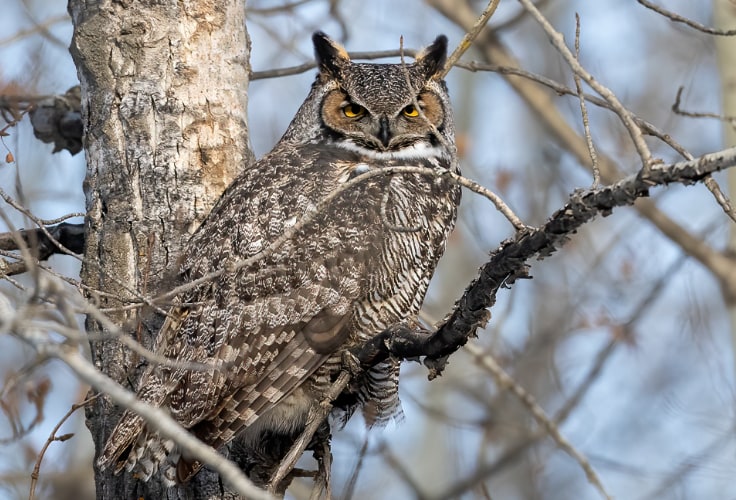
The Great Horned Owl is the most widespread and most frequently encountered owl in New York and is often the first owl species noticed by residents, including those in suburban and semi-urban settings. It measures 46 to 63 centimeters (18.1 to 24.8 inches) in length and has a large, thick-bodied build with a broad head, prominent ear tufts, and large yellow eyes set within a well-defined facial disc. Plumage is strongly mottled in brown, buff, gray, and black, with a white throat patch that is often visible when the bird calls, a feature that makes it conspicuous even in low light.
In the field, Great Horned Owls are most often detected by their loud, deep hoots. These calls, typically delivered in a series of three to six notes, are among the most familiar nocturnal sounds in the state and may begin as early as late summer or early fall, continuing through winter. The species is primarily nocturnal but may hunt at dusk, dawn, or occasionally during the day. Individuals frequently perch upright on exposed branches, utility poles, cliffs, or nest structures, scanning nearby open areas for prey. Flight is strong and deliberate, with deep wingbeats and short glides. The diet includes a wide range of mammals and birds, taken using perch-and-pounce tactics, low hunting flights, or ground strikes.
Great Horned Owls are distributed statewide in New York and are considered permanent residents, with only limited local movements during fall and winter. Records are widespread across the state, with especially dense concentrations in western and central New York, the Finger Lakes region, the Hudson Valley, and Long Island. The species occurs in a broad range of habitats, including open and secondary-growth forests, agricultural fields, wetlands, rocky cliffs, and suburban or urban landscapes. Fewer records come from the interior Adirondacks, Catskills, Tug Hill, and the Allegheny Plateau, likely reflecting lower survey coverage in these remote regions.
In New York City, Great Horned Owls are regularly documented, particularly in large parks, green corridors, and urban-edge habitats, where they nest early in the year and remain the most consistently reported owl in the city. On Long Island, the species is widespread across mixed suburban and coastal landscapes.
The species remains common and broadly distributed across New York, supported by its flexible habitat use and broad diet. Breeding Bird Atlas data and long-term observations indicate stable overall presence, although density declines as human development intensifies, particularly in heavily urbanized or suburban areas. One of the most significant documented threats in New York is secondary poisoning from anticoagulant rodenticides, which have been found in a substantial proportion of individuals examined over multiple decades. Additional local threats include habitat modification and collisions with vehicles or structures. Despite these pressures, the Great Horned Owl continues to function as New York’s most adaptable and resilient owl, maintaining a strong presence across both natural and human-dominated landscapes.
Eastern Screech-Owl
Megascops asio
- Identification: Small, stocky owl with prominent ear tufts, yellow eyes, and gray or rufous plumage marked with intricate bars and spots that provide excellent camouflage against tree bark.
- Where found: Widespread and year-round throughout New York in wooded, suburban, and urban landscapes, including parks, residential neighborhoods, and forest edges.
- How to spot: Listen at night for its distinctive monotonic trills or descending whinnies, or check tree cavities and nest boxes where individuals may roost at the entrance.
- Conservation status: Least Concern (IUCN); fairly common in New York, though vulnerable locally to habitat loss and competition for nesting cavities.

The Eastern Screech-Owl is the most regularly seen small owl in New York and is especially familiar in suburban and residential settings. The species measures 16 to 25 centimeters (6.3 to 9.8 inches) in length and has a compact body, broad head, short tail, and conspicuous ear tufts. Plumage occurs in gray and rufous color morphs, with both forms patterned by fine bars and spots that closely resemble tree bark. In New York, particularly in coastal and lowland areas, rufous individuals are relatively common alongside gray birds.

In the field, Eastern Screech-Owls are far more often detected by sound than by sight. Their vocalizations include a steady, monotonic trill used for contact and a descending whinny associated with territorial behavior, both of which carry well through wooded neighborhoods and parklands at night. Individuals move through the lower canopy with quick, direct flights and typically hunt from low perches. The diet consists of large insects and small vertebrates, including rodents, and birds may forage along forest edges, in yards, or near artificial lights where prey is concentrated.
In New York, the species is widely distributed and considered a permanent resident, with no regular migratory movements. Records during the breeding season are most concentrated in western and central New York, the Finger Lakes region, the Hudson Valley, and Long Island, reflecting both suitable habitat and high observer coverage. Reports become less frequent in the interior Adirondacks and other remote forested regions, while this pattern likely reflects reduced survey effort and the species’ small size and nocturnal habits rather than true absence.
In New York City, the Eastern Screech-Owl is regularly observed in residential neighborhoods, parklands, and wooded urban corridors, particularly in large parks with mature trees. On Long Island, it is widely present across suburban landscapes and coastal plain habitats.
The Eastern Screech-Owl remains fairly common across much of New York and benefits from its tolerance of human-altered environments. Population trends vary locally, with losses linked to removal of mature trees, reduction of cavity-bearing habitat, and competition for nest sites. Despite these pressures, the species persists well in many suburban and urban areas where tree cover is maintained and nest cavities or boxes are available, supporting its continued presence as one of the state’s most familiar owls.
Barred Owl
Strix varia
- Identification: Large gray-brown owl with a rounded head, dark eyes, a well-defined facial disc, and brown-and-white barred and streaked plumage across the breast and underparts.
- Where found: Widespread year-round across forested regions of New York, with regular occurrence in large parks and wooded corridors in NYC and localized presence on Long Island.
- How to spot: Listen at dusk or night for the distinctive “Who cooks for you?” call, or watch for a broad, rounded owl gliding quietly through mature forest or roosting high on shaded branches.
- Conservation status: Least Concern (IUCN); widespread and increasing in New York, particularly in extensive forested regions.

The Barred Owl is one of the most familiar and easily detected forest owls in New York, known for its loud, resonant calls and strong association with mature woodlands. It measures 43 to 50 centimeters (16.9 to 19.7 inches) in length and has a large, broad-bodied build with a rounded head lacking ear tufts, deep brown eyes, and a pale yellow bill set within a full facial disc. Plumage is gray-brown overall, with bold horizontal barring across the upper breast that transitions to vertical streaking along the belly, giving the species a distinctive patterned appearance well suited to shaded forest interiors.
In the field, Barred Owls are most often detected by voice. Their best-known call, commonly rendered as “Who cooks for you? Who cooks for you-all?,” carries far through forested landscapes and is frequently heard at dusk and during the night. Individuals roost quietly during the day, often high in coniferous or dense deciduous trees, and become active around sunset. Flight is silent and buoyant, with broad wings allowing smooth movement through wooded habitats. The species hunts primarily at night, using elevated perches to locate prey that includes rodents and other small mammals, and it may also forage along wetland edges or shallow water.
Barred Owls are widely distributed across New York and occur primarily as permanent residents, though some wandering is noted during fall and winter. Breeding and seasonal records are widespread, with particularly strong representation in central and northern New York, the Adirondacks, the Tug Hill region, and much of the Hudson Valley, reflecting the species’ preference for large, continuous forested landscapes. Occurrence is somewhat less concentrated in intensively agricultural lowlands and heavily urbanized areas, but the species remains broadly present wherever mature woodland persists.
In New York City, Barred Owls are documented mainly in large forested parks and adjacent wooded corridors, where suitable roosting and hunting habitat remains. On Long Island, the species is recorded more locally, associated primarily with larger forest tracts and less-developed areas, and is less consistently encountered than more urban-tolerant owl species.
The Barred Owl is currently widespread and increasing across much of New York, a trend linked to forest maturation and expansion in many regions. Its success is greatest in extensive, structurally complex woodlands that provide suitable roost sites and nesting cavities. Although adaptable within forested environments, the species remains sensitive to large-scale forest loss and fragmentation, particularly where mature trees are removed. Overall, the Barred Owl continues to thrive as a characteristic and highly vocal inhabitant of New York’s forests, from remote northern woodlands to well-wooded urban parks.
Northern Saw-whet Owl
Aegolius acadicus
- Identification: Very small, round-headed owl with bright yellow eyes, brown upperparts spotted with white, and white underparts boldly streaked with brown.
- Where found: Occurs across New York primarily as a migrant and winter visitor, with scattered and localized breeding in forested regions of the state.
- How to spot: Listen at night from late winter through spring for a sharp, repetitive “too-too-too” call, or look for a tiny owl roosting quietly in dense conifers, sometimes revealed by mobbing songbirds.
- Conservation status: Least Concern (IUCN); widespread but easily overlooked in New York due to its small size, nocturnal habits, and brief vocal period.

The Northern Saw-whet Owl is the smallest regularly occurring owl in New York and one of the most elusive. This miniature species measures 18 to 22 centimeters (7.1 to 8.7 inches) in length and has a compact body, a large rounded head without ear tufts, and striking yellow eyes set in a pale facial disc. Plumage is brown above with white spotting and streaking, while the underparts are white with bold brown streaks, a pattern that provides excellent camouflage in shaded coniferous cover.
In the field, Northern Saw-whet Owls are most often detected by their distinctive, high-pitched “too-too-too” call. This sound is given primarily by males from late winter through spring and may carry surprisingly far on still nights. During the day, individuals roost silently in dense conifers, often close to the trunk and sometimes at low heights, remaining motionless and difficult to see. Flight is quick and agile, with rapid wingbeats and short, direct movements through forest understory. They hunt almost exclusively at night, taking small mammals, especially mice, from low perches along forest edges and clearings.
In New York, the species is best described as a regular migrant and winter visitor, with occasionally high numbers reported during fall migration. Breeding occurs sparsely and irregularly, with scattered records from central New York, parts of the Adirondacks, and localized areas of the Hudson Valley, indicating a broadly distributed but poorly documented breeding presence. Much of the state shows only observation-level records, a pattern attributed to the species’ secretive behavior and brief vocal season. Migrating individuals pass through New York in autumn, and rare records indicate that some birds are capable of crossing large bodies of water, including a documented case of an owl landing on a fishing vessel well offshore near Montauk.
In New York City, the Northern Saw-whet Owl is recorded infrequently through isolated observations, where it roosts quietly in conifers within large parks. On Long Island, records consist mainly of scattered observations, suggesting occasional presence with limited detection compared to inland forested regions.
Although the owl is widespread across North America, its population status in New York is difficult to assess due to underreporting. The species’ small size, nocturnal habits, and reliance on dense cover make it easy to overlook, even where present. Loss of mature forest structure and nesting cavities may contribute to localized declines, but the owl readily uses nest boxes where available. Overall, the Northern Saw-whet Owl remains a regular but subtle component of New York’s owl community, most noticeable during migration and in quiet forested areas during the breeding season.
American Barn Owl
Tyto furcata
- Identification: Medium-sized owl with a pale, heart-shaped facial disc, long rounded wings, long sparsely feathered legs, and buff-and-gray upperparts contrasting with whitish underparts.
- Where found: Very localized in New York, occurring primarily in the southeastern lowlands, especially Long Island and parts of NYC, with only sporadic records elsewhere.
- How to spot: Look for a ghostly pale owl flying low over open fields or marshes at night, or listen for its harsh, rasping scream near barns, nest boxes, or other quiet structures.
- Conservation status: Least Concern (IUCN); Imperiled in New York due to rarity, limited breeding distribution, and ongoing habitat loss.

The American Barn Owl is a rare and highly localized species in New York, occurring at the northern edge of its North American range. It measures 32 to 40 centimeters (12.6 to 15.7 inches) in length and appears lanky and long-legged compared with other owls, with a rounded head lacking ear tufts and a distinctive, pale heart-shaped facial disc. Plumage is warm buff and gray above and largely whitish below, giving the species a strikingly pale appearance in flight and earning it a reputation as one of the most visually distinctive owls in the state.
In the field, Barn Owls are most often detected by their flight or voice rather than prolonged visual encounters. They fly low and buoyantly over open ground with slow, deep wingbeats, often quartering fields, marshes, or grasslands in near silence. Vocalizations differ sharply from the hoots of other owls and consist of a long, harsh, rasping scream that may be heard near roosts or nest sites. The species hunts almost entirely at night, relying heavily on sound to locate prey and feeding primarily on small mammals, especially rodents, which it captures during low hunting flights.

In New York, the species has a very restricted and uneven distribution. Breeding is concentrated almost entirely in the southeastern portion of the state, with the most consistent presence on Long Island and in limited parts of New York City, particularly where open lowland habitat and nest boxes are available. Occurrence elsewhere in the state is sporadic, with birds recorded only occasionally outside the southeastern counties and largely absent from mountainous regions and the far north. Within New York City, the Barn Owl is confined to a small number of suitable open or coastal sites and is encountered only intermittently, including locations such as Pelham Bay, the New York Botanical Garden area, and Floyd Bennett Field. Barn Owls may be present year-round in southern New York, but some individuals also show migratory or dispersive movements, particularly outside the breeding season.
The Barn Owl is one of New York’s most vulnerable owl species. Comparison of Breeding Bird Atlas data shows a marked decline in the number of occupied breeding blocks over recent decades, with current breeding largely confined to Staten Island, Kennedy Airport, and parts of Long Island. Loss of open grassland habitat, conversion of hayfields to row crops, and exclusion from farm structures have reduced nesting and foraging opportunities. Secondary poisoning from rodenticides and collisions with vehicles further threaten the small remaining population. Nest box programs in suitable open habitats have played a critical role in sustaining breeding pairs in southern New York, and continued management of grasslands and reduction of toxic rodent control are essential to the species’ persistence within the state.
Long-eared Owl
Asio otus
- Identification: Medium-sized, slender owl with long, upright ear tufts, yellow eyes, a buff facial disc with pale eyebrows, mottled brown-and-buff upperparts, and streaked whitish to buff underparts.
- Where found: Uncommon and patchily distributed across New York, occurring in open woodlands with adjacent fields, with scattered breeding and more regular presence during migration and winter.
- How to spot: Listen at night from late winter through summer for low, evenly spaced hoots, or search winter communal roosts in dense conifers near open fields.
- Conservation status: Least Concern (IUCN); Imperiled as a breeding species in New York, with small and unstable nesting populations.

The Long-eared Owl is one of New York’s most secretive and least frequently encountered owls, despite being widely distributed across North America. The species measures 35 to 40 centimeters (13.8 to 15.7 inches) in length and has a slim, elongated profile with long ear tufts, a rounded head, and long wings adapted for agile flight. Plumage is intricately patterned in browns, buffs, and grays, providing excellent camouflage when the bird roosts upright against tree trunks or dense foliage in coniferous cover.
In the field, Long-eared Owls are most often detected by sound. Males give low, evenly spaced hoots that may begin in late winter and increase in frequency during early spring as territories are established and mates attracted. During the breeding season, additional vocalizations include barking calls and loud, shrieking begging calls from fledglings, which are often the most noticeable sign of successful nesting from mid-summer into early fall. During daylight hours, individuals roost quietly in dense conifers, often communally in winter, where their narrow posture and cryptic plumage make them difficult to see. At dusk, they emerge to hunt, flying low over adjacent open fields in long, buoyant glides while searching for small mammals.
Long-eared Owls occur year-round in New York but are unevenly distributed and difficult to generalize. Breeding is rare and scattered, with historical nesting documented across most major regions of the state, excluding much of the southern tier, but with low and shifting occupancy from year to year. Suitable breeding habitat consists of dense coniferous or mixed woodland patches adjacent to open fields, where the species relies on old nests built by other birds, such as crows, rather than constructing its own. Northward migration through New York occurs mainly from mid-March to mid-April, and wintering birds are more readily detected when they form communal roosts in dense evergreen stands near open hunting areas. Winter roosts do not necessarily indicate local breeding presence.
The Long-eared Owl is considered vulnerable as a breeding species in New York, reflecting its low numbers, unstable nesting distribution, and dependence on a specific combination of habitats. Loss of dense roosting cover, removal of shelterbelts and small woodlots, and changes in agricultural landscapes that reduce prey availability all contribute to its scarcity. While wintering and migratory individuals remain a regular but subtle component of New York’s owl community, sustained breeding in the state appears limited and closely tied to the availability of suitable roosting habitat and abandoned nests in open woodland settings.
Short-eared Owl
Asio flammeus
- Identification: Medium-sized owl with a pale facial disc, black-rimmed yellow eyes, mottled brown-and-buff upperparts, streaked whitish to rusty underparts, and broad wings showing a dark comma at the wrist in flight.
- Where found: Patchily distributed in New York in open grasslands, marshes, and coastal habitats, with rare and localized breeding and more regular occurrence during migration and winter.
- How to spot: Watch for a buoyant, mothlike flight low over open fields at dawn or dusk, or look for birds perched directly on the ground; listen for soft hooting during spring courtship.
- Conservation status: Least Concern (IUCN); Imperiled in New York due to rarity, habitat loss, and declining breeding distribution.

The Short-eared Owl is a distinctive open-country species and one of the few owls regularly active during daylight hours. It measures 34 to 43 centimeters (13.4 to 16.9 inches) in length and has a rounded head with very small, often inconspicuous ear tufts, large yellow eyes set within a pale facial disc, and long, broad wings adapted for low, coursing flight. Plumage is mottled brown and buff above, with pale, streaked underparts that blend closely with grasses and marsh vegetation.
In the field, Short-eared Owls are most often detected visually. They fly low over open landscapes with buoyant, erratic wingbeats, frequently changing direction as they search for prey, a flight style often compared to that of a large moth. Activity peaks at dawn and dusk, though birds may hunt during the day, especially in winter. They prey primarily on small mammals, particularly voles, located using acute hearing during low hunting flights or brief hovering. During the breeding season, males may give soft, rhythmic hoots while displaying in flight, and additional calls can be heard near nests during territorial defense.

In New York, the species has a highly localized and uneven distribution. Breeding is rare and confined mainly to open landscapes in the St. Lawrence and Lake Champlain valleys, the Great Lakes plains, and historically the south shore of Long Island, where it now appears largely extirpated as a breeder. Across much of the state, suitable habitat is limited, and true absences are likely in heavily forested or developed regions. Outside the breeding season, numbers increase as northern populations move south, with wintering birds recorded more regularly in western and central New York, the Lake Ontario plain, parts of the Finger Lakes region, and scattered locations in the Hudson Valley.
In New York City, the Short-eared Owl is documented only sporadically, primarily in open coastal or airport-adjacent areas, indicating irregular and seasonal use. On Long Island, observations are more regular than in most other downstate areas, particularly in coastal grasslands, dunes, and marshes during winter.
The owl is considered imperiled in the state, reflecting its small population size, restricted breeding range, and long-term declines documented by Breeding Bird Atlas data. Conversion of grasslands and marshes to agriculture or development, intensive land management, and reductions in small-mammal prey have contributed to its decline. Wintering numbers fluctuate widely from year to year in response to prey availability and snow cover, but sustained breeding appears increasingly limited. Protection and restoration of large, open grassland and coastal habitats remain critical to the species’ continued presence in New York.
Snowy Owl
Bubo scandiacus
- Identification: Large white owl with yellow eyes, a rounded head, and variable dark barring that is heavier on some birds and reduced on others.
- Where found: Regular but highly variable winter visitor to New York, concentrated along coastal areas, the Great Lakes shoreline, and other open lowland habitats.
- How to spot: Search wide-open landscapes for a pale owl perched on the ground, dunes, fences, or posts, or watch for low, buoyant flights over open terrain during daylight or at dusk.
- Conservation status: Vulnerable (IUCN); global populations declining, with New York occurrences tied to Arctic prey cycles and winter survival conditions.

The Snowy Owl is one of the most striking and sought-after winter visitors in New York and among the largest owls encountered in the region. The species measures 52 to 71 centimeters (20.5 to 28.0 inches) in length and has a powerful, broad-bodied build with a rounded head and intense yellow eyes. Plumage appears predominantly white at a distance, often marked with varying amounts of dark barring that break up the outline against snowy or sandy landscapes.
In the field, Snowy Owls are primarily detected visually, as their bold appearance and conspicuous perching behavior make them highly recognizable in open habitats. They are active both day and night and often perch directly on the ground, dunes, fences, hay bales, or low structures while scanning surrounding terrain for prey. Flight is usually low and buoyant, with deep wingbeats and long glides, though it can become fast and direct when pursuing birds. Vocalizations are infrequently heard in New York, as most birds encountered are wintering individuals, but the species is capable of low hoots, whistles, and hissing sounds.
In New York, the Snowy Owl occurs as a regular but highly variable winter visitor, with numbers fluctuating widely from year to year. Observations are strongly concentrated along coastal areas, the Great Lakes shoreline, and open lowlands, with the highest density of records on Long Island and along Lakes Ontario and Erie. Inland occurrences are scattered and irregular, typically associated with irruption winters when birds move beyond preferred coastal or lakeshore habitats.
In New York City, Snowy Owls are recorded primarily in winter at open coastal sites such as beaches, waterfronts, and airport-adjacent areas, including locations along the Atlantic shoreline. On Long Island, winter observations are more consistent than in most other parts of the state, making the region a core winter reporting area for the species.
The species presence in New York reflects conditions on the Arctic breeding grounds rather than local population dynamics. Low lemming abundance in the Arctic often triggers southward movements that bring birds into the state in some winters, while other years see few or none. Despite global population declines, Snowy Owls still appear regularly in New York, though their numbers vary greatly from winter to winter. Wintering birds face risks from vehicle collisions, disturbance in heavily visited coastal areas, and limited prey availability, underscoring the importance of minimizing disturbance and maintaining open coastal and grassland habitats used during the winter months.
Northern Hawk-Owl
Surnia ulula
- Identification: Medium-sized owl with a long tail, short pointed wings, brown upperparts marked with white spots, a narrowly bordered facial disc, and white underparts with heavy brown barring.
- Where found: Irregular winter visitor to New York, occurring sporadically in open boreal-edge habitats and northern forested landscapes during some winters.
- How to spot: Watch for a conspicuous, diurnal owl perched atop tall trees scanning open ground, or for fast, low flights with deep, falcon-like wingbeats.
- Conservation status: Least Concern (IUCN); uncommon and irregular in New York, with occurrences tied to prey cycles in the boreal forest.

The Northern Hawk-Owl is one of the most distinctive and least predictable owls to occur in New York, appearing only during some winters and absent in many years. It measures 36 to 45 centimeters (14.2 to 17.7 inches) in length and has a compact, thickset build with a long, tapered tail and short, pointed wings that give it a strongly hawk-like silhouette. Plumage is dark brown above with prominent white spotting, while the underparts are white with bold brown barring, creating a high-contrast appearance that remains visible at long distances.
In the field, Northern Hawk-Owls are most often detected by their behavior. Unlike most owls in the state, they are strongly diurnal and hunt primarily by sight. Individuals typically perch upright on the tops of conifers or other tall trees, leaning forward as they scan open areas for prey. Flight is fast, direct, and low, with deep wingbeats and short glides, often resembling that of a small falcon. When present, the species is often conspicuous and approachable, though vocalizations are rarely heard in New York, as most birds encountered are non-breeding winter visitors.
In New York, the Northern Hawk-Owl occurs as a casual to irregular winter visitor, with records scattered and highly variable from year to year. Most occurrences are associated with northern and interior parts of the state, reflecting southward movements from boreal breeding areas during some winters. Observations are typically linked to open coniferous or mixed forests, forest edges, burned or cut-over areas, and wetlands with scattered trees that resemble boreal habitats. The species is not considered a regular winter resident anywhere in the state. Documented records from New York City and Long Island are extremely sparse or absent in most reporting periods, indicating that occurrence in these regions is, at most, exceptional and irregular.
The presence of Northern Hawk-Owls in New York is driven by conditions far beyond the state, particularly fluctuations in small-mammal populations across the boreal forest. As a result, local abundance varies dramatically, with some winters producing one or several well-documented individuals and others yielding none. The species is considered uncommon whenever it occurs, but its bold behavior and daytime activity make it disproportionately noticeable. No specific conservation concerns are identified for New York, and occurrences in the state are best understood as episodic extensions of broader boreal population dynamics rather than reflections of local habitat conditions.
Boreal Owl
Aegolius funereus
- Identification: Small, large-headed owl with a grayish-white facial disc bordered in brown, bright yellow eyes, brown upperparts marked with white spots, and white underparts heavily streaked with brown.
- Where found: Rare and irregular winter visitor to New York, recorded mainly in the Adirondacks and far northern portions of the state during some winters.
- How to spot: Listen on quiet winter nights for the male’s rapid, hollow series of hoots, or search dense conifer stands for a small owl roosting close to tree trunks.
- Conservation status: Least Concern (IUCN); extremely uncommon in New York, with occurrences linked to episodic winter movements from boreal breeding areas.
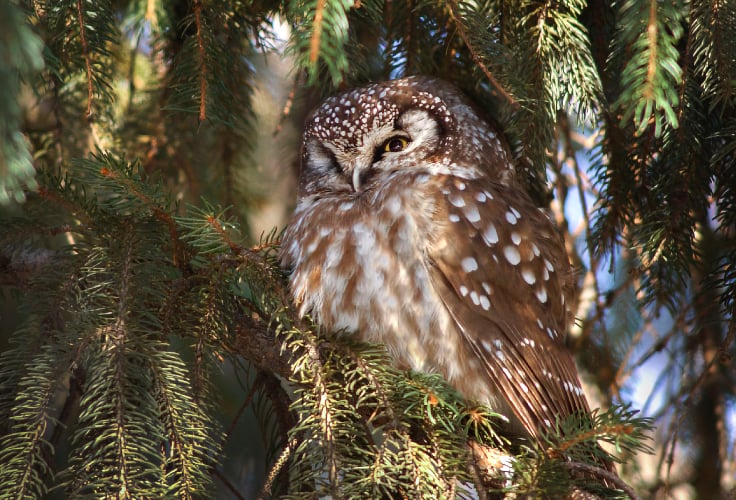
The Boreal Owl is one of the rarest and most elusive owls recorded in New York and is absent from the state in most years. The species measures 21 to 28 centimeters (8.3 to 11.0 inches) in length and is a small but large-headed owl with a square facial appearance, a short tail, and relatively long wings. Plumage is brown above with prominent white spotting, while the underparts are pale with heavy brown streaking, a pattern that blends effectively into dense coniferous forest interiors.
In the field, Boreal Owls are difficult to detect due to their strictly nocturnal habits and preference for dense forest cover. They hunt quietly at night from low to mid-level perches, making short, direct flights between trees before dropping onto prey below. Although capable of vocalizing, calling activity in New York is infrequent and typically associated with wintering birds rather than territorial behavior. When present, individuals are most often discovered incidentally during daytime roosting, where they sit close to tree trunks or within thick conifer foliage, remaining motionless for long periods.
In New York, the species is best classified as a rare and sporadic winter visitor. Documentation is extremely sparse and localized, with the majority of records concentrated in the Adirondacks and the far northern portion of the state. There is no evidence of breeding within New York, and observations are interpreted as the result of occasional winter movements from boreal populations farther north. Records from the rest of the state are scattered and infrequent. In New York City and on Long Island, the species is effectively absent under normal conditions, with only exceptional records documented, including a well-known individual that overwintered in Central Park in 2004-2005. Such occurrences are considered extraordinary and do not represent regular regional use.
The occurrence of Boreal Owls in New York reflects broader boreal population dynamics rather than local habitat conditions. Periodic winter invasions into parts of the northeastern United States, including New York, have been documented, but these events are irregular and unpredictable. Because of the species’ nocturnal behavior, low density, and transient presence, regional abundance cannot be reliably assessed. No specific conservation concerns are identified within New York, and the species’ status in the state is best understood as that of a rare boreal visitor appearing only during occasional winters with southward movements.
Great Gray Owl
Strix nebulosa
- Identification: Very large gray owl with a broad, rounded head, long tail, fine gray-brown barring and streaking, and a large circular facial disc marked with pale arcs and a white “bow tie.”
- Where found: Exceptional and highly irregular winter visitor to New York, recorded primarily in the far northern part of the state during rare irruption years.
- How to spot: Look for a massive gray owl perched on low branches or roadside trees near open areas, or watch for slow, buoyant flight at dawn or dusk.
- Conservation status: Least Concern (IUCN); extremely rare in New York, with occurrences tied to infrequent southward irruptions from boreal populations.
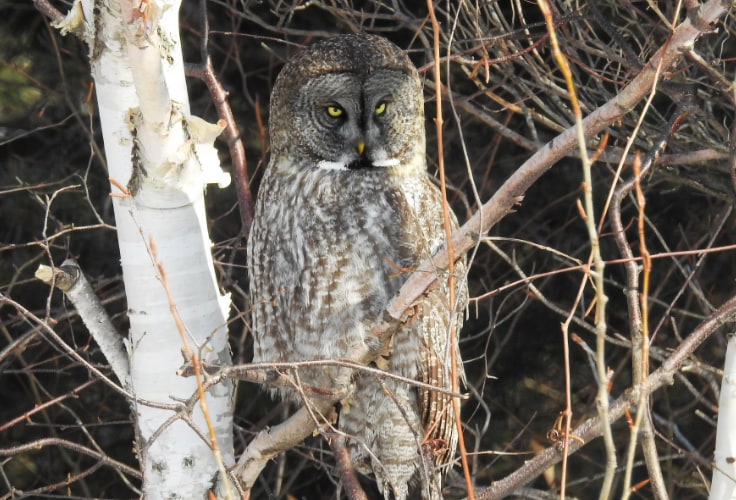
The Great Gray Owl is one of the most spectacular and least predictable owl species ever recorded in New York, appearing only during exceptional winters and drawing widespread attention when it does. It measures 61 to 84 centimeters (24.0 to 33.1 inches) long and is the largest owl in the world by body length, though its immense size is largely the result of dense insulating plumage rather than body mass. The species has a long tail, broad wings, and an oversized facial disc that gives it a striking, almost expressionless appearance when perched.
In the field, Great Gray Owls are often detected visually rather than by sound, as wintering individuals in New York are typically silent. They perch quietly on low or mid-level branches, fence lines, or roadside trees bordering open areas, remaining motionless for extended periods while hunting. Flight is slow, buoyant, and deliberate, with deep wingbeats and long glides. When actively foraging, individuals may hover briefly before plunging into snow to capture small mammals, a behavior that can be observed even in daylight during irruption winters.
In New York, the Great Gray Owl is best classified as an exceptional and highly irregular winter visitor. Most records are confined to the far northern portion of the state, particularly areas near the Canadian border, and are associated with rare southward movements from boreal regions. These events are infrequent and typically involve only a small number of individuals. Observations are often concentrated in open landscapes adjacent to forested areas, including roadsides, meadows, bog edges, and other vole-rich habitats that resemble boreal hunting grounds. There is no evidence of breeding in New York, and the species is absent from the state in most winters. Records from New York City and Long Island are extremely sparse, and occurrence in these regions is considered exceptional rather than regular.
The appearance of Great Gray Owls in New York reflects conditions well beyond the state, particularly prey shortages in boreal breeding areas that occasionally trigger southward irruptions. In northeastern North America, most winter movements stop in southern Canada, with only a small number of birds continuing into northern New York during notable irruption years. Because these events are rare and unpredictable, regional abundance cannot be meaningfully assessed. No New York-specific conservation actions are directed at this species, and its status in the state is best understood as that of an extraordinary boreal visitor whose presence depends entirely on episodic large-scale ecological conditions.
Where and When to See Owls in New York
Owls occur across New York in a wide range of habitats, but their visibility varies strongly by season, landscape, and species. Forested regions dominate the state’s owl diversity, supporting year-round residents such as Great Horned, Barred, and Eastern Screech-Owls, while dense conifer stands and mixed woodlands host more secretive species like Northern Saw-whet and Long-eared Owls. Open grasslands, marshes, and coastal lowlands play a critical role for Short-eared Owls and wintering Snowy Owls, particularly where large, undisturbed expanses remain. Northern boreal species such as Boreal Owl, Northern Hawk-Owl, and Great Gray Owl appear only during irregular winter movements and are absent in most years, making their occurrence highly localized and unpredictable.
Seasonally, late fall through winter offers the greatest variety of owl activity statewide. Resident species become more vocal beginning in late summer or early autumn, while migrants and winter visitors arrive from the north as temperatures drop. Winter is the prime season for detecting Short-eared and Snowy Owls in open habitats, as well as for locating Northern Saw-whet Owls during migration and winter roosting periods. In contrast, spring and early summer are best for listening surveys, when breeding residents vocalize regularly but many winter visitors have already departed. Across all seasons, successful owl observation in New York depends on quiet, patient viewing, respect for sensitive habitats, and minimizing disturbance, especially near roosts and nesting areas.
Notable Places for Owl Observation in New York
The following locations consistently provide suitable habitat and documented opportunities for owl observation. Presence varies by season and year, and visits are most productive during dawn, dusk, or nighttime hours where permitted.
Western and Central New York
- Braddock Bay Wildlife Management Area – Productive for Great Horned Owls and Short-eared Owls, especially during winter.
- Iroquois National Wildlife Refuge and Oak Orchard Wildlife Management Area – Extensive wetlands and open fields support wintering owls and breeding forest species.
- Montezuma National Wildlife Refuge – A strong location for Great Horned Owls and occasional Short-eared Owls in surrounding open habitats.
- Letchworth State Park – Forested gorge landscapes support resident forest owls year-round.
Northern New York and Grassland Regions
- Alfred Z. Solomon Grassland Bird Trail and Viewing Area – One of the best locations in the state for observing Short-eared Owls hunting low over open grasslands during winter.
Long Island
- Cold Spring Harbor State Park – Supports Great Horned Owls and other woodland species in a coastal setting.
- Rockaway Beach – A regular winter location for Snowy Owls during suitable conditions.
New York City Parks
- Central Park – Hosts Eastern Screech-Owls, Barred Owls, Northern Saw-whet Owls, and rare boreal visitors during exceptional winters.
- Inwood Hill Park – One of the city’s most reliable parks for forest owls, especially Barred and Eastern Screech-Owls.
- Pelham Bay Park – Important for forest owls and one of the few NYC sites with occasional Barn Owl records.
- Prospect Park and Alley Pond Park – Known for Great Horned Owl nesting and winter activity.
- Floyd Bennett Field – An open coastal site with rare Barn Owl records and strong winter owl potential.
For a broader perspective, see our guide to the types of owls in North America, and explore the Birds of New York and Birds of the United States pages for additional regional and national bird guides.


