
North America is home to 22 woodpecker species, found from the forests of Alaska and Canada to the deserts of the Southwest. All belong to the family Picidae – a remarkable group of climbing, drumming, and bark-probing birds, each with its own distinctive appearance, voice, and habits.
This guide begins with the most familiar and widespread species likely to be seen across the United States and Canada, and continues toward the more localized and elusive woodpeckers of the continent’s varied landscapes. Each entry provides field-ready identification details – plumage patterns, vocalizations, flight and foraging styles, together with range and conservation notes, supported by clear photographs to aid confident recognition in the field.
Downy Woodpecker
Dryobates pubescens
- Identification: Small black and white woodpecker with a broad white back stripe, checkered wings, and a small red nape patch on males; bill short and stubby.
- Where found: Year-round resident across nearly all wooded regions of North America, from Alaska and Canada to Florida and southern California, in deciduous and mixed forests, parks, and residential areas.
- How to spot: Listen for the sharp “pik” call or descending whinny; look for a tiny black-and-white bird hitching acrobatically on thin branches or visiting suet feeders.
- Conservation status: Least Concern (IUCN); populations stable or slightly increasing, benefiting from secondary growth and suburban habitats though locally affected by habitat loss.

The downy woodpecker is the most widespread and frequently seen woodpecker in North America, thriving from northern boreal forest edges to city parks and backyard feeders. The species measures 14 to 17 centimeters (5.5 to 6.7 inches) in length and is the smallest woodpecker on the continent. It is barely larger than a nuthatch and shows a classic straight-backed woodpecker stance with a short, chisel-like bill. Its small size, adaptability, and tolerance of people make it a familiar companion across the continent.
Adults display a crisp black-and-white pattern: a broad white stripe down the back, spotted black wings, and bold white facial lines separated by a black ear patch. Underparts are plain white, sometimes grayish in the Pacific Northwest. Males show a bright red spot on the nape, absent in females. Sexes otherwise appear similar, and plumage remains constant through the year aside from wear. Juveniles are duller, often with a blackish crown showing a few red-tipped feathers.

In the field, downy woodpeckers move with short hops up trunks and along thin branches, frequently bracing with the tail and sometimes hanging upside down on small stems or seed heads. Their flight is undulating, alternating rapid flaps with short glides. Calls include a sharp, high “pik,” a series of notes forming a descending whinny, and short bursts of drumming on resonant surfaces during territory display. They feed mainly on insects and larvae gleaned from bark, but also visit feeders for suet, seeds, and even nectar, joining mixed flocks of chickadees and nuthatches in winter.
This adaptable species occupies nearly all forested and semi-wooded habitats across North America – riparian woods, deciduous and mixed forests, orchards, and urban parks. It reaches the northern treeline in Canada and Alaska and extends south through most of the United States except the Florida Keys and the driest southwestern deserts. Nests are excavated in dead wood or even fence posts, usually at low to mid-trunk height, and both sexes share incubation and care.
Downy woodpeckers remain abundant and broadly distributed, with long-term monitoring showing stable or slightly rising numbers. They prosper in young or open woodlands created by natural disturbance or human activity. Local declines may occur where old trees are removed or nesting sites replaced by metal fencing, yet overall the species continues to thrive across its vast range, a lively and enduring symbol of North American woodlands.
Hairy Woodpecker
Leuconotopicus villosus
- Identification: Medium-sized black-and-white woodpecker with a broad white back stripe, clean white underparts, and a long, robust bill nearly as long as the head; males show a red patch on the nape.
- Where found: Resident across most of North and Central America, from Alaska and Canada south through the U.S. into western Panama and the Bahamas, favoring mature deciduous and mixed forests.
- How to spot: Search trunks and main branches of large trees for a sharply patterned black-and-white bird with a square head and long bill; listen for a loud “peek” call or harsh descending whinny and steady drumming.
- Conservation status: Least Concern (IUCN); populations stable to slightly increasing, though local declines can result from forest fragmentation and competition for nest sites with starlings.

The hairy woodpecker is the larger counterpart of the familiar downy woodpecker, with which it shares much of its range. This medium-sized species measures 18 to 26 centimeters (7.1 to 10.2 inches) in length and has a sturdy frame, strong claws, and a long, chisel-shaped bill almost the same length as the head. This proportion gives it a tougher, more heavy-billed look than its smaller relative. Its erect stance and powerful drumming make it a classic representative of the North American woodpecker form.
Adults are sharply patterned in black and white. The back bears a wide white stripe, wings are black with white spotting, and the face is boldly striped. The underparts are plain white to grayish white, though western and southern populations show buff or dusky tones. Males have a red patch across the nape, often divided into two squares in eastern birds, while females lack red entirely. Juveniles are duller, sometimes showing orange- or red-tipped feathers on the crown.

In the field, hairy woodpeckers climb with short, deliberate hops up tree trunks and large limbs, rarely venturing onto the thin branches favored by downies. They use their stiff tail feathers for support and often hammer vigorously on bark, logs, or stumps. Calls include a sharp, explosive “peek,” a harsher “cheerk” near the nest, and a fast, descending whinny similar to that of the downy but lower-pitched. The steady drumming bursts, lasting about one second with roughly 25 beats, are a key territorial signal. Diet consists mostly of wood-boring insects and larvae, along with some fruit and seeds; they frequently inspect old holes of larger woodpeckers to find prey.
This species inhabits a wide variety of mature forests across the continent – from northern boreal spruce and pine to eastern deciduous woods, western conifer slopes, and highland forests of Mexico and Central America. It also frequents wooded parks, orchards, and large shade trees in suburban areas, but is generally less common in small woodlots than its smaller cousin. Nests are excavated in dead trunks or branches, both sexes participating in excavation, incubation, and chick rearing.
Hairy woodpeckers remain widespread and secure throughout North America, showing slight population growth over recent decades. They benefit from deadwood availability and from recovering forests but may be affected locally by fragmentation of large forest tracts and nest-site competition from European starlings. Overall, this adaptable, strong-billed species continues to thrive in both natural and human-modified forests across its vast range.
Northern Flicker
Colaptes auratus
- Identification: Large brownish woodpecker with barred back, spotted underparts, black breast crescent, and bright yellow or red flight feather shafts; white rump flashes conspicuously in flight.
- Where found: Breeds across most of North America from Alaska and Canada to Central America and Cuba; winters mainly in the southern U.S. and Mexico, favoring open woodlands, forest edges, and grasslands with scattered trees.
- How to spot: Look for a woodpecker feeding on the ground or rising in a bounding flight, showing a bright flash of yellow or red under the wings and a white rump; listen for loud “wick-wick-wick” calls or piercing “peah” notes.
- Conservation status: Least Concern (IUCN); still widespread but showing a long-term population decline linked to habitat changes and competition for nest sites.

The northern flicker is among the most distinctive and wide-ranging of North America’s woodpeckers, equally at home in open woods, forest edges, and backyards. It measures 28 to 31 centimeters (11.0 to 12.2 inches) in length and stands out for its slightly curved bill, sleek brown plumage, and striking flashes of color in flight. Unlike most woodpeckers, flickers spend much of their time foraging on the ground for ants and beetles, making them one of the few terrestrial specialists in their family.
Adults are finely patterned in shades of grayish brown, with a barred back, spotted belly, and bold black crescent across the breast. The wings and tail reveal bright salmon-red or golden-yellow shafts, depending on the subspecies: “red-shafted” in the West and “yellow-shafted” in the East. Males show a colored malar stripe – black in the eastern form and red in the western, while females lack it. A gleaming white rump is conspicuous in flight. Juveniles resemble adults but are slightly duller and less sharply marked.

Northern flickers move with a strong, undulating flight, alternating rapid flaps and short glides. Their loud, ringing “wick-wick-wick” call carries over long distances, especially in spring, while softer “peah” or rhythmic “wicka-wicka” notes accompany close courtship displays. Drumming is steady and resonant, used for territory defense and pair communication. On the ground, flickers walk or hop deliberately, probing soil and anthills for ants with their long, sticky, barbed tongue. They also take beetles, termites, and in winter, fruits and seeds.
This species breeds throughout North America – from the treeline in Alaska and northern Canada to Central America and the Caribbean, and winters mainly in the southern United States and Mexico, withdrawing from areas of deep snow. It prefers habitats that combine open ground for foraging with trees or snags for nesting: forest edges, woodlands, rangelands, and suburban parks. Nests are excavated in dead trees, posts, or even earthen banks, and both sexes share in incubation and care of the young.
Despite its wide range and adaptability, the northern flicker has declined significantly over the past half century, with surveys showing a nearly 50% cumulative decrease. Habitat loss, reduced availability of dead trees, and competition with European starlings for nest cavities contribute to this trend. Still, it remains a common and visible woodpecker across most of North America – its white rump and bright underwings flashing over fields and forest edges wherever ants stir below the soil.
Red-Bellied Woodpecker
Melanerpes carolinus
- Identification: Medium-sized, pale woodpecker with black-and-white barred back and red crown and nape in males (only nape red in females); the faint reddish patch on the belly is often hard to see.
- Where found: Resident across the eastern and central United States, from the Great Lakes and southern Ontario south to Florida and the Gulf Coast, west to the Great Plains; favors hardwood and mixed forests, and suburban parks.
- How to spot: Look for a pale woodpecker with a bold zebra back and bright red cap climbing tree trunks or branches; listen for its rolling “kwirr” or “churr” calls echoing through eastern woods.
- Conservation status: Least Concern (IUCN); population increasing and range expanding northward, though competition with starlings for nest cavities remains a persistent threat.

The red-bellied woodpecker is one of the most familiar and vocal woodpeckers of the eastern United States, a year-round resident whose trilling calls often reveal it before it’s seen. This species measures 23 to 27 centimeters (9.1 to 10.6 inches) in length and is similar in size to the hairy woodpecker but slimmer, with a pale face and a strongly patterned back. The “red belly” that gives the woodpecker its name is a small, often hidden flush on the lower abdomen, rarely visible in the field.
Adults are strikingly barred in black and white across the back, wings, and tail, with a pale grayish face and underparts. Males have red extending from the forehead to the nape, while females show red only on the back of the head and nape. In flight, a white rump and white patches near the wingtips flash clearly. Juveniles are grayer overall and lack red on the head until their first molt. Both sexes share the same pattern year-round, with little seasonal change.

In the field, these birds move nimbly along trunks and branches, hitching upward with short hops, sometimes even descending sideways or backward. They often pause to scan bark for insects or nuts, gleaning or probing with a sharp black bill. Their voice is a rolling “kwirr” or “churr,” carrying far through the forest, and they also give shorter cha and “chee-wuck” notes in excitement or alarm. Like other woodpeckers, they drum frequently during the breeding season. The diet is broad and opportunistic – mainly insects, acorns, nuts, and fruit, but also small vertebrates and seeds; they occasionally visit feeders for suet or peanuts.
This adaptable species is found across the eastern and central United States, from the Great Lakes and southern Ontario south through Florida and the Gulf Coast, and west to the wooded portions of the Great Plains. It occupies nearly any forested environment east of that line – mature hardwoods, river floodplains, mixed pine-hardwood stands, and suburban parks. Nests are typically excavated in dead trunks and branches, sometimes in old fence posts or telephone poles. Once confined largely to the Southeast, the red-bellied woodpecker has expanded northward since the mid-20th century, now reaching southern Ontario, the Great Lakes, and parts of New England.
Populations are increasing across most of the range, aided by milder winters and greater forest cover in suburban areas. Nonetheless, the species faces competition from European starlings, which often usurp its nest cavities. Despite this pressure, the red-bellied woodpecker remains a conspicuous and successful inhabitant of eastern forests, its ringing calls and flash of red among the trees a constant feature of North American woodlands.
Pileated Woodpecker
Dryocopus pileatus
- Identification: Very large black woodpecker with bold white neck stripes and a flaming-red crest; males have a red mustache stripe, females a dark one; shows broad white underwings and a flashing white patch in flight.
- Where found: Resident across southern Canada and much of the United States, from the Pacific Northwest and Great Lakes to the Southeast and Florida, extending west to the forested Great Plains; favors mature forests with large standing and fallen trees.
- How to spot: Look for a crow-sized black woodpecker with a tall red crest pounding deep rectangular holes into logs or stumps; listen for loud “kuk-kuk-kuk” calls or a deep, resonant drumming that slows near the end.
- Conservation status: Least Concern (IUCN); populations stable or increasing, benefiting from forest recovery, though reliant on mature trees and dead wood for nesting and feeding.

The pileated woodpecker is a dramatic forest bird whose ringing calls and powerful blows echo through quiet woodlands. This large species measures 40 to 49 centimeters (15.7 to 19.3 inches) long and is North America’s largest living woodpecker, rivaling the size of a crow and surpassed only by the extinct or nearly extinct ivory-billed and imperial woodpeckers. Its broad wings, long neck, and flaming red crest give it a bold and unmistakable silhouette.
Adults are mainly black with a prominent white line running from the bill down the neck, a large white underwing patch, and a long, chisel-shaped bill nearly the length of the head. Males have red extending from the forehead to the nape and a red malar stripe; females show a darker forehead and lack the red mustache. Juveniles resemble adults but with shorter crests. In flight, the bird’s strong, slightly undulating wingbeats reveal white crescents on the upperwing and broad white patches beneath.

Pileated woodpeckers are energetic excavators, swinging their heads in deep, rhythmic blows that leave large rectangular holes in rotting wood – feeding sites so extensive that smaller birds and mammals often forage in them later. Their main diet is carpenter ants and woodboring beetle larvae, supplemented by fruits and nuts. They climb trunks with strong, deliberate movements and powerful hops, occasionally descending sideways or foraging on fallen logs. Their loud “kuk-kuk-kuk” or “jungle laughter” call carries far through the forest, while the slow, rolling drumming serves both to claim territory and attract a mate.
This species is found year-round throughout most of forested North America, from Nova Scotia, southern Canada, and the Great Lakes region south to Florida, and west through forested river corridors to Texas and up through the Pacific Northwest into central California. It inhabits a range of mature forest types – deciduous, coniferous, and mixed, and often favors older stands with abundant snags and downed timber. Nests and roosts are excavated in large dead trees, and their spacious cavities later shelter small owls, swifts, ducks, bats, and other wildlife.
After historic declines due to widespread forest clearing in the 19th century, the pileated woodpecker has rebounded strongly as eastern and western forests have regenerated. Today, it remains a symbol of healthy mature woodlands, its haunting calls and great excavations marking the presence of one of North America’s most enduring forest specialists.
Yellow-Bellied Sapsucker
Sphyrapicus varius
- Identification: Small to medium woodpecker with bold black-and-white pattern, red crown, and red throat (in males); pale yellowish underparts and large white wing patch.
- Where found: Breeds across boreal and northern temperate forests of Canada and the northeastern and north-central United States; winters from the southern U.S. to Central America and the West Indies in woodlands and forest edges.
- How to spot: Look for neat horizontal rows of sap wells on birch or maple trunks, or listen for its irregular, stuttering drum and nasal “mew” calls.
- Conservation status: Least Concern (IUCN); populations stable or increasing, benefiting from young second-growth forests though locally impacted by tree damage concerns.

The yellow-bellied sapsucker is the only fully migratory woodpecker in eastern North America, breeding across Canada and the northern United States and wintering far south into the tropics. This compact species measures 18 to 22 centimeters (7.1 to 8.7 inches) in length and is smaller and more slender than most North American woodpeckers, with a straight, pointed bill and cleanly patterned black-and-white plumage. Its pale wash of yellow below and bright red crown make it instantly recognizable among woodland trunks in spring.
Adults show crisp contrasts: a black bib, red forehead and crown bordered in black, and a broad white stripe along each side of the head joining at the nape. Males have a red throat, while females show white. The back is barred black and pale yellow, with a conspicuous white patch on the wings visible in flight. Underparts are buffy or yellow-tinged, the rump white. Juveniles are dull brownish with smudged markings and only traces of red, molting into adult plumage by their first spring.

In the field, sapsuckers are often motionless for long periods, clinging upright against trunks while tending their characteristic grids of sap wells. When active, they hitch up trunks or perch near the crown, sometimes fly-catching insects or hanging from slender branches to feed on buds. Their flight is bounding and undulating. The voice includes mewing or squealing “mew” calls, nasal “week-week” contact notes, and soft “juk-juk” exchanges between mates, while their drumming is irregular and stuttering compared to the steady rhythms of other woodpeckers. They feed mainly on tree sap, which they lap up with a brush-tipped tongue, and on insects, fruit, and cambium.
This species breeds widely across the boreal and mixed forests of southern Canada, from Alaska to Newfoundland, and south into the northern and northeastern United States, including the Great Lakes region, New England, and the Appalachians. It favors young, early-successional forests dominated by birch, aspen, and maple, often near water. Nests are excavated in live or dead trees, typically in aspen or birch. In winter it retreats southward through the eastern and central U.S. to Mexico, Central America, and the Caribbean, where it continues to feed on live trees and maintains fresh sap wells.
Once considered an orchard pest, the yellow-bellied sapsucker is now recognized as an important ecological engineer: its sap wells provide food for hummingbirds, bats, and other species. Populations have increased in recent decades, helped by widespread regeneration of young forests across its range. With its tidy rows of sap holes and nasal mewing calls, this lively traveler remains one of the most distinctive and intriguing members of North America’s woodpecker community.
Red-Headed Woodpecker
Melanerpes erythrocephalus
- Identification: Medium-sized woodpecker with a fully crimson head, black back, large white wing patches, and clean white underparts; sexes identical.
- Where found: Breeds across open woodlands and farmlands of eastern and central North America, from southern Canada through the Great Plains to Florida and Texas; winters mainly in the southeastern United States.
- How to spot: Look for the striking black-and-white wings flashing in flight or listen for its harsh “weah” calls; often seen perching on snags or fence posts and fly-catching in open areas.
- Conservation status: Least Concern (IUCN); populations have declined markedly due to loss of standing dead trees, reduced nut crops, and habitat changes, though still locally common in managed open woods.

The red-headed woodpecker is among the most instantly recognizable birds in North America, famous for its vivid crimson head and bold black-and-white plumage. It measures 19 to 24 centimeters (7.5 to 9.4 inches) in length and has a sturdy build, broad wings, and a powerful bill. This species stands apart for its omnivorous habits and agility in flight – it is one of the few woodpeckers that regularly catches insects in midair and stores food for later use.
Adults are unmistakable: the entire head, neck, and upper breast glow crimson, sharply separated from the snowy-white belly and black back with a glossy bluish sheen. Large white patches on the wings create a “checkerboard” pattern when the bird flies. Juveniles are gray-brown on the head and upper breast, gradually replacing this with red as they mature, while retaining the distinctive white patches in the wings. Males and females look identical, making this one of the few sexually monomorphic woodpeckers.

Unlike most of its relatives, the red-headed woodpecker spends much time in open air and on the ground. It sallies out from perches to snatch flying insects, hammers acorns into tree crevices, and occasionally perches on fences or telephone poles in search of prey. Its calls are loud, rolling “churr” or “weah” notes, often given while defending territories or when alarmed. In flight, it alternates strong wingbeats with glides, a steadier motion than the bounding flight typical of other woodpeckers. It feeds on insects, nuts, seeds, fruits, and even small vertebrates, and is one of the few woodpeckers known to cache food, sometimes covering stored items with bark or wood chips.
This species favors open forests and park-like landscapes, including oak and beech woods, pine savannas, riparian groves, orchards, and farmlands with scattered trees or snags. It nests in dead trees or utility poles, excavating cavities several meters above ground. The range extends from southern Canada across the eastern and central United States, west to the Great Plains and south to Florida and Texas. In winter, most northern populations migrate to the southeastern states, though local movements vary depending on acorn and beech nut abundance.
Once abundant, the red-headed woodpecker has experienced sharp declines over the last century due to loss of mature nut-producing trees, widespread removal of snags, and declines in open forest habitats. It was formerly so common that farmers paid bounties for its destruction; today, it benefits from habitat management that preserves dead trees and open woodlands. Although still widespread, its recovery depends on maintaining these semi-open, snag-rich environments that sustain its striking presence across North America’s landscapes.
Acorn Woodpecker
Melanerpes formicivorus
- Identification: Medium-sized, glossy black-and-white woodpecker with a bright red crown, white forehead, black mask around pale eyes, and white rump and wing patches; females show a black band between forehead and crown.
- Where found: Resident of oak and pine-oak woodlands from Oregon and California through the southwestern United States and Mexico to Central America and Colombia.
- How to spot: Look for noisy, clown-faced groups giving parrotlike “waka-waka” calls and tending “granary trees” filled with stored acorns; note their distinctive black-and-white flash pattern in flight.
- Conservation status: Least Concern (IUCN); populations stable but locally affected by oak loss, habitat conversion, and slow regeneration of suitable woodland.

The acorn woodpecker is one of North America’s most remarkable and social birds, best known for its communal habits and vast acorn storage systems. It measures 19 to 23 centimeters (7.5 to 9.1 inches) long and shows a striking “clown-faced” appearance with a bold red crown, black mask, and gleaming white eyes. This species depends heavily on oak forests, which provide both its primary food – acorns, and suitable trees for its communal “granaries.”
Adults are boldly patterned, with glossy black upperparts, a white rump, and large white patches on the wings. The face is white with a black patch around the bill and eyes. Males have an entirely red crown, while females show a black band separating the red crown from the white forehead. Underparts are pale gray to buffy with a darker chest band. Juveniles resemble duller adults, often with brownish tones and dark irises that later turn white. The sexes are similar in size, showing only minor differences.

Acorn woodpeckers are highly social and almost always seen in noisy groups. They move actively through the canopy, perching on exposed branches or tree trunks and calling “waka-waka” or “karrit-cut” in constant communication. Their flight is direct but slightly undulating, showing three bright white flashes – one on each wing and one on the rump. These woodpeckers feed mainly on acorns, insects, and fruits, catching flying insects in midair with impressive agility. They store thousands of acorns each autumn in holes drilled into “granary trees,” fence posts, or even human-made structures such as utility poles or buildings, defending these stores cooperatively through the winter.
This species occurs year-round in oak and pine-oak woodlands from the Pacific slopes of Oregon and California through the southwestern U.S., Mexico, and Central America to the northern Andes of Colombia. It thrives in foothill and montane zones wherever oaks are present, including riparian corridors and urban parks. In the southwestern deserts it inhabits mountain ranges where oak stands persist, while farther south it occupies highland forests. Groups remain resident as long as acorn supplies last, occasionally abandoning territories in poor mast years.
Although widespread and adaptable, the acorn woodpecker faces localized threats from habitat loss and oak decline due to development, grazing, and disease. Removal of dead trees and old oaks reduces nest sites and granary trees. Yet this species also shows resilience, often adapting to suburban settings and using human structures for roosting and food storage. Its complex social system, colorful appearance, and communal granaries make it one of the most distinctive and studied woodpeckers in North America.
Ladder-Backed Woodpecker
Dryobates scalaris
- Identification: Small black-and-white woodpecker with barred “ladder” pattern on the back, buffy underparts, and red crown in males (black in females); face pale with strong black eye and malar stripes joining at the neck.
- Where found: Resident from the southwestern United States through most of Mexico and into parts of Central America, inhabiting deserts, desert scrub, thorn forests, and dry open woodlands.
- How to spot: Search early in the morning in stands of mesquite, cholla, or Joshua trees; listen for sharp “peek” notes and descending rattles, or look for a small, quick bird climbing deftly among spines and branches.
- Conservation status: Least Concern (IUCN); populations stable with little direct human pressure, though heavy grazing and habitat degradation can reduce local abundance.

The ladder-backed woodpecker is a characteristic resident of the arid deserts and thorny scrublands of the American Southwest. It thrives where few other woodpeckers can survive, moving nimbly among mesquite and cholla in search of insects. This miniature species measures 16 to 18 centimeters (6.3 to 7.1 inches) in length and is among the smallest North American woodpeckers. Its crisp black-and-white barring across the back and wings gives the appearance of ladder rungs, while its compact body and short, straight bill are well adapted for probing the spiny vegetation of its desert home.
Adults are striking in detail: the upperparts display narrow black-and-white bars, the face is pale with black lines through the eye and across the cheek that meet at the neck, and the underparts are buffy white with fine spotting on the flanks. Males have a red crown extending to the nape, while females lack red entirely, showing a plain black crown. Juveniles are duller overall, with dusky heads and traces of red-tipped feathers. Sexes are otherwise similar, and plumage remains fairly constant year-round.

In the field, ladder-backed woodpeckers often reveal themselves by sound rather than sight. Their sharp “peek” calls and dry rattles carry through quiet desert mornings, especially from January through March when pairs defend territories and perform short bursts of drumming. They climb and twist energetically around branches and cactus stems, probing bark crevices and cholla joints for ants, beetles, and larvae. Though primarily arboreal, they occasionally forage near the ground, even digging at cactus roots or fallen logs for insects. Their flight is quick and undulating but rarely covers long distances.
This hardy species occupies dry habitats from the southwestern United States – southern California, Nevada, Arizona, New Mexico, Texas, and Oklahoma, south through nearly all of Mexico and into parts of Central America. It frequents Joshua tree stands, mesquite flats, pinyon-juniper woodland, and desert scrub, as well as riparian groves and open thorn forest farther south. Nests are typically excavated in dead branches of mesquite, cactus skeletons, or agave stalks, and pairs maintain year-round territories in most of their range.
Well adapted to arid landscapes and largely insulated from urbanization, the ladder-backed woodpecker remains common throughout its broad range. Populations appear stable, benefiting from the abundance of native desert vegetation. However, overgrazing and habitat degradation can locally diminish suitable foraging and nesting sites. Even so, this resilient little woodpecker continues to thrive across the deserts of the American Southwest and Mexico, a lively symbol of life in the driest of North American woodlands.
Golden-Fronted Woodpecker
Melanerpes aurifrons
- Identification: Medium-sized woodpecker with a black-and-white barred back, golden nape, yellow nasal tufts, and red crown on males; grayish head and underparts with a pale yellow belly.
- Where found: Resident in southern Great Plains and northern Mexico, from central Oklahoma and Texas through eastern and central Mexico to northern Nicaragua, inhabiting dry woodlands, mesquite brushlands, and semi-open forests.
- How to spot: Look for a boldly patterned woodpecker calling loudly from tree tops in early morning; note its harsh “chuh-chuh-chuh” calls, undulating flight, and flashes of gold and red on the head.
- Conservation status: Least Concern (IUCN); populations stable or slightly declining, adapting to modified habitats and rangeland expansion but threatened locally by habitat loss.

The golden-fronted woodpecker is a characteristic bird of the dry woodlands and brushlands of the southern Great Plains and Mexico, where its bright head markings and loud calls make it one of the region’s most conspicuous woodpeckers. It measures 22 to 26 centimeters (8.7 to 10.2 inches) in length and is a robust, medium-sized species with a straight, chisel-tipped bill, a sturdy stance, and distinctive black-and-white barring across the back and wings. Its presence marks the southern counterpart of the red-bellied woodpecker, replacing that species across much of the arid southwest.
Adults show intricate horizontal barring across the upperparts, a white rump, and a black tail with white outer feathers. The head and underparts are grayish, blending to a pale yellow wash on the belly. The male’s forehead glows golden orange, the nape bright yellow, and the crown red, creating a tricolored blaze visible at a distance; females lack the red crown but share the yellow markings. Juveniles are duller overall, with faint color on the nape and nasal tufts and fine dusky streaks on the crown and breast.

Golden-fronted woodpeckers are active and noisy birds, hopping along trunks and limbs and often perching conspicuously atop branches. Their undulating flight is typical of woodpeckers – rapid wingbeats followed by short glides. They give a variety of loud calls, including harsh, rapid “chuh-chuh-chuh” series used in territorial display, as well as rolling “churrs” and sharp “cha” or “check” notes exchanged between pairs. Drumming is frequent in spring. They forage by gleaning, pecking, and probing bark crevices for insects and larvae, occasionally fly-catching, and seasonally consuming fruits, acorns, and corn. Ground foraging increases in winter, especially in open grassy areas.
In the United States the species is largely confined to central and southern Texas, barely reaching southwestern Oklahoma and occasionally straying east or north. Its range continues south through eastern and central Mexico and into northern Central America. Within Texas it occupies mesquite and oak woodlands, cottonwood groves, riparian bosques, and wooded suburbs. Nests are excavated in dead limbs, posts, or tree trunks, with both sexes sharing incubation and care.
Golden-fronted woodpeckers remain locally common and well adapted to a range of open habitats. North American surveys show stable to slightly declining numbers, though the species persists even in modified rangelands where mesquite has expanded. It benefits from scattered trees and edge habitats but remains sensitive to extensive clearing and loss of large snags. Overall, it continues to thrive across much of its southwestern range – a striking, vocal symbol of the dry woodlands of Texas and Mexico.
Lewis’s Woodpecker
Melanerpes lewis
- Identification: Medium-sized, dark greenish-black woodpecker with a gray collar, dark red face, and pink belly; long wings and tail give it a crowlike silhouette in flight.
- Where found: Breeds in western North America from southern British Columbia and California to New Mexico and Colorado; winters irregularly in the southern parts of this range, favoring open pine, oak, and riparian woodlands, burned forests, and orchards.
- How to spot: Watch for a dark, crowlike bird flying with slow, deep wingbeats and gliding between perches; often seen sallying out to catch insects in midair.
- Conservation status: Least Concern (IUCN); listed as a Yellow Alert Tipping Point species due to long-term declines over 50 years, affected by habitat loss and reduced availability of dead trees.

The Lewis’s woodpecker stands apart from its relatives in both appearance and behavior. It is one of the most unusual North American woodpeckers, combining the flight and feeding habits of a flycatcher with the structure of a woodpecker. The species measures 26 to 28 centimeters (10.2 to 11.0 inches) in length and has a sleek profile with long, pointed wings and a strong tail that it uses for climbing. Its steady, crowlike flight and glossy dark plumage make it instantly recognizable even at a distance.
Adults show an elegant and unique color pattern: a dark greenish-black back, wings, and tail; silvery gray collar and upper breast; dark red face; and pinkish to salmon-red belly. The sexes are alike, although males are slightly larger, and immatures appear duller and more brownish, lacking much of the gray, red, and pink seen in adults. In strong light, the subtle metallic sheen of the upperparts becomes apparent, distinguishing this species from any other North American woodpecker.

Unlike most of its family, the Lewis’s woodpecker seldom drills or excavates for insects. Instead, it gleans from bark surfaces and catches prey on the wing, often perching upright on dead branches, posts, or wires to launch short aerial sallies. It also stores acorns, nuts, and grains in bark crevices for later use, especially in fall and winter. Its flight is slow and buoyant, with deep, steady wingbeats and frequent glides. The species is generally quiet, producing a few distinctive calls – a harsh “churr” and a descending chatter of squeaks, along with sharp “yick” or “yick-ick” alarm notes that may differ slightly between sexes.
This woodpecker breeds in open ponderosa pine forests, cottonwood-lined riparian areas, and burned or logged pine stands across the interior West – from southern British Columbia, eastern Washington, and Oregon through California’s Sierra Nevada and into the Rocky Mountains of Montana, Wyoming, Colorado, and New Mexico. It is partly migratory, with many birds moving south or downslope in winter to oak woodlands, orchards, and lowland valleys with abundant mast and suitable perches. Nests are placed in cavities within dead trees or snags, often in areas with scattered openings and standing decay.
Populations have declined substantially over the past five decades, leading to its designation as a Yellow Alert Tipping Point species in North America. Although still locally common in suitable habitats, the Lewis’s woodpecker faces ongoing pressure from fire suppression, intensive logging, and grazing practices that reduce the availability of open forests and dead trees for nesting. Protection of burned and mature pine habitats, along with retention of snags and restoration of natural fire regimes, remains key to conserving this distinctive, aerially adept member of the woodpecker family.
White-Headed Woodpecker
Leuconotopicus albolarvatus
- Identification: Medium-sized black woodpecker with an entirely white head and neck, short bill, and white patches in the wings; males show a small red crown patch.
- Where found: Resident in mountainous pine forests of the western United States and southern British Columbia, from the Okanagan Valley and Cascades south through Oregon, California, and into western Nevada.
- How to spot: Look for a glossy black bird with a brilliant white head clinging to pine trunks or cones; listen for soft “pee-dink” or rattling calls and light drumming from large pines.
- Conservation status: Least Concern (IUCN); globally stable with slight long-term increase, though locally declining in regions of heavy logging and loss of old-growth pine habitat.

The white-headed woodpecker is one of the most distinctive and range-restricted woodpeckers in North America, found only in the mountains of the western United States and southern British Columbia. It measures 21 to 23 centimeters (8.3 to 9.1 inches) in length and is a medium-sized, trim species with a short, sharp bill, long wings, and a straight-backed posture typical of its genus. The combination of dark body and bright head makes the bird unmistakable even at long distances, especially when perched against pine trunks or cones.
The plumage contrast of black and white gives this species a bold, almost graphic appearance. The white of the face, throat, and crown extends onto the neck and wing patches, which flash distinctly in flight. The rest of the plumage, including back, tail, and underparts, is glossy black. Males have a small red patch on the rear crown, absent in females, while juveniles are duller black with broken white wing patches and a variable red crown. Adults keep the same plumage year-round.
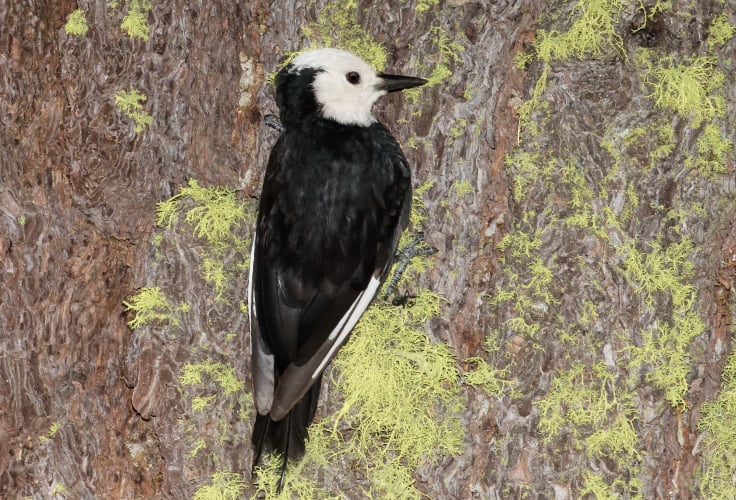
White-headed woodpeckers are most often seen moving along trunks and large limbs of pines, hitching upward in short spurts or hopping sideways along branches. They also cling to pine cones to hammer out seeds and flake bark to uncover insects. Unlike many woodpeckers, they rarely excavate deep into wood, instead using quick angled strokes to chip or pry loose flakes of bark. Their diet consists mainly of large pine seeds, complemented by insects and occasional sap taken from shallow holes. Their calls are soft and varied – a sharp “pee-dink” or “peek-it” note is the most common contact call, while a rapid “peek-peek-peek” rattle is used during interactions. They drum and call most actively in spring.
This species inhabits montane conifer forests dominated by large pines, particularly ponderosa pine and sugar pine, but also occurs in mixed stands with white fir, Douglas fir, and incense cedar. It ranges from southern British Columbia through eastern Washington and Oregon, across the Sierra Nevada of California, and locally into western Nevada and southern California’s higher mountain ranges. It is generally resident year-round but may move short distances in winter, often using recently burned forests, logged areas with standing snags, and older pine stands with large cones. Nests are excavated in dead pines or snags within open forest stands.
Although global trends suggest a modest population increase, the white-headed woodpecker remains vulnerable to forestry practices that eliminate mature pines and standing dead trees. Regional declines have been recorded where clearcutting, snag removal, and fire suppression have reduced open, multi-aged pine forests. Conservation programs in Oregon, Washington, and California emphasize retention of large pines and snags, selective logging, and maintenance of natural fire cycles. Despite its limited range, the species continues to persist as an emblematic bird of the western mountain pines, its white head gleaming against the dark trunks of high forests.
Williamson’s Sapsucker
Sphyrapicus thyroideus
- Identification: Medium-sized woodpecker; males glossy black with red throat, white wing patches, and yellow belly; females brownish with barred upperparts and pale rump.
- Where found: Resident or migratory across western mountain ranges from British Columbia and Washington south to Arizona and northern Mexico, breeding mainly in mature montane conifer and mixed forests.
- How to spot: Watch for a strikingly dimorphic pair on tree trunks in open conifer woods; listen for the sharp “chyaah” call or steady drumming and look for rectangular sap wells on conifers.
- Conservation status: Least Concern (IUCN); globally stable but declining locally in Canada and the U.S. where mature forests are lost, leading to regional concern listings.

The Williamson’s sapsucker is one of the most striking and unusual North American woodpeckers – so sexually distinct that males and females were once thought to be separate species. It measures 21 to 25 centimeters (8.3 to 9.8 inches) in length and has a compact body, a medium-length bill, and a strong tail used for bracing against trunks. The species serves as a sensitive indicator of mature conifer forests, especially at middle to high elevations.
Adult males are velvety black above, with a bold white rump, large white wing patch, and vivid red throat contrasting against the glossy black head and breast. Their belly shines yellow, and fine white lines mark the face. Females are strikingly different – barred in brown, black, and white, with a pale brown head, white rump, partial black breast patch, and yellowish belly; some show a few orange-reddish feathers on the chin, throat, or along the malar region. Juveniles resemble duller, less clearly marked versions of the adults, the young male lacking the red throat.

In the field, this sapsucker clings vertically to tree trunks, climbing with short, jerky movements. It drills neat horizontal rows of small sap wells in conifer bark and returns regularly to feed on oozing sap, inner bark, and insects trapped in the resin. During the breeding season, both sexes also forage for ants and other insects gleaned from bark or caught in short sallies. The flight is undulating, and calls are varied: the sharp, ringing “chyaah” series is most often heard, while a rattling trill may accompany display flights. Drumming is steady and rhythmic, used for communication and territory defense.
This species breeds throughout the western mountains, from British Columbia and the Pacific Northwest south through the Cascades, Sierra Nevada, and the Rockies to Arizona, New Mexico, and northern Mexico. It favors open, mature coniferous and mixed forests with ponderosa pine, Douglas fir, larch, and aspen. Some populations are year-round residents; others move to lower elevations or farther south in winter, occupying oak-pine and juniper woodlands. Nests are excavated in live or decayed conifers, especially aspen, where both parents care for the young.
Although globally secure, the Williamson’s sapsucker faces regional threats from logging and the loss of large, mature conifers needed for nesting and sap feeding. Populations remain stable overall but are declining locally, particularly in Canada, where the species is listed as Endangered due to the loss of old western larch forests. Where mature trees persist and post-fire habitats recover, the bird continues to thrive in suitable montane woodlands across the western cordillera.
Red-Naped Sapsucker
Sphyrapicus nuchalis
- Identification: Medium-sized woodpecker, black and white overall with red crown, nape, and throat; males have fully red throats, females white and red; both show large white wing patch and yellowish underparts.
- Where found: Breeds through the interior West from British Columbia and Alberta south through the Rocky Mountains to Arizona and New Mexico; winters mainly in the southwestern U.S. and Mexico, in coniferous and mixed woodlands.
- How to spot: Look for neat horizontal rows of sap wells in aspen, birch, or willow and listen for a harsh “weep” or “squeal” call and irregular drumming; often seen clinging to trunks or slender branches.
- Conservation status: Least Concern (IUCN); overall stable though locally affected by logging and forest management practices that reduce aspen and mixed-wood habitats.

The red-naped sapsucker is the characteristic sapsucker of the interior West, a striking bird of mountain forests from southern Canada to the southwestern United States. The species measures 19 to 21 centimeters (7.5 to 8.3 inches) in length and combines sharp black-and-white contrasts with vivid red on the head and nape. Like its close relatives, it plays a key role in forest ecosystems, both as a sap-feeder and as a creator of nest cavities later used by bluebirds, chickadees, and nuthatches.
Adults are crisply patterned: the black crown and nape are separated by a bright red patch on the rear crown, with a red forehead and black facial stripe bordered by two clean white lines. The upperparts are dark with fine barring and a prominent white wing patch, while the rump is white and the belly washed with buff or yellow tones. Males have a fully red throat bordered in black; females usually show white on the chin and upper throat and variable red below, though in some females the red is reduced or absent. Juveniles are brownish overall until their first autumn molt, when they assume adult coloration.

These agile birds hitch up trunks and branches, leaning on stiff tail feathers for support, and often hover briefly as they drill circular sap wells. The neat, parallel rows of holes encircling aspen or willow trunks are unmistakable signs of their presence. They lap up flowing sap and capture insects attracted to it, also feeding on fruits and arthropods in summer. Their flight is undulating, and their calls include a harsh, nasal “weep” or “squeal” and a dry chattering series. Drumming is slow and irregular, often heard early in the breeding season.
The species breeds across interior western North America, from British Columbia and Alberta south through the Cascades, Rockies, and mountain ranges of Idaho, Montana, Wyoming, Utah, Colorado, and northern Arizona and New Mexico. It favors aspen groves, mixed conifer-deciduous forests, and open ponderosa pine or Douglas-fir stands with willows or birches nearby. In winter it moves south and downslope to pine-oak woodlands, riparian groves, and orchards from southern California and Arizona into the mountains of Mexico. Nests are excavated in soft or decayed aspen and occasionally other deciduous trees.
Populations remain widespread and stable across most of the range, benefiting from mixed forests and the persistence of mature aspen groves. Local declines can occur where extensive logging removes aspen or other preferred nest trees, but the species continues to adapt well to a range of managed and natural forest habitats.
Red-Breasted Sapsucker
Sphyrapicus ruber
- Identification: Medium-sized woodpecker with a brilliant red head and breast, black back with white mottling, large white wing patch, and yellow-washed belly; sexes alike.
- Where found: Resident or short-distance migrant along the Pacific Coast from southeastern Alaska through British Columbia, Washington, Oregon, and California into northwestern Baja California, in coniferous and mixed forests.
- How to spot: Listen for irregular, stuttering drumming or a nasal “squeal;” look for rows of sap wells on aspen, alder, or pine and for the vivid red-headed bird clinging to trunks in coastal or mountain forests.
- Conservation status: Least Concern (IUCN); populations stable or slightly increasing, though local declines occur where snags are removed or mature forests are logged.

The red-breasted sapsucker is the brilliant western counterpart to the more widespread yellow-bellied and red-naped sapsuckers. Endemic to the Pacific Coast, it is one of the most vividly colored North American woodpeckers, with its entire head and breast cloaked in red. This species measures 20 to 22 centimeters (7.9 to 8.7 inches) in length and inhabits lush coastal and montane forests, where its sap wells support a host of insects, birds, and mammals that share in its sugary harvest.
Both sexes look alike, with a deep red head extending over the nape and breast, interrupted only by a small white mark before the eye. The back is black and white, forming a checkered or spotted pattern, and the wings bear a prominent vertical white patch. Underparts are pale with faint streaking on the sides and a yellowish wash across the belly. Juveniles are brownish overall until molting into the striking red and black adult plumage by early fall.

Red-breasted sapsuckers move with a hitching climb up trunks and limbs, often pausing to probe or tap at bark. They drill neat, horizontal rows of sap wells in a wide range of trees, especially aspen, alder, birch, maple, and conifers such as Douglas fir and pine, and return repeatedly to lap up the flowing sap and insects drawn to it. Foraging birds sometimes sally out briefly to catch flying insects. Their drumming is irregular and uneven, and calls include a nasal “weep” or “squeal” and short chattering notes exchanged between mates near the nest.
This species breeds from coastal Alaska and British Columbia south through Washington and Oregon to the Sierra Nevada and mountains of southern California. It favors mature coniferous or mixed forests, often with patches of deciduous trees used for feeding and nesting, and readily occupies second-growth stands, orchards, and forest edges. Many individuals remain resident year-round, while others move to lower elevations or coastal foothills in winter, frequenting wooded valleys, parks, and suburban areas. Nests are excavated in decayed trees or snags, where both parents share care of the young.
Red-breasted sapsuckers remain fairly common across their coastal and montane range, with stable or slightly increasing populations. They benefit from mixed forest mosaics but can decline in regions where dead trees are removed or large conifers are logged. Despite these localized pressures, the species continues to thrive in the Pacific woodlands, its bright red plumage and rhythmic drumming an unmistakable signature of western forests.
Gila Woodpecker
Melanerpes uropygialis
- Identification: Medium-sized woodpecker with grayish-tan head and underparts, boldly barred black-and-white back, and small red crown patch in males.
- Where found: Resident across the deserts of the southwestern United States and northwestern Mexico, especially in southern Arizona and adjacent Sonora, favoring saguaro cactus stands, riparian groves, and desert towns.
- How to spot: Listen for rolling “churr” or sharp “pip” calls; watch for a noisy pair perched atop saguaros or darting between cacti and mesquite trees in open desert habitats.
- Conservation status: Least Concern (IUCN); generally stable in the U.S. but declining regionally with habitat loss and competition from starlings for nesting cavities.

The Gila woodpecker is an unmistakable symbol of the Sonoran Desert – one of the few woodpeckers adapted to thrive in nearly treeless landscapes. This medium-sized species measures 22 to 24 centimeters (8.7 to 9.4 inches) in length and is a robust, energetic bird that fills the desert air with harsh calls and constant movement. Unlike most woodpeckers, it frequently excavates its nest holes in living saguaro cacti, turning the towering succulents into vertical colonies of desert life.
Adults are grayish brown overall, with black-and-white barring across the back, wings, and tail. The head and underparts are pale gray, the belly lightly washed with golden yellow, and the forehead whitish. Males have a small red patch on the crown, usually absent or limited to a few red feathers in females. In flight, large white patches at the base of the wings flash conspicuously. Juveniles resemble adults but are duller, with reduced red on the head.

These woodpeckers spend much of the day climbing trunks and saguaro stems, pecking, probing, and gleaning for insects and larvae, especially ants, beetles, grasshoppers, and cicadas. They also feed on cactus fruits, mistletoe berries, and saguaro nectar, and will visit feeders for suet or fruit. Males tend to forage on main branches and trunks, while females often work along the periphery of trees or decayed areas. Their calls include rolling “churr” notes and sharp “pip-pip” series, often given in rapid succession, while drumming is rare and brief.
Gila woodpeckers are year-round residents of arid lowlands from southeastern California and southern Nevada through central and southern Arizona and southwestern New Mexico, extending south through much of Baja California and western Mexico to Jalisco and Aguascalientes. They occupy desert scrub, saguaro and organ pipe cactus forests, riparian corridors, and even suburban areas with mature cacti and trees. Nests are usually excavated in saguaros but also occur in mesquite or cottonwood. Pairs often leave the cavity unused for several months to allow the cactus interior to dry and harden before nesting.
Populations are broadly stable in the United States, though long-term monitoring suggests moderate overall decline across the species’ range. Urban expansion and removal of mature saguaros reduce suitable nesting sites, while European starlings increasingly compete for cavities. Even so, the Gila woodpecker remains a common and noisy resident of desert regions, its calls echoing among the cacti that define the Sonoran landscape.
Gilded Flicker
Colaptes chrysoides
- Identification: Medium-large desert woodpecker with warm grayish-brown upperparts, spotted white underparts, bright yellow underwings and tail, and a cinnamon crown; males show a red malar stripe.
- Where found: Resident of the Sonoran Desert from southern Arizona and southeastern California south through Baja California and northwestern Mexico, strongly tied to stands of giant saguaro and cardon cacti.
- How to spot: Listen for loud “wick-wick-wick” calls echoing across cactus flats at dawn, and look for a flicker with yellow underwings, white rump, and a cinnamon crown perched on saguaros or foraging on the ground for ants.
- Conservation status: Least Concern (IUCN); populations stable to slightly declining, with local losses linked to desert development, saguaro destruction, and brush fires.

The gilded flicker is another hallmark of the Sonoran Desert, a more localized species confined to the arid cactus landscapes of southern Arizona, southeastern California, and northwestern Mexico. It measures 28 to 29 centimeters (11.0 to 11.4 inches) in length and is slightly smaller than its close relative, the northern flicker, and shows the same sleek, long-billed form and undulating flight. Its dependence on the giant saguaro and cardon cactus makes it one of the few woodpeckers closely associated with a single desert ecosystem.
Adults are pale brown and gray with fine barring across the back, bold black spots below, and a large black crescent on the upper breast. The crown is rich cinnamon, and the rump gleams white in flight. The undersides of the wings and tail are bright yellow, contrasting with the paler body. Males have a red malar stripe that females lack. Compared with nearby red-shafted northern flickers, the gilded flicker has yellower flight feathers, a rustier crown, and paler, more finely barred upperparts. Juveniles resemble adults but appear duller overall.

In the field, this species often betrays its presence by ringing calls that carry far across the desert, similar to the northern flicker’s “wick-wick-wick” or “peah.” It drums and utters varied rhythmic wicka notes during display flights around nesting territories. On the ground it moves with short hops, probing anthills and loose soil with its long, extensible tongue to extract ants and larvae, its primary diet through much of the year. In winter, it supplements this with fruits and seeds. Its buoyant, bounding flight alternates bursts of flapping with short glides, and the white rump and golden underwings are distinctive field marks.
The gilded flicker occupies the Sonoran Desert from southern Arizona and extreme southeastern California south along the Pacific slope through Sonora to northern Sinaloa, as well as most of Baja California. Within this range it inhabits stands of giant saguaro and cardon cactus interspersed with desert scrub and dry washes. Nests are usually excavated directly into the arms or trunks of large cacti but may occasionally be placed in cottonwoods or willows along desert drainages. In Arizona, hybrids with the red-shafted northern flicker are found in riparian zones bordering desert habitats.
Although still fairly common in suitable habitat, the gilded flicker faces long-term pressures from urban expansion, cactus loss, and fire damage to desert vegetation. Populations appear stable to moderately declining, with projections suggesting continued reduction if desert development continues. Nonetheless, where healthy stands of saguaros persist, the gilded flicker remains a striking emblem of the Sonoran landscape, its yellow wings flashing above the cactus forests of the southwestern desert.
Nuttall’s Woodpecker
Dryobates nuttallii
- Identification: Small black-and-white woodpecker with barred back, white underparts marked on the sides and flanks, and a red nape patch in males; slightly larger than a downy woodpecker.
- Where found: Year-round resident of California and northwestern Baja California, favoring oak and mixed riparian woodlands, especially those with coast live oak, valley oak, willow, and cottonwood.
- How to spot: Listen for a dry metallic rattle or high-pitched “pit” call, and look for a black-and-white woodpecker circling oak branches or foraging among thin twigs and foliage rather than on trunks.
- Conservation status: Least Concern (IUCN); population stable or slightly increasing, though locally vulnerable to habitat loss and diseases such as sudden oak death that affect oak forests.

The Nuttall’s woodpecker is a small, lively species found almost exclusively in California’s oak woodlands, extending just into northwestern Baja California. It measures 16 to 18 centimeters (6.3 to 7.1 inches) in length and is slightly larger than a downy woodpecker. This compact woodpecker’s presence is closely tied to oak forests and riparian groves, where its rattling calls echo through the trees on calm days.
Adults are boldly patterned in black and white, with narrow horizontal bars across the back and wings and white underparts marked with dark spots and barring along the flanks. The face shows black ear coverts and a malar stripe connecting with a black patch on the neck. Males have a red patch across the rear crown and nape, while females lack red. Juveniles resemble adults but are duller, with buffy underparts and some red-tipped feathers on the crown.

In the field, Nuttall’s woodpeckers move quickly among branches, often circling limbs and twigs rather than hitching straight up trunks like many other woodpeckers. They probe bark crevices, tap lightly on branches, and sometimes perch crosswise on slender stems, balancing with their wings. Their most frequent sounds are a sharp “pit,” “pitit,” or “pik” call and a short, dry rattle used for communication and territorial defense. They feed mostly on insects and other arthropods, gleaned from bark and foliage, and occasionally take fruits. Despite their reliance on oak woodlands, they do not feed on acorns.
This species occurs year-round across much of California, from the northern counties south through the coastal and foothill oak zones to Los Angeles and San Diego Counties, and slightly into northwestern Baja California. It occupies live oak, blue oak, and valley oak stands, as well as riparian woodlands with willows, cottonwoods, and sycamores. In southern parts of its range, where oaks are scarce, it relies more on riparian habitats. Nests are excavated in dead branches of oaks or nearby trees, typically at moderate height.
Nuttall’s woodpecker populations are stable or slowly increasing, aided by their adaptability to oak parks and suburban groves. However, because of their limited range and strong dependence on healthy oak forests, they remain sensitive to regional habitat changes. The spread of sudden oak death disease and continued loss of riparian woodlands pose future risks. Still, in most of California’s oak-covered hills and canyons, their dry rattle remains a familiar sound – a small, striped sentinel of the state’s characteristic woodlands.
Arizona Woodpecker
Leuconotopicus arizonae
- Identification: Medium-sized brown-and-white woodpecker with solid brown upperparts, large white cheek patches, and spotted white underparts; males show a small red patch on the rear crown.
- Where found: Resident of pine-oak and oak woodlands in the mountains of southeastern Arizona, southwestern New Mexico, and north through the Sierra Madre Occidental of Mexico.
- How to spot: Look for a small brown woodpecker spiraling up trunks in shady canyons and listen for a sharp “pik” or harsh rattling call; often joins mixed flocks of titmice, nuthatches, and warblers outside the breeding season.
- Conservation status: Least Concern (IUCN); global population small but stable, with threats from habitat loss and forest degradation in Mexico leading to its inclusion on the Yellow Watch List.

The Arizona woodpecker stands out among North American woodpeckers for its rich brown plumage, a striking contrast to the black-and-white pattern of most of its relatives. It measures 18 to 20 centimeters (7.1 to 7.9 inches) in length and is a compact, short-tailed species of mountain woodlands in the American Southwest and northwestern Mexico. In the United States it occurs only in a few mountain ranges of southern Arizona and southwestern New Mexico, making it a distinctive specialty of this region’s Madrean forests.
Adults are chocolate-brown above with narrow white barring on the wings and white outer tail feathers marked with dark bars. The face is white with brown ear coverts and a brown malar stripe, giving a capped appearance. Underparts are white, marked with brown spots and streaks that vary in density across individuals. Males bear a small red patch on the nape, while females lack red. Juveniles resemble adults but are paler and more diffusely spotted, with both sexes showing some red on the crown.

In the field, the Arizona woodpecker behaves much like a small creeper, flying to the base of a tree and then spiraling upward along the trunk. It works rapidly over the bark, prying, probing, and flaking small pieces loose to extract insects and larvae, rather than heavy hammering. The species often forages close to the ground and may also explore agave stalks or fallen branches. Its calls include a sharp “pik,” a nasal rattle, and varied “wicka” or “kweek” series, especially during breeding displays. Outside the nesting season, it frequently joins mixed flocks of woodland songbirds.
Within the United States, the Arizona woodpecker is confined to the mountain ranges of southeastern Arizona and southwestern New Mexico, including the Santa Catalina, Chiricahua, and Peloncillo Mountains. Southward, it is widespread through the Sierra Madre Occidental from Sonora and Chihuahua to Michoacán. Its preferred habitat is montane oak or pine-oak woodland, often with adjacent riparian belts of sycamore and walnut. It nests in cavities excavated in dead limbs or trunks, generally at mid-elevation forest zones.
Although fairly common in suitable habitat, the Arizona woodpecker has a small global range and relies heavily on intact mid-elevation oak and pine-oak forests. In the United States it remains locally stable, but in Mexico forest loss from logging, grazing, and groundwater depletion threatens key habitat. The species is therefore listed on the Yellow Watch List for range-restricted birds. In healthy oak canyons of southern Arizona, however, its soft rattling calls still echo through the mountain woods – a subtle reminder of the region’s Mexican affinities and unique montane ecosystems.
American Three-Toed Woodpecker
Picoides dorsalis
- Identification: Medium-sized, black-and-white woodpecker with a yellow crown patch in males, barred flanks, and white outer tail feathers.
- Where found: Resident across the boreal forests of Alaska and Canada, extending south into the northern and western U.S. mountains, especially in spruce and mixed conifer forests affected by fire or bark beetles.
- How to spot: Look for a quiet, methodical woodpecker flaking bark from dead or dying conifers in burned or insect-infested forests; listen for soft tapping and faint “pik” calls rather than loud drumming.
- Conservation status: Least Concern (IUCN); populations appear stable across much of the range, though vulnerable to habitat loss from logging, fire suppression, and post-fire salvage operations.

The American three-toed woodpecker is the northernmost breeding woodpecker in North America, thriving in boreal and montane forests shaped by disturbance. It measures 20 to 23 centimeters (7.9 to 9.1 inches) in length and is relatively small but powerfully built, with an unusually strong neck and bill for its size. This species is one of only three woodpeckers in the world that have just three toes – an adaptation that may allow greater leverage and stronger blows when chiseling into wood.
Adults show a striking black-and-white pattern, with black upperparts irregularly barred and spotted with white, and underparts white with fine black barring along the flanks. The head is mostly black with two white facial stripes, and males display a bright yellow patch on the crown. Females have the same pattern but lack the yellow. The outer tail feathers are white with narrow black bars. Juveniles resemble adults but are duller, often showing a smaller yellow crown patch and buffy tones on the underparts.

In the field, this species is quiet and unobtrusive. It typically flies to the base of a tree and works slowly upward, flaking bark from the trunk with sideways blows rather than deep excavation. The pale patches of freshly exposed bark are often the best sign of its presence. It feeds mainly on bark beetle larvae and other wood-boring insects, spending long periods on a single tree before moving on. Calls include a soft “pik” and a short, even rattle similar to that of the hairy woodpecker but weaker. Its drumming is distinctive – a rapid burst that tapers at the end.
The American three-toed woodpecker occupies boreal and subalpine conifer forests across Alaska and Canada, south through the Rockies and western mountains into the northern United States. It is most often found in spruce, fir, or mixed conifer woods, especially where fire, wind, or beetle infestations have created abundant snags and dying trees. In the contiguous U.S., it breeds locally in the Cascades, northern Rockies, and high mountains of Colorado, Utah, Arizona, and New Mexico, as well as in parts of northern New England.
Populations are generally stable, though trends are difficult to measure because much of the range lies beyond standard survey coverage. The species benefits from natural disturbance, thriving in recently burned or beetle-killed forests, but declines when old snags are removed through salvage logging or intensive timber harvest. Fire suppression and widespread pesticide use against bark beetles also reduce available habitat. Despite these pressures, the American three-toed woodpecker remains a resilient specialist of northern forests – an indicator of healthy, naturally disturbed conifer ecosystems from Alaska’s taiga to the mountains of the Southwest.
Black-Backed Woodpecker
Picoides arcticus
- Identification: Medium-sized, black-and-white woodpecker with solid black upperparts, white underparts barred on the flanks, and a single white facial stripe; males have a yellow crown patch.
- Where found: Resident across northern coniferous forests of Alaska, Canada, and the northern United States, most often in recently burned or insect-infested spruce and pine forests.
- How to spot: Search in burned forests one to eight years after fire; look for a dark woodpecker flaking bark from charred trunks and listen for a sharp “kyik” call or drumming that trails off at the end.
- Conservation status: Least Concern (IUCN); overall population stable but locally affected by fire suppression, logging, and postfire salvage operations that remove essential foraging habitat.

The black-backed woodpecker is a specialist of burned forests, its inky plumage blending almost perfectly with the charred bark of fire-killed trees. It measures 23 to 24 centimeters (9.1 to 9.4 inches) in length and is one of the most enigmatic North American woodpeckers, rare and elusive and highly dependent on pulses of insect life that follow forest fires. This species is one of only two North American woodpeckers with three toes, an adaptation that may increase the force of its blows when chiseling into hard wood.
Adults are glossy black above with clean white underparts barred on the sides and flanks. The face shows a white malar stripe extending from the bill to the neck, and the outer tail feathers are white. Males display a bright yellow patch in the center of the crown, while females have a black crown. Juveniles resemble adults but are duller, with reduced or absent yellow and a buff wash on the underparts. The plumage is remarkably effective camouflage against burned bark, making perched birds surprisingly difficult to spot.

In the field, black-backed woodpeckers are quiet, deliberate foragers that spend long periods excavating deep into dead wood to extract large beetle larvae, their main prey. They feed mostly on trunks of recently burned conifers, where wood-boring beetles are abundant, and leave conspicuous patches of light-colored sapwood where bark has been stripped away. The call is a sharp “kyik” or double “click,” and their drumming, rapid at first, then fading, is much like that of the American three-toed woodpecker. They move methodically from trunk to trunk, flying low and directly through the forest.
The species is widespread across boreal North America, from Alaska and most of Canada south to the northern and western United States, including the Cascades, Sierra Nevada, northern Rockies, and northern Great Lakes region. It is notably absent from the central and southern Rockies, likely due to insufficient mature conifer habitat there. South of its breeding range, individuals occasionally wander or irrupt in winter, sometimes reaching the Midwest and Appalachians. Within its preferred habitats – recently burned spruce, pine, fir, or tamarack forests, it is often among the first woodpeckers to arrive after a fire, remaining for several years until beetle populations decline.
Though difficult to census because of its mobile, disturbance-dependent lifestyle, the black-backed woodpecker appears globally stable. Its fortunes, however, rise and fall with natural fire cycles. Modern fire suppression, salvage logging, and short timber-rotation forestry have reduced the availability of postfire forests on which it depends. Where wildfires are allowed to burn and standing snags remain, this species thrives, serving as an emblem of the ecological renewal that follows fire – one of the clearest examples of how disturbance can sustain life in northern forests.
Red-Cockaded Woodpecker
Leuconotopicus borealis
- Identification: Medium-sized black-and-white woodpecker with bold white cheek patches, barred back, and a narrow black malar stripe; males have a tiny red streak on each side of the head that is often hidden.
- Where found: Resident of old, open pine forests of the southeastern United States, especially longleaf, loblolly, and slash pine stands maintained by frequent natural fires.
- How to spot: Look for a pale-cheeked woodpecker scaling bark high on mature pines in open woods; note trees with resin flowing below cavities and listen for sharp “sklit” calls echoing through the pines.
- Conservation status: Near Threatened (IUCN); global population slowly increasing after decades of decline from habitat loss, fragmentation, and fire suppression, but still limited to managed pine ecosystems.
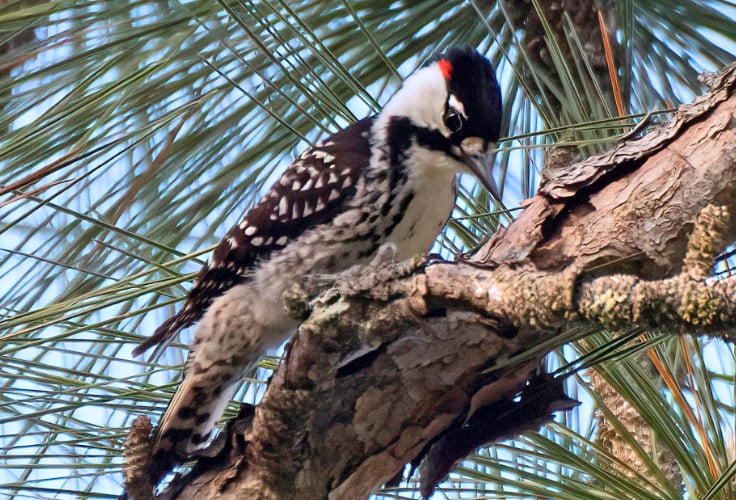
The red-cockaded woodpecker is one of the most distinctive and specialized birds of the southeastern United States, a true emblem of the region’s longleaf pine forests. The species measures 20 to 23 centimeters (7.9 to 9.1 inches) in length and is modest in size but remarkable in behavior. It is the only North American woodpecker that excavates its nesting cavities in living pines, usually those softened by red heart fungus, and it maintains these trees for decades through careful upkeep and resin production.
Adults are strikingly patterned in black and white, with barred backs and a bold white cheek patch unique among woodpeckers of the region. The underparts are white with light spotting along the flanks. Males possess a minute red streak, or “cockade,” at the upper border of the cheek, rarely visible in the field. The head is otherwise glossy black, and both sexes have white nasal tufts and a fine black malar stripe framing the cheek. Juveniles resemble adults but are duller, often showing scattered red on the crown.

Red-cockaded woodpeckers are active but quiet workers, climbing and hitching along trunks and branches in search of insects beneath the bark. They forage mostly on pine trunks, scaling loose bark to reveal ants, beetle larvae, and other arthropods. Around nesting trees, they peck small resin wells above and below each cavity, causing sap to flow – an ingenious defense against snakes and other predators. Their calls include a distinctive “sklit” note, longer and more drawn-out than that of the downy or hairy woodpecker, and a variety of chatters and churrs used in communication within their social groups.
This species is a resident of mature pine ecosystems across the southeastern United States, from Virginia and the Carolinas south through Georgia, Florida, Alabama, and Mississippi, and west to eastern Texas and southeastern Oklahoma. It requires extensive stands of old pines with open, grassy understory maintained by frequent fire. Within these landscapes, red-cockaded woodpeckers live in cooperative family groups, usually consisting of a breeding pair and several helpers – often sons from previous years, that share in cavity maintenance, incubation, and feeding duties.
Once widespread across the Southeast, the species declined severely during the 20th century as old-growth longleaf pine forests were logged and replaced with dense pine plantations or farmland. Today, the red-cockaded woodpecker persists mainly in protected areas such as national forests, wildlife refuges, and military bases where fire regimes and forest structure are actively managed. Intensive conservation programs, including the creation of artificial nest cavities, translocation of birds, and habitat restoration, have helped populations recover after decades of decline. Even so, it remains a Yellow Alert Tipping Point species, dependent on ongoing management and fire to sustain its fragile pine-forest world.
North America’s Lost Woodpecker
The 22 woodpecker species described above represent nearly every forest and landscape in North America, from the boreal spruce of Alaska to the cacti of the Sonoran Desert, from quiet suburban gardens to mountain pines and swampy river floodplains. Yet towering above them all, both in size and in legend, stands a bird few living people have ever seen: the ivory-billed woodpecker. Long considered the ultimate prize among birders, it remains a symbol of mystery and loss – a species that may still exist, unseen, in the deepest remnants of its once-vast realm.

At about 50 centimeters (20 inches) in length, the ivory-billed woodpecker ranked among the three largest woodpeckers in the world, rivaled only by the great slaty woodpecker of Southeast Asia and the imperial woodpecker of Mexico. It was striking in life: glossy black above, gleaming white below, with bold white stripes running down the neck and meeting on the folded wings to form a large, bright “shield” on its back. Males wore a vivid red crest, females a black one, and both sexes carried the heavy ivory-white bill that gave the species its name.
It inhabited extensive tracts of old-growth forest, particularly cypress, pine, and swamp hardwoods, where it chipped away great sheets of bark to reach the beetle larvae buried in dying trees. Its resonant double knock carried through the woods, and its clear, trumpet-like calls were said to echo for miles across the still water of southern bayous.
Once widespread across the southeastern United States and in Cuba, the ivory-billed woodpecker retreated with the destruction of its forests. Logging of bottomland cypress and longleaf pine in the late nineteenth and early 20th centuries reduced its habitat to scattered remnants. By the 1940s, only a few pairs were known, the last studied in Louisiana’s Singer Tract. The species was widely believed extinct by mid-century, yet sporadic reports have continued, including an intensely publicized claim from Arkansas in 2004.
Despite extensive searches using modern technology, no conclusive evidence has been found. Whether a few individuals still haunt the remote bayous of the South or the forests of eastern Cuba remains uncertain. For now, the ivory-billed woodpecker endures as a reminder of what North America once possessed, and what dedicated eyes and careful stewardship might one day rediscover.


