
Indiana supports a small but diverse group of owls, with eight species recorded regularly across the state. These include four resident species – the Eastern Screech-Owl, Barred Owl, Great Horned Owl, and the rare Barn Owl, which occur year-round, along with several others that appear mainly during migration or winter. This guide highlights the identification, seasonal occurrence, and habitat use of owls most likely to be encountered in Indiana.
Eastern Screech-Owl
Megascops asio
- Identification: Small, stocky owl with prominent ear tufts, yellow eyes, and gray or rufous plumage marked with fine bars and streaks that provide excellent camouflage against tree bark.
- Where found: Year-round across Indiana in wooded landscapes, including forests, riparian corridors, parks, farmland edges, and residential neighborhoods with mature trees.
- How to spot: Listen at night for its monotonic trills or descending whinnies, or look for individuals roosting at the entrances of tree cavities or nest boxes.
- Conservation status: Least Concern (IUCN); common and widespread in Indiana, though long-term monitoring indicates modest regional declines in parts of its range.

The Eastern Screech-Owl is the most frequently encountered owl in Indiana and one of the most familiar nocturnal birds in the state’s towns, suburbs, and wooded countryside. It measures 16 to 25 centimeters (6.3 to 9.8 inches) in length and has a compact, broad-headed build with prominent ear tufts, yellow eyes, and a short, square tail. Plumage occurs in two main color morphs, gray and rufous, both patterned with intricate bars, streaks, and spots that blend closely with tree bark and shaded trunks. This cryptic coloration allows the species to remain nearly invisible while roosting during daylight hours.

In the field, the species is most often detected by its voice, producing a steady monotonic trill used for close communication and a descending whinny associated with territorial activity. These vocalizations carry clearly through wooded neighborhoods and forest edges, especially on calm nights in late winter and spring. Eastern Screech-Owls hunt primarily from low perches, making short, rapid flights through the lower canopy or across open ground. Their diet includes insects, small mammals, songbirds, and other small vertebrates, and individuals frequently forage in suburban yards, along woodland edges, and near lights that attract insects.
Eastern Screech-Owls are widely distributed across Indiana and occur in most parts of the state. The species is especially common across central and southern Indiana, while it appears somewhat less frequent in the northern counties. The species occupies a broad range of wooded habitats, including deciduous and mixed forests, riparian corridors, agricultural landscapes with scattered woodlots, parks, and residential areas with mature trees. Breeding evidence is scattered widely across the state rather than concentrated in specific regions, indicating that the species nests wherever suitable tree cavities or nest boxes occur. Eastern Screech-Owls are permanent residents in Indiana and stay within their territories throughout the year.
The Eastern Screech-Owl remains common across Indiana and continues to be recorded in a large number of survey blocks. Comparisons between atlas periods suggest generally stable statewide distribution, although some variation in detections likely reflects local changes in habitat or survey coverage. Local population fluctuations can occur when prey availability shifts. For example, winter surveys in southern Indiana documented a decline in screech-owl occupancy following a sharp drop in white-footed mouse numbers, an important prey species linked to poor acorn mast production. Habitat loss, removal of mature cavity-bearing trees, and competition for nesting sites can also influence local populations, but the species persists widely due to its flexible diet and tolerance of human-altered landscapes.
Barred Owl
Strix varia
- Identification: Large gray-brown owl with a rounded head, dark eyes, a full facial disc, and brown-and-white barring and streaking across the underparts.
- Where found: Year-round across Indiana in mature deciduous and mixed forests, especially near rivers, swamps, and wooded wetlands.
- How to spot: Listen at night for the distinctive “Who cooks for you?” call, or watch for a broad, rounded owl gliding quietly through forest interiors.
- Conservation status: Least Concern (IUCN); populations stable or increasing in Indiana.

The Barred Owl is one of Indiana’s most familiar forest owls and among the species most often heard calling at night in wooded landscapes. It measures 43 to 50 centimeters (16.9 to 19.7 inches) in length and shows a large, broad-bodied form with a rounded head lacking ear tufts. The face appears full within a well-defined facial disc, and the dark brown eyes give the species a distinctive expression compared with the yellow-eyed owls that occur in the region. Plumage is gray-brown overall with brown-and-white barring across the upper breast and bold vertical streaking along the belly and sides, a pattern that blends closely with shaded trunks and mature forest interiors.
Barred Owls are most often detected by their distinctive two-part hooting series commonly rendered as “Who cooks for you? Who cooks for you-all?” These resonant calls carry through wooded valleys and wetlands and are most frequently heard from dusk through the night. Owls roost quietly in dense forest cover during the day and become active at dusk, moving through the trees with buoyant, nearly silent flight. They hunt mainly from elevated perches and take a wide variety of prey, including small mammals, amphibians, birds, and other small vertebrates, sometimes dropping to the forest floor or wading into shallow water to capture prey.
The Barred Owl occurs widely across Indiana and is found throughout much of the state. It inhabits mature deciduous and mixed forests, wooded wetlands, riparian corridors, and floodplain forests along major river systems. The species is especially common across the southern half of Indiana, including southwestern, south-central, and southeastern regions where forest cover is more extensive. Occurrence becomes somewhat less frequent across northern Indiana, where large forest tracts are more limited, although individuals still appear in scattered woodlots and riparian habitats. Barred Owls nest in large tree cavities or old stick nests and are resident within their territories throughout the year.
The owl remains a common and well-established species across Indiana’s forested landscapes. Breeding records occur across many counties, particularly in the forested landscapes of the southern and central parts of the state. Comparisons between atlas periods indicate stable or increasing presence in many areas, with some evidence of expanded occurrence toward central and northern Indiana. The species remains closely associated with mature forest structure and large cavity-bearing trees. Loss of extensive forest habitat and removal of large nesting trees can affect local populations, but overall the Barred Owl remains a characteristic and widespread owl of Indiana’s woodlands.
Great Horned Owl
Bubo virginianus
- Identification: Large, powerful owl with broad wings, prominent ear tufts, a white throat patch, and striking yellow eyes, showing mottled brown, buff, and black plumage.
- Where found: Year-round across Indiana in forests, farmland, wetlands, and suburban landscapes where wooded cover occurs near open hunting areas.
- How to spot: Listen for deep, multi-note hoots at dusk or night, or watch for a thick-bodied owl perched on exposed branches, poles, or other elevated structures.
- Conservation status: Least Concern (IUCN); common across Indiana with stable populations.
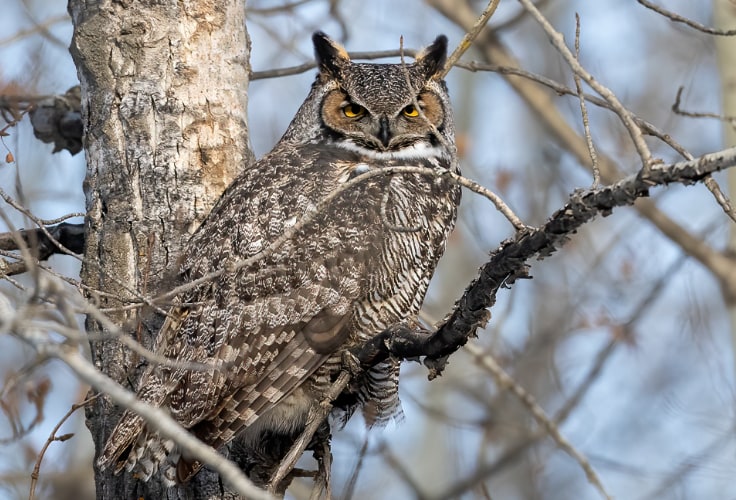
The Great Horned Owl is the most common large owl found in Indiana and a familiar nocturnal predator across much of the state. It measures 46 to 63 centimeters (18.1 to 24.8 inches) in length and has a thick-bodied build with a broad head, prominent ear tufts, and large yellow eyes set within a well-defined facial disc. Plumage is heavily mottled in brown, buff, gray, and black, with a pale throat patch that often becomes visible when the bird calls. Its robust structure and distinctive ear tufts give the species a bold silhouette when perched.
In the field, Great Horned Owls are often detected by their deep, rhythmic hoots, typically delivered as a slow series of four to six notes that may be exchanged between mates. Individuals frequently perch upright on exposed branches, fence posts, utility poles, or other elevated structures while scanning nearby open areas for prey. Flight is strong and deliberate, combining deep wingbeats with short glides. The species hunts primarily at night but may also hunt at dusk or dawn, taking a wide range of prey that includes mammals, birds, and other vertebrates captured from perches or during low hunting flights over open ground.
Great Horned Owls occur throughout Indiana and are widely distributed across the entire state. The species occupies a broad range of habitats, including agricultural landscapes with scattered woodlots, deciduous and mixed forests, wetlands, river corridors, and suburban areas. Individuals often use landscapes that combine wooded cover with adjacent open fields or clearings where prey is easier to detect. Breeding occurs across most regions of Indiana, with nesting sites placed in abandoned raptor nests, tree cavities, cliff ledges, or occasionally on human-made structures. The species remains resident throughout the year and maintains territories across both rural and developed landscapes.
The Great Horned Owl remains common across Indiana and shows a stable statewide presence. Observations and breeding evidence occur throughout the state, reflecting the species’ ability to occupy a wide variety of habitats. Populations appear generally stable, supported by the owl’s flexible diet and tolerance of human-modified environments. Local threats can include habitat alteration, collisions with vehicles or structures, and secondary poisoning from rodenticides consumed through contaminated prey, but overall the species continues to thrive as one of Indiana’s most adaptable nocturnal raptors.
Northern Saw-whet Owl
Aegolius acadicus
- Identification: Very small, round-headed owl with bright yellow eyes, brown upperparts spotted with white, and white underparts boldly streaked with brown.
- Where found: Occurs mainly during migration and winter in forested areas across Indiana, with only rare indications of breeding in the state.
- How to spot: Listen at night for a sharp, repetitive “too-too-too” call, or watch for a small owl roosting quietly in dense conifers during the day.
- Conservation status: Least Concern (IUCN); very uncommon in Indiana with most records occurring during migration or winter.

The Northern Saw-whet Owl is the smallest owl regularly recorded in Indiana and one of the most elusive. It measures 18 to 22 centimeters (7.1 to 8.7 inches) in length and has a compact body, a large rounded head without ear tufts, and bright yellow eyes set within a well-defined facial disc. The overall appearance is soft and rounded, with rich brown upperparts marked by white spots and streaks and white underparts boldly streaked with brown. Despite its small size, the species is a capable nocturnal predator and remains extremely difficult to detect in dense forest habitats.
Northern Saw-whet Owls are most often detected by their high, repetitive “too-too-too” call, a sharp series of evenly spaced notes given mainly during the breeding season. These calls can carry surprisingly far on still nights. During the day the species roosts quietly in dense conifers, usually perched close to the trunk where its cryptic plumage blends with shaded branches. The owl becomes active after dark and hunts primarily from low perches along forest edges and clearings. Its diet consists mostly of small mammals, particularly mice, which it captures using short, quick flights through the understory.
In Indiana, the species occurs primarily as a migrant and winter visitor. Most individuals recorded in the state are thought to originate from breeding populations farther north and move southward during colder months. Suitable habitat includes dense conifer stands, mixed forests, and wooded areas that provide sheltered daytime roosts and nearby openings for hunting. Breeding in Indiana appears to be extremely rare. A single probable nesting record has been documented in the eastern part of the state, in Franklin County, suggesting that occasional individuals may attempt to breed, but most occurrences likely involve transient or wintering birds.
Despite occurring regularly in Indiana during migration and winter, the Northern Saw-whet Owl remains one of the least frequently observed owls in the state. Its small size, highly nocturnal habits, and secretive behavior make it difficult to detect even in suitable habitats. Across its broader range, populations are difficult to monitor, and conservation concerns generally relate to the loss of mature forest structure and nesting cavities. In Indiana, however, the species is primarily notable for its rarity as a breeder rather than for well-documented population trends.
Short-eared Owl
Asio flammeus
- Identification: Medium-sized owl with a pale facial disc, black-rimmed yellow eyes, mottled brown-and-buff upperparts, streaked whitish to rusty underparts, and broad rounded wings marked with a dark comma at the wrist.
- Where found: Occurs mainly during migration and winter in open landscapes across Indiana, including grasslands, agricultural fields, and marshes.
- How to spot: Search open fields at dawn or dusk for a buoyant, mothlike flight low over vegetation, or watch for birds perched directly on the ground.
- Conservation status: Least Concern (IUCN); considered Endangered in Indiana, with significant declines and only sporadic historical breeding.

The Short-eared Owl is an open-country owl that occasionally appears in Indiana’s grasslands and agricultural landscapes, especially during the colder months. It measures 34 to 43 centimeters (13.4 to 16.9 inches) in length and has a rounded head with very small, often inconspicuous ear tufts and large yellow eyes set within a pale facial disc. Plumage is mottled brown and buff above, blending with dry grasses, while the underparts range from whitish to rusty tones marked with vertical streaks. In flight, the long, broad wings show pale underwings with a distinctive dark patch near the wrist and darker wingtips.
In the field, Short-eared Owls are most often detected while flying low over open ground at dusk or during the early evening. Their flight is buoyant and irregular, with slow wingbeats and frequent changes in direction that give the bird a mothlike appearance. Unlike most North American owls, this species is regularly active during daylight hours, especially in winter. Individuals hunt small mammals, particularly voles, by quartering low over fields and grasslands and occasionally hovering briefly before dropping onto prey. Birds may also be seen perched directly on the ground or on low posts in open landscapes.
In Indiana, the Short-eared Owl occurs mainly as a migrant and winter visitor in open habitats. Suitable areas include large grasslands, agricultural fields, marshes, and other treeless landscapes that support populations of small mammals. Most records come from winter observations, when birds may appear in open country across parts of the state. Breeding in Indiana has always been sporadic and has occurred mainly in the northern parts of the state where suitable grassland habitats exist. Although nesting was documented occasionally in earlier periods, no confirmed breeding records were reported during the most recent atlas survey.
The Short-eared Owl has declined significantly in Indiana and is considered Endangered within the state. Loss and fragmentation of grassland habitat have likely reduced opportunities for both breeding and wintering birds. Conversion of native grasslands to agriculture and development has limited the large open landscapes this species requires. Because populations can fluctuate with prey availability, the species may appear irregularly from year to year. In Indiana today, the Short-eared Owl is primarily encountered as a scarce winter visitor rather than as a regular breeding species.
Long-eared Owl
Asio otus
- Identification: Medium-sized, slender owl with long upright ear tufts, yellow eyes, a buff facial disc with pale vertical markings between the eyes, mottled brown-and-buff upperparts, and streaked whitish to buff underparts.
- Where found: Occurs mainly during migration and winter in wooded areas near open fields across Indiana, including shelterbelts, pine stands, and dense groves used for daytime roosting.
- How to spot: Search dense evergreen groves or shelterbelts for well-camouflaged birds at winter roosts, or listen at night for a series of low, evenly spaced hoots during the breeding season.
- Conservation status: Least Concern (IUCN); considered a species of Special Concern in Indiana, with declining records and no confirmed breeding in recent surveys.

The Long-eared Owl is a slender, secretive owl that appears in Indiana mainly during migration and winter. It measures 35 to 40 centimeters (13.8 to 15.7 inches) in length and has a narrow-bodied build with long upright ear tufts, large yellow eyes, and a buff facial disc marked by pale vertical lines between the eyes. Plumage is intricately patterned in brown, gray, buff, and black across the upperparts, while the underparts appear pale with strong vertical streaking. Its tall ear tufts and elongated profile give the bird a distinctive upright silhouette when perched.
Long-eared Owls are often detected at communal winter roosts rather than during active hunting. During the day they roost in dense conifers, shelterbelts, or thick evergreen groves where their camouflage allows them to remain nearly invisible among branches. At dusk they leave these roosts to hunt over nearby open areas, flying with long glides and deep wingbeats. Their diet consists mainly of small mammals, particularly mice and voles. Males produce a series of low, evenly spaced hoots during the breeding season, though these calls are rarely heard in Indiana because most birds present in the state occur outside the nesting period.
In Indiana, this species occurs mainly as a migrant and winter visitor. Birds typically occupy wooded roost sites such as pine stands, shelterbelts, and dense groves located near open grasslands or agricultural fields used for hunting. Winter roosts may contain several individuals clustered in the same group of trees. Breeding in the state has historically been sporadic and was likely associated with suitable woodland and grassland mosaics. However, no confirmed nesting was documented during the most recent atlas survey.
The Long-eared Owl has declined in Indiana and is now considered a species of Special Concern in the state. Atlas comparisons indicate a significant reduction in records between survey periods. Loss of suitable habitat, particularly the combination of open grasslands for hunting and dense tree stands for roosting, may contribute to these declines. Because the species is highly secretive and often roosts quietly in dense cover, it can also be overlooked during surveys. In Indiana today, the owl is encountered mainly during migration and winter rather than as a regular breeding species.
American Barn Owl
Tyto furcata
- Identification: Medium-sized owl with a pale heart-shaped facial disc, long rounded wings, short tail, long sparsely feathered legs, and buff-and-gray upperparts contrasting with whitish underparts.
- Where found: Localized in Indiana, occurring mainly in open farmland, grasslands, and pastures in the southern part of the state.
- How to spot: Look for a pale owl flying low over fields at night with slow, buoyant wingbeats, or listen for a harsh rasping scream near barns, silos, and other quiet structures.
- Conservation status: Least Concern (IUCN); Endangered in Indiana, where the species is rare and restricted mostly to southern agricultural landscapes.

The American Barn Owl is the rarest breeding owl in Indiana and is easily recognized by its pale plumage and distinctive heart-shaped face. It measures 32 to 40 centimeters (12.6 to 15.7 inches) in length and has a lanky appearance compared with most other North American owls, with long legs, a rounded head lacking ear tufts, and long softly rounded wings. The upperparts are buff and gray with scattered dark spotting, while the face and underparts appear largely whitish. This pale coloration and buoyant flight give the species a ghostlike appearance when seen at night over open landscapes.
In the field, Barn Owls are most often detected by their harsh, rasping scream rather than by the hooting calls typical of many other owls. They hunt primarily at night, flying slowly and silently over fields and grasslands while listening for prey. Their flight is buoyant with deep wingbeats and gentle glides. In Indiana, the species feeds mainly on small mammals, especially voles and shrews, which it locates using highly specialized hearing. During the day, individuals usually roost quietly in barns, silos, abandoned buildings, tree cavities, or other sheltered structures.
In Indiana, the Barn Owl occurs mainly in the southern half of the state, where suitable open farmland and nesting structures are more common. Most records come from southwestern, south-central, and southeastern counties, particularly in areas with a mix of pasture, hayfields, and open agricultural landscapes. Observations become much scarcer across central and northern Indiana, where intensive row-crop agriculture and fewer nesting sites provide less suitable habitat. The species nests in barns, abandoned buildings, grain bins, and tree cavities, and may also use nest boxes placed in appropriate habitats.
The Barn Owl is now rare in Indiana and is listed as Endangered in the state. Fewer than 50 nests are typically documented each year, with most breeding pairs concentrated in the southern counties along the Ohio River and surrounding farmland. The species declined after major changes in agricultural landscapes, including the loss of grasslands and pastures and the replacement of traditional wooden barns with modern metal structures that offer fewer nesting opportunities. Nest box programs and habitat management in open grasslands, including reclaimed mine lands, have been used to support the small remaining population.
Snowy Owl
Bubo scandiacus
- Identification: Large white owl with yellow eyes, a rounded head, and variable dark barring that ranges from heavy on females and young birds to nearly absent on older males.
- Where found: Irregular winter visitor in Indiana, most often appearing in open areas of the northern part of the state, especially near Lake Michigan.
- How to spot: Scan wide-open landscapes such as fields, shorelines, and airports for a large pale owl perched on the ground or on posts, or watch for low, buoyant flights over open terrain.
- Conservation status: Vulnerable (IUCN); appears irregularly in Indiana during winter irruptions.

The Snowy Owl is the largest owl likely to appear in Indiana and one of the most striking winter visitors recorded in the state. It measures 52 to 71 centimeters (20.5 to 28.0 inches) in length and has a powerful build with broad rounded wings, a large rounded head, and bright yellow eyes. Plumage ranges from heavily barred white in females and younger birds to nearly pure white in older males. The legs and toes are densely feathered, an adaptation to the extreme cold of the Arctic where the species normally breeds.
In the field, Snowy Owls are often seen perched in the open on the ground, fenceposts, dunes, or buildings where they watch surrounding terrain for prey. Their flight can appear slow and buoyant, though they are capable of fast direct pursuit when hunting birds. Unlike many owls, they are frequently active during the day, especially in winter. In southern wintering areas they hunt small mammals and birds in open landscapes that resemble their tundra breeding habitat.
In Indiana, the Snowy Owl appears only as an irregular winter visitor during occasional irruption years. Most sightings occur in the northern part of the state, especially along the Lake Michigan shoreline, including the Indiana Dunes, where large open landscapes resemble the species’ Arctic habitat. Individuals are also occasionally reported farther south during strong irruptions, appearing in agricultural fields, airports, and other open areas across the state. These movements are typically associated with cycles in lemming populations in the Arctic, which influence breeding success and the number of young owls dispersing southward.
Snowy Owls are irregular visitors in Indiana and are absent in many winters. When irruptions occur, however, they can attract significant attention from birders and the general public due to their size and striking appearance. Across their Arctic breeding range, populations fluctuate with prey cycles and show long-term declines linked to climate change and changing Arctic ecosystems. During winter, individuals dispersing southward face additional risks such as starvation, vehicle collisions, and other human-related hazards.
Where and When to see Owls in Indiana
Most owl encounters in Indiana occur at night in wooded landscapes, especially from late fall through early spring when calling activity increases and leaves no longer obscure roosting birds. Year-round residents such as the Eastern Screech-Owl, Barred Owl, and Great Horned Owl can be heard across much of the state in forests, suburban woodlots, and riparian corridors. Listening on calm evenings near mature woodlands, farmland edges, or along river valleys often provides the best chance of detecting these species.
Winter can bring additional owls to Indiana’s open landscapes and forest edges. Northern Saw-whet Owls and Long-eared Owls appear mainly during migration and winter, often roosting quietly in dense conifers near open fields. In large grasslands and agricultural areas, observers may occasionally see Short-eared Owls flying low over fields at dusk. During some winters, Snowy Owls arrive from the Arctic and are most often seen in wide-open areas such as fields, shorelines, or airports, particularly in the northern part of the state near Lake Michigan.
For a broader perspective, see our guide to the types of owls in North America, and visit the Birds of Indiana and Birds of the United States pages for additional regional and national bird guides.


