
Nebraska hosts two regularly occurring eagle species, which occupy distinct habitats within the state. The Bald Eagle is closely associated with major rivers, reservoirs, and other aquatic systems, especially during migration and winter, while the Golden Eagle is primarily a bird of open rangelands and broken terrain in western Nebraska. This guide provides identification notes, seasonal patterns, regional distribution, and key locations for observing eagles across the state.
Bald Eagle
Haliaeetus leucocephalus
- Identification: Very large eagle with a heavy body and broad flat-held wings; adults show a white head and tail contrasting sharply with a dark brown body and wings.
- Where found: Occurs statewide in Nebraska near major rivers, lakes, reservoirs, and wetlands, with strong concentrations along the Platte River and other major river valleys.
- How to spot: Look for slow, powerful wingbeats, long periods of soaring with wings held flat, frequent perching near open water, and gatherings of multiple birds during migration and winter.
- Conservation status: Least Concern (IUCN); common and increasing in Nebraska following past extirpation and successful recovery, though still affected by localized threats.

The Bald Eagle is the most familiar and most frequently observed eagle in Nebraska and one of the largest raptors in the state. Adults measure 71 to 96 centimeters (28.0 to 37.8 inches) in length, with a wingspan of 168 to 244 centimeters (66.1 to 96 inches), and have a heavy body, a large head, and a massive hooked beak. The species presents a commanding profile in flight and at rest. Adult plumage shows a dark brown body and wings set off by a bright white head and tail, while younger birds appear mostly dark with irregular white mottling and lack the clean white head and tail of adults.

In the field, Bald Eagles are often detected by their size and flight style. They fly with slow, deliberate, powerful wingbeats and frequently soar or glide on broad wings held flat in a straight horizontal line. Individuals perch conspicuously in tall trees near water or along shorelines, especially during winter. The species feeds opportunistically, taking live prey, scavenging carrion, and occasionally stealing food from other birds. Wintering Bald Eagles in Nebraska along the Platte River and associated reservoirs feed primarily on fish, with gizzard shad frequently recorded as prey, while waterfowl and carp also contribute substantially to the diet. Groups of multiple birds are especially noticeable during migration and in midwinter concentrations.
The Bald Eagle occurs statewide in Nebraska as a regular migrant and winter visitor and as an increasingly established breeding species. Migration becomes evident in February and March as ice melts, with numbers peaking in early to mid-March during spring passage. Fall migration is noticeable by late September and peaks in late November, although sizeable groups of non-breeding immatures may gather as early as August. Winter distribution depends strongly on open water, with large congregations forming along major river valleys, including the Platte River system, and at reservoirs such as Calamus Reservoir, Harlan County Reservoir, and Lake McConaughy. Breeding has expanded dramatically in recent decades, with most active nests located along river valleys from the Platte River north and east of Lincoln and Cherry Counties. Breeding remains limited in much of the southwest and southwestern Panhandle, and only a small number of nests have been documented south of the Platte River and west of Harlan County. Some breeding birds remain through winter, while others are joined by migrants from farther north.
The Bald Eagle was extirpated in Nebraska around 1900 and did not successfully nest again in the modern era until 1991. Since that time, the number of active nests has increased sharply, and the species is now considered recovered and widespread in suitable habitats. Midwinter surveys documented substantial increases in numbers through the late 20th and early 21st centuries before surveys were discontinued after recovery was confirmed. Although populations are now strong, the species remains vulnerable to localized threats, including lead poisoning from ammunition, collisions, shoreline development, and disturbance near nest sites. Continued protection of river corridors and open-water habitats remains important for maintaining Nebraska’s growing Bald Eagle population.
Golden Eagle
Aquila chrysaetos
- Identification: Very large, heavy-bodied, dark-brown eagle with long broad wings, a relatively small head, and a long tail, with adults showing golden feathers on the nape.
- Where found: Breeds in western Nebraska, especially in the Panhandle west of the Sandhills, and occurs as a migrant and winter visitor across western and central parts of the state, with rare records in the southeast.
- How to spot: Watch for solitary birds soaring with wings held in a slight “V” and widely spread “fingered” primaries, drifting eastward in fall or hunting low over open country.
- Conservation status: Least Concern (IUCN); uncommon in Nebraska, with breeding now largely confined to the Panhandle and subject to pressures linked to habitat change and human activity.

The Golden Eagle is the western counterpart to the Bald Eagle in Nebraska and a characteristic raptor of open country in the Panhandle. Adults measure 70 to 99 centimeters (27.6 to 39.0 inches) in length and have a wingspan of 185 to 222 centimeters (72.8 to 87.4 inches). The species has a heavy body, long broad wings, and a long tail that projects noticeably in flight, often giving the bird a small-headed appearance at distance. Plumage is predominantly dark brown, with adults showing golden feathers on the nape that can produce a warm sheen in good light, while younger birds show white at the base of the flight feathers and a pale base to the tail with a dark terminal band.

In the field, Golden Eagles are usually seen alone or in pairs, soaring and gliding over open terrain. In soaring flight, the wings are often held in a slight “V,” and the primary tips are widely spread into distinct “fingers.” Individuals use updrafts over ridges, escarpments, and rolling hills and may hunt by soaring, flying low in contour flight, or watching from elevated perches. The species feeds largely on small to medium-sized mammals during the breeding season and also scavenges on carrion, especially outside the nesting period.
In Nebraska, the Golden Eagle breeds primarily in the Panhandle west of the Sandhills. Current nesting is concentrated in western counties of the Panhandle, where suitable open landscapes include cliffs, escarpments, and other elevated nesting sites. Historically, the species nested more broadly across the state, including areas farther east, but the modern breeding range is largely restricted to western Nebraska. During migration, Golden Eagles occur across western and central parts of the state, with occasional eastward movements, especially in fall. Winter distribution extends beyond the breeding range, with birds recorded in western, central, and northeastern Nebraska, and only rare occurrences in the southeast.
The Golden Eagle is considered uncommon in Nebraska in all seasons. Breeding numbers are limited, and evidence suggests that the nesting range has contracted compared to the 1970s and 1980s, though more than 20 nests were documented in the Panhandle in the mid-2000s. Breeding birds in western Nebraska are probably resident year-round, while most birds observed outside the Panhandle, especially in central and eastern parts of the state, are migrants or non-breeding subadults. Winter survey totals have remained relatively low statewide, and eastern occurrences are sporadic, though some winters bring modest eastward movements. Although the species is globally stable, Nebraska’s population remains limited in distribution and is vulnerable to pressures associated with human activity, including habitat alteration, disturbance, collisions, electrocution, and exposure to contaminated prey.
Distinguishing Golden and Bald Eagles in the Field
Immature Golden Eagles are most often confused with immature and subadult Bald Eagles, as both species lack the white head and tail of adult Bald Eagles and appear largely dark at a distance.
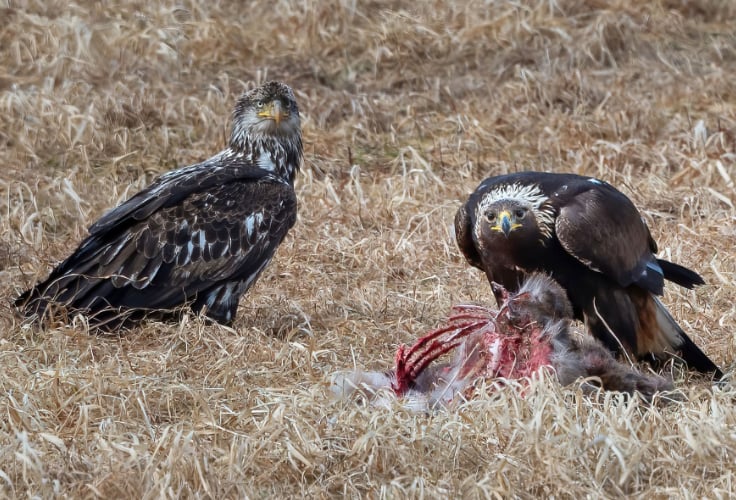
Structural differences are usually the most reliable clue. Bald Eagle shows a larger, more protruding head and massive beak that project well beyond the body in flight, while Golden Eagle has a noticeably smaller head and beak with a more streamlined profile. In flight, the head of a Bald Eagle projects more than half the length of the tail, whereas the head of a Golden Eagle projects less. Bald Eagle also has unfeathered lower legs, while Golden Eagle has fully feathered legs.
Plumage patterns provide additional separation. Immature Bald Eagles show irregular white mottling on the body, underwing coverts, and tail, often in patchy or spotted patterns. Golden Eagle lacks white on the body and shows white restricted to the base of the flight feathers and tail, forming cleaner, sharply defined areas rather than irregular patches.

Golden Eagles may also be confused at a distance with vultures and large buteo hawks. Turkey Vulture is smaller, holds its wings in a more pronounced dihedral, and rocks from side to side while soaring; its underwings appear dark in front and paler along the trailing edge. Golden Eagle soars more steadily, with wings held in a shallow dihedral and without rocking except in strong winds. Black Vulture has a much shorter tail and white limited to the outer primaries.

Large buteos are smaller, broader-winged, and lack the long-winged, long-tailed profile of an eagle. Careful attention to wing shape, tail length, and overall flight style is essential when separating Golden Eagles from vultures and large hawks at a distance.
Where and When to See Eagles in Nebraska
Eagles in Nebraska are most reliably observed near open water and along major river systems, particularly during migration and winter. The Platte River Valley forms the core corridor for Bald Eagle movement and wintering, with numbers building in February and March as ice recedes and spring migration peaks. Winter concentrations are strongest where flowing water prevents freeze-up, including dam outflows, reservoirs, and major river valleys. Golden Eagles are most likely in western Nebraska, especially the Panhandle west of the Sandhills, where they breed and remain year-round, while migrants and wintering birds may appear across central parts of the state and occasionally farther east. Fall migration of Golden Eagles becomes noticeable from late September through October, while Bald Eagles peak later in fall and again in late winter.
During winter, open water determines distribution. Large reservoirs and river valleys that retain unfrozen sections attract feeding eagles, particularly in January and February. Spring brings visible northward movement, especially along the Platte River system and at major lakes, where fish and waterfowl provide abundant prey. Summer eagle viewing is more localized. Bald Eagles nest primarily along river corridors north and east of the Platte River, while Golden Eagles are confined mainly to the Panhandle. In all seasons, elevated vantage points overlooking reservoirs, dam outflows, and broad river valleys offer the best opportunities for observation.
Key Eagle Viewing Locations in Nebraska
Western Nebraska / Panhandle
- Lake McConaughy and Lake Ogallala (Keith County) – Excellent winter Bald Eagle viewing below Kingsley Dam, especially January-February.
- Sutherland Reservoir State Recreation Area (Lincoln County) – Reliable winter site near warm-water discharge areas.
- North Platte National Wildlife Refuge / Lake Alice (Scotts Bluff County) – Productive for wintering Bald Eagles and occasional Golden Eagles.
- Wildcat Hills State Recreation Area (Scotts Bluff County) – Open rangelands, ridges, and escarpments provide suitable Golden Eagle habitat year-round.
- Pine Ridge area (Dawes County) – Cliff-lined ridges and broken terrain in the northwestern Panhandle offer some of the best opportunities to observe Golden Eagles in breeding habitat.
Central Nebraska
- Calamus Reservoir State Recreation Area and Wildlife Management Area (Loup County) – Notable winter concentrations of Bald Eagles.
- Platte River Valley (statewide corridor) – Major migration and winter corridor, especially where open channels persist.
- Niobrara State Park (Knox County) – Good habitat along the Niobrara River Valley for winter Bald Eagles.
Southern Nebraska
- Harlan County Reservoir (Harlan County) – Winter Bald Eagle concentrations when open water is available.
Eastern Nebraska
- Branched Oak State Recreation Area (Lancaster County) – Late winter and early spring Bald Eagle activity near the dam and shoreline.
- Pawnee State Recreation Area (Lancaster County) – Frequently hosts winter Bald Eagles.
- Lake Wanahoo NRD Recreation Area (Saunders County) – Consistent winter Bald Eagle viewing from shoreline trails and platforms.
These locations provide the most dependable opportunities to observe Bald Eagles in winter and migration, while western escarpments, open rangelands, and river valleys in the Panhandle offer the best chances to encounter Golden Eagles year-round.


