
Ohio supports a varied group of herons across its marshes, lakes, rivers, streams, and other wetlands, from widespread Great Blue and Green Herons to secretive bitterns and localized egrets and night herons. The greatest diversity occurs around the extensive wetlands of western Lake Erie, while several species are scarce, highly localized, or appear only as occasional visitors from farther south. This guide covers the herons recorded in Ohio and explains how to identify them, where they occur, and when they are most likely to be seen.
Quick ID: 12 species at a glance
| Species | Length | Field mark | When present |
|---|---|---|---|
| Great Blue Heron | 97 to 137 centimeters (38.2 to 53.9 inches) | distinctive black stripe over the eye | Widespread year-round |
| Great Egret | 80 to 104 centimeters (31.5 to 40.9 inches) | Large, all-white heron with very long legs, a long dagger-like bill, and a tall, slender profile | Summer resident in western Lake Erie; rare to uncommon migrant elsewhere; winter accidental |
| Green Heron | 41 to 46 centimeters (16.1 to 18.1 inches) | rich chestnut neck | — |
| Black-crowned Night Heron | 58 to 66 centimeters (22.8 to 26.0 inches) | glossy black crown and back, pale gray wings, deep red eyes | — |
| Snowy Egret | 56 to 66 centimeters (22.0 to 26.0 inches) | contrasting yellow feet | migration and summer |
| American Bittern | 60 to 85 centimeters (23.6 to 33.5 inches) | long black stripe down the side of the neck | — |
| Least Bittern | 28 to 36 centimeters (11.0 to 14.2 inches) | contrasting dark upperparts with buffy and white underparts | summer resident |
| Yellow-crowned Night Heron | 55 to 70 centimeters (21.7 to 27.6 inches) | glossy black head that contrasts with a white cheek patch and pale crown | summer |
| Little Blue Heron | 56 to 74 centimeters (22.0 to 29.1 inches) | slate-blue adult plumage and entirely white plumage in first-year birds | migration and summer |
| Western Cattle-Egret | 46 to 56 centimeters (18.1 to 22.0 inches) | orange-buff plumes on the head, lower neck, and back | summer resident; uncommon to fairly common migrant; casual to rare elsewhere |
| Tricolored Heron | 60 to 70 centimeters (23.6 to 27.6 inches) | dark slate upperparts, a contrasting white breast and belly | spring and summer |
| Reddish Egret | 70 to 80 centimeters (27.6 to 31.5 inches) | thick, two-toned bill with pink at the base and black toward the tip | — |
Great Blue Heron
Ardea herodias
- Identification: Very large heron with long legs and neck, blue-gray upperparts, a thick dagger-like bill, and a distinctive black stripe over the eye.
- Where found: Widespread year-round across Ohio on lakes, rivers, reservoirs, marshes, and other wetlands, with the largest breeding colonies and summer concentrations along western Lake Erie.
- How to spot: Look for a tall heron standing motionless or wading slowly in shallow water, or flying on deep, deliberate wingbeats with its neck tucked and long legs trailing behind.
- Conservation status: Least Concern (IUCN); common to abundant during migration and summer in Ohio after a major historical recovery, but rare to uncommon during winter.

The Great Blue Heron is Ohio’s largest and most familiar heron, widely encountered around wetlands and other aquatic habitats across the state. It measures 97 to 137 centimeters (38.2 to 53.9 inches) in length and has very long legs, an S-shaped neck, and a heavy, pointed bill. Adults are predominantly blue-gray above, with a streaked white, black, and rusty-brown foreneck and a mostly white head marked by a bold black stripe from above the eye to the back of the head. Elongated head, chest, and back plumes often give adults a shaggy appearance.
Great Blue Herons are often identified by their distinctive posture and deliberate movements. Birds usually stand motionless or wade slowly in shallow water before striking prey with a rapid thrust of the head and neck. Flight is slow and powerful, with deep wingbeats, the neck tucked against the body, and the long legs extended well beyond the tail. Alarmed birds and those around breeding colonies may give loud, harsh, rasping calls. The diet consists mainly of fish but also includes amphibians, reptiles, invertebrates, small mammals, and occasionally birds.
The Great Blue Heron breeds throughout Ohio, but its abundance varies considerably across the state. The largest colonies occur along the Western Basin of Lake Erie, including a major heronry on West Sister Island, and large inland colonies are also known around Buckeye Lake, Senecaville Reservoir, and in Ashtabula County. The species is fairly common to locally common during summer across northern and central Ohio but becomes less numerous toward the counties bordering the Ohio River. Colonies usually occupy tall trees and may occur near feeding areas or in isolated woodlots several miles from major waterways. Most birds return between late February and March, and northward migration peaks from late March through mid-April. Numbers reach their seasonal maximum from mid-July through September, particularly around western Lake Erie, before most birds depart as freezing conditions develop. Small numbers remain throughout winter, when the species is rare to uncommon statewide and most likely to persist during mild weather.
Great Blue Herons are much more numerous in Ohio today than they were during the 19th century, when persecution associated with the millinery trade greatly reduced their populations and eliminated them from parts of the state. Legal protection allowed a substantial recovery during the early 20th century, followed by continued expansion across Ohio. The species is now a fairly common to abundant migrant and summer resident, with breeding colonies scattered throughout the state and especially large concentrations along western Lake Erie. Winter numbers have also increased since the first half of the 20th century, although they vary considerably with weather and fall sharply during severe winters. Large, undisturbed heronries can persist for decades, which makes continued protection from disturbance important for maintaining established breeding colonies.
Great Egret
Ardea alba
- Identification: Large, all-white heron with very long legs, a long dagger-like bill, and a tall, slender profile; adults typically have a yellow bill and black legs outside the breeding season.
- Where found: Widespread during summer in the marshes of western Lake Erie, where it breeds locally, but rare to uncommon elsewhere in Ohio as a migrant and non-breeding summer visitor.
- How to spot: Look for a tall white heron wading slowly or standing motionless in shallow water, or flying with slow, buoyant wingbeats, a tucked-in neck, and long legs trailing behind.
- Conservation status: Least Concern (IUCN); Ohio’s breeding population recovered during the 20th century and is concentrated in the Western Basin of Lake Erie.

The Great Egret is a distinctive breeding heron in Ohio, but its regular nesting distribution is largely restricted to the marshes and heronries of western Lake Erie. Slightly smaller and more slender than the Great Blue Heron, it measures 80 to 104 centimeters (31.5 to 40.9 inches) in length and has very long legs, an S-shaped neck, and a long, sharply pointed bill. Adults are entirely white, with predominantly black legs and a yellow bill outside the breeding season. Breeding birds develop long, delicate plumes on the back and show brighter colors on the bill and bare facial skin.
Great Egrets usually forage by walking slowly through shallow water or standing motionless for long periods before striking prey with a rapid thrust of the neck and bill. Birds also rest and preen on exposed sites such as muskrat houses, trees, and other elevated perches around wetlands. Flight is slow and buoyant, with deep, measured wingbeats, the neck tucked against the body, and the long legs extended well beyond the tail. The species is generally quiet away from nesting colonies, where harsh, guttural calls may be heard. Its diet consists primarily of fish but also includes amphibians, reptiles, small mammals, birds, and aquatic invertebrates.
In Ohio, the Great Egret breeds primarily along western Lake Erie, including West Sister Island and the Sandusky Bay region, and is a common to abundant summer resident in the surrounding marshes. Elsewhere along Lake Erie the species is generally rare to uncommon migrant, while birds in the interior are casual to uncommon migrants and occasional non-breeding summer visitors, particularly in central and northeastern Ohio. The first spring migrants normally arrive around March 20 to 25, and spring migration continues through April and May. Post-breeding movement becomes most evident from mid-August through October, and most birds leave western Lake Erie by early November. Ohio-banded birds have been recovered during winter as far south as Florida, the Caribbean, and Costa Rica. Winter occurrence in Ohio is accidental, although occasional birds have lingered around the western Lake Erie marshes during mild winters.
Great Egrets have undergone a substantial historical recovery in Ohio. Persecution for ornamental breeding plumes reduced the species to a rare and irregular visitor around the beginning of the 20th century, but regular late-summer occurrence resumed during the 1920s. The first documented Ohio nesting occurred along Sandusky Bay in 1940, followed by the establishment of a colony on West Sister Island during the 1940s. The western Lake Erie breeding population subsequently increased, and Great Egrets became common summer residents in the region, although nesting remains highly localized and the species is still much less frequent elsewhere in the state. Protection of established heronries and the extensive marshes of western Lake Erie remains important to the species’ continued presence in Ohio.
Green Heron
Butorides virescens
- Identification: Small, stocky heron with a short neck and legs, a dark cap and back, rich chestnut neck, gray underparts, and a long, straight bill.
- Where found: Widespread during summer across Ohio along small streams, rivers, marshes, ponds, and lakes, with the highest numbers in northeastern Ohio and around western Lake Erie.
- How to spot: Look for a compact heron hunched along a vegetated water’s edge or perched on low branches, or listen for its harsh “skeow” call as it flies from cover.
- Conservation status: Least Concern (IUCN); still a fairly common summer resident in Ohio despite long-term declines associated with wetland drainage and stream channelization.

The Green Heron is among Ohio’s most widely distributed breeding herons, although its small size and secretive habits can make it surprisingly inconspicuous. The species measures 41 to 46 centimeters (16.1 to 18.1 inches) in length and has a compact, stocky build with relatively short legs and a short neck that is often held retracted. Adults have a glossy greenish-black cap and back, dark wings with a greenish or bluish sheen, a rich chestnut neck, and gray underparts. The long, dark bill and hunched posture further distinguish this diminutive heron from the taller wading birds that share Ohio wetlands.
Green Herons usually forage alone along sheltered shorelines, where they stand motionless on low branches, roots, rocks, or at the water’s edge before striking rapidly at passing prey. They favor very shallow water and solid perches rather than the more open wading typical of larger herons. Flight is slow and steady on broad, rounded wings, with the neck normally retracted but sometimes briefly extended. Birds are often first detected by a harsh, descending “skeow” call as they flush from shoreline vegetation. The diet consists mainly of small fish but also includes amphibians, aquatic insects, crustaceans, and other invertebrates.
The Green Heron breeds throughout Ohio along small streams, rivers, marshes, and the vegetated margins of ponds and lakes. The species is most numerous in northeastern Ohio and around western Lake Erie and is less frequent in the intensively farmed western counties and on the unglaciated Allegheny Plateau. Scattered pairs also use urban streams where undisturbed riparian habitat remains. Unlike many larger herons, Green Herons usually nest as isolated pairs in dense shrubs or trees near water rather than in large mixed-species colonies. Most spring migrants arrive from mid- to late April, although occasional birds appear as early as March, and the species is widely distributed by late April or early May. Southward movement begins during late July and is strongest in August, with numbers declining sharply by mid-September. A few birds remain into October or November, while winter occurrence is accidental and the species is not known to overwinter regularly in Ohio.
Green Herons were considered common throughout Ohio in the early 20th century, but their numbers declined substantially after 1940 as wetland drainage and stream channelization reduced suitable habitat, particularly in western Ohio. These declines continued through the 1980s and were also reflected in smaller fall concentrations, which became much less frequent than in earlier decades. The species nevertheless remains a common migrant and fairly common summer resident statewide, with local differences in abundance tied to the availability of suitable wetlands and vegetated shorelines. Protection of small wetlands, natural stream margins, and undisturbed riparian vegetation is therefore particularly important for maintaining Green Heron habitat in Ohio.
Black-crowned Night Heron
Nycticorax nycticorax
- Identification: Stocky, medium-sized heron with a relatively short neck and legs, gray wings, a black crown and back, red eyes, and a stout black bill.
- Where found: Widespread during migration and summer in the marshes of western Lake Erie, where Ohio’s breeding population is concentrated, but much less frequent elsewhere in the state.
- How to spot: Look for a compact heron roosting quietly in trees or dense vegetation by day, or watch and listen for birds leaving roosts with harsh squawks around dusk.
- Conservation status: Least Concern (IUCN); listed as Threatened in Ohio after a major decline and contraction of its breeding population.

The Black-crowned Night Heron is a localized breeding heron in Ohio, with most birds now concentrated around the marshes and islands of western Lake Erie. It measures 58 to 66 centimeters (22.8 to 26.0 inches) in length and has a compact, thick-set build with a relatively short neck and legs. Adults have a glossy black crown and back, pale gray wings, a whitish face and underparts, deep red eyes, and a stout black bill. Long white head plumes develop during the breeding season and add to the distinctive appearance of adults.
Black-crowned Night Herons are most active from evening through early morning and often remain quietly concealed in trees, shrubs, or dense vegetation near water during the day. Birds emerge around dusk to forage along marsh edges, shorelines, and other shallow wetlands, where they take fish, amphibians, crustaceans, insects, reptiles, small mammals, birds, and other available prey. Flight is relatively heavy, with the neck retracted against the shoulders and the legs trailing behind the body. The harsh, guttural “quak” or “wok” call is often an easier way to detect birds moving between roosting and feeding areas, particularly in low light.
In Ohio, the Black-crowned Night Heron is a common migrant and summer resident in the marshes of the Western Basin of Lake Erie, where the state’s principal breeding colonies are located. West Sister Island has historically supported the largest colony, while nesting has also occurred around Sandusky Bay and elsewhere in the western Lake Erie region. Birds usually begin returning in late March and become more numerous by mid-April. Numbers increase again after breeding, and larger concentrations may gather during late summer before gradually declining through September and October; small flocks may remain into November. Along the Central Basin east to Cleveland, the species is an uncommon to fairly common migrant and non-breeding summer visitor, while it is rare to uncommon during migration and casual to rare in summer across most of interior Ohio. Most birds migrate south, but small numbers winter locally around western Lake Erie where open water remains available.
Black-crowned Night Herons were formerly much more widely distributed as breeders in Ohio. The population expanded during the early 20th century, and by the 1940s colonies occurred across much of western and central Ohio. Most inland colonies disappeared during the 1950s and 1960s, leaving breeding increasingly concentrated along western Lake Erie. West Sister Island remained the state’s stronghold, but this major colony also declined substantially during the late 20th century, although some recovery was recorded afterward. The species is now listed as Threatened in Ohio, and its restricted breeding distribution makes the protection of established colonies, roosting sites, and associated Lake Erie wetlands particularly important.
Snowy Egret
Egretta thula
- Identification: Medium-sized, slender white heron with a long black bill, black legs, and contrasting yellow feet; adults develop delicate plumes during the breeding season.
- Where found: Occurs locally during migration and summer in the marshes of western Lake Erie, where a small breeding population occurs; accidental to casual elsewhere in Ohio.
- How to spot: Look for a small, active white egret wading quickly through shallow water and using its conspicuous yellow feet to stir and flush prey.
- Conservation status: Least Concern (IUCN); listed as Endangered in Ohio, where breeding is restricted to a small population in the western Lake Erie region.

The Snowy Egret is a rare and highly localized breeding heron in Ohio, where a small population occurs around western Lake Erie. Smaller and more delicately built than the Great Egret, it measures 56 to 66 centimeters (22.0 to 26.0 inches) in length and has a slender body, long legs, a thin neck, and a fine, pointed bill. Adults are entirely white, with a black bill, black legs, and contrasting yellow feet that provide one of the best identification features. Breeding birds also develop long, wispy plumes on the breast and back and a short, shaggy crest on the nape.
Snowy Egrets are active feeders and usually forage by walking rapidly through shallow water, with quick dashes, abrupt turns, and sudden strikes at prey. Birds frequently use their bright feet to stir the substrate and flush small animals into view, a behavior that can help distinguish them from other large white wetland birds. They may also flick their wings, hop, or make short runs while feeding. Flight is buoyant, with deep wingbeats, the neck tucked against the body, and the legs trailing behind. The diet consists mainly of small fish and aquatic invertebrates, including crustaceans and insects, with amphibians and other small vertebrates taken opportunistically.
In Ohio, the Snowy Egret is a rare to uncommon migrant and summer resident in the marshes of the Western Basin of Lake Erie. The species first nested in the state in 1983, when two nests were discovered on West Sister Island, and a small breeding population subsequently became established in the region. Birds usually arrive between late April and early May, although occasional individuals appear earlier, and small numbers remain through the breeding season. After young fledge in late July or August, small flocks may gather in the western Lake Erie marshes before the breeding population departs by late September; a few migrants remain into mid-October. Away from western Lake Erie, Snowy Egrets are accidental to casual migrants and non-breeding summer visitors, with most records involving only one or two birds.
Snowy Egrets have always been scarce in Ohio, although their occurrence has changed considerably over time. The species was probably only a casual late-summer visitor during the 19th century and became exceptionally scarce after plume hunting severely reduced populations across North America. Records gradually increased during the 20th century, particularly along western Lake Erie, where summering birds appeared regularly before nesting was first confirmed in 1983. Numbers in this region increased after 1980, but the species remains a rare and geographically restricted breeder in the state. The Snowy Egret is currently listed as Endangered in Ohio, which makes the protection of its western Lake Erie breeding sites and associated marsh habitat especially important.
American Bittern
Botaurus lentiginosus
- Identification: Medium-large, heavily streaked brown heron with a stout body, thick neck, relatively short legs, and a distinctive dark stripe running down the side of the neck.
- Where found: Occurs locally during summer in Ohio, primarily in the marshes of western Lake Erie and the extreme northeastern counties, with migrants scarce elsewhere.
- How to spot: Listen for its deep, booming territorial calls in spring or scan dense marsh vegetation carefully for a striped bird standing motionless among the reeds.
- Conservation status: Least Concern (IUCN); listed as Endangered in Ohio after significant declines caused primarily by the loss and degradation of large wetlands.
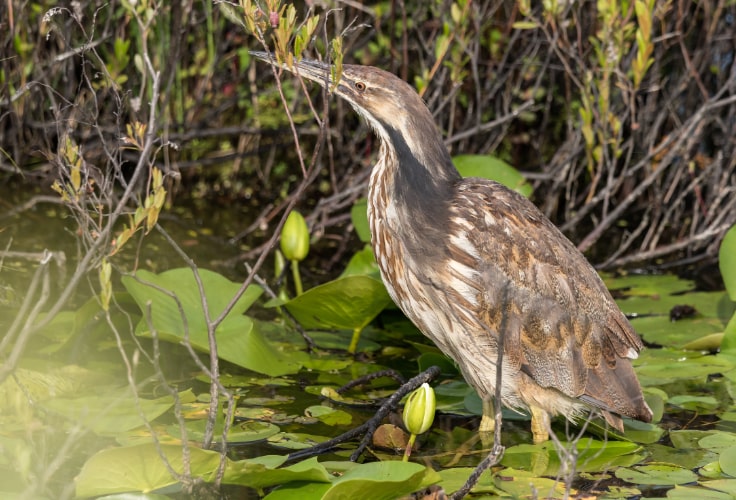
The American Bittern is a rare and highly localized breeding heron in Ohio, where it depends on some of the state’s remaining large, undisturbed marshes. This species measures 60 to 85 centimeters (23.6 to 33.5 inches) in length and has a compact, thick-bodied profile with relatively short legs, a stout neck, and a broad body. Its plumage combines brown, buff, and white, with fine dark markings above and bold vertical streaking below that provide excellent camouflage among marsh vegetation. A long black stripe down the side of the neck is a particularly useful identification feature.
American Bitterns are secretive birds that are usually detected by sound or subtle movement within dense vegetation. They forage alone by standing motionless or taking very slow, deliberate steps through shallow water before striking at insects, amphibians, small fish, crayfish, and other prey. When alarmed, a bird may stretch its neck vertically and point its bill upward, allowing its streaked plumage to blend with surrounding reeds. Males advertise their presence in spring with a distinctive series of deep, resonant booming notes that can carry across a large marsh and are often the easiest way to locate the species.
In Ohio, the American Bittern is now concentrated primarily in the extensive marshes bordering western Lake Erie, with a small population also persisting in the extreme northeastern counties. Occasional breeding has occurred elsewhere, including at Big Island Wildlife Area in Marion County, but the species is an accidental to casual non-breeding summer visitor across most of the state. Nesting birds favor large wetlands with dense emergent vegetation broken by small pools and occasionally use bogs and extensive wet meadows. Spring migrants usually arrive between early and mid-April and are most often encountered from mid-April through early May. Fall movement begins by late August but is most evident from mid-September through early October, with occasional birds lingering into November. Winter occurrence is casual and is concentrated mainly in the western Lake Erie marshes of Ottawa and Lucas counties.
American Bitterns have declined substantially in Ohio since the early 20th century. The species once bred locally wherever suitable marshes and bogs occurred, but widespread drainage and filling of wetlands eliminated much of its habitat, particularly in the interior counties. Remaining wetlands are often too small or fragmented for nesting birds, while spring and summer water drawdowns can further reduce the suitability of otherwise intact marshes. Breeding populations had largely disappeared from interior Ohio by the 1960s, and numbers also fell sharply along western Lake Erie. Migrant numbers declined along with breeding populations throughout the Great Lakes region, and the species is now listed as Endangered in Ohio.
Least Bittern
Botaurus exilis
- Identification: Very small heron with a compact body, short neck, thin bill, and contrasting dark upperparts with buffy and white underparts; males are darker than females.
- Where found: Occurs locally during summer, mainly in the marshes of western Lake Erie, rare and highly localized elsewhere in Ohio, where it depends on dense emergent wetland vegetation.
- How to spot: Listen for quiet, cuckoo-like calls around dawn or dusk, or watch for a tiny heron clambering through cattails or briefly fluttering low over the marsh.
- Conservation status: Least Concern (IUCN); listed as Threatened in Ohio after serious declines, particularly in interior wetlands affected by drainage and habitat loss.

The Least Bittern is Ohio’s smallest heron and a highly secretive breeding bird of dense marshes, with its strongest remaining population along western Lake Erie. It measures 28 to 36 centimeters (11.0 to 14.2 inches) in length and has a compact body, short neck, and slender yellow bill. Adult males have a dark greenish-black crown and back, rich chestnut wings, and buffy and white underparts, while females have a browner, more chestnut appearance. Its tiny size and contrasting dark back and pale underparts help distinguish it from other herons when a bird emerges from cover.

Least Bitterns spend most of their time concealed within dense emergent vegetation, where they climb among cattails and reeds by grasping stems with their long toes. Birds forage from vegetation or along small pools, taking small fish, insects, amphibians, and crustaceans with quick strikes. When disturbed, they usually make a short, weak flight low over the marsh before dropping back into cover. Their quiet, cuckoo-like calls are most often heard around dawn or dusk and can reveal birds that otherwise remain hidden. Occasionally, a Least Bittern may perch near the tops of cattails or feed along the exposed edge of a small pool.
In Ohio, the Least Bittern is an uncommon summer resident in the marshes of the Western Basin of Lake Erie and rare and highly localized elsewhere. Small breeding populations occur in scattered wetlands across northeastern, central, and southwestern Ohio, including the Mentor Marsh area and sites south to Warren and Licking counties, while the species is largely absent from the unglaciated Allegheny Plateau. Breeding birds favor marshes with dense emergent vegetation and standing water, and suitable western Lake Erie wetlands may support several pairs. Most birds arrive between late April and early May, and northward migration continues into early June. Fall movement begins in late July and is strongest from mid-August into early September. Most birds depart by early October, although occasional stragglers remain later.
Least Bitterns were considerably more numerous and widespread in Ohio during the early 20th century, when some large inland marshes supported substantial breeding populations. Numbers began to decline locally by the 1930s and fell particularly sharply between the 1930s and 1960s as wetland drainage eliminated or degraded many breeding sites. Populations also decreased in the western Lake Erie marshes, although this region remains the species’ principal stronghold in the state. Inland populations are now small and scattered, with only a few breeding pairs at most occupied sites. The Least Bittern is currently listed as Threatened in Ohio, and the preservation of marshes with suitable water levels and dense emergent vegetation is especially important for its continued presence in the state.
Yellow-crowned Night Heron
Nyctanassa violacea
- Identification: Medium-sized, dark-bodied heron with a stocky build, heavy bill, bluish-gray plumage, and a bold black-and-white head pattern in adults.
- Where found: Occurs in Ohio during summer, with most breeding records from the southern half of the state along shallow, rocky streams.
- How to spot: Look for a stocky heron walking slowly along stream margins and shallow water, often around dusk, where it searches primarily for crayfish and other aquatic prey.
- Conservation status: Least Concern (IUCN); Ohio supports a small, localized breeding population that expanded into the state during the 20th century but later declined.

The Yellow-crowned Night Heron is a rare and highly localized breeding heron in Ohio, near the northern edge of its more regular inland range. The species measures 55 to 70 centimeters (21.7 to 27.6 inches) in length and has a compact, thickset body, a large head, and a stout bill. Adults are mostly bluish gray, with darker patterned wings and a glossy black head that contrasts with a white cheek patch and pale crown. Breeding birds develop long, straw-colored head plumes, which make the distinctive black-and-white facial pattern even more conspicuous.
Yellow-crowned Night Herons forage with slow, deliberate movements, walking along water margins with the body angled forward and pausing frequently to watch for prey. Ohio birds are particularly associated with shallow, rocky streams, where they feed mainly on crayfish and small fish. Birds may forage during daylight but are also active around dusk and after dark. Flight is steady and unhurried, with broad, rounded wings, the neck retracted, and the legs extending beyond the tail. Their calls are generally harsh and squawking and are most likely to be heard around nesting sites or when birds are disturbed.
In Ohio, the Yellow-crowned Night Heron is a rare to uncommon and very locally distributed migrant and summer resident, with most breeding records concentrated in the southern half of the state. Long-established nesting populations have occurred around Columbus and Dayton, while breeding has also been documented at scattered sites elsewhere and occasionally as far north as Lake Erie. Most Ohio nests involve isolated pairs or small colonies, and birds use settings ranging from secluded woods and undisturbed parks to trees in residential neighborhoods near suitable feeding habitat. Returning birds may appear from late March or early April, with most breeding adults present by late April. Young generally fledge by early August, and small post-breeding groups may appear later that month. Most birds leave during September, although occasional individuals remain into the first half of October. Away from established or suspected breeding areas, the species is an accidental visitor, most often reported during spring or post-breeding dispersal.
Yellow-crowned Night Herons were unknown in Ohio until nesting was first documented at Indian Lake in 1928. A northward expansion followed during the 1940s and 1950s, when records increased and small breeding colonies became established at Cincinnati, Dayton, and Columbus. This expansion slowed during the 1960s, and the statewide population subsequently declined as some colonies disappeared and observations away from established breeding areas became less frequent. The species now maintains only a small and scattered breeding population, although some urban nesting sites have proved remarkably persistent. Its continued presence in Ohio depends on localized nesting areas and nearby shallow streams that provide suitable feeding habitat.
Little Blue Heron
Egretta caerulea
- Identification: Medium-sized, slender heron with long legs and a straight bill, showing slate-blue adult plumage and entirely white plumage in first-year birds.
- Where found: Occurs locally during migration and summer, mainly in the marshes of western Lake Erie, where it nests in small numbers; casual to rare elsewhere in Ohio.
- How to spot: Look for a solitary, slow-moving heron stalking shallow water with deliberate steps; entirely white first-year birds may be more conspicuous than dark adults.
- Conservation status: Least Concern (IUCN); rare in Ohio, where a small breeding presence developed along western Lake Erie after earlier periods of irregular post-breeding invasions.

The Little Blue Heron is a rare and localized summer heron in Ohio, with its most regular occurrence in the marshes of western Lake Erie. It measures 56 to 74 centimeters (22.0 to 29.1 inches) in length and has a slender body, relatively long neck and legs, and a straight, pointed bill. Adults are predominantly slate blue with a contrasting purplish head and neck and a bicolored bill that is pale bluish at the base and black at the tip. First-year birds are entirely white, an unusually distinctive age-related difference that can make young Little Blue Herons look very different from adults.

Little Blue Herons usually forage alone or in small groups, walking slowly through shallow water with a deliberate pattern of steps and pauses before making precise strikes at prey. Their patient feeding style contrasts with the more active movements of some small white egrets, an especially useful distinction when identifying white first-year birds. Flight is unhurried, with rounded wings and measured wingbeats, sometimes interrupted by brief glides. The species feeds on small fish, amphibians, crustaceans, and other aquatic invertebrates.
In Ohio, the Little Blue Heron is a rare migrant and summer resident in the marshes of the Western Basin of Lake Erie. Small numbers have summered there regularly since the late 1960s, and nesting was first confirmed in 1983, when two pairs were discovered on West Sister Island. Elsewhere in the state, the species is a casual to rare spring migrant and a casual non-breeding summer and fall visitor, with recent records generally involving only one or two birds. Most spring arrivals occur between late April and early May, and birds away from western Lake Erie usually depart again by late May. Post-breeding visitors may begin to appear by mid-July, with most records from late July through August. Numbers decline rapidly during September, although occasional individuals remain into early October.
Little Blue Herons have a long history of irregular occurrence in Ohio. After becoming scarce during the era of intensive plume hunting, the species returned as a regular late-summer visitor during the 1920s and produced several major post-breeding invasions during the 1930s, when birds appeared throughout the state. These large movements diminished during subsequent decades and have not occurred since the mid-1960s. At the same time, the species developed a small summer presence along western Lake Erie and eventually began nesting there. Little Blue Herons remain rare in Ohio today, but the western Lake Erie marshes continue to provide the state’s most consistent habitat for this primarily southern heron.
Western Cattle-Egret
Ardea ibis
- Identification: Small, stocky white heron with a short, thick neck, relatively short legs, and a distinctive head-pumping walk; breeding birds show orange-buff plumes.
- Where found: Occurs around western Lake Erie during summer, where it nests, and uncommon to fairly common there during migration; casual to rare elsewhere in Ohio.
- How to spot: Look for small groups walking through pastures, grasslands, wet meadows, or recently mowed fields, often well away from the water where most other herons forage.
- Conservation status: Least Concern (IUCN); colonized Ohio during its 20th-century North American expansion, with the state population apparently stabilizing after 1980.

The Western Cattle-Egret is a relatively recent addition to Ohio’s heron fauna, reaching the state during its remarkable 20th-century expansion across North America. The species measures 46 to 56 centimeters (18.1 to 22.0 inches) in length and has a compact, stocky build with relatively short legs, a thick neck, and a slightly hunched posture. Adults are predominantly white, with a yellow bill outside the breeding season. Breeding birds develop conspicuous orange-buff plumes on the head, lower neck, and back, which make them particularly distinctive among Ohio’s white herons.
Western Cattle-Egrets differ from most Ohio herons in their strong preference for feeding on dry or damp ground rather than in open water. Birds walk or run through fields with a characteristic head-pumping motion and often forage in loose groups. In Ohio, spring birds favor wet meadows and pastures, while late-summer and fall flocks around western Lake Erie use dry grasslands and recently mowed fields where insects are abundant. The diet consists mainly of insects such as grasshoppers and flies, supplemented by spiders, frogs, and other small animals. Flight is direct, with relatively rapid wingbeats and the neck tucked against the body.
In Ohio, the Western Cattle-Egret is most regular around the Western Basin of Lake Erie, where the species is an uncommon to fairly common migrant and uncommon summer resident. Nesting was first confirmed on West Sister Island in 1978, and small numbers later bred near Sandusky. Spring migrants may arrive during the first half of April but are most often encountered from late April through mid-May. Breeding birds remain concentrated around western Lake Erie during summer and are seldom reported elsewhere in June or July. After young fledge, birds become more conspicuous during August, and the local population may gather into flocks that forage in fields around the Western Basin during late August and early September. Most depart by early October, although occasional birds linger into November or early December. Elsewhere in Ohio, the species is a casual to rare migrant and non-breeding summer visitor.
Western Cattle-Egrets were unknown in Ohio until the first state record near Columbus in 1958. Sightings increased during the 1960s as the species expanded rapidly across North America, and by the 1970s it had established a regular pattern of occurrence in Ohio, particularly along western Lake Erie. Breeding followed in the late 1970s, but the state population remained small, and the number of observations began to decline somewhat during the 1980s. Populations subsequently appeared to stabilize, with western Lake Erie remaining the center of occurrence in Ohio. The species’ unusual use of agricultural fields, pastures, and other open upland habitats distinguishes it ecologically from the state’s more wetland-dependent herons.
Tricolored Heron
Egretta tricolor
- Identification: Medium-sized, slender heron with dark slate upperparts, a contrasting white breast and belly, and a long, narrow neck and bill.
- Where found: Occurs rarely during spring and summer in the marshes of western Lake Erie, particularly in Ottawa and Lucas counties, and accidental elsewhere in Ohio.
- How to spot: Look for a slim, dark heron with a conspicuous white belly actively stalking shallow water with quick steps, sharp turns, and occasional short runs.
- Conservation status: Least Concern (IUCN); a rare non-breeding visitor to Ohio, with most records concentrated around the western Lake Erie marshes.

The Tricolored Heron is one of Ohio’s rarest regularly occurring herons, reaching the state mainly as a non-breeding visitor to the marshes of western Lake Erie. It measures 60 to 70 centimeters (23.6 to 27.6 inches) in length and has a slender build, a long S-shaped neck, and a narrow, pointed bill. Adults have slate-gray to bluish-gray upperparts that contrast sharply with a white breast and belly, creating a distinctive two-toned appearance. Breeding birds may also show white head plumes and mauve to violet tones on the neck and back.
Tricolored Herons are active feeders that usually stalk small fish in shallow water. Their deliberate steps can suddenly change into quick runs, tight turns, and abrupt stops as they pursue prey, sometimes with brief movements of the wings. Flight is steady and direct, with the neck retracted and the legs trailing behind the body. The diet consists primarily of small fish, with insects, crustaceans, and amphibians taken less frequently.
In Ohio, the Tricolored Heron is a casual to rare spring migrant and non-breeding summer visitor along the Western Basin of Lake Erie, particularly in the marshes of Ottawa and Lucas counties. Birds usually appear during the second half of May, although occasional individuals have arrived in April, and summer visitors may remain into September. Individuals have occasionally visited the West Sister Island heronry, but nesting has never been confirmed in the state. Away from western Lake Erie, the species is accidental, with only scattered records along the central and eastern Lake Erie shoreline and at a few inland locations.
The Tricolored Heron was first documented in Ohio in 1954, when a bird collected in Ashtabula County represented an exceptionally unusual occurrence in the Great Lakes region. Records remained extremely sporadic until the 1970s, when the species began to wander inland more frequently from its primarily coastal range. By the end of that decade, Tricolored Herons had become rare but increasingly regular non-breeding summer visitors to the western Lake Erie marshes. This pattern reflects the species’ tendency to disperse northward and inland after breeding, sometimes over considerable distances. Despite this increased occurrence, the Tricolored Heron remains a rare visitor in Ohio and is still exceptional away from western Lake Erie.
Reddish Egret
Egretta rufescens
- Identification: Medium-large, slender heron with long legs and a thick, two-toned bill, occurring in a dark morph with a gray body and cinnamon head and neck or an entirely white morph.
- Where found: Occurs irregularly in Ohio as a vagrant far outside its normal coastal range, with only occasional inland appearances expected during seasonal dispersal.
- How to spot: Look for an unusually active heron running, hopping, turning abruptly, and flicking or spreading its wings while pursuing fish in shallow water.
- Conservation status: Near Threatened (IUCN); an exceptional vagrant in Ohio with no regular population or breeding presence in the state.

The Reddish Egret is the least expected of Ohio’s herons, occurring only as an exceptional vagrant far beyond its normal coastal range. This species measures 70 to 80 centimeters (27.6 to 31.5 inches) in length and has a slender build, long legs, and a thick, distinctly two-toned bill. Dark-morph adults have a slate-gray body with a rich cinnamon to chestnut head and neck, while white-morph birds are entirely white. Both forms share the same distinctive structure and bill pattern, with pink at the base and black toward the tip.

Reddish Egrets are most readily identified by their unusually animated feeding behavior. Birds pursue small fish through shallow water by running, hopping, making sudden turns, and repeatedly flicking or spreading their wings. They may also stir the bottom with their feet or hold their wings out to shade the water while searching for prey. Flight is strong and direct, with steady wingbeats and the neck usually retracted. The diet consists almost entirely of small fish, which are normally captured in very shallow water.
The Reddish Egret has no regular seasonal presence in Ohio and occurs only as a vagrant during movements that occasionally carry individuals far inland and north of the species’ normal range. Spring and summer wandering, including post-breeding dispersal, can bring birds to inland locations as far north as Ohio. A particularly notable state occurrence came in 2014, when a white-morph individual was documented repeatedly during early September in Delaware and Union Counties. Such records are exceptional, and the species has no known breeding population or predictable area of occurrence within the state.
Where and When to See Herons in Ohio
Ohio offers its greatest diversity of herons from spring through early fall, with the extensive marshes of western Lake Erie providing the best opportunities to see multiple species. Great Blue Herons and Green Herons are widespread across the state, while Great Egrets, Black-crowned Night Herons, and several scarcer species are much more strongly concentrated around the Western Basin. Large marshes in Ottawa and Lucas counties and the islands and wetlands around Sandusky Bay are particularly important for breeding, feeding, and post-breeding gatherings.
Spring migration begins in March and builds through April and May as resident breeders return and occasional southern visitors reach the state. Summer offers the best chance to find localized breeding species such as Least Bitterns and American Bitterns, while late summer can bring dispersing Little Blue, Tricolored, and other southern herons northward. Numbers decline through September and October, and winter diversity is much lower, although Great Blue Herons remain scattered across Ohio and a few other species occasionally persist where open water and suitable feeding habitat remain.
For a broader perspective, see our guide to the types of herons in North America, and explore the Birds of Ohio and Birds of the United States pages for additional regional and national bird guides.

Raeesah Habib is a South African conservationist and freelance writer. She completed a diploma in nature conservation in 2016 through the University of South Africa (UNISA). During her internship, she spent a year working with wattled cranes on the Wattled Crane Recovery Programme (WCRP).
The program aims to prevent the local extinction of the wattled crane in Southern Africa through the release of captive-reared individuals into critically endangered wild populations across the country. During her time at the research facility, she was also responsible for the general monitoring and husbandry of other magnificent species, including blue cranes and secretary birds.
Following her internship, she was fortunate to have worked in some spectacular wilderness areas across the country, including the Cradle of Humankind, the Kruger National Park, and the northern Zululand. As a wildlife monitor, her responsibilities included conducting bird point counts. Birds surveys are a useful means to collect data on the avian populations in an area. The data helps researchers gain an understanding of population trends and ecosystem health.
When not in the field, Rae enjoys writing to share her passion, knowledge, and experiences with others.


