
North Dakota is home to a varied mix of owls, with 12 species documented across the state’s forests, open prairies, wooded river valleys, wetlands, farm country, and winter fields. Some are widespread year-round residents, while others are localized breeders, open-country specialists, or rare northern visitors that appear mainly in winter. This guide focuses on the owls most likely to be encountered in North Dakota, with practical notes on identification, habitat, regional distribution, seasonal occurrence, and conservation status.
Great Horned Owl
Bubo virginianus
- Identification: Large, powerful owl with broad wings, prominent ear tufts, striking yellow eyes, a white throat patch, and mottled brown, buff, gray, and black plumage.
- Where found: Widespread year-round across North Dakota in groves, tree thickets, forest tracts, and open prairie, marsh, and cropland landscapes with nearby nesting or roosting sites.
- How to spot: Listen at dusk or night for deep, rhythmic hoots, or watch for a thick-bodied owl perched upright on exposed limbs, poles, or field-edge trees.
- Conservation status: Least Concern (IUCN); common and adaptable in North Dakota.
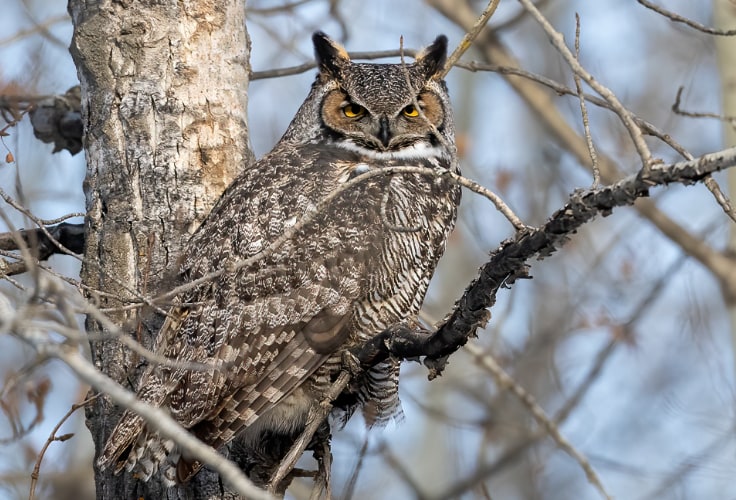
The Great Horned Owl is North Dakota’s most consistently expected owl and one of the state’s most adaptable nocturnal raptors. It measures 46 to 63 centimeters (18.1 to 24.8 inches) in length and has a large, thick-bodied build, broad wings, a broad head with prominent ear tufts, and large yellow eyes set in a strong facial disc. Its plumage is heavily mottled brown, buff, gray, and black, with a white throat patch that often stands out in low light. This powerful structure and cryptic pattern suit a resident predator that uses both wooded cover and open foraging country across the state.
Great Horned Owls are most often detected by their deep, rhythmic hoots, usually given at dusk or at night. Birds perch upright on exposed branches, poles, or other elevated sites and scan open ground for prey. Their flight is strong and deliberate, with deep wingbeats and short glides. They hunt mainly as nocturnal perch predators and take a broad range of prey, including mammals, birds, and other vertebrates. In northwestern parts of the state, wetland birds such as coots and rails can form an especially important part of the diet.
The Great Horned Owl is a year-round resident that breeds across much of North Dakota. It is common in the Turtle Mountains, fairly common on the Southern Drift Plain and Little Missouri Slope, and fairly common locally on the Northwestern Drift Plain, Missouri Coteau, Coteau Slope, and Missouri Slope. It is more local in the Agassiz Lake Plain Region and on the Northeastern Drift Plain. The species is a characteristic inhabitant of groves, tree thickets, and larger forest tracts, but it often forages over adjoining prairie, marsh, and cropland. It usually nests in old hawk or crow nests in trees, including nests originally built by Cooper’s, Red-tailed, Swainson’s, and Ferruginous Hawks, and cottonwoods are among the trees used for nesting in North Dakota. Unusual documented nest sites in the state include a hollow dead cottonwood stump, a downtown building ledge at Kenmare, and the floor of an abandoned barn in McIntosh County.
The Great Horned Owl remains widespread and adaptable in North Dakota. The species benefits from landscapes that combine trees or other nesting structures with open foraging areas, including prairie, marsh, and cropland. Its flexible use of abandoned raptor nests, tree cavities, buildings, and barns helps explain why it remains the owl most likely to be heard or seen across North Dakota.
Eastern Screech-Owl
Megascops asio
- Identification: Small, stocky owl with prominent ear tufts, yellow eyes, a short tail, and gray or rufous bark-patterned plumage marked with fine bars, streaks, and spots.
- Where found: Year-round but localized in North Dakota, mainly in wooded areas, groves, shelterbelts, riparian corridors, and towns with mature trees, especially in the eastern part of the state.
- How to spot: Listen at night for a monotonic trill or descending whinny, or check tree cavities and bird boxes in mature wooded areas.
- Conservation status: Least Concern (IUCN); uncommon in North Dakota, with breeding tied to suitable tree cavities and nest boxes.
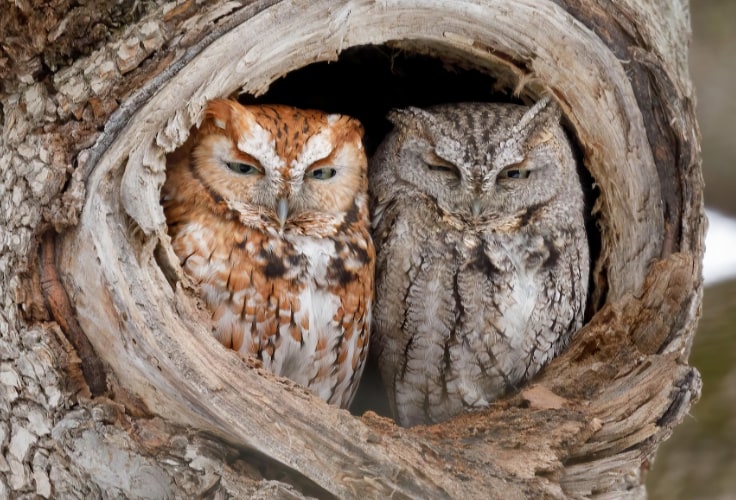
The Eastern Screech-Owl is a small, local resident owl in North Dakota, where it reaches the northwestern edge of its broader eastern North American range. The species measures 16 to 25 centimeters (6.3 to 9.8 inches) in length and has a compact, stocky body, a broad head with prominent ear tufts, bright yellow eyes, and a short, square tail. Its plumage is intricately marked with bars, streaks, and spots that blend well with tree bark. Most North Dakota birds appear to be gray morphs, but rufous birds also occur.
In the field, Eastern Screech-Owls are more often heard than seen. Their main calls are a steady, monotonic trill and a descending whinny, both given at night from wooded areas, shelterbelts, and mature trees around towns. Birds roost quietly by day in cavities or dense cover and may sometimes sit at the entrance of a cavity or nest box. They hunt from low perches and take a varied diet of invertebrates, small mammals, birds, and other small vertebrates, using short, direct flights through the lower canopy and along woodland edges.
The Eastern Screech-Owl is present throughout the year in North Dakota, but it is localized and occurs mainly in the state’s more wooded eastern and central regions. It is most likely to be found in wooded areas, riparian corridors, shelterbelts, and towns with mature trees. Its breeding range is local in the Agassiz Lake Plain Region, Turtle Mountains, Northeastern Drift Plain, Southern Drift Plain, and Northwestern Drift Plain, and it is rare and local on the Missouri Coteau and in the Southwestern Slope Region. Definite nesting or young have been reported from Grand Forks, Cass, Richland, Barnes, LaMoure, Stutsman, Kidder, Burleigh, and Ward counties. The species uses groves, semiopen stands of trees, and the margins of larger woodlands, nesting in tree cavities or bird boxes with suitably sized entrances.
The Eastern Screech-Owl remains uncommon and localized in North Dakota, with its distribution largely limited by the availability of mature trees, wooded corridors, and suitable nesting cavities within an otherwise open prairie landscape.
Short-eared Owl
Asio flammeus
- Identification: Medium-sized owl with a pale facial disc, black-rimmed yellow eyes, mottled brown-and-buff plumage, streaked underparts, and broad wings with dark wrist marks.
- Where found: Year-round but localized in North Dakota, mainly in large open grasslands, prairie, wetlands, hayland, retired cropland, and CRP fields.
- How to spot: Search open grasslands and wetlands at dawn or dusk for a buoyant, moth-like owl flying low over vegetation.
- Conservation status: Least Concern (IUCN); local and variable in North Dakota, with populations affected by grassland loss, wetland degradation, mowing, prey cycles, and broader long-term declines.

The Short-eared Owl is one of the most visible owls of North Dakota’s open country because it often hunts over grasslands and wetlands at dusk. It measures 34 to 43 centimeters (13.4 to 16.9 inches) in length and has a medium-sized body, a rounded head, very small ear tufts that are often hidden, and yellow eyes set in a pale facial disc with dark rims. Its upperparts are mottled brown and buff, and the whitish to rusty underparts are streaked with brown. In flight, the long, broad wings show a dark comma-like mark near the wrist, a useful field mark when a bird is quartering low over prairie.
Compared to other owl species, Short-eared Owls are often detected in flight rather than by voice. They fly low over open vegetation with buoyant, irregular, moth-like wingbeats and frequent changes in direction, especially near dawn and dusk. Birds may also perch directly on the ground in open habitat. They hunt mainly by coursing over grassland and wetland edges and take small mammals as primary prey, especially meadow voles. Their numbers can change sharply from year to year as vole populations rise and fall, and breeding birds may be present in scattered pairs during high-prey years but rare or absent when prey is low.
In North Dakota, the Short-eared Owl occurs across much of the year and may be resident, migratory, or present only during winter in some areas. It is fairly common locally on the Northwestern Drift Plain and Missouri Coteau, and uncommon and local elsewhere in the state. The species uses large expanses of open grassland and wetlands, including native prairie, hayland, retired cropland, small-grain stubble, shrub-steppe, mesic prairie, marshes, wet-meadow zones, and CRP grassland. Nests are placed on the ground in dry uplands, usually in fairly dense herbaceous cover within prairie, wet-meadow zones, hayfields, retired cropland, or stubble fields.
The Short-eared Owl remains a local and variable breeder in North Dakota, and its abundance can fluctuate strongly with small-mammal cycles and its nomadic movements. Breeding populations appear to have been more widespread and numerous historically, when extensive native prairie covered more of the state. The main regional pressures are loss of grassland, loss of grassland-wetland complexes, wetland drainage and consolidation, early cutting or mowing that can destroy nests or young, reduced prey availability from insecticides or rodenticides, and collisions with vehicles or other man-made structures. The species depends on large, open habitats that retain suitable nesting cover and support strong vole populations.
Burrowing Owl
Athene cunicularia
- Identification: Small, long-legged, ground-dwelling owl with a rounded head, bright yellow eyes, pale eyebrows and throat, spotted brown upperparts, and barred buff-white underparts.
- Where found: Local during summer in North Dakota, mainly in open short-grass and mixed-grass prairie, especially where prairie dog or ground-squirrel burrows are available.
- How to spot: Scan burrow mounds, fence posts, and low open ground for a small upright owl active by day as well as at dusk.
- Conservation status: Least Concern (IUCN); declining in North Dakota, with threats including grassland loss, removal of burrowing mammals, pesticides, climate-related range loss, and wind-turbine collisions.

The Burrowing Owl is a very distinctive prairie owl because it lives on the ground and nests underground rather than in trees. The species measures 19 to 25 centimeters (7.5 to 9.8 inches) in length and has a small, lean body, long, lightly feathered legs, a rounded head without ear tufts, and bright yellow eyes set beneath pale eyebrows. Its brown upperparts are spotted with buff, and the buff-white underparts are barred, while the pale throat and upright posture help separate it from other small owls in open country.
In the field, Burrowing Owls are often seen standing alert at burrow entrances, on low mounds, or on fence posts in open prairie. They may be active during the day as well as at dawn and dusk, and they fly low over the ground with slow wingbeats and short glides. Their calls include soft cooing notes and raspy alarm calls near nest sites. They hunt insects and other small prey on foot or in short flights, and small mammals form an important part of the diet. In North Dakota, deer mice often dominate the vertebrate prey, while sagebrush voles and meadow voles can also contribute depending on the surrounding agricultural landscape.
Within North Dakota, the Burrowing Owl occurs mainly from April through September and is best treated as a localized summer breeder. It is fairly common on the Northwestern Drift Plain, uncommon but locally fairly common on the Missouri Coteau and in the Southwestern Slope Region, uncommon on the Southern Drift Plain, and rare in the Agassiz Lake Plain Region and on the Northeastern Drift Plain. Important areas include the glacial outwash plain of Kidder County, parts of the Coteau Slope in Burleigh, Emmons, Logan, and McIntosh Counties, the Missouri Slope in southeastern Morton and eastern Sioux counties, and portions of Bowman and Slope counties. The species is especially characteristic of heavily grazed mixed-grass prairie and closely cropped prairie dog towns, and it often concentrates where colonies of Black-tailed Prairie Dogs or Richardson’s Ground Squirrels provide burrows.
The Burrowing Owl is declining in North Dakota and appears to have been more widespread and numerous historically. Its regional persistence depends on open grasslands with short vegetation and suitable burrows, especially abandoned dens of prairie dogs and ground squirrels, though badger dens and occasionally self-dug burrows may also be used. Major pressures include grassland loss, removal of prairie dogs or ground squirrels, deterioration of unused burrow systems, taller vegetation after burrowing mammals disappear, reduced prey availability from pesticides, direct harm from improper pesticide use, projected climate-related range loss, and collisions with wind turbines.
Snowy Owl
Bubo scandiacus
- Identification: Large white owl with yellow eyes, a rounded head, feathered legs and feet, and variable dark barring that is heaviest on females and young birds.
- Where found: Occurs in North Dakota mainly during winter, using open country such as agricultural fields, prairie, and other broad treeless landscapes.
- How to spot: Search open areas by day for a pale owl perched on the ground, fence posts, hay bales, or other low vantage points.
- Conservation status: Vulnerable (IUCN); rare but regular winter visitor in North Dakota, with global declines linked to prey cycles, Arctic change, and winter mortality risks.

The Snowy Owl is North Dakota’s most striking winter owl and one of the few owls in the state that is often searched for in daylight. It measures 52 to 71 centimeters (20.5 to 28.0 inches) in length and has a large, powerful body, a rounded head, bright yellow eyes, and dense feathering on the legs and feet. Its plumage is mostly white with variable dark barring across the head, body, wings, and tail. Older males can appear nearly pure white, while females and younger birds usually show heavier dark barring.
In the field, Snowy Owls are usually detected by sight rather than sound. Birds perch conspicuously on the ground, fence posts, hay bales, utility poles, or other low vantage points, where their pale plumage stands out against open winter landscapes. They are active by day as well as at dawn and dusk, and their flight is broad-winged, buoyant, and low over open ground. On their Arctic breeding grounds, Snowy Owls give deep hoots, barks, and other calls, but wintering birds in North Dakota are more often located by scanning open country for a still, pale shape.
In North Dakota, the Snowy Owl is a winter visitor rather than a breeding species. It appears mainly from November through March, with some records extending into April. The species uses wide-open landscapes that resemble its Arctic tundra breeding habitat, including agricultural fields, prairie, and other broad treeless areas where it can perch in the open and scan for prey. Recent records show regular annual occurrence in the state, with many winter observations from northern and eastern counties. Cass, Grand Forks, and Bottineau counties are among the more productive areas for sightings.
The Snowy Owl is a rare but regular winter presence in North Dakota, though its numbers vary from year to year. In good winters, it can be one of the easier owls to spot because it favors open country and often hunts or perches during daylight. Its broader population is vulnerable to changes in prey availability, Arctic habitat shifts, and winter mortality risks such as collisions and starvation. In North Dakota, suitable viewing areas are generally open agricultural and prairie landscapes where wintering birds can hunt across broad, unobstructed terrain.
Barred Owl
Strix varia
- Identification: Large gray-brown owl with a rounded head, dark eyes, a well-defined facial disc, and brown-and-white barred and streaked plumage.
- Where found: Year-round but localized in North Dakota, mainly in wooded eastern and northeastern areas, especially mature bottomland forests along river corridors.
- How to spot: Listen at dusk or night for the distinctive “Who cooks for you?” call, or search mature wooded bottomlands for a broad, rounded owl roosting quietly in dense cover.
- Conservation status: Least Concern (IUCN); increasing in North Dakota but still localized and tied to suitable wooded habitat.

The Barred Owl is a localized forest owl in North Dakota, where it occurs near the western edge of its main eastern North American range. The species measures 43 to 50 centimeters (16.9 to 19.7 inches) in length and has a large, broad-bodied shape, a rounded head without ear tufts, dark eyes, and a well-defined facial disc. Its gray-brown and buff plumage is marked with horizontal barring across the upper breast and vertical streaking below, giving it a softly patterned appearance that blends well with mature woodland shade.
Barred Owls are most often detected by their loud, rhythmic hooting, commonly rendered as “Who cooks for you? Who cooks for you-all?” which carries well through wooded river bottoms and mature forests. Birds roost quietly in dense cover during the day and become active at dusk and night, moving with smooth, silent flight among trees. They hunt mainly from perches and take a wide range of prey, including small mammals, birds, amphibians, and other small animals where available.
The Barred Owl is present throughout the year in North Dakota within suitable habitat but remains localized rather than broadly expected statewide. It is most associated with wooded eastern and northeastern parts of the state, especially mature bottomland forests along river corridors. Breeding is most likely in the rich wooded bottomlands along the Sheyenne River in northwestern Richland County and northeastern Ransom County, where adults have been recorded repeatedly during the breeding season. Other records suggesting possible local breeding or summer presence include wooded bottomland along the Mouse River near Towner in McHenry County, wooded bottomland along the Tongue River near Cavalier in Pembina County, and a historical record from Fort Rice in Morton County.
The Barred Owl is increasing in North Dakota but remains a localized owl of suitable forested habitats. Its presence depends on mature wooded bottomlands and similar forest structure that provides roosting cover, hunting perches, and potential nesting sites. It is not a generally expected owl across the open prairie portions of the state, but in the right eastern and northeastern river-bottom habitats it is now more likely to be encountered than it was historically.
Long-eared Owl
Asio otus
- Identification: Medium-sized, slender owl with long upright ear tufts, yellow eyes, a buff facial disc, mottled brown-and-buff upperparts, and streaked whitish to buff underparts.
- Where found: Year-round but localized in North Dakota, mainly in dense thickets, tree groves, and brushy woodland margins, especially on the Northwestern Drift Plain.
- How to spot: Listen at night for low, repeated hoots, or search dense groves and thickets for a slim, well-camouflaged owl roosting close to cover.
- Conservation status: Least Concern (IUCN); uncommon and local in North Dakota, with breeding tied to dense wooded cover and old stick nests.

The Long-eared Owl is one of North Dakota’s more secretive owls, best known for its slender shape, tall ear tufts, and close association with dense tree cover near open hunting areas. It measures 35 to 40 centimeters (13.8 to 15.7 inches) in length and has a medium-sized body, long rounded wings, densely feathered legs, and a narrow, upright profile. Its yellow eyes are set in a buff facial disc with pale eyebrow-like markings, while the mottled brown-and-buff upperparts and streaked whitish to buff underparts help it blend into branches, bark, and shadowed thickets.
Long-eared Owls are much more often detected at night than seen by day. Males give long series of low, evenly spaced hoots during the breeding season, and disturbed birds near nests may produce harsher barking, squealing, or catlike calls. During daylight, birds roost quietly in dense foliage, often close to the trunk or deep within a grove, where their slim posture and cryptic plumage make them difficult to find. At dusk and night, they leave cover to hunt small mammals over nearby open ground, using low flights, glides, and acute hearing to locate prey.
Within North Dakota, the Long-eared Owl occurs year-round and is considered an uncommon, local breeder on the Northwestern Drift Plain and rare elsewhere in the state. It usually occurs in fairly dense thickets or groves of small trees, as well as brushy margins of more extensive wooded tracts. Nesting typically occurs in old abandoned tree nests built by crows, magpies, or hawks. Documented nest trees include Saskatoon serviceberry, box elder, and bur oak, and most known nests were placed above ground in wooded cover. Unusual nest sites have included a ground nest in a tree thicket in Benson County and a Wood Duck nesting box attached to a tree in McHenry County.
The Long-eared Owl remains a localized owl in North Dakota because suitable breeding habitat is limited and patchily distributed. The species depends on dense groves, thickets, and wooded margins that provide roosting cover and old stick nests, along with nearby open areas that support small-mammal prey. Maintaining sheltering tree cover within open landscapes is especially important for this quiet, easily overlooked owl.
Northern Saw-whet Owl
Aegolius acadicus
- Identification: Very small, round-headed owl with bright yellow eyes, a crisp facial disc, brown upperparts spotted with white, and white underparts streaked with brown.
- Where found: Secretive and poorly known in North Dakota, with records spanning much of the year and possible local breeding in wooded areas of the northeastern part of the state.
- How to spot: Listen at night for a sharp, repetitive “too-too-too” call, especially during focused searches or migration periods.
- Conservation status: Least Concern (IUCN); status in North Dakota is uncertain because the species is very small, nocturnal, and easily overlooked.

The Northern Saw-whet Owl is the smallest owl species that may occur in North Dakota. It measures 18 to 22 centimeters (7.1 to 8.7 inches) in length and has a compact body, a large rounded head without ear tufts, and bright yellow eyes set in a well-defined facial disc. Its brown upperparts are marked with white spots, and the white underparts are boldly streaked with brown. Its tiny size, nocturnal behavior, and habit of remaining hidden in dense cover make it difficult to detect without targeted listening.
In the field, Northern Saw-whet Owls are most often detected by voice. Males give a sharp, repetitive “too-too-too” call, a steady series of notes that can reveal a bird otherwise hidden in wooded cover. By day, individuals usually roost quietly in dense vegetation, where their small size and cryptic plumage make them hard to find. They hunt mostly at night from low perches and take small mammals, especially mice, along forest edges, openings, and other suitable wooded habitats.
In North Dakota, the Northern Saw-whet Owl is poorly known and may be present or breeding only locally. Seasonal records span much of the year, especially from fall through spring, but the species is very small, nocturnal, and secretive, so many detections likely come from calls, migration monitoring, or focused searches. Breeding status remains uncertain. Historical breeding-season records from northeastern North Dakota include fluting calls heard at Pembina, an adult collected at Grafton, and a calling bird in a wooded ravine near the south shore of Devils Lake.
The Northern Saw-whet Owl remains a difficult species to assess in North Dakota. Its possible local breeding presence is supported only by limited breeding-season records rather than confirmed nests or young. The species depends on wooded habitats that provide roosting cover, hunting edges, and suitable cavities elsewhere in its range, but the extent of its regular use of such habitats in North Dakota is unclear. Its apparent rarity in the state may partly reflect its secretive behavior and the difficulty of detecting a tiny nocturnal owl outside focused surveys.
American Barn Owl
Tyto furcata
- Identification: Medium-sized pale owl with a heart-shaped facial disc, dark eyes, long rounded wings, short tail, long legs, buff-and-gray upperparts, and whitish underparts.
- Where found: Occurs locally in North Dakota, mainly during the warm season, in open country, farms, grasslands, and areas with suitable nesting or roosting structures.
- How to spot: Look at night for a ghostly pale owl flying low over fields, or listen for a harsh, rasping scream near barns, silos, or other quiet structures.
- Conservation status: Least Concern (IUCN); rare and irregular in North Dakota, with severe winters likely limiting persistence at the northern edge of its range.

The American Barn Owl is one of the rarest owls in North Dakota and is best treated as an irregular warm-season visitor or local breeder rather than a dependable resident. The species measures 32 to 40 centimeters (12.6 to 15.7 inches) in length and has a lanky, long-legged shape, long rounded wings, a short tail, and a large rounded head without ear tufts. Its pale, heart-shaped facial disc, dark eyes, buff-and-gray upperparts, and whitish underparts give it a ghostly appearance that separates it from the state’s more typical owls.
In the field, Barn Owls are most often detected at night. Their flight is buoyant and silent, with slow wingbeats as they move low over fields and other open habitats. They do not give typical owl hoots; their best-known call is a harsh, rasping scream that may be heard near roosting or nesting sites. They hunt mainly by sound and take small mammals, especially rodents, while quartering over open fields, grasslands, and farm country.
The Barn Owl is rare, irregular, and local in North Dakota. Seasonal records fall mainly from May through August, and the species is most closely associated with open country, farms, grasslands, and suitable nesting or roosting structures. Confirmed breeding has been documented at Chaffee in Cass County, where young were banded in a nest. Summer records of adults have also come from Walsh, Grand Forks, McHenry, and McLean counties. Its occurrence in the state may be influenced by dispersing birds from areas farther south, especially in years when mild winters allow some individuals to survive into spring and breed.
The Barn Owl remains uncommon and unpredictable in North Dakota. Severe winters, especially those with heavy snowfall, likely limit its ability to persist, while milder years may allow temporary increases or successful nesting. The species depends on open hunting habitat and secure nesting or roosting sites, including barns, silos, abandoned buildings, and other quiet structures where available. Grasslands, wetlands, hayfields, wheat fields, and rye fields can provide suitable foraging landscapes, but its status in the state remains much less secure than in areas farther south.
Northern Hawk-Owl
Surnia ulula
- Identification: Medium-sized owl with a long tail, short pointed wings, yellow eyes, brown upperparts spotted with white, and white underparts heavily barred with brown.
- Where found: Irregular during winter in North Dakota, mainly from late fall through winter, most likely in northern and northeastern parts of the state.
- How to spot: Watch for a daytime owl perched on exposed treetops, poles, or other high vantage points while scanning open ground for prey.
- Conservation status: Least Concern (IUCN); rare and irregular in North Dakota, where it appears only in some winters and is much less expected than Snowy Owl.

The Northern Hawk-Owl is an unusual winter visitor in North Dakota, notable for its hawk-like shape, long tail, and daytime hunting behavior. The species measures 36 to 45 centimeters (14.2 to 17.7 inches) in length and has a medium-sized body, a long tapered tail, short pointed wings, and a compact frame. Its brown upperparts are spotted with white, the facial disc is small and narrowly bordered, and the white underparts are heavily barred with brown. This combination of long-tailed structure and bold barring gives it a distinctive look among North Dakota’s occasional northern owls.
Northern Hawk-Owls are often recognized by posture and behavior. Birds perch conspicuously on exposed treetops, poles, or other high vantage points, where they lean forward and scan open ground for prey. They hunt mainly by sight and are active during the day, making them easier to observe than many nocturnal owls when present. Their flight is fast, direct, and low, with deep wingbeats that can look more falcon-like than owl-like. They take small mammals and other prey in open or semi-open northern landscapes.
Within North Dakota, the Northern Hawk-Owl is best treated as an irregular winter visitor. Most records fit the period from October or November through March, and northern and northeastern counties are the most likely areas for occurrence. The species normally belongs to boreal and forest-tundra regions farther north, but some individuals wander south in winter into southern Canada and the northern United States.
The Northern Hawk-Owl remains rare and unpredictable in North Dakota, is much less regular than the Snowy Owl, and should not be expected every year. Its appearances depend on irregular winter movements from the boreal zone, likely influenced by prey conditions farther north. When it does occur, its habit of hunting by day from exposed perches can make it surprisingly conspicuous despite its rarity.
Great Gray Owl
Strix nebulosa
- Identification: Very large gray owl with a broad rounded head, long tail, finely barred and streaked plumage, and a huge circular facial disc marked with pale arcs and a white “bow tie.”
- Where found: Rare and irregular during winter in North Dakota, with records mainly in winter and no expected breeding presence in the state.
- How to spot: Search northern-style wooded edges and open areas in winter for a massive gray owl perched quietly on branches or other exposed perches.
- Conservation status: Least Concern (IUCN); rare and irregular in North Dakota, where it appears only as an occasional northern visitor.

The Great Gray Owl is one of the rarest and most impressive northern owls that may appear in North Dakota during winter. The species measures 61 to 84 centimeters (24.0 to 33.1 inches) in length and has a very large, tall shape, a broad rounded head, a long tail, and dense gray plumage. Its huge circular facial disc shows pale arcs, small yellow eyes, and a white “bow tie” marking at the throat. Although it looks massive, much of its size comes from thick feathering rather than body weight.
Great Gray Owls are most likely to be found by scanning quiet winter landscapes for a large gray owl perched near open ground. Birds often perch quietly on branches or other exposed sites near openings, where they may remain motionless for long periods while watching and listening for prey. Their flight is slow, deep-winged, and buoyant. Across their regular northern range, they hunt mainly from perches and take small mammals, using exceptional hearing to locate prey, including animals hidden beneath snow.
In North Dakota, the Great Gray Owl is a rare and irregular visitor. Records fit mainly the winter period, especially January to February and November to December. The species normally belongs to boreal and northern forest regions farther north, and occasional North Dakota appearances represent southward movements rather than regular seasonal occurrence.
The Great Gray Owl remains an occasional northern visitor in North Dakota, not a species most birders should expect to find in the state. Its appearances are likely tied to movements from northern forests, where prey availability and harsh seasonal conditions can influence wandering. When present, its large size and habit of perching near openings can make it conspicuous, but its rarity means that most encounters are exceptional rather than expected.
Boreal Owl
Aegolius funereus
- Identification: Small, large-headed owl with bright yellow eyes, a grayish-white facial disc bordered in brown, brown upperparts spotted with white, and whitish underparts streaked with brown.
- Where found: Rare during winter in North Dakota, mainly from November through March, with no regular breeding-season presence indicated.
- How to spot: Listen on winter nights for a rapid, hollow series of hoots, or search dense wooded cover for a small owl roosting close to tree trunks.
- Conservation status: Least Concern (IUCN); extremely rare and secretive in North Dakota, where it is unlikely for most observers and appears only as an occasional visitor.

The Boreal Owl is one of the least likely owls to be encountered in North Dakota, appearing only as a rare and secretive northern visitor. The species measures 21 to 28 centimeters (8.3 to 11.0 inches) in length and has a small body, a large head, a short tail, and long wings. Its bright yellow eyes sit within a grayish-white facial disc bordered in brown, giving the face a square, sharply outlined look. The brown upperparts are marked with white spots, and the whitish underparts are heavily streaked with brown.
Boreal Owls are difficult to find because they are nocturnal, quiet outside calling periods, and usually hidden in dense cover by day. Males give a rapid, hollow series of hoots during late-winter courtship in their regular northern range, but North Dakota encounters would more often depend on unusual winter movement or focused searching. Birds hunt mostly at night from low to mid-level perches, making short flights between trees and dropping quickly onto small-mammal prey.
In North Dakota, the Boreal Owl should be treated as a rare winter visitor. Records fit mainly the period from November through March, and no regular breeding-season presence is indicated. The species normally occupies boreal and subalpine forests farther north, especially spruce, fir, aspen, and mixed woodland. Any occurrence in North Dakota is therefore best understood as an occasional southward winter movement from northern forest regions rather than part of a regular local population.
The Boreal Owl remains an exceptional find in North Dakota. Its rarity, small size, nocturnal habits, and secretive roosting behavior make it the least likely owl in this guide for a typical observer.
Where and When to See Owls in North Dakota
North Dakota’s owls are most easily found by matching species to habitat and season. Great Horned Owls are the most widespread year-round residents, using groves, shelterbelts, wooded river corridors, farm country, and prairie edges across much of the state. Eastern Screech-Owls, Barred Owls, Long-eared Owls, and possible Northern Saw-whet Owls are more localized and tied to mature trees, wooded bottomlands, dense groves, thickets, and river valleys, especially in eastern and northeastern areas.
Open-country species are best searched for in prairie landscapes: Short-eared Owls hunt low over grasslands and wetlands at dusk, while Burrowing Owls occur mainly from spring through early fall in short-grass and mixed-grass prairie with prairie dog or ground-squirrel burrows.
Winter brings the best chance for northern visitors, with Snowy Owls appearing most regularly in open agricultural and prairie country, while Northern Hawk-Owls, Great Gray Owls, and Boreal Owls are rare or irregular visitors that are most likely during late fall and winter.
For a broader perspective, see our guide to the types of owls in North America, and explore the Birds of North Dakota and Birds of the United States pages for additional regional and national bird guides.
