
California supports a diverse group of herons found across a wide range of wetland habitats, from coastal estuaries and tidal lagoons to inland marshes, rivers, and agricultural landscapes. These species range from large, familiar waders that are present year-round to secretive marsh specialists and rare coastal visitors that appear only seasonally or irregularly. This guide highlights the herons most likely to be encountered in California and explains how to identify them based on structure, behavior, habitat, and seasonal patterns.
Quick ID: 12 species at a glance
| Species | Length | Field mark | When present |
|---|---|---|---|
| Great Blue Heron | 97 to 137 centimeters (38.2 to 53.9 inches) | bold black stripe over the eye | year-round |
| Great Egret | 80 to 104 centimeters (31.5 to 40.9 inches) | entirely white plumage and tall, slender build | year-round |
| Snowy Egret | 56 to 66 centimeters (22.0 to 26.0 inches) | bright yellow feet | — |
| Black-crowned Night Heron | 58 to 66 centimeters (22.8 to 26.0 inches) | black crown and back contrasting with pale gray wings | year-round |
| Green Heron | 41 to 46 centimeters (16.1 to 18.1 inches) | dark cap and back, rich chestnut neck, gray underparts | year-round resident |
| Western Cattle-Egret | 46 to 56 centimeters (18.1 to 22.0 inches) | orange-buff plumes on head, neck, and back in breeding season | — |
| American Bittern | 60 to 85 centimeters (23.6 to 33.5 inches) | bold dark stripe along the side of the neck | most widespread in winter; localized during breeding season |
| Least Bittern | 28 to 36 centimeters (11.0 to 14.2 inches) | contrasting dark upperparts with buffy and pale underparts | April to September |
| Reddish Egret | 70 to 80 centimeters (27.6 to 31.5 inches) | slate-gray body with a rich cinnamon-colored head and neck | late summer through early winter, especially from July through January |
| Tricolored Heron | 60 to 70 centimeters (23.6 to 27.6 inches) | dark gray to bluish upperparts and a clean white breast and belly | most frequent from autumn through spring |
| Little Blue Heron | 56 to 74 centimeters (22.0 to 29.1 inches) | Adults are slate-blue with a slightly purplish head and neck; first-year birds are entirely white | All months of the year |
| Yellow-crowned Night Heron | 55 to 70 centimeters (21.7 to 27.6 inches) | bold black-and-white head pattern in adults | much of the year, with many records between spring and fall |
Great Blue Heron
Ardea herodias
- Identification: Very large heron with long legs and neck, blue-gray plumage, a heavy dagger-like bill, and a bold black stripe over the eye.
- Where found: Widespread year-round across most of California in shallow wetlands, estuaries, lakes, rivers, and coastal habitats, with less frequent use of uplands and mountains.
- How to spot: Look for a tall heron standing motionless or walking slowly in shallow water, or flying with deep wingbeats, a tucked neck, and long trailing legs.
- Conservation status: Least Concern (IUCN); common and generally stable in California, though sensitive to disturbance at nesting colonies and wetland degradation.

The Great Blue Heron is the largest and most widespread heron in California and the species most often encountered in both coastal and inland wetlands. It measures 97 to 137 centimeters (38.2 to 53.9 inches) in length and has a tall, elongated profile with very long legs, an S-shaped neck, and a thick, pointed bill. The plumage is predominantly blue-gray, with a pale head marked by a bold black stripe that extends behind the eye. The long neck often appears streaked, and adults may show elongated plumes that give a slightly shaggy appearance. Its size, structure, and slow, deliberate movements make it immediately recognizable across the state’s wetlands and shorelines.
In the field, this species is usually detected by posture and behavior rather than fine plumage detail. Individuals forage by standing motionless or walking slowly through shallow water, then striking prey with a rapid forward thrust of the head and neck. Most feeding occurs in water less than about 30 centimeters (12 inches) deep, though birds may also forage in open fields. The diet consists primarily of fish, including species such as bass, perch, and flounder in California, along with amphibians, reptiles, invertebrates, and small mammals. Flight is slow and powerful, with deep wingbeats, a tucked neck, and long legs trailing well beyond the tail. Harsh, rasping calls are most often heard near nesting colonies or when birds are disturbed.
Within California, the Great Blue Heron is widespread year-round across most of the state. It occurs widely in shallow estuaries, freshwater wetlands, salt ponds, lakes, and river systems, and is less common along rocky marine shores, in agricultural fields, and in mountainous areas above the foothills. The species is especially common in coastal and lowland regions where shallow water and abundant prey are available, and it often concentrates in salt ponds during late summer and early fall when fish are abundant. Breeding occurs in colonies, with birds nesting primarily in tall, secluded trees near feeding areas, though colonies are scattered and not fully documented across the state. Individuals disperse from nesting colonies after the breeding season, and while some movement occurs, the species is largely resident, with limited seasonal migration within California.
The Great Blue Heron remains a common and widespread species in California, and historical data indicate population increases in parts of the state during the late 20th century. Current populations are considered stable overall, reflecting the species’ adaptability to a wide range of wetland and coastal habitats. However, it remains sensitive to disturbance at nesting colonies, where human activity can lead to nest abandonment. Ongoing threats include wetland loss, water pollution, and habitat degradation. Protection of nesting sites and the maintenance of healthy wetland ecosystems are important for sustaining stable populations.
Great Egret
Ardea alba
- Identification: Large, all-white heron with very long legs, a long dagger-like bill, and a tall, slender profile.
- Where found: Widespread year-round across most of California in wetlands, estuaries, lakes, rivers, mudflats, salt ponds, and agricultural areas, with limited presence in high mountains and deserts.
- How to spot: Look for a tall white heron wading slowly or standing motionless in shallow water, or flying with slow, buoyant wingbeats, a tucked neck, and long trailing legs.
- Conservation status: Least Concern (IUCN); common and generally stable in California, though sensitive to wetland loss and disturbance at nesting colonies.

The Great Egret is one of the most conspicuous and elegant wading birds in California, easily recognized by its entirely white plumage and tall, slender build. This species measures 80 to 104 centimeters (31.5 to 40.9 inches) in length and has very long legs, an S-shaped neck, and a long, sharply pointed bill. The overall appearance is clean and striking, with a bright white body contrasting with dark legs and a typically yellow bill outside the breeding season. Its size, upright posture, and pure white coloration make it one of the most noticeable herons across the state.
Great Egrets are usually identified by behavior and bright coloration. Individuals forage by standing motionless or walking slowly through shallow water, then striking prey with a rapid thrust of the bill. Feeding occurs in a wide range of habitats, including estuaries, marshes, ditches, and irrigated fields, and the diet consists mainly of fish along with amphibians, reptiles, invertebrates, and small mammals. Flight is graceful and buoyant, with deep, measured wingbeats, the neck held folded against the body, and the long legs extending well beyond the tail. The species is generally quiet away from nesting colonies, where harsher calls may be heard.
The Great Egret is a widespread year-round resident across most lowland regions of California. It occurs broadly in freshwater and saline wetlands, along estuarine margins, lakes, slow-moving rivers, mudflats, and salt ponds, and also uses irrigated croplands and pastures. The species is largely absent from high mountain regions and occurs only sparsely in desert areas, where it appears mainly as a migrant or local breeder near suitable water bodies such as the Salton Sea and the lower Colorado River. Breeding is localized but widespread, with colonies scattered across the Central Valley, coastal regions including Humboldt Bay and the San Francisco Bay area, and parts of northeastern California. Birds concentrate near nesting colonies from spring through midsummer, then disperse more widely after the breeding season, with some seasonal movement but no strong long-distance migration within the state.
The Great Egret remains a common and secure species in California, reflecting a long-term recovery following historical declines caused by plume hunting. Populations are generally stable or increasing, though local fluctuations occur. The species remains vulnerable to wetland loss, drainage, and degradation, as well as disturbance at nesting colonies, where human intrusion can lead to nest abandonment. Continued protection of wetland habitats and maintenance of undisturbed nesting sites are important for sustaining stable populations in California.
Snowy Egret
Egretta thula
- Identification: Medium-sized white heron with a slender build, black bill and legs, and distinctive bright yellow feet.
- Where found: Widespread across much of California in coastal estuaries, wetlands, ponds, rivers, irrigation ditches, and wet fields, with more seasonal presence in some regions.
- How to spot: Watch for an active white egret moving quickly through shallow water, often using rapid movements and foot-stirring, or flying with buoyant wingbeats and trailing legs.
- Conservation status: Least Concern (IUCN); generally stable in California, though vulnerable to wetland loss and disturbance at nesting colonies.

The Snowy Egret is one of the most active and easily recognized herons in California, notable for its bright white plumage and energetic feeding behavior. It measures 56 to 66 centimeters (22.0 to 26.0 inches) in length and has a slender body, long legs, and a thin, pointed bill. The species appears light and agile, with clean white coloration sharply contrasted by a black bill and legs and striking yellow feet. Its smaller size and more delicate proportions distinguish it from larger white herons such as the Great Egret.
In the field, this species is often identified by its behavior as much as by its appearance. Snowy Egrets forage actively, walking or running through shallow water, making quick turns and sudden stops as they pursue prey. They frequently use their bright feet to stir the substrate and flush small animals into view, a behavior that is especially noticeable in calm, shallow habitats. Feeding occurs along the edges of wetlands, in tidal channels, irrigation ditches, and flooded fields, and the diet consists mainly of small fish, crustaceans, and aquatic insects, with amphibians and other small animals taken opportunistically. Flight is buoyant and graceful, with steady wingbeats, a tucked neck, and long legs extending behind the body.
The Snowy Egret is widespread across the state but shows regional and seasonal variation in occurrence. It is present across coastal estuaries, inland wetlands, ponds, slow-moving rivers, and agricultural landscapes. The species is a year-round resident in parts of the Central Valley and southern regions such as the Imperial Valley and along the Colorado River, while in coastal northern California it occurs mainly from spring through fall. Along the southern coast, numbers increase from autumn through spring with the arrival of migrants, while summer presence becomes more localized, especially around breeding areas such as San Diego County. Breeding occurs locally across the state, including the Central Valley, San Francisco Bay area, Salton Sea, and scattered inland and coastal sites, with colonies typically located in dense wetlands or low trees near feeding areas. Birds disperse from nesting colonies after the breeding season, and some individuals undertake seasonal movements, though many remain within California year-round.
The Snowy Egret is considered secure in California, with populations generally stable following historical recovery from plume hunting. Regional fluctuations occur, and declines have been noted at some nesting sites, including areas where competition for nesting habitat or human disturbance affects breeding success. The species remains sensitive to disturbance at colonies, as well as to wetland loss, altered hydrology, and changes in prey availability. Continued protection of wetland habitats and careful management of breeding colonies are important for maintaining stable populations in the state.
Black-crowned Night Heron
Nycticorax nycticorax
- Identification: Stocky, medium-sized heron with a short neck and legs, gray wings, a black crown and back, red eyes, and a stout black bill.
- Where found: Widespread year-round across much of California in lowland wetlands, river margins, estuaries, and agricultural areas, with more limited presence in mountains and deserts.
- How to spot: Most active at dusk and night; watch for birds leaving daytime roosts or listen for harsh “quak” calls near wetlands and colonies.
- Conservation status: Least Concern (IUCN); generally stable and locally increasing in California, though vulnerable to wetland loss and disturbance at nesting colonies.

The Black-crowned Night Heron is among the most widespread herons in California, but it is often overlooked because of its largely nocturnal habits and tendency to remain hidden during the day. The species measures 58 to 66 centimeters (22.8 to 26.0 inches) in length and has a compact, thick-set body with a relatively short neck and legs. Adults show a distinctive pattern, with a black crown and back contrasting with pale gray wings and a white face and underparts. The red eyes and stout, dark bill add to its distinctive appearance, and its stocky shape sets it apart from the more slender, day-active herons.
Black-crowned Night Herons are usually detected by timing and behavior rather than constant visibility. During daylight hours, individuals roost quietly in dense trees, shrubs, or emergent vegetation, often near water but sometimes at some distance from feeding areas. Activity peaks at dusk and through the night, when birds move out to forage along marsh edges, river margins, tidal flats, and flooded fields. They typically hunt by standing still or moving slowly before striking prey, though they may occasionally use more active techniques. The diet is broad and includes fish, crustaceans, aquatic insects, amphibians, reptiles, and small mammals. Flight appears heavier and more direct than that of many other herons, with relatively quick wingbeats and a tucked neck. The most familiar call is a harsh, guttural “quak,” often given in flight or near colonies.
In California, the Black-crowned Night Heron is a widespread year-round resident across most lowland regions and foothills. It occurs broadly along the margins of lakes, rivers, estuaries, and freshwater and saline wetlands, and also uses agricultural landscapes such as flooded fields. The species is largely absent from mountainous areas and occurs only sparsely in deserts and on offshore islands. Breeding is common in suitable habitats, with colonies established in dense trees, shrubs, or emergent wetlands near feeding areas. After breeding, individuals disperse widely from colonies, and some seasonal movement occurs, particularly in northern parts of the state where birds may move southward or become scarce in midwinter. Important wintering areas include major wetland systems such as the San Francisco Bay region and the Sacramento and San Joaquin valleys.
The Black-crowned Night Heron remains a widespread and resilient species in California, and long-term trends indicate generally stable or increasing populations in parts of the state. It can be locally abundant at nesting colonies, although regional declines have occurred where wetlands have been drained or degraded. The species is sensitive to disturbance at breeding sites, where human activity can lead to nest abandonment, and it is also vulnerable to pollution and contaminants that accumulate in aquatic food webs. Continued protection of wetland habitats and secure nesting areas is important for maintaining stable populations in California.
Green Heron
Butorides virescens
- Identification: Small, stocky heron with a short neck and legs, a dark cap and back, rich chestnut neck, gray underparts, and a straight bill.
- Where found: Occurs across much of California in lowland and foothill wetlands, especially along wooded ponds, slow streams, riparian corridors, and marsh edges.
- How to spot: Look for a compact heron crouched at the water’s edge, often partly hidden in vegetation, or listen for its harsh “skeow” call.
- Conservation status: Least Concern (IUCN); uncommon and declining in California, mainly due to loss and degradation of riparian and wetland habitats.

The Green Heron is one of the smallest and most inconspicuous herons in California, often overlooked because of its secretive habits and preference for dense vegetation. It measures 41 to 46 centimeters (16.1 to 18.1 inches) in length and has a compact, stocky build with relatively short legs and a short neck. The species typically appears hunched, especially when perched along shaded shorelines. Adults show a dark, glossy cap and back, a rich chestnut neck, and gray underparts, creating a distinctly patterned but subdued appearance suited to wooded wetland habitats.
In the field, this species is most often detected by posture and behavior rather than conspicuous movement. Individuals usually forage alone, standing motionless along the edges of ponds, streams, or marshes, often under overhanging vegetation or from low branches. They strike quickly at passing prey, sometimes diving from perches or using subtle movements to flush prey into view. Feeding occurs mainly in shallow water or along vegetated margins, and the diet consists largely of small fish, along with crustaceans, insects, and other aquatic prey. Activity peaks in the early morning and late afternoon. The flight is slow with rounded wings, and birds may briefly extend the neck in flight. The most familiar call is a harsh, descending “skeow,” often given when flushed.
The Green Heron is a year-round resident across much of the state’s lowlands and foothills, though it is never abundant. It occurs primarily in riparian corridors, wooded wetlands, and slow-moving freshwater habitats, including ponds, marshes, and small rivers. The species is largely absent from areas east of the Sierra Nevada and Cascade ranges and is rarely found on the Channel Islands. It appears seasonally along some coastal areas, where it occurs in spring and fall in estuarine habitats, and is present year-round in areas such as the Salton Sea. Local movements occur, with some individuals shifting southward or dispersing widely after breeding, particularly in the northwestern part of the state. Breeding is associated with trees near water, where nests are placed in branches, often in willows or other riparian vegetation.
The Green Heron is considered uncommon in California and has declined significantly in parts of the state. Habitat loss and fragmentation of riparian woodlands are the primary drivers of this decline, along with disturbance in wetland areas. Because the species relies on small, vegetated water bodies and wooded shorelines, it is particularly sensitive to changes in land use and water management. Its secretive behavior and low density make population trends difficult to monitor, but the preservation and restoration of riparian and wetland habitats remain essential for maintaining viable populations in the state.
Western Cattle Egret
Ardea ibis
- Identification: Small, stocky white heron with a short, thick neck and relatively short legs; often shows a head-pumping walk and, in breeding season, orange-buff plumes.
- Where found: Occurs in California mainly in agricultural areas, pastures, and open fields, especially in the Central Valley, Salton Sea region, and parts of the coast.
- How to spot: Look for groups walking on dry ground near livestock or farm equipment, actively foraging in fields rather than standing in water.
- Conservation status: Least Concern (IUCN); locally common in parts of California, with populations increasing in some areas but influenced by agricultural changes and habitat conditions.

The Western Cattle Egret is one of the most distinctive herons in California, notable for its preference for dry, open habitats rather than wetlands. This species measures 46 to 56 centimeters (18.1 to 22.0 inches) in length and has a compact, thickset build with a short neck and relatively short legs. The plumage is mostly white, and its chunky shape and upright stance give it a very different appearance from other herons in the state. In the breeding season, individuals develop warm orange-buff patches on the head, neck, and back, adding a brief but striking contrast to the otherwise white body.
Western Cattle Egrets are most often identified by behavior and habitat. Individuals typically forage in open fields, pastures, and croplands, walking steadily with a characteristic head-bobbing motion. They frequently feed near cattle or other large animals, capturing insects and small prey flushed from the grass, and may also gather around farm machinery or areas where irrigation or disturbance exposes food. The diet consists mainly of insects and other arthropods, along with small vertebrates such as frogs and reptiles. Unlike most herons, they rarely feed in standing water. Flight is direct, with relatively quick wingbeats and a tucked neck, and birds are usually seen in small groups or loose flocks.
In California, the Western Cattle Egret has a localized but expanding distribution. It is a year-round resident in the Salton Sea region, where it is especially well established, and breeds locally in the Central Valley, coastal southern California, and at sites such as Humboldt Bay. Outside these core areas, it occurs as an uncommon to common winter visitor across the Central Valley and along the coast, dispersing widely from breeding colonies between autumn and early spring. The species favors lowland agricultural landscapes, including irrigated croplands, pastures, and grasslands, and requires nearby trees or shrubs for nesting and roosting, typically near wetland or riparian areas.
The Western Cattle Egret has increased in California since its arrival in the mid-20th century and remains locally common in suitable habitats, particularly around the Salton Sea. Its success is closely tied to agricultural landscapes and the availability of livestock and irrigated fields. However, populations are influenced by changes in land use, water management, and availability of nesting sites. Competition with other herons for nesting locations has been observed in some areas. Continued changes in agricultural practices and habitat conditions will likely shape the future distribution and abundance of this species in California.
American Bittern
Botaurus lentiginosus
- Identification: Medium-large, heavily streaked brown heron with a stout body, thick neck, relatively short legs, and a bold dark stripe along the side of the neck.
- Where found: Occurs in California mainly in freshwater and saline marshes with dense emergent vegetation, especially in the Central Valley, coastal wetlands, and interior basins.
- How to spot: Most often detected by its deep, booming calls or by carefully scanning dense reed beds where its striped plumage blends into vegetation.
- Conservation status: Least Concern (IUCN); uncommon and declining in California due to wetland loss, degradation, and disturbance.
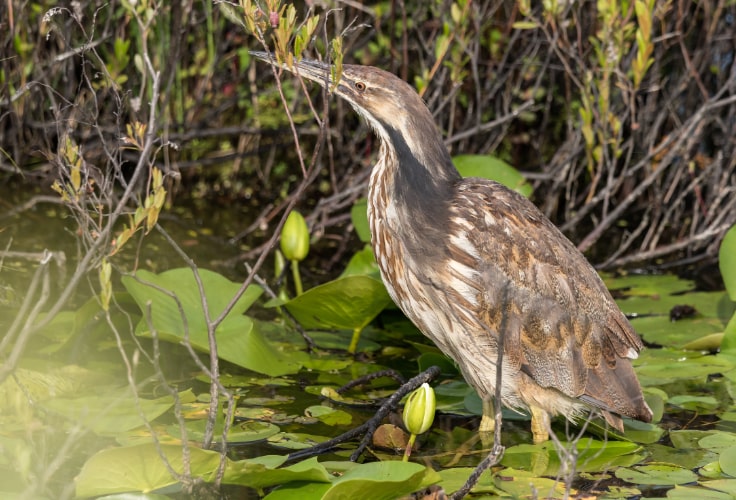
The American Bittern is a very secretive species, rarely seen in the open despite its broad distribution. It measures 60 to 85 centimeters (23.6 to 33.5 inches) in length and has a compact, heavy-bodied build with a thick neck and relatively short legs. The plumage is intricately patterned in brown, buff, and white, with strong vertical streaking that provides excellent camouflage among reeds and cattails. A distinctive dark stripe runs down the side of the neck, helping to separate it from other herons in the region. Its hunched posture and cryptic coloration allow it to remain nearly invisible in dense marsh vegetation.
In the field, this species is most often detected by sound or subtle movement. Individuals forage alone, standing motionless or moving very slowly through tall emergent vegetation, striking prey with a quick thrust of the bill. Feeding occurs mainly in shallow marshes and adjacent waters, and the diet includes insects, amphibians, fish, crayfish, and small mammals. Activity is most pronounced at dawn, dusk, and at night, though feeding may occur at any time of day. When disturbed, birds may freeze in place with the bill pointed upward, blending into surrounding vegetation. Flight is typically short and abrupt, with stiff wingbeats and the neck retracted. The deep, resonant “pump-er-lunk” call is most often heard during the breeding season.
The American Bittern shows a strongly seasonal and regionally variable distribution in California. It is most widespread in winter, when birds occur across much of the Central Valley, coastal wetlands, and interior lowlands west of the Sierra Nevada. Wintering individuals are fairly common in the Central Valley from October to April and also occur in the Imperial Valley and along the Colorado River. During the breeding season, the species becomes much more localized, with small, scattered populations nesting in suitable marsh habitats in the Central Valley, northeastern plateau, and occasionally near the Salton Sea. It is now rare as a breeder south of Monterey County along the coast. In many areas, especially the northeastern plateau, birds are absent in winter and present only during the breeding season. Overall, the species depends on large marshes with dense emergent vegetation for both breeding and wintering.
The American Bittern is considered uncommon in California and has declined in many parts of the state. These declines are closely linked to the loss and degradation of freshwater marshes, as well as disturbance and changes in vegetation structure caused by grazing or water management. Because the species is highly secretive and difficult to detect, population trends are not always well documented, but available evidence indicates a long-term decrease. Protection and restoration of large, intact marsh habitats remain essential for maintaining viable populations of this specialized wetland species.
Least Bittern
Botaurus exilis
- Identification: Very small, compact heron with a short neck, thin bill, and contrasting dark upperparts with buffy and pale underparts.
- Where found: Occurs locally in California in dense freshwater and brackish marshes, especially in the Central Valley, Salton Sea region, and scattered interior basins.
- How to spot: Most often detected by soft calls at dawn or dusk or seen briefly as it moves through dense reeds or flutters low over marsh vegetation.
- Conservation status: Least Concern (IUCN); uncommon and vulnerable in California due to wetland loss and degradation.

The Least Bittern is the smallest heron in California and one of the most difficult to observe, spending most of its time hidden within dense marsh vegetation. The species measures 28 to 36 centimeters (11.0 to 14.2 inches) in length and has a compact, finely built body with a short neck and slender bill. The plumage shows strong contrast, with dark upperparts and buffy to pale underparts, helping break up its outline among reeds. Its small size, secretive behavior, and preference for dense cover distinguish it from all other herons in the state.
Least Bitterns are usually detected by subtle movement or voice rather than prolonged views. Individuals move through cattails and tules by clambering along stems, often gripping multiple stalks with their long toes. They forage by standing motionless or stalking slowly in shallow water or along the edges of openings in dense vegetation, striking quickly at prey. The diet consists mainly of small fish, insects, and crayfish, along with amphibians and other small animals. When flushed, the bird flies only a short distance with weak, fluttering wingbeats before dropping back into cover. Activity occurs mostly during the day, with peaks in early morning and evening, and vocalizations are soft and easily overlooked.
Within California, the Least Bittern has a localized and strongly seasonal distribution tied to suitable marsh habitat. It breeds in lowland wetlands of the Central Valley, the Modoc Plateau, and scattered interior locations, as well as in southern regions such as the Salton Sea and along the Colorado River. The species is most regularly encountered from spring through early fall, typically from April to September, when breeding occurs in dense emergent vegetation near shallow water. In coastal lowlands and desert regions it is rare and localized, though it breeds in some areas such as the Owens Valley and Mojave Desert. Most of the state population migrates south for the winter, with birds largely absent from October through March, although some individuals in southern California may remain year-round.
The Least Bittern is considered uncommon in California and has declined in many areas. These declines are closely linked to the loss and degradation of marsh habitats, including drainage, water management changes, and disturbance. Because the species depends on dense emergent vegetation and is highly secretive, population trends are difficult to monitor. Collisions during nocturnal migration and predation at nests may also affect local populations. Conservation of extensive, undisturbed marshes with stable water levels is essential for maintaining healthy populations of this heron species in California.
Reddish Egret
Egretta rufescens
- Identification: Medium-large heron with a slender build, long legs, and a thick two-toned bill; in California almost always seen in the dark morph with a gray body and cinnamon head and neck.
- Where found: Irregular along the southern California coast, especially in shallow coastal lagoons, estuaries, and tidal flats.
- How to spot: Best identified by its highly active foraging, including running, wing-flicking, and abrupt turns in very shallow water.
- Conservation status: Near Threatened (IUCN); extremely rare in California, occurring only as an irregular coastal visitor.

The Reddish Egret is one of the rarest herons recorded in California and a highly specialized coastal species that appears only as an occasional visitor. It measures 70 to 80 centimeters (27.6 to 31.5 inches) in length and has a slender, long-legged build with a relatively heavy, two-toned bill. In California, individuals are almost always of the dark morph, showing a slate-gray body with a rich cinnamon-colored head and neck, often with slightly shaggy feathering. Its structure, coloration, and especially its distinctive behavior make it unlike any other heron likely to be encountered in the state.
In the field, this species is most readily identified by its animated and highly active foraging style. Unlike most North American herons, it moves quickly through shallow water, running, hopping, and making sudden turns while chasing prey. It frequently flicks or spreads its wings, sometimes using them to create shade or help control movement as it hunts. Feeding takes place almost entirely in very shallow coastal waters, where it captures small fish. Flight is steady and direct, with the neck usually held retracted and the long legs trailing behind. The species is generally quiet, and behavior is often the primary clue to identification.
In California, the Reddish Egret occurs as a rare and irregular visitor along the southern coast. Most records come from coastal Orange and San Diego Counties, particularly in estuaries, tidal flats, and coastal lagoons such as Bolsa Chica and similar shallow-water habitats. Occurrence is most frequent from late summer through early winter, especially from July through January, although individuals have been recorded in all months. The species does not breed in California and is best regarded as a vagrant from populations centered along the Gulf Coast and Baja California. Suitable habitat in the state is limited to shallow coastal flats and lagoons, which closely resemble its core range habitats.
The Reddish Egret remains extremely rare in California, with only a small number of individuals recorded in most years. At the continental scale, the species faces ongoing declines driven by loss and degradation of coastal habitats, disturbance at nesting sites, and sensitivity to environmental change. Its reliance on specific shallow-water foraging conditions makes it particularly vulnerable to habitat alteration. Although California lies outside its regular range, continued protection of coastal wetlands and estuarine systems is important for maintaining the occasional presence of this specialized and distinctive heron.
Tricolored Heron
Egretta tricolor
- Identification: Medium-sized, slender heron with dark slate upperparts, a bright white belly, and a long, narrow neck and bill.
- Where found: Rare along the southern California coast, mainly in coastal lagoons, estuaries, and tidal flats.
- How to spot: Watch for an active heron with a striking white belly moving quickly through shallow water with sharp turns and brief runs.
- Conservation status: Least Concern (IUCN); extremely rare in California, occurring only as an irregular coastal visitor.

The Tricolored Heron is a rare and irregular visitor to California, far outside its core range along the Atlantic and Gulf coasts. The species measures 60 to 70 centimeters (23.6 to 27.6 inches) in length and has a slim, delicate build with a long neck and narrow bill. The plumage is strongly contrasted, with dark gray to bluish upperparts and a clean white breast and belly, a combination that is distinctive among herons when seen well. Its slender structure and sharp color contrast help separate it from other species in the region, particularly in coastal habitats.
Tricolored Herons are most often identified by active feeding behavior. Individuals typically forage alone, stalking fish with deliberate steps that often shift into quick runs, tight turns, and sudden stops. This species frequently pursues prey through very shallow water, sometimes using rapid movements or brief wing motions while hunting. The diet consists primarily of small fish taken in shallow coastal waters. Flight is steady and direct, with the neck held retracted and the legs trailing behind. The species is generally quiet away from breeding areas, and behavior is often the most reliable identification feature in California.
In California, the Tricolored Heron occurs as a rare and irregular visitor, primarily along the southern coast. Most records come from coastal Orange and San Diego Counties, especially at sites such as tidal lagoons, estuaries, and marsh channels with shallow water and sparse vegetation. Occurrence is most frequent from autumn through spring, though records exist in all months, including occasional summer observations. The species does not breed in California, with only historical and unconfirmed breeding reports, and is best considered a vagrant likely originating from populations in Baja California or farther south. It may wander northward after the breeding season, occasionally reaching more northern coastal or inland locations.
The Tricolored Heron remains extremely rare in California, with only a small number of individuals recorded in most years. At a broader scale, populations show mixed trends, with declines in parts of the southeastern United States linked to habitat alteration and changes in wetland hydrology. Although California lies outside the regular range, the species depends on intact coastal wetlands and shallow estuarine systems, which are limited and vulnerable to disturbance. Protection of these habitats is important for supporting the occasional presence of this distinctive coastal heron.
Little Blue Heron
Egretta caerulea
- Identification: Medium-sized, slender heron with a long neck and legs; adults are slate-blue, while first-year birds are entirely white.
- Where found: Rare along the southern California coast, mainly in estuaries, lagoons, tidal flats, and other shallow coastal wetlands.
- How to spot: Look for a solitary heron moving slowly through shallow water; white immatures may stand out among other egrets.
- Conservation status: Least Concern (IUCN); extremely rare in California, occurring as an irregular coastal visitor.

The Little Blue Heron is a rare and irregular visitor to California, occurring far outside its primary range in the southeastern United States. It measures 56 to 74 centimeters (22.0 to 29.1 inches) in length and has a slim, upright profile with a long neck and legs. Adults show a distinctive slate-blue body with a slightly purplish head and neck, while younger birds are entirely white, creating a striking contrast between age classes. This variation can make identification challenging, especially when white immatures are mixed with other white long-legged birds in coastal habitats.

In the field, this species is most often identified by its behavior and structure. Individuals typically forage alone, moving slowly and deliberately through shallow water with a steady walk-and-pause rhythm. They rely on careful stalking rather than rapid pursuit, striking prey with controlled movements. The diet consists mainly of small fish, amphibians, and aquatic invertebrates. Flight is steady and unhurried, with rounded wings and a tucked neck. The species is generally quiet, and behavior and overall shape are often more useful for identification than vocalizations.
In California, the Little Blue Heron occurs as a rare and irregular visitor, primarily along the southern and central coast. Most records come from coastal counties such as San Diego and Orange, with additional occurrences in Los Angeles and San Luis Obispo Counties. Birds are typically found in shallow estuarine habitats, tidal lagoons, and coastal wetlands similar to those used within their core range. Records occur in all months of the year, suggesting both post-breeding dispersal and occasional overwintering individuals, with some birds likely originating from populations in Baja California. Breeding in California has been recorded only rarely and remains sporadic. The species is best regarded as a vagrant with limited and unpredictable occurrence.
The Little Blue Heron remains extremely rare in California, with only small numbers recorded annually. At a broader scale, populations have experienced declines in parts of North America due to wetland loss, altered water regimes, and disturbance at nesting colonies. Although California lies outside its regular range, the availability of intact coastal wetlands influences its occurrence in the state. Continued protection of estuarine and wetland habitats is important for supporting the occasional presence of this distinctive and variable heron.
Yellow-crowned Night Heron
Nyctanassa violacea
- Identification: Medium-sized, stocky heron with a heavy bill, dark body, and a bold black-and-white head pattern in adults.
- Where found: Rare and irregular in California, mainly along the coast in estuaries, lagoons, and tidal wetlands, with occasional inland records.
- How to spot: Often seen walking slowly along shorelines or tidal channels, especially at dusk or night, with a hunched posture and deliberate movements.
- Conservation status: Least Concern (IUCN); extremely rare in California, occurring as an irregular visitor with very limited breeding.

The Yellow-crowned Night Heron is a rare and irregular visitor to California, far outside its primary range along the Atlantic and Gulf coasts. The species measures 55 to 70 centimeters (21.7 to 27.6 inches) in length and has a compact, thickset build with a relatively large head and stout bill. Adults are distinctive, showing a smooth bluish-gray body and a striking head pattern with black and white markings. This combination of structure and coloration makes it recognizable when seen well, though it is encountered only infrequently in the state.
Yellow-crowned Night Herons are typically identified by behavior and posture. Individuals move slowly along the edges of wetlands, tidal channels, and shorelines, often with the body hunched and the head partially drawn in. They forage by stalking prey with deliberate steps or standing motionless before striking. The diet consists largely of crustaceans such as crabs and crayfish, along with other small aquatic animals. Activity often peaks at dusk and night, though birds may also feed during the day. Flight is steady, with broad wings, slow wingbeats, and the neck held retracted. Vocalizations are usually limited to breeding contexts and are rarely heard in California.
In California, the Yellow-crowned Night Heron occurs as a rare and irregular visitor, primarily along the coast. Most records come from coastal counties such as San Diego, Orange, and Los Angeles, with additional scattered occurrences as far north as Monterey and Marin counties and occasional inland records. Birds are typically found in estuaries, coastal lagoons, and tidal wetlands similar to habitats used within their core range. Occurrence spans much of the year, with many records between spring and fall, though individuals have been recorded in multiple seasons. The species was first documented in the state in 1951, and breeding has been recorded only rarely, with the first confirmed successful nesting occurring in the early twenty-first century. Overall, it is best considered a vagrant with very limited and localized presence.
The Yellow-crowned Night Heron remains extremely rare in California, with only a small number of individuals recorded annually. At a broader scale, populations are generally stable, though local declines occur where coastal habitats are degraded or disturbed. Because the species depends on shallow wetlands that support crustacean prey, habitat quality is a key factor influencing its distribution. Continued protection of coastal wetlands and estuarine systems is important for supporting the occasional presence of this distinctive night heron in California.
Where and When to See Herons in California
Herons can be found across California year-round, but the best locations and seasons depend on habitat and species. The most reliable places to look are wetlands, especially coastal estuaries, tidal lagoons, the Central Valley, and large marsh systems, where species such as the Great Blue Heron, Great Egret, and Black-crowned Night Heron occur throughout the year. Freshwater marshes with dense vegetation are particularly important for secretive species like the American Bittern and Least Bittern, which are easiest to detect in spring and summer when they are most active and vocal.
Seasonal patterns play a key role in what you are likely to see. Winter brings an influx of herons to lowland wetlands, especially in the Central Valley and along the coast, while spring and summer concentrate breeding birds near colonies and in productive marsh habitats. Late summer and fall are often the best times to encounter rarer coastal visitors, particularly in southern California, where species such as Reddish Egret, Tricolored Heron, and Little Blue Heron appear irregularly in shallow coastal lagoons and tidal flats.
Behavior also helps guide observation. Many herons are most active at dawn and dusk, especially night herons and bitterns, while others forage openly during the day in shallow water or nearby fields. By focusing on the right habitats and timing visits to match seasonal movements, observers can encounter a diverse range of heron species across California’s varied landscapes.
For a broader perspective, see our guide to the types of herons in North America, and explore the Birds of California and Birds of the United States pages for additional regional and national bird guides.

Raeesah Habib is a South African conservationist and freelance writer. She completed a diploma in nature conservation in 2016 through the University of South Africa (UNISA). During her internship, she spent a year working with wattled cranes on the Wattled Crane Recovery Programme (WCRP).
The program aims to prevent the local extinction of the wattled crane in Southern Africa through the release of captive-reared individuals into critically endangered wild populations across the country. During her time at the research facility, she was also responsible for the general monitoring and husbandry of other magnificent species, including blue cranes and secretary birds.
Following her internship, she was fortunate to have worked in some spectacular wilderness areas across the country, including the Cradle of Humankind, the Kruger National Park, and the northern Zululand. As a wildlife monitor, her responsibilities included conducting bird point counts. Birds surveys are a useful means to collect data on the avian populations in an area. The data helps researchers gain an understanding of population trends and ecosystem health.
When not in the field, Rae enjoys writing to share her passion, knowledge, and experiences with others.


