
Washington supports two regularly occurring eagle species, each associated with different landscapes across the state. The Bald Eagle is widespread and closely tied to marine shorelines, rivers, lakes, and other aquatic habitats, where it is present year-round and often occurs in large numbers during winter. The Golden Eagle is much less common and is primarily a bird of open and mountainous terrain, especially in eastern Washington and other remote areas. This guide provides identification notes, seasonal patterns, regional distribution, and key locations for observing eagles across Washington.
Bald Eagle
Haliaeetus leucocephalus
- Identification: Very large eagle with a heavy body and broad flat-held wings; adults show a white head and tail contrasting sharply with a dark brown body and wings.
- Where found: Occurs statewide in Washington near marine shorelines, rivers, lakes, and reservoirs, with highest densities in the Puget Sound region and west of the Cascade Range.
- How to spot: Look for slow, powerful wingbeats, long periods of soaring with wings held flat, frequent perching near water, and concentrations around salmon streams in fall and winter.
- Conservation status: Least Concern (IUCN); abundant and recovered in Washington, with populations now stable but still influenced by habitat and prey availability.

The Bald Eagle is the most familiar and widespread eagle in Washington and one of the largest raptors in the state. Adults measure 71 to 96 centimeters (28.0 to 37.8 inches) in length, with a wingspan of 168 to 244 centimeters (66.1 to 96 inches), and have a heavy body, a large head, and a massive hooked beak. The species presents a commanding profile in flight and at rest. Adult plumage shows a dark brown body and wings set off by a bright white head and tail, while younger birds appear mostly dark with irregular white mottling and lack the clean white head and tail of adults.

In the field, Bald Eagles are often detected by their size and flight style. They fly with slow, deliberate, powerful wingbeats and frequently soar or glide on broad wings held flat in a straight horizontal line. Individuals perch prominently in large trees near shorelines, rivers, and lakes, especially where prey is abundant. The species feeds opportunistically, taking fish, waterfowl, and small mammals, scavenging carrion, and stealing prey from other birds. In Washington, fish and birds dominate the diet, and concentrations of eagles are especially noticeable at salmon spawning streams in fall and winter, where birds gather to feed on spawned-out fish.
The Bald Eagle is present year-round across most of Washington and is strongly associated with aquatic habitats. The species is most numerous west of the Cascade Range, particularly in the Puget Sound basin, the San Juan Islands, and along coastal shorelines, but it also occurs along major rivers, inland lakes, and reservoirs statewide. Breeding pairs nest primarily near marine shorelines, large lakes, and major rivers, typically in large trees within a short distance of water. Nesting is rare or absent in the Columbia Basin and parts of southeastern Washington, although wintering birds can occur there locally. Many individuals breeding in Alaska and Canada migrate south in autumn to overwinter in Washington, where they concentrate along salmon-bearing rivers and other productive foraging areas.
The Bald Eagle is now abundant in Washington following a major recovery linked to the ban of DDT and long-term legal protection. Populations increased substantially over recent decades, and the species is now considered a stable and prominent part of the state’s ecosystems. The population may be approaching habitat limits in some regions, particularly in parts of western Washington where nesting territories are dense. Ongoing threats include habitat loss or disturbance near nest sites, reduction in prey such as salmon, and loss of suitable nesting trees, but continued protections and habitat management have supported a strong and persistent population.
Golden Eagle
Aquila chrysaetos
- Identification: Very large dark-brown eagle with long broad wings, a relatively small head, and a long tail; adults show a golden sheen on the nape.
- Where found: Occurs mainly in mountainous and open landscapes of Washington, especially in eastern regions, with scattered presence in alpine and limited open habitats elsewhere.
- How to spot: Watch for solitary birds or pairs soaring with wings held in a slight “V,” often over ridges, slopes, or open country, and for low hunting flights over grasslands and shrubsteppe.
- Conservation status: Least Concern (IUCN); uncommon in Washington and of concern due to low population density, prey declines, and human-related mortality.

The Golden Eagle is a large soaring raptor of Washington’s open and mountainous landscapes and a characteristic species of remote terrain. Adults measure 70 to 99 centimeters (27.6 to 39.0 inches) in length and have a wingspan of 185 to 222 centimeters (72.8 to 87.4 inches). The species has a heavy body, long broad wings, and a long tail, and in flight it often appears small-headed with the tail projecting beyond the wings. Adult plumage is mostly dark brown with a distinctive golden wash on the back of the head and neck, giving the species its name.

In the field, Golden Eagles are most often identified by their flight profile and behavior. They are usually seen alone or in pairs, soaring and gliding for long periods while using updrafts over ridges, cliffs, and open terrain. The wings are typically held in a slight dihedral or “V,” with widely spread “fingered” primaries. Hunting occurs primarily over open landscapes, where birds fly low in contour flight or hunt from elevated perches. In Washington, the species feeds mainly on medium-sized mammals and birds, including rabbits, hares, ground squirrels, marmots, and game birds, with regional variation that includes prey such as pheasants and chukar in eastern Washington and mountain beaver in western parts of the state.
The Golden Eagle occurs at low densities across Washington and is most strongly associated with mountainous and open habitats. Breeding is concentrated in eastern Washington, including the Okanogan Highlands, shrubsteppe and canyonlands of the Columbia Plateau, and the Blue Mountains along the Snake and Grande Ronde rivers. Additional breeding occurs in rainshadow areas of the Olympic Mountains and Cascades, as well as locally in the San Juan Islands. The species uses steep terrain, cliffs, and open landscapes for nesting and foraging, with most nests in eastern Washington placed on rocky cliffs and outcrops, while nests in western Washington may occur in large trees near openings such as clearcuts or above timberline. The breeding population in the state is largely resident year-round.
The Golden Eagle is uncommon in Washington and occurs in relatively low numbers, with a limited breeding population distributed across suitable habitats. Populations are influenced by prey availability, and declines in key species such as jackrabbits and ground squirrels have affected distribution and reproductive success. Human-related mortality remains a significant concern, including collisions with vehicles and structures, electrocution on power lines, lead exposure from contaminated prey, and potential impacts from wind energy development. Habitat loss and fragmentation of shrubsteppe and other open landscapes further reduce suitable foraging areas. Ongoing monitoring and habitat conservation are important for maintaining Washington’s Golden Eagle population.
Distinguishing Golden and Bald Eagles in the Field
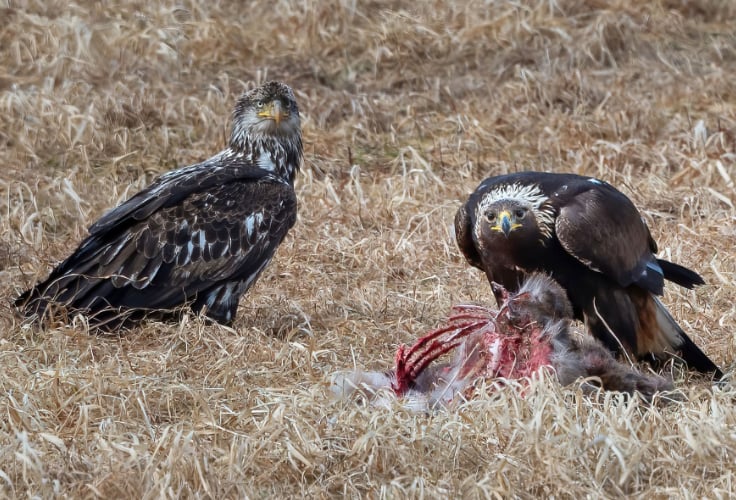
Immature Golden Eagles are most often confused with immature and subadult Bald Eagles, as both species lack the white head and tail of adult Bald Eagles and can appear largely dark at a distance.
Structural differences are usually the most reliable clue. Bald Eagle shows a larger, more protruding head and massive beak that project well beyond the body in flight, while Golden Eagle has a noticeably smaller head and beak with a more streamlined profile. In flight, the head of a Bald Eagle projects more than half the length of the tail, whereas the head of a Golden Eagle projects less. Bald Eagle also has unfeathered lower legs, while Golden Eagle has fully feathered legs.

Plumage patterns provide additional separation. Immature Bald Eagles show irregular white mottling on the body, underwing coverts, and tail, often in patchy or blotchy patterns. Golden Eagle lacks white on the body and shows white restricted to the base of the flight feathers and tail, forming cleaner, more sharply defined areas.

Golden Eagles may also be confused at a distance with vultures and large buteo hawks. Turkey Vulture is smaller, holds its wings in a more pronounced dihedral, and rocks from side to side while soaring; its underwings appear dark in front and paler along the trailing edge. Golden Eagle soars more steadily, with wings held in a shallow dihedral and without rocking except in strong winds. Large buteos are smaller, broader-winged, and lack the long-winged, long-tailed profile of an eagle. Careful attention to wing shape, tail length, and overall flight style is essential when separating Golden Eagles from vultures and large hawks at a distance.
Where and When to See Eagles in Washington
Washington offers reliable opportunities to observe both Bald Eagles and Golden Eagles, though their habitats and seasonal patterns differ. Bald Eagles are widespread and can be seen year-round near marine shorelines, large lakes, and major rivers, with especially high concentrations in the Puget Sound region, San Juan Islands, and along coastal and inland waterways west of the Cascade Range. Numbers increase noticeably from late autumn through winter, when migrants from Alaska and Canada arrive and gather along salmon-bearing rivers and other productive feeding areas.
Golden Eagles are much less common and are primarily associated with open and mountainous landscapes. The best chances to see them are in eastern Washington, including the Columbia Plateau, Okanogan Highlands, and canyon systems of the Snake and Grande Ronde rivers, as well as in alpine zones and select open habitats in other regions. They occur year-round at low densities and are typically seen singly or in pairs, soaring over ridges, cliffs, and open terrain rather than forming the large seasonal gatherings typical of Bald Eagles.
Key Eagle Viewing Locations in Washington
- Upper Skagit River (Skagit County) – One of the best eagle-viewing areas in the state, with large winter concentrations of Bald Eagles feeding on spawning salmon from mid-December through early February.
- Howard Miller Steelhead Park and Rockport Bridge (Skagit County) – Reliable winter site along the Skagit River where eagles gather on gravel bars and perch in riverside trees near salmon runs.
- Sutter Creek Rest Area, SR 20 (Skagit County) – Easy-access viewpoint overlooking the Skagit River, with feeding areas and nearby forested roost sites.
- Skagit Wildlife Area / Fir Island (Skagit County) – Productive lowland and estuary habitat where Bald Eagles occur alongside large numbers of waterfowl.
- North Cascades National Park / Newhalem (Whatcom County) – Scenic river corridors and old-growth forest near the Skagit River support eagles, especially where salmon are present.
- Nooksack River, near Welcome / SR 542 (Whatcom County) – Consistent winter site east of Bellingham where eagles gather along river corridors near Mount Baker foothills.
- Deception Pass State Park (Island / Skagit Counties) – Coastal cliffs and strong tidal currents attract Bald Eagles hunting along marine shorelines.
- Dungeness National Wildlife Refuge and Discovery Bay (Clallam County) – Strait of Juan de Fuca shoreline habitats where eagles are regularly seen hunting waterfowl and patrolling coastal areas.
- Woodard Bay and Nisqually National Wildlife Refuge (Thurston County) – South Puget Sound wetlands and shoreline habitats that attract Bald Eagles year-round, especially in winter.
- Commencement Bay and Point Defiance Park (Pierce County) – Urban shoreline area where eagles can be seen perched on pilings, coastal bluffs, and river mouths.
- Grays Harbor National Wildlife Refuge (Grays Harbor County) – Estuarine habitat supporting waterfowl and shorebirds, which in turn attract foraging Bald Eagles.
- Grays River, near Rosburg (Wahkiakum County) – Productive winter site along a Columbia River tributary, with peak eagle numbers from mid-January to early February.
- Yakima Canyon, SR 821 (Kittitas / Yakima Counties) – One of the best inland locations, with wintering Bald Eagles along the Yakima River and good chances for Golden Eagles in surrounding canyon terrain.
- Columbia River Gorge / The Dalles area (Klickitat County region) – Winter concentrations of Bald Eagles occur near dams and along the river, especially during salmon runs.
- Okanogan Highlands (Okanogan County) – Remote open landscapes and mountainous terrain in northeastern Washington that support breeding Golden Eagles at low densities.
- Blue Mountains / Snake River canyonlands (Asotin / Garfield Counties) – Rugged canyon systems and open habitats in southeastern Washington where Golden Eagles are regularly present.
For a broader perspective, see our guide to the types of eagles in North America, and explore the Birds of Washington and Birds of the United States pages for additional regional and national bird guides.


