
Birds of prey, also known as raptors, can be broadly grouped into ten distinct types based on shared structure, behavior, and field appearance. All birds of prey share core predatory traits, including a hooked beak, strong feet with sharp talons, highly developed eyesight, and a diet consisting primarily of other animals. Some of these groups are widespread and found across much of the world, while others are restricted to specific regions or represented by only a single species with a highly specialized lifestyle. This guide focuses on how birds of prey look and behave in the field, using familiar North American species to illustrate broader groups found across many habitats.
Hawks
- Identification: Medium to large daytime raptors recognized by strong, purposeful flight and hunting behavior that combines sustained soaring with rapid, close-quarters pursuit.
- Where found: Widespread globally, occupying open country, forest edges, woodlands, and increasingly suburban environments.

Hawks are the most familiar and commonly seen birds of prey, encountered across in a wide range of habitats. They are medium to large predatory birds that vary widely in size, from relatively small, agile species to large, broad-winged forms, and share adaptations for active hunting, including sharply hooked beaks and powerful talons. Scientifically, hawks belong to the family Accipitridae, a broad lineage that also includes eagles, harriers, and kites. Most hawks fall into two major structural and ecological forms: broad-winged soaring species typical of open habitats, often referred to as buzzards or buteos, and more compact, forest-adapted hunters commonly known as accipiters.
In the field, hawks are typically recognized by their daytime activity and strong, purposeful flight. In flight, buteos usually show broad wings and relatively short, often fanned tails, a configuration suited to sustained soaring, while accipiters have shorter, rounded wings and longer tails that allow rapid acceleration and tight maneuvering. These structural differences correspond to distinct hunting styles: buteos commonly search for prey from the air or from elevated perches, whereas accipiters rely on sudden ambushes and fast pursuits launched at close range. Many hawks are also detected by voice, producing sharp, often high-pitched calls that carry over distance, especially during territorial interactions or while soaring. Compared with eagles, hawks are generally smaller and more maneuverable, and unlike harriers, they do not rely on prolonged low, coursing flight or the use of hearing as a primary hunting aid.

Globally, hawks occur on every continent except Antarctica, occupying an extraordinary range of climates and ecosystems. They are found from deserts and grasslands to forests, wetlands, and mountainous regions, with different forms adapted to different environments. Many hawk species are strongly migratory, undertaking seasonal movements between breeding and wintering areas that can span thousands of kilometers, while others are resident or only partially migratory depending on latitude and food availability. In North America, hawks are especially visible across open countryside, woodland edges, and increasingly in suburban settings, with migration making them particularly conspicuous along ridgelines, coastlines, and other natural corridors during spring and fall. Nesting typically takes place in trees or on cliffs, with large stick nests reused over multiple years in some species.
For North American readers, the most familiar hawks are the Red-tailed Hawk and the Cooper’s Hawk, which together represent two contrasting approaches to hunting and habitat use. The Red-tailed Hawk is a classic broad-winged soaring hawk, frequently seen circling high over open landscapes or perched conspicuously while scanning for prey below. In contrast, the Cooper’s Hawk is a forest-adapted accipiter that relies on speed, agility, and surprise to pursue birds through woodland edges and increasingly through suburban environments. Together, these two species illustrate the primary structural and ecological divisions within the hawk group and account for much of the everyday hawk experience across the United States and Canada.
Eagles
- Identification: Very large daytime raptors recognized by long, broad wings, powerful flight, and an imposing silhouette visible at long distances.
- Where found: Widespread across much of the world, occupying open landscapes, coastlines, mountainous regions, and large forested areas.

Eagles are the most iconic and instantly recognizable birds of prey, widely known for their size, strength, and commanding presence. They are large raptors with massive wingspans, heavy beaks, and strong talons adapted for capturing and handling relatively large prey. Like hawks, eagles belong to the family Accipitridae, but they represent the upper end of size and power within this group. Most eagle species share a general build optimized for strength and soaring flight, though there is variation between forest-associated eagles and those adapted to open country or aquatic environments.
In the field, eagles are identified primarily by their sheer size and flight style. They typically soar with long, broad wings held flat or slightly raised, moving on slow, powerful wingbeats interspersed with extended glides. Compared with hawks, eagles appear heavier and less agile, relying more on altitude, visibility, and strength than on speed or rapid maneuvering. Hunting behavior is often conspicuous, with many species taking prey on the ground or near water after long periods of scanning from the air or from prominent perches. Vocalizations are generally less noticeable than in hawks and are usually heard near nesting areas rather than during routine flight.

Eagles have a nearly worldwide distribution, occupying a wide range of ecosystems from Arctic tundra and temperate forests to tropical savannas, deserts, and coastal regions. Some species are strongly tied to water, especially rivers, lakes, and coastlines, while others favor open plains or rugged mountainous terrain. Migration varies widely: certain eagles undertake long-distance seasonal movements, while others are resident year-round or show partial migration depending on latitude and food availability. In North America, eagles are most often associated with large open spaces and water-rich landscapes. Nesting typically involves large stick nests placed in tall trees, cliffs, or other elevated structures, often reused and expanded over many years.
In the United States and Canada, the Bald Eagle is the most familiar representative of the group and the species most likely to be encountered. It is closely associated with aquatic environments, where it relies heavily on fish and other water-linked prey, making it a common sight along coastlines, rivers, and inland lakes. The Golden Eagle provides a contrasting example within the same group, being more strongly tied to open and mountainous landscapes where it hunts terrestrial prey across broad expanses. As two of the largest eagles in the world, these species illustrate how size, powerful flight, and access to open space shape the way eagles hunt and use their environment.
Falcons
- Identification: Small to medium-sized daytime raptors recognized by long, pointed wings, fast, direct flight, and aerial hunting behavior.
- Where found: Distributed across much of the world, occurring in open landscapes, coastlines, deserts, grasslands, and urban areas.

Falcons are fast, agile birds of prey best known for their speed and aerial hunting style. They are generally smaller and more streamlined than hawks and eagles, with long, pointed wings and compact bodies adapted for pursuit in open air. Falcons belong to the family Falconidae, which is distinct from the hawks, eagles, and vultures of the family Accipitridae, despite similar predatory roles. Within the group, most species fall into a few broadly recognized forms, ranging from small, hovering hunters to larger, powerful aerial predators, reflecting different approaches to prey capture rather than major structural divisions.
In the field, falcons are often recognized by their swift, purposeful flight and narrow-winged silhouette. Many species fly with rapid, stiff wingbeats and long glides, appearing sharply pointed at the wingtips, a contrast to the broader wings of hawks. Hunting behavior is typically active and visually striking, with prey taken in midair or seized after fast, direct chases. Smaller falcons often hover briefly while scanning below, while larger species rely on speed and altitude to overtake prey in open air. Vocalizations are usually sharp and repetitive, commonly heard near nesting sites or during territorial encounters, but less prominent during routine flight.

Falcons occur across most of the globe, from Arctic regions to the tropics, and occupy a wide range of open or semi-open habitats. Many species favor grasslands, deserts, coastlines, and tundra, while others readily use human-modified environments, including cities. Migration varies widely within the group: some falcons are long-distance migrants, others are resident year-round, and several show partial or irregular movements depending on latitude and prey availability. In North America, falcons are most often associated with open country and coastal zones, with nesting typically taking place on cliffs, rocky ledges, or human structures rather than in trees, and nest sites are often reused over multiple seasons.
For readers in the United States and Canada, the most familiar falcons are the Peregrine Falcon and the American Kestrel, which together show the group’s range in size and hunting strategy. The Peregrine Falcon is a large, powerful species adapted for high-speed aerial pursuit, often seen along coasts, open landscapes, and increasingly in urban areas where tall structures substitute for cliffs. The American Kestrel represents the smaller end of the group, frequently observed hovering over fields or perched along roadsides while hunting small prey. As a whole, these species highlight the defining falcon traits of speed, aerial precision, and a strong association with open space.
Owls
- Identification: Small to medium-sized raptors recognized by upright posture, broad wings, rounded silhouettes, and slow, buoyant flight, most often active at night or low light.
- Where found: Occur across much of the world in forests, grasslands, wetlands, deserts, and increasingly urban and suburban areas.

Owls are a distinctive group of predatory birds, best known for their nocturnal habits and adaptations for hunting in low light. Relative to other raptors, most owls are small to medium in size, though the group spans a wide range, from compact woodland species to very large predators of open landscapes. Like all birds of prey, they possess strongly hooked beaks and powerful talons, but they are further defined by forward-facing eyes and the ability to rotate the head through an exceptionally wide arc, allowing them to scan their surroundings without shifting body position. Owls belong to the order Strigiformes, which is separate from the daytime raptors and includes two closely related families: the typical owls (Strigidae) and the barn owls (Tytonidae), which differ mainly in external structure and facial form.
In the field, owls are identified by their rounded heads, broad wings, and characteristically soft, silent flight. Many appear large-bodied with relatively short tails and wide wings, giving them a floating or moth-like flight style when moving between perches. Hunting behavior is typically perch-based, with owls dropping silently onto prey detected below rather than pursuing it in sustained flight. Vocalizations are often the most noticeable sign of their presence, with hoots, screeches, or whistles commonly used to locate owls at night and to distinguish between different species or groups. Compared with falcons or hawks, owls rely less on speed and visibility and more on stealth and ambush.

Owls have a nearly global distribution and occupy an exceptional range of habitats, from dense forests and open grasslands to tundra, wetlands, and deserts. Most species are resident year-round, with relatively limited migration, though some northern or open-country species show seasonal movements linked to prey availability. In North America, owls are found across both wild and human-altered landscapes, often remaining hidden during daylight hours. Nesting typically occurs in tree cavities, abandoned nests of other birds, cliffs, or man-made structures, with many species reusing the same sites repeatedly.
In North America, the Great Horned Owl and the Barred Owl are among the most familiar owls and illustrate the diversity within the group. The Great Horned Owl is a large, adaptable predator associated with a wide range of open and semi-open habitats, often detected by its deep, resonant calls. The Barred Owl represents a forest-oriented form, closely tied to mature woodlands where its vocalizations are frequently heard at night. As large, well-known members of the group, these species reflect the core owl pattern of ambush hunting, strong site fidelity, and reliance on sound and low-light conditions rather than speed or open-air pursuit.
Harriers
- Identification: Medium-sized daytime raptors recognized by long wings, long tails, and low, coursing flight over open ground.
- Where found: Occur across much of the world, primarily in open habitats such as grasslands, wetlands, marshes, and tundra.

Harriers are a distinctive group of birds of prey that combine features of both hawks and owls, making them immediately recognizable in open landscapes. They are medium-sized raptors with long wings, long tails, lightly built bodies, and an owl-like facial disc that aids in directing sound while hunting. Harriers belong to the family Accipitridae and are placed in the genus Circus, setting them apart from other hawks and eagles as a clearly defined and closely related group. Most species share adaptations associated with hunting close to the ground in open habitats, rather than pursuing prey from height or dense cover.
In the field, harriers are best identified by their unique hunting flight. They typically fly low and slowly over fields, marshes, or tundra, holding their wings in a shallow V-shape while scanning the ground below. This buoyant, side-to-side coursing flight sets them apart from the higher soaring of most hawks and the fast, direct flight of falcons. Harriers often hunt by dropping suddenly onto prey detected beneath them, and their flight behavior is usually the first clue to their identity. Compared with other hawks, they appear slimmer and more owl-like in motion, though they remain active daytime hunters.

Harriers are widely distributed and occur on most continents, with a strong association with open, treeless, or lightly vegetated landscapes. Wetlands, grasslands, agricultural fields, and tundra are especially important habitats, providing both hunting grounds and nesting areas. Many harrier species are migratory or partially migratory, with seasonal movements linked to latitude and prey availability. In North America, harriers are especially noticeable during migration and winter, when they frequent open countryside and coastal marshes. Nesting typically takes place on the ground, a trait that distinguishes harriers from most other members of the hawk family.
In the United States and Canada, the Northern Harrier is the only regularly occurring species of harrier, yet it remains a familiar sight across open habitats. The Northern Harrier is often seen gliding low over marshes, fields, and open plains, using a slow, searching flight to locate prey. As the sole representative of the group in the region, it clearly illustrates the defining harrier pattern, including a reliance on open habitats, low coursing flight, and ground-oriented hunting.
Kites
- Identification: Small to medium-sized daytime raptors recognized by long, narrow wings, buoyant flight, and a light, graceful silhouette.
- Where found: Occur mainly in tropical and subtropical regions worldwide, with a few species extending into temperate areas.

Kites are a distinct group of predatory birds known for their aerial grace and lightweight build. Compared with most other raptors, they are generally small to medium in size, with slender bodies, long wings, and relatively weak feet, reflecting a hunting style that emphasizes aerial capture rather than overpowering prey. Kites belong to the family Accipitridae, placing them within the same broader lineage as hawks, eagles, and harriers, but they form several loosely related groups rather than a single tightly defined lineage. As a result, the term “kite” describes a functional and structural type more than a strict taxonomic division.
In the field, kites are identified by their buoyant, effortless flight and narrow-winged profiles. Many species glide for long periods with minimal wingbeats, often appearing to drift or float while scanning below. Prey is typically taken from the air or snatched from vegetation or the ground without landing, and some species are known for feeding on insects, small vertebrates, or carrion depending on opportunity. Compared with hawks, kites appear lighter and less forceful in flight, and unlike falcons, they do not rely on speed or direct pursuit. Vocalizations are generally inconspicuous and are rarely a primary identification cue.

Globally, kites are most diverse in warm climates, particularly in Africa, South Asia, and parts of Australia and the Americas. Most species favor open or semi-open habitats such as savannas, wetlands, forest edges, and agricultural landscapes, often near water. Migration varies widely: many tropical kites are resident, while some temperate species undertake seasonal movements or show nomadic behavior linked to food availability. In North America, kites are localized and largely confined to the southern United States. Nesting typically occurs in trees, with small to moderate-sized stick nests reused in successive seasons.
In North America, the Mississippi Kite and the Swallow-tailed Kite are the most familiar members of the group and illustrate its defining traits. The Mississippi Kite is increasingly associated with open woodlands and suburban areas in the southern United States, where its smooth flight and aerial foraging are readily observed. The Swallow-tailed Kite, with its deeply forked tail and buoyant flight, represents a more specialized form tied to warm, open landscapes and seasonal movement. Together, these species highlight the kite pattern of light build, graceful flight, and reliance on aerial foraging rather than forceful predation.
Caracaras
- Identification: Medium to large daytime raptors recognized by long legs, broad wings, and a terrestrial, often upright posture.
- Where found: Occur mainly in the Americas, from the southern United States through Central and South America, using open and semi-open landscapes.

Caracaras are an unusual and distinctive group of birds of prey that differ noticeably from most other raptors in both appearance and behavior. They are medium to large predatory birds with long legs, relatively flat heads, and broad wings, giving them a profile that often appears more ground-oriented than aerial. Caracaras belong to the family Falconidae, placing them within the falcon lineage rather than among hawks and eagles, despite their very different lifestyle. Within this group, caracaras are united less by speed or aerial pursuit and more by flexibility, intelligence, and an opportunistic approach to feeding.
In the field, caracaras are often recognized as much by their behavior as by their structure. Unlike most falcons, they spend considerable time walking on the ground, standing upright, or moving deliberately across open terrain. Flight is usually steady and unhurried, with broad wingbeats and frequent gliding, lacking the fast, pointed-wing flight typical of true falcons. Hunting and feeding behavior is highly varied and visible, ranging from active predation to scavenging, and caracaras are often seen interacting boldly with other birds or exploiting human-altered environments. Vocalizations are noticeable at times, typically harsh or croaking, and may draw attention to perched or feeding birds.

Caracaras occur primarily in the Americas, with their range extending from the southern United States through Central America and across much of South America. They are largely associated with open habitats, including grasslands, savannas, scrub, agricultural areas, and coastal regions, often favoring landscapes with a mix of open ground and scattered perches. Most species are resident year-round, with limited long-distance migration, though local movements occur in response to food availability. In the United States, caracaras are confined to the southernmost regions, where warm climates and open terrain support their foraging style. Nesting generally takes place in trees, shrubs, or occasionally on artificial structures, with bulky stick nests reused in successive seasons.
In North America, the Crested Caracara is the only regularly occurring member of the group and defines its overall pattern. It is frequently observed on the ground or perched conspicuously in open country, where its slow, deliberate movements and opportunistic feeding habits set it apart from other raptors. This species illustrates how caracaras as a whole differ from both hawks and falcons, emphasizing adaptability, terrestrial foraging, and behavioral flexibility over speed or aerial dominance.
Osprey
- Identification: Medium-large daytime raptor recognized by long, narrow wings, a distinctive kinked wing profile in flight, and direct, purposeful movement over water.
- Where found: Widespread across much of the world, closely tied to coastal areas, rivers, lakes, and other large bodies of water.

The Osprey is a unique and highly specialized bird of prey, distinct from all other raptors in both structure and ecology. It is a medium-large species with long wings, a relatively slender body, and powerful feet adapted specifically for capturing fish. Scientifically, the Osprey is placed in its own family, Pandionidae, reflecting its evolutionary separation from hawks, eagles, and other predatory birds. The Osprey is a single species worldwide, defined by a highly specialized fishing strategy closely tied to aquatic environments.
In the field, the Osprey is readily identified by its flight style and hunting behavior. It typically flies with long, angled wings that create a shallow bend at the wrist, giving it a distinctive silhouette unlike that of hawks or eagles. Hunting is conspicuous and visually striking: Ospreys hover briefly or circle above water before plunging feet-first to seize fish near the surface. Unlike most raptors, they regularly dive into water and emerge carrying prey head-first, a behavior closely tied to their specialized structure and flight control. Vocalizations are often sharp and whistled, commonly heard near nesting areas or during aerial interactions.
Ospreys occur across much of the globe, breeding on every continent except Antarctica and using aquatic environments almost exclusively. They inhabit coastlines, large lakes, rivers, reservoirs, and wetlands, wherever fish are abundant and accessible. Migration varies by region: many populations are strongly migratory, undertaking long seasonal movements between breeding and wintering areas, while others remain resident in warmer climates. In North America, Ospreys are widely distributed during the breeding season and are strongly associated with open water. Nesting typically takes place on elevated structures such as tall trees, cliffs, or artificial platforms, with large stick nests often reused and expanded over many years.
In the United States and Canada, the Osprey is a familiar and widely recognized raptor of waterways and coastlines. Its close association with water, specialized fishing behavior, and unmistakable flight profile make it one of the easiest birds of prey to identify in suitable habitat. As the sole member of its family, the Osprey illustrates how extreme ecological specialization can produce a raptor that is both globally widespread and immediately distinct from all others.
Vultures
- Identification: Medium to very large raptors recognized by broad wings, soaring flight, and a scavenging lifestyle rather than active hunting.
- Where found: Occur across much of the world, primarily in warm and temperate regions, using open landscapes and areas with reliable food visibility.

Vultures are a distinctive group of birds of prey specialized for feeding on carrion rather than capturing live prey. They range from medium-sized to extremely large raptors, with broad wings, strong beaks, and adaptations suited to locating and consuming animal remains. Vultures fall into two separate evolutionary lineages: the New World vultures of the Americas, placed in the family Cathartidae, and the Old World vultures of Africa, Europe, and Asia, which belong to the family Accipitridae alongside hawks and eagles. Despite this separation, both groups share similar ecological roles and outward appearance due to convergent evolution.
In the field, vultures are most often identified by their flight style and behavior rather than by fine structural details. They typically soar for long periods on broad wings, holding them flat or slightly raised while circling high over open ground. Unlike most other raptors, vultures rarely pursue prey and are usually seen gliding in search of carrion or descending to feed on carcasses. Some species rely heavily on vision to locate food, while others use scent, a rare trait among birds. Vocalizations are generally minimal, and vultures are more often noticed in silence, either soaring or gathered at feeding sites.

Vultures occur on most continents and occupy a wide range of open and semi-open habitats, including grasslands, deserts, savannas, agricultural areas, and mountainous regions. They are largely absent from dense forests and areas with persistent cold climates. Many species are resident year-round, though some show seasonal or regional movements in response to food availability and weather conditions. In North America, vultures are widespread and increasingly common across open countryside and suburban areas. Nesting typically takes place on the ground, in caves, or on cliffs and ledges rather than in constructed nests, reflecting their reliance on sheltered sites.
For North American readers, the Turkey Vulture is the most familiar and frequently encountered vulture, shaping how most people experience the group. It is commonly seen soaring low over open landscapes with a loose, unsteady flight, relying heavily on scent to locate carrion. The California Condor offers a contrasting perspective, not through everyday visibility but through scale and conservation context, representing the largest bird of prey on the continent and a species defined by intensive management and recovery efforts. Viewed together, these species illustrate both the routine ecological role of vultures as widespread scavengers and the vulnerability of the group at its largest and most specialized extreme.
Secretarybird
- Identification: Very large, long-legged bird of prey recognized by an upright stance, long stride on the ground, and broad wings used mainly for soaring.
- Where found: Restricted to sub-Saharan Africa, occurring primarily in open savannas, grasslands, and lightly wooded plains.

The Secretarybird is probably the most unusual bird of prey in the world and stands apart from all other raptors in both structure and lifestyle. It is a very large predatory bird with extremely long legs and a tall, elongated body, making it the tallest and longest-bodied bird of prey by overall proportions. Despite its crane-like appearance, it is a true raptor, equipped with a hooked beak and powerful feet adapted for killing prey. Scientifically, the Secretarybird is placed in its own family, Sagittariidae, reflecting its deep evolutionary separation from hawks, eagles, and other birds of prey.
In the field, the Secretarybird is most often identified by its terrestrial behavior and upright stance. It spends much of the day walking steadily through open landscapes, scanning the ground for prey and pursuing it on foot rather than from the air. When hunting, it relies on rapid, forceful kicks to strike and subdue prey, including snakes and other ground-dwelling animals, a method unique among birds of prey. During chases, it can run at speeds of up to about 32 km/h (20 mph), making it one of the fastest birds on land when actively pursuing prey. Flight is used mainly to move between areas or reach nesting sites, with broad wings and a heavy, deliberate takeoff reflecting its primarily ground-based lifestyle.
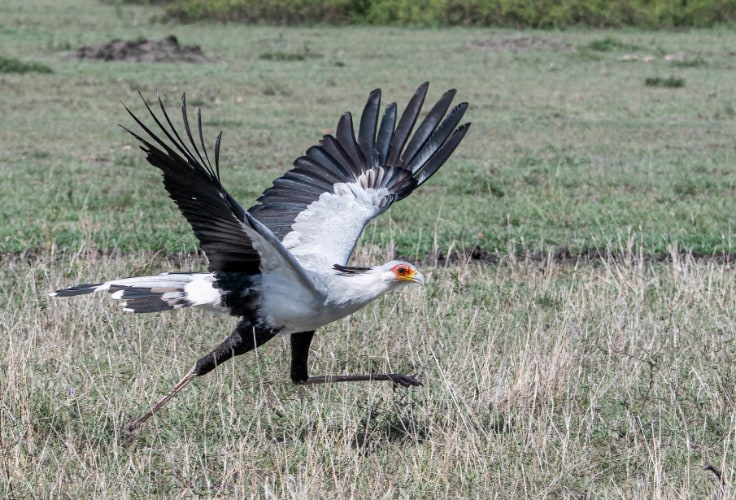
The species is confined to Africa south of the Sahara, where it occupies open savannas, grasslands, and lightly wooded regions that allow unobstructed movement on the ground. It is largely resident, with movements influenced more by rainfall and prey availability than by seasonal migration. Nesting takes place in trees, often acacias, where large stick nests are built high above the ground and reused over multiple years. Its strong reliance on open terrain and terrestrial hunting makes it especially sensitive to habitat change.
Rather than fitting neatly into the patterns defined by other birds of prey, the Secretarybird represents an alternative raptor strategy built around size, height, and ground-based pursuit. Its combination of long legs, endurance on foot, and powerful strikes illustrates how birds of prey can occupy predatory roles far removed from aerial hunting, expanding the ecological scope of raptors as a whole.
Recognizing Birds of Prey in the Field
Birds of prey are a familiar presence in many landscapes, yet they vary widely in how they look and move. While all share the basic tools of a predator, their differences become clear in the field. For casual observers, birds of prey are often best identified by overall shape and behavior rather than fine detail. Broad or narrow wings, long or short tails, the way a bird soars, hunts low over the ground, dives into water, walks on land, or gathers at carcasses can quickly point to a particular group. Paying attention to posture, flight style, and how a bird uses its surroundings provides a practical way to recognize birds of prey and understand their role in the landscape.