
New Hampshire supports 11 species of owls, shaped by its position between temperate forests and the southern edge of the boreal zone. These include four regular resident species that occur predictably across forested landscapes, towns, and rural areas throughout the year, alongside a larger group of irregular or seasonal owls that appear mainly as winter visitors, migrants, or episodic incursions from farther north and may be highly localized or absent in some years. This guide provides identification notes and state-specific context on habitat use, distribution, and seasonal occurrence for all owl species recorded in New Hampshire.
Barred Owl
Strix varia
- Identification: Large gray-brown owl with a rounded head, dark eyes, a well-defined facial disc, and brown-and-white barred and streaked plumage across the head, breast, and underparts.
- Where found: Widespread across New Hampshire in forested landscapes, especially mature hardwood-mixed forests and wooded swamps.
- How to spot: Listen at dusk or night for the distinctive “Who cooks for you?” call, or look for a broad, rounded owl gliding quietly through forest interiors or roosting motionless on shaded branches.
- Conservation status: Least Concern (IUCN); common and increasing in New Hampshire, though dependent on intact forest habitat and sensitive to fragmentation.

The Barred Owl is the most common and widespread owl in New Hampshire and has occupied that position for at least the past two centuries. It measures 43 to 50 centimeters (16.9 to 19.7 inches) in length and has a large, broad-bodied build with a rounded head lacking ear tufts, dark brown eyes, and a yellow bill set within a full facial disc. Plumage is gray-brown overall, with brown-and-white barring across the head and upper breast that transitions to bold vertical streaking on the lower underparts, creating effective camouflage in shaded forest interiors. The species belongs to a group of woodland owls adapted to maneuvering within closed-canopy forests, and its frequent vocal activity makes it especially conspicuous despite its largely nocturnal habits.
In the field, Barred Owls are most often detected by voice rather than by sight. Their well-known hooting call, commonly rendered as “Who cooks for you? Who cooks for you-all?,” carries long distances through forested wetlands and mature woods and is given frequently, especially during the breeding season. Birds typically roost quietly in dense cover during daylight hours and become active at dusk, moving through the forest with slow, buoyant, silent flight. The species hunts mainly from elevated perches and feeds primarily on small mammals such as mice, chipmunks, and squirrels, while also taking birds and amphibians when available.
In New Hampshire, the Barred Owl is a year-round resident distributed statewide wherever sufficiently large forest blocks occur. It is strongly associated with hardwood and mixed forests, spruce-fir stands, wooded swamps, and riparian corridors, often where dense forest cover lies adjacent to open areas used for hunting. The species occurs from lowland river valleys to upland forests and has been recorded at elevations up to approximately 910 meters (3,000 feet). Although primarily resident, historical and modern records indicate periodic fall and winter movements or incursions, particularly in years when prey populations decline farther north, leading to temporary increases in numbers detected during winter surveys.
The Barred Owl remains abundant across New Hampshire, with long-term monitoring indicating a slowly increasing population overall. Breeding Bird Survey data and atlas projects consistently identify it as the state’s most frequently recorded owl. Annual fluctuations are pronounced and are closely tied to variation in small mammal populations and winter weather conditions that influence hunting success, including deep snow or icy crusts. Despite its adaptability, the species depends on mature, unfragmented forest habitat with suitable roosting and nesting sites, making habitat loss and fragmentation the principal long-term threats within the state.
Great Horned Owl
Bubo virginianus
- Identification: Large, powerful owl with broad wings, prominent ear tufts, striking yellow eyes, a white throat patch, and a mottled mix of brown, buff, and black.
- Where found: Year-round resident but localized across New Hampshire, mainly in open forests, forest edges, and landscapes near fields, wetlands, and orchards.
- How to spot: Listen at dawn or dusk for deep, multi-note hoots, or watch for a thick-bodied owl perched on exposed limbs along woodland edges.
- Conservation status: Least Concern (IUCN); present statewide but showing recent declines based on state-level monitoring.
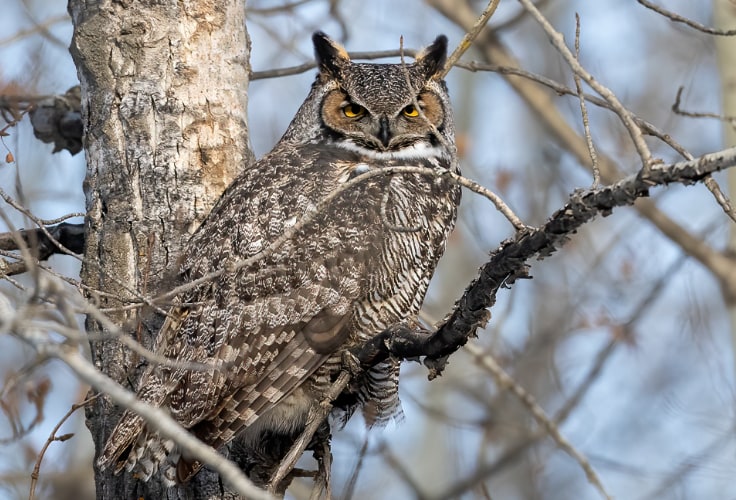
The Great Horned Owl is the largest regularly breeding owl in New Hampshire and is widely distributed across the state, though it is encountered less frequently than the Barred Owl. This species measures 46 to 63 centimeters (18.1 to 24.8 inches) in length and has a large, thick-bodied build with a broad head, prominent ear tufts, and large yellow eyes set within a well-defined facial disc. Plumage is heavily mottled in brown, buff, and black, with a contrasting white throat patch that is often conspicuous when the bird is calling. Its size, strength, and ability to exploit a wide range of prey place it among the dominant raptors wherever suitable habitat occurs.
In the field, Great Horned Owls are most reliably detected by their deep, resonant hooting, typically delivered in a slow series of four to six notes. The call carries long distances and is most often heard at dusk and dawn, with vocal activity increasing in late fall and winter as pairs reestablish territories. Birds usually perch upright on exposed branches, snags, poles, or fence posts overlooking open areas, and their flight is strong and deliberate, with deep wingbeats and short glides. Hunting occurs almost entirely at night, with prey taken from the ground or from elevated perches. In New Hampshire, the diet is dominated by mammals, including medium-sized species, with birds, often larger species such as waterfowl or nestlings of other birds, taken opportunistically.
Within New Hampshire, the Great Horned Owl is a year-round resident but has a more restricted and patchy distribution than several other owl species. It is most closely associated with open forests, forest edges, grasslands, large wetlands, orchards, and agricultural landscapes, and it is generally scarce or absent from extensive, unbroken forest interiors. The species occurs statewide, including the coastal plain, river valleys, and interior lowlands, but is less consistently recorded in heavily wooded portions of the White Mountains. Nesting typically takes place very early in the year, often beginning in mid to late winter, with birds frequently using abandoned stick nests of other large birds, particularly in coniferous trees such as Eastern White Pine.
The Great Horned Owl is present across much of New Hampshire, but its abundance and population trends show mixed signals when viewed across long-term and recent monitoring efforts. Historical accounts describe it as fairly common and widely distributed for more than two centuries, with some evidence of modest long-term increases linked to expanding edge habitats. In contrast, recent state-level assessments indicate a declining trend, likely reflecting habitat loss and fragmentation, along with exposure to pesticides through contaminated prey. The species’ large home ranges and low detectability also complicate monitoring, meaning individuals may be present but overlooked. Despite these pressures, the owl continues to persist across much of the state wherever suitable open forest and edge habitats remain.
Eastern Screech-Owl
Megascops asio
- Identification: Small, stocky owl with prominent ear tufts, yellow eyes, and gray or rufous plumage marked with intricate bars and spots that closely resemble tree bark.
- Where found: Year-round resident in southern New Hampshire, mainly in the coastal plain, lower Merrimack Valley, and parts of the southwestern Connecticut River region.
- How to spot: Listen at night for a monotonic trill or descending whinny, or check tree cavities and nest boxes in wooded neighborhoods and forest edges.
- Conservation status: Least Concern (IUCN); locally uncommon in New Hampshire but stable overall, with evidence of increase since the 1980s in southern parts of the state.

The Eastern Screech-Owl is the most frequently encountered small owl in developed and edge-dominated landscapes of the southern part of the state. It measures 16 to 25 centimeters (6.3 to 9.8 inches) in length and has a compact, broad-headed build with prominent ear tufts, yellow eyes, and a short, square tail. Plumage occurs in two primary color morphs, gray and rufous, both marked with intricate bars, streaks, and spots that closely resemble tree bark. In New Hampshire, the gray morph predominates, while rufous individuals occur much less frequently. The species’ small size and bark-mimicking appearance make it difficult to detect visually even where it is known to occur.
In the field, Eastern Screech-Owls are far more often heard than seen. Their most characteristic vocalizations include a steady, monotonic trill used for close-range communication and a descending whinny associated with territorial defense, both of which can be given by either sex. Calling is most frequent in spring, particularly in April and May, but may also be heard during other parts of the year. At night, birds move through the lower canopy with rapid wingbeats, hunting from low perches and taking a wide variety of prey, including invertebrates, small mammals, and small birds, often near forest edges, lawns, or lightly developed areas.
In New Hampshire, the Eastern Screech-Owl occurs near the northern limit of its continental range and has a distinctly patchy distribution. It is primarily confined to the coastal plain, the lower Merrimack River valley, and parts of the southwestern Connecticut River watershed, with the densest concentrations in the southeastern portion of the state. Records extend northward into the Lakes Region and, less regularly, toward the southern edge of the White Mountains, but the species is absent from most heavily forested northern uplands. It is a year-round resident where it occurs, relying on tree cavities, old woodpecker holes, and nest boxes for both nesting and roosting.
The Eastern Screech-Owl is considered regular but uncommon in New Hampshire, with long-term patterns showing substantial historical fluctuation. The species declined markedly in the early 20th century as landscapes shifted toward more continuous forest, but evidence from atlases, winter counts, and local reports indicates a gradual increase since the 1980s, particularly in southern counties. Current populations appear stable, though likely underdetected due to the owl’s small size and secretive habits. Primary threats in the state include collisions with vehicles and exposure to contaminants, while the retention of cavity-bearing trees and the use of nest boxes continue to support local populations in developed and semi-wooded landscapes.
Northern Saw-whet Owl
Aegolius acadicus
- Identification: Very small, round-headed owl with a catlike facial disc, bright yellow eyes, brown upperparts spotted with white, and white underparts boldly streaked with brown.
- Where found: Widespread across New Hampshire in forested habitats, breeding mainly in northern and upland regions and occurring more broadly during migration and winter.
- How to spot: Listen at night from late winter through spring for a sharp, repetitive “too-too-too” call, or look for a small owl roosting low in dense conifers, sometimes revealed by mobbing songbirds.
- Conservation status: Least Concern (IUCN); widespread and regular across the state, though population size and trends are difficult to assess due to secretive behavior and variable migratory movements.

The Northern Saw-whet Owl is the smallest owl found in New Hampshire and one of the most elusive forest species in the state. This tiny owl measures 18 to 22 centimeters (7.1 to 8.7 inches) in length and has a compact body, a large, rounded head without ear tufts, and bright yellow eyes set within a crisp facial disc. Plumage is brown above with white spotting on the crown, nape, and wings, and pale below with bold brown streaking, a pattern that provides excellent camouflage against tree trunks and dense conifer foliage. Its small size and bark-matching coloration allow it to remain well hidden during daylight hours even in areas where it is present.
In the field, Northern Saw-whet Owls are best located by their vocalizations. Their characteristic advertising call is a steady, high-pitched “too-too-too” given at regular intervals, most frequently from late winter through spring as males establish territories. During the day, birds roost quietly in dense conifers or thick understory, often close to the trunk and sometimes at eye level, where they may be revealed only when mobbed by chickadees, titmice, or other small birds. The species hunts almost exclusively at night, flying low with quick, maneuverable wingbeats and taking small mammals, especially mice, from low perches along forest edges and openings.
In New Hampshire, the species breeds across much of the state, particularly in spruce-fir forests, mixed hardwood-conifer woodlands, and forested uplands. Breeding occurs from northern regions and higher elevations southward into suitable forest blocks statewide, including parts of the Lakes Region and interior river valleys. In the state, Northern Saw-whet Owls show partial migratory behavior: some individuals remain year-round, while others move south or arrive from farther north in fall and early winter. Migrants are most often detected in October and November and again from February through March, with numbers varying widely from year to year, likely in response to prey availability on breeding grounds.
The Northern Saw-whet Owl is considered widespread and moderately common in New Hampshire, though it is likely more numerous than records alone suggest. Its secretive habits, nocturnal behavior, and irregular migratory movements make population trends difficult to assess, leading to considerable uncertainty in abundance estimates. Habitat loss and fragmentation remain the primary long-term threats, particularly the reduction of mature forest structure and cavity availability. Despite these challenges, the species persists across the state, and the protection of large, unfragmented forest blocks continues to be the most important conservation measure for maintaining viable populations.
Short-Eared Owl
Asio flammeus
- Identification: Medium-sized owl with a pale facial disc, black-rimmed yellow eyes, very small ear tufts, mottled brown-and-buff upperparts, streaked pale underparts, and broad wings showing a dark mark at the wrist in flight.
- Where found: Very uncommon migrant and occasional winter visitor in New Hampshire, occurring mainly in open coastal habitats and, less often, inland river valleys.
- How to spot: Search open fields and marshes at dawn or dusk for a low, buoyant, mothlike flight over vegetation, or watch for birds perched directly on the ground.
- Conservation status: Least Concern (IUCN); rare in New Hampshire and declining historically, reflecting long-term loss of open grassland and marsh habitats.

The Short-Eared Owl is an uncommon open-country owl in New Hampshire and one of the few owl species regularly seen flying in daylight when it occurs. The species measures 34 to 43 centimeters (13.4 to 16.9 inches) in length and has a medium-sized, lightly built form with a rounded head, very small and often inconspicuous ear tufts, and large yellow eyes set in a pale facial disc outlined by dark eye patches. Plumage is mottled brown and buff above, with pale underparts marked by vertical streaking, and the broad wings show a distinctive dark mark near the wrist that is conspicuous in flight. Its structure and flight style make it immediately distinctive among North America’s owls.
In the field, Short-Eared Owls are most often detected by their characteristic behavior. These owls hunt by coursing low over open ground with slow, buoyant wingbeats and frequent changes in direction, often resembling a large moth or bat as they quarter fields and marshes. Activity peaks at dawn and dusk, but birds may also hunt during the day, especially in winter. They feed primarily on small mammals, particularly voles, which are taken from the ground after low searching flights or brief hovers, and they often rest directly on the ground or on low hummocks within open habitats.
In New Hampshire, the Short-Eared Owl occurs primarily as a spring and fall migrant and as an occasional winter visitor. Records are strongly concentrated along the coast, where birds appear in salt marshes, coastal grasslands, and open fields, with far fewer inland reports from river valleys such as the Merrimack and Connecticut. Migration occurs mainly from mid-September through November and again from March into April, while winter occurrences are irregular and usually involve only one or a few individuals. There is no substantiated evidence of regular breeding in the state, and any historical nesting is considered unproven.
The species is now rare in New Hampshire and appears to have declined markedly since the 19th century, a pattern closely tied to the long-term reduction of grasslands, pastures, and other open habitats. Although the Short-Eared Owl was likely a more regular migrant in the past, modern records are few and typically involve small numbers. Occasional influxes during irruption years in neighboring states are only weakly reflected in New Hampshire. Continued loss and fragmentation of open landscapes remain the primary limiting factors, making the protection and maintenance of large, undisturbed coastal and grassland habitats essential for the species’ continued occurrence in the state.
Long-Eared Owl
Asio otus
- Identification: Medium-sized, slender owl with long, upright ear tufts, yellow eyes, a buff facial disc with pale eyebrows, mottled brown-and-buff upperparts, and streaked pale underparts.
- Where found: Local in New Hampshire in open landscapes near dense woodland, especially along the coast and in river valleys, occurring mainly as a migrant and occasional winter visitor.
- How to spot: Listen at night in spring for long series of low hoots, or search dense evergreen stands and thickets near open fields for well-camouflaged roosting birds.
- Conservation status: Least Concern (IUCN); very rare in New Hampshire, with few modern records and an uncertain population trend.
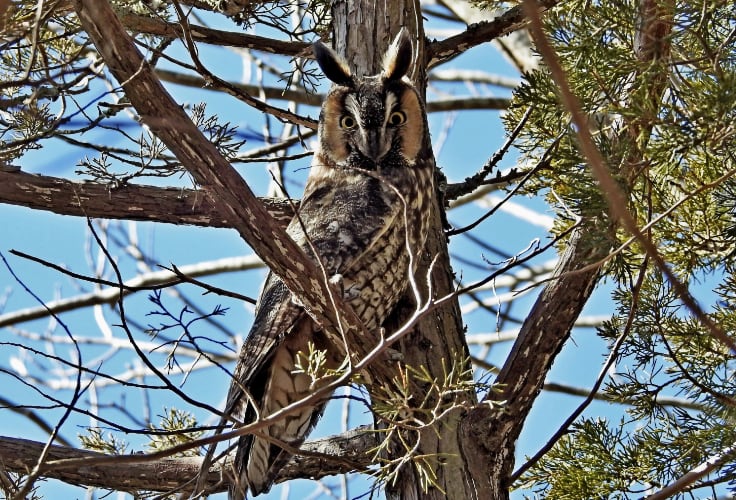
The Long-Eared Owl is one of the most elusive and least frequently observed owls in New Hampshire. It measures 35 to 40 centimeters (13.8 to 15.7 inches) in length and has a slender, medium-sized build with long, narrow ear tufts, yellow eyes, and a buff facial disc marked by pale vertical accents between the eyes. Plumage is finely mottled in brown, gray, and buff, with darker streaking on the pale underparts, creating effective camouflage in dense foliage. Its narrow profile and preference for concealed roosts make visual detection especially difficult.
In the field, Long-Eared Owls are best located by their vocalizations. Males give long, evenly spaced sequences of low hooting notes that carry considerable distances on calm nights, most often during spring. Away from the breeding season, the species is typically silent and remains hidden during the day, roosting close to tree trunks within dense conifers or thick deciduous cover. At dusk, individuals emerge to hunt over adjacent open areas, flying low with slow, deliberate wingbeats and long glides while searching for small mammals.
In New Hampshire, the Long-Eared Owl is rare and irregular, occurring primarily as a spring and fall migrant and as an occasional winter visitor. Records are scattered statewide but are slightly more frequent near the coast and in river valleys, where suitable combinations of open foraging habitat and dense roosting cover occur. Breeding has been documented only sporadically and has not been confirmed in recent decades, with no verified nests reported since the mid-1980s. Seasonal occurrence peaks in March through May and again in September through November, consistent with migratory movements through the region.
The Long-Eared Owl is among the rarest regularly occurring owl species in New Hampshire, and its true status remains difficult to assess. Historical accounts suggest it may once have been more frequent, but records have declined over time despite increased observer effort, indicating a genuine reduction in occurrence. Loss of open grassland habitats combined with the reduction of dense roosting cover likely contributes to its scarcity. Given the very small number of modern records, the species’ continued presence in the state likely depends on the availability of intact habitat mosaics that support both prey populations and secure daytime roosts.
Snowy Owl
Bubo scandiacus
- Identification: Large white owl with yellow eyes, a rounded head, and variable dark barring that is heavier on females and young birds and reduced or absent on older males.
- Where found: Irregular winter visitor to New Hampshire, occurring mainly along the coast and locally inland in open landscapes such as beaches, airports, and large fields.
- How to spot: Scan wide, open areas for a pale owl perched on the ground, dunes, posts, or structures, or watch for low, buoyant flights over open terrain.
- Conservation status: Vulnerable (IUCN); declining globally, with wintering birds in New Hampshire facing risks from climate change and human-associated hazards.

The Snowy Owl is among the most iconic and conspicuous winter visitors to New Hampshire, appearing irregularly from the Arctic during some winters and drawing widespread attention when present. It measures 52 to 71 centimeters (20.5 to 28.0 inches) in length and is a very large owl with a broad body, rounded head, and striking yellow eyes. Plumage varies markedly by age and sex, ranging from nearly pure white in older males to heavily barred and spotted in females and immature birds. Dense feathering on the legs and toes provides insulation, and the overall structure reflects its adaptation to open, treeless environments.
In the field, Snowy Owls are typically detected visually rather than by sound. They often perch conspicuously on the ground, dunes, hay bales, fenceposts, airport structures, or other elevated features in open landscapes, remaining motionless for long periods while surveying for prey. Flight is usually low, slow, and buoyant, with deep wingbeats interspersed with glides, though it can become fast and direct when pursuing prey. Vocalizations are rarely heard in New Hampshire, as most birds encountered are non-breeding immatures or wintering adults, but the species is capable of deep hoots and sharp barks on breeding territories.
In New Hampshire, the Snowy Owl is an irregular winter visitor that occurs in most years, with numbers varying greatly from year to year. Most reports occur between November and March, with peak abundance during major irruptions linked to prey conditions on the Arctic breeding grounds. The species is strongly concentrated along the coast, especially at sites such as Hampton Beach, Rye Harbor, and the Isles of Shoals, where open, flat terrain resembles tundra habitat. Inland records occur primarily at airports, large agricultural fields, and open river valleys, while reports north of the White Mountains are comparatively few. During irruption years, multiple individuals may be present simultaneously in favorable coastal localities, whereas in non-irruption winters only a small number of birds may be recorded statewide.
The species’ occurrence in New Hampshire reflects broader population fluctuations rather than local breeding or residency. Long-term historical accounts document major incursions prior to the mid-20th century, with smaller and less frequent invasions since 1950, despite regular annual occurrence. Most individuals wintering in the state are immatures, particularly females, which tend to move farther south than adult males. Although many birds pass the winter without incident, threats in New Hampshire include vehicle and aircraft collisions, disturbance in heavily visited coastal areas, and exposure to toxins through prey. Climate change poses a larger, indirect risk by altering Arctic habitat and prey dynamics, which in turn affects both reproductive success and the frequency of southward movements into the state.
Boreal Owl
Aegolius funereus
- Identification: Small owl with a large head, a grayish-white facial disc bordered in brown, bright yellow eyes, brown upperparts with white spotting, and white underparts heavily streaked with brown.
- Where found: Very rare and irregular in New Hampshire, occurring mainly in the White Mountains and adjacent high-elevation forests, chiefly in winter and exceptionally as a breeder.
- How to spot: Listen on late-winter nights for the male’s rapid, hollow series of hoots, or search dense conifer forest for a small owl roosting close to tree trunks.
- Conservation status: Least Concern (IUCN); extremely rare in New Hampshire, with occurrence tied to boreal habitat availability and episodic incursions from the north.

The Boreal Owl is one of the rarest and least frequently encountered owl species in New Hampshire and represents a primarily boreal element at the extreme southern edge of its range. It measures 21 to 28 centimeters (8.3 to 11.0 inches) in length and is a small but large-headed owl with a square-faced appearance, short tail, and relatively long wings. Plumage is brown above with prominent white spotting and pale scapular patches, while the underparts are whitish with bold brown streaking. The facial disc is pale grayish white, sharply outlined in dark brown and accented by raised white “eyebrows,” giving the species a distinctive, alert expression.
In the field, Boreal Owls are seldom detected visually and are more often identified by sound during periods of vocal activity. Males produce a rapid, hollow series of hooting notes during late winter and early spring, which can carry long distances through dense conifer forest. During the day, individuals roost quietly close to tree trunks or within dense branches, relying on their cryptic plumage for concealment. The species hunts primarily at night, using short, direct flights between low to mid-level perches to capture small mammals, and may occasionally hunt during daylight under low-light conditions.
In New Hampshire, the Boreal Owl is a very rare and irregular winter visitor, with most records occurring between November and March during years of broader incursions in northeastern North America. The species is strongly associated with high-elevation spruce-fir forests of the White Mountains, particularly within the White Mountain National Forest, and reports from lower elevations are exceptional. A single confirmed breeding event occurred in summer 2001, when adults and juveniles were documented near 1,250 meters (4,100 feet) elevation on Mount Monroe, representing the first verified breeding record for the state and the eastern United States. Additional observations from nearby peaks during the same period suggest the possibility of extremely rare and sporadic nesting in suitable high-elevation habitat.
The Boreal Owl’s status in the state reflects its position at the fringe of its continental range and the scarcity of appropriate boreal habitat. Historical and modern records indicate long periods with no detections punctuated by occasional incursions involving small numbers of birds. Even during incursion years, the species remains difficult to detect due to its nocturnal behavior and preference for dense forest. The long-term persistence of Boreal Owls in New Hampshire likely depends on the continued availability of mature, high-elevation conifer forest and cavity-bearing trees, as well as broader population dynamics in the boreal zone to the north.
Northern Hawk-Owl
Surnia ulula
- Identification: Medium-sized owl with a long tail, short pointed wings, brown upperparts spotted with white, a narrowly bordered facial disc, and white underparts marked by heavy brown barring.
- Where found: Rare and irregular fall and winter visitor to New Hampshire, occurring mostly in the northern part of the state.
- How to spot: Look for a diurnal owl perched atop tall trees scanning open ground, or watch for fast, low, falcon-like flights over fields and clearings.
- Conservation status: Least Concern (IUCN); very rare in New Hampshire, with occurrence tied to irregular southward movements from boreal regions.

The Northern Hawk-Owl is one of the most distinctive and less commonly seen owls in New Hampshire, appearing only during occasional southward movements from its boreal range. It measures 36 to 45 centimeters (14.2 to 17.7 inches) in length and has a medium-sized, thickset body with a long, tapered tail and short, pointed wings. The species’ overall structure and posture recall a small hawk more than a typical owl, an impression reinforced by its upright stance and conspicuous daytime activity. Plumage is brownish-black above with heavy white spotting and pale scapular patches, while the underparts are white with bold brown barring.
In the field, Northern Hawk-Owls are most readily identified by behavior. Unlike most owls, they are strongly diurnal and frequently hunt by day, perching on the tops of trees or utility poles to scan surrounding terrain for prey. When hunting, they launch into fast, direct, low flights punctuated by deep, powerful wingbeats, often gliding briefly before dropping toward prey. Their hunting style is primarily visual, and they use elevated vantage points to detect small mammals in open or sparsely vegetated areas. Vocalizations are seldom reported in New Hampshire, as most individuals occur outside the breeding season.
In New Hampshire, the Northern Hawk-Owl is a rare and irregular visitor in late fall and winter, with most records falling between November and March. Reports are concentrated in the northern part of the state, particularly in Coos County and adjacent areas, though occasional individuals have been documented farther south during broader movements. The species does not breed in New Hampshire and appears only during years when birds disperse southward from boreal regions, often in association with prey fluctuations farther north. Even during these periods, numbers remain low, and there have been no large-scale incursions comparable to those recorded in the late nineteenth and early twentieth centuries.
The scarcity of Northern Hawk-Owls in New Hampshire reflects both the species’ low density and the limited extent of suitable open boreal habitat within the state. Historical records document periodic influxes during major irruption years, but modern reports since 1950 indicate continued rarity, with only small numbers recorded during favorable winters. Because occurrences are irregular and unpredictable, long-term trends within the state are difficult to assess. The species’ continued appearance in New Hampshire likely depends on broader boreal population dynamics and the availability of open hunting habitat during occasional southward movements.
Great Gray Owl
Strix nebulosa
- Identification: Very large gray owl with a broad, rounded head, long tail, fine gray-brown barring and streaking, and a large circular facial disc marked with pale arcs and a white “bow tie.”
- Where found: Very rare winter visitor to New Hampshire, occurring irregularly during incursions, with records scattered statewide.
- How to spot: Look for a massive gray owl perched quietly along woodland edges or open areas, or watch for slow, buoyant flight during daylight or at dusk.
- Conservation status: Least Concern (IUCN); extremely rare in New Hampshire, with occurrences linked to periodic southward movements from boreal regions.

The Great Gray Owl is one of the rarest owl species recorded in New Hampshire and appears only during infrequent winter incursions from its boreal range. It measures 61 to 84 centimeters (24.0 to 33.1 inches) in length and is the tallest owl species in the world, though its great size is largely the result of dense plumage rather than body mass. The species has a massive, rounded head, an exceptionally large circular facial disc, and a long, wedge-shaped tail that contributes to its imposing silhouette. Plumage is predominantly soft gray, finely patterned with brown and white streaking, with barred wings and tail and a pale facial disc marked by concentric rings and a distinctive white “bow tie” at the throat, providing effective camouflage in forested landscapes.
In the field, Great Gray Owls are often detected by their size and behavior. They typically perch motionless on low to mid-level branches, snags, or fence posts bordering open areas, remaining still for long periods. Flight is slow, deep-winged, and buoyant, with a deliberate, almost floating quality. Vocalizations are rarely reported in New Hampshire, as most individuals occur outside the breeding season, but the species is capable of producing low, evenly spaced hoots near nesting areas. Hunting is conducted primarily from perches, with birds listening intently for small mammals and plunging through snow to seize prey concealed beneath the surface.
In New Hampshire, the Great Gray Owl is a very rare and irregular winter visitor, with records concentrated in years of broader regional incursions. Reports span much of the state and occur in both inland and coastal areas, reflecting wandering individuals rather than consistent habitat use. Most occurrences fall between late autumn and early spring, though the timing and number of records vary widely among years. The species does not breed in New Hampshire, and there is no evidence of regular seasonal presence.
The species’ scarcity in New Hampshire reflects its position well south of the core breeding range and the limited extent of suitable boreal habitat within the state. Historical accounts suggest that the species may have been slightly more numerous during major incursions in the 19th century, but modern records remain sporadic and involve very small numbers of birds. Because occurrences are unpredictable and infrequent, population trends within the state cannot be assessed reliably. The owl’s appearance in New Hampshire depends largely on prey fluctuations and winter conditions in boreal regions farther north.
American Barn Owl
Tyto furcata
- Identification: Medium-sized owl with a pale, heart-shaped facial disc, long rounded wings, short tail, long sparsely feathered legs, and buff-and-gray upperparts contrasting with whitish underparts.
- Where found: Extremely rare in New Hampshire, occurring at the far northeastern edge of its range, primarily in lowland river valleys and agricultural areas.
- How to spot: Watch for a ghostly pale owl flying low over open fields at night, or listen for its harsh, rasping scream near barns, silos, or other quiet structures.
- Conservation status: Least Concern (IUCN); extremely rare in the state, limited by climate, habitat availability, and scarcity of suitable nesting sites.

The American Barn Owl is the rarest owl species recorded in New Hampshire and represents a true milestone observation for advanced birders in the state. It measures 32 to 40 centimeters (12.6 to 15.7 inches) in length and has a distinctive, long-legged, lightly built appearance unlike any other North American owl species. The large, rounded head bears a pale, heart-shaped facial disc, while the body is supported by long, softly rounded wings and a short tail. Plumage is warm buff and gray above and largely whitish below, creating a striking contrast that gives the owl its ghostlike appearance in low light.
In the field, Barn Owls are most often detected by sound rather than sight. Instead of hooting, they produce a long, harsh, rasping scream that carries well through quiet nighttime landscapes. Flight is buoyant and silent, with slow, deep wingbeats as birds quarter low over open ground. They hunt primarily by sound, using exceptionally precise hearing to locate small mammals concealed in vegetation, and drop directly onto prey from low flight. Their long legs and talons are well adapted for seizing rodents, which make up the bulk of their diet.
In New Hampshire, the Barn Owl is an extremely rare visitor and breeder at the extreme northeastern edge of its continental range. Records are concentrated in lowland agricultural areas, particularly within the Merrimack River and Connecticut River watersheds, where open fields and farm structures resemble more typical habitat farther south. Only one confirmed breeding record exists for the state, involving a pair with young in a barn silo at Hollis in late summer 1977. Additional records consist of isolated sightings and specimens, mostly from autumn through winter, with no evidence of regular seasonal presence or sustained population establishment.
In New Hampshire, Barn Owls occur only at the limits imposed by climate and by the limited extent of suitable open habitat and nesting structures. At this latitude, harsh winters likely restrict survival, and the decline of traditional farm buildings further reduces nesting opportunities. Although populations have increased slightly in parts of southern New England, occurrences in New Hampshire remain exceptional and sporadic. Given the very small number of records, the species’ presence in the state is best regarded as incidental, dependent on rare dispersal events rather than indicating a stable or expanding population.
Where and When to See Owls in New Hampshire
Owls occur in New Hampshire year-round, but successful observation depends heavily on location, season, and habitat selection. Common resident species such as Barred Owl, Great Horned Owl, Eastern Screech-Owl, and Northern Saw-whet Owl can be encountered in most seasons, especially in forested landscapes with a mix of mature trees and open edges. Late winter through early spring is often the most productive period for detection, when territorial calling increases and snow cover improves visibility. By contrast, several of the state’s most sought-after owls, including Snowy Owl, Northern Hawk-Owl, Great Gray Owl, and Boreal Owl, appear only irregularly, typically during fall and winter movements tied to prey availability farther north.
Successful owl observation in New Hampshire depends on targeting appropriate habitats rather than expecting broad, predictable distribution. Coastal open areas, river valleys, agricultural lowlands, and large northern forest blocks each support different species assemblages. Many rare owls occur only during specific winters and may linger for weeks if food conditions are favorable, while others pass through quickly and quietly. Patience, repeated visits, and careful attention to habitat and timing are essential, particularly for advanced birders seeking milestone species.
Notable Areas for Owl Observation in New Hampshire
- New Hampshire Seacoast – Open beaches, dunes, and saltmarsh edges are the most reliable locations for wintering Snowy Owls and occasional Great Gray Owls during incursions.
- Hampton Beach State Park and Rye Harbor State Park – Frequently productive during Snowy Owl winters, with expansive open terrain and regular monitoring by birders.
- Isles of Shoals – Historically and presently one of the most consistent sites for Snowy Owls in New England during irruptive years.
- Merrimack River Valley – Agricultural lowlands and open fields support wintering owls and account for most records of American Barn Owl in the state.
- Connecticut River Valley – Open floodplains and farmland attract winter visitors and wandering boreal species in some years.
- White Mountain National Forest – The primary region for Boreal Owl records and the only area with confirmed breeding, as well as a focal point for Great Gray Owl occurrences during rare incursions.
- Coos County – Northern forests and open clearings offer the best chances for Northern Hawk-Owl and other boreal species during invasion years.
Owling in New Hampshire rewards persistence and restraint. Many species are best appreciated by listening rather than searching visually, and responsible observation, especially avoiding disturbance of rare wintering owls, is essential. While some owls are reliable annual residents, others may appear only a handful of times in a lifetime, making each encounter a reminder of the state’s position at the crossroads of temperate and boreal birdlife.


