
North America hosts a small but distinctive assemblage of cranes, dominated by two native breeding species and supplemented by a handful of exceptionally rare Eurasian vagrants. All cranes belong to the family Gruidae and are large, long-legged, long-necked birds closely tied to open wetlands, grasslands, and agricultural landscapes. While cranes are among the most conspicuous birds on the continent during migration and winter in key regions, their overall diversity is low compared to many other bird groups, making each species’ appearance especially notable.
This ID guide begins with the two regularly occurring native species and then transitions to rare and occasional visitors whose appearances represent milestone sightings for North American birders. Each account emphasizes practical, field-oriented identification, including structure, plumage, vocalizations, behavior, and habitat use, with particular attention to how vagrant species are most often encountered in association with native cranes and how they can be reliably distinguished under real-world viewing conditions.
Sandhill Crane
Antigone canadensis
- Identification: Large gray crane with long legs and neck, broad wings, a drooping feathered bustle over the tail, pale cheek, and a bare red crown in adults.
- Where found: Occurs widely across North America in wetlands, grasslands, prairies, agricultural fields, and shallow marshes, with both resident and migratory populations in the United States and Canada.
- How to spot: Look for tall, slow-walking birds in open landscapes or large flocks flying high in migration, and listen for loud, rolling trumpeting calls audible over long distances.
- Conservation status: Least Concern (IUCN); most populations are stable or increasing, but small isolated populations face habitat loss and remain of conservation concern.

The Sandhill Crane is the most widespread and frequently encountered crane species in North America and the only one that occurs regularly across much of the continent. It is a tall, imposing wading bird that measures 100 to 120 centimeters (39.4 to 47.2 inches) in height, with a wingspan of around 200 centimeters (78.7 inches). Its long legs, elongated neck, and broad wings give it a stately appearance, while its upright posture and slow, deliberate movements make it highly conspicuous in open habitats.
Adult sandhill cranes are mostly gray, often showing a rusty or cinnamon wash on the upperparts caused by contact with iron-rich soils during preening. The head is small relative to the body, with a straight, stout bill longer than the head and a distinctive area of bare red skin on the crown and forehead, which is present in all but first-year birds. Pale whitish cheeks contrast with the gray neck, and the short tail is largely hidden by elongated inner wing feathers that form a drooping “bustle” when the bird is standing. Sexes are alike in plumage, with males typically larger than females, though size overlap makes sex difficult to determine in the field. Juveniles lack the red crown and pale cheek and appear browner overall, with rusty-buff tones that gradually fade as they mature.

In the field, Sandhill Cranes are often detected by their voice as much as by sight. Their calls are loud, rolling, trumpeting or rattling notes that can carry for several miles, produced by an elongated trachea coiled within the sternum. Birds may be heard calling from the ground or in flight, sometimes in antiphonal duets between pair members. Sandhill Cranes usually forage by walking slowly through open ground, probing soil or shallow water with their bills and gleaning food from the surface. They feed on a wide variety of plant material, waste grain, seeds, invertebrates, and small vertebrates. During migration and winter, they form large flocks that may number in the thousands, often flying high with steady wingbeats and outstretched necks and legs.
Sandhill Cranes occupy an exceptionally broad range in North America. Three small populations are non-migratory: one confined to peninsular Florida and adjacent southeastern Georgia, one restricted to a small area of coastal Mississippi, and one occurring in Cuba outside the core North American range. All other populations are migratory. Breeding occurs widely across northern North America, from the Great Lakes region and northern United States through boreal Canada to Alaska, with additional breeding in the Rocky Mountains, Great Basin, Pacific Northwest, and parts of northern California. Breeding habitats include shallow freshwater wetlands, bogs, fens, wet prairies, tundra, and open marshes. During winter, migratory populations concentrate in the southern United States and northern Mexico, using river valleys, agricultural fields, managed wetlands, and wildlife refuges as foraging and roosting sites. Nests are placed on the ground in wetlands, often on low mounds or among emergent vegetation.
Overall, Sandhill Cranes are common and secure across much of their range, and many populations have increased since the mid-20th century following earlier declines caused by habitat loss and overexploitation. The species’ wide distribution and adaptability to agricultural landscapes have contributed to its recovery. However, population growth is slow because breeding pairs usually raise only one chick per year, and the species remains sensitive to large-scale wetland loss and changes in agricultural practices. Particular concern persists for the small, isolated populations in Mississippi and Florida, which depend on the protection and management of specialized wetland habitats. Despite these localized issues, the Sandhill Crane remains a widespread and iconic bird of North American open landscapes.
Whooping Crane
Grus americana
- Identification: Very large white crane with a long neck and legs, broad wings, black wingtips in flight, and a red crown with dark facial bristles in adults.
- Where found: Breeds in shallow wetlands in and around Wood Buffalo NP in northwestern Canada and winters mainly in coastal marshes and estuaries on the central Texas coast, with additional reintroduced populations in parts of the eastern United States.
- How to spot: Scan coastal marshes and migration stopovers for tall white birds moving with a stately walk, and listen for loud, far-carrying whooping or bugling calls; in flight, note the extended neck and black primaries.
- Conservation status: Endangered (IUCN); recovered from near-extinction but remains vulnerable, with ongoing threats that include wetland loss, collisions with power lines, and severe weather.

The Whooping Crane is the tallest bird in North America and one of the continent’s most iconic conservation success stories, having returned from the brink but still remaining rare and at risk. The species stands 120 to 150 centimeters (47.2 to 59.1 inches) tall, with very large individuals reaching roughly 160 centimeters (63 inches), and they show a wingspan of about 230 centimeters (91 inches). The body looks slender and long-necked at a distance, but it broadens into a pronounced feathered “bustle” at the rear, and the long legs trail well beyond the short tail in flight.
Adults are strikingly snowy white with black primaries and darker alulae (thumb feathers) that are most obvious in flight, while the wings look largely white when folded. The head shows bare red skin on the crown and a dark malar area with sparse black bristly feathers, and a darker wedge-shaped patch is typically visible on the nape, varying among individuals. The bill is stout and dark olive-gray, often lighter in the breeding season with pinkish tones at the base, and the legs and feet are dark gray-black. Sexes look alike in plumage, with males typically larger than females. Immatures appear whitish below but show mottled brownish-rust tones above and on the head, lacking the crisp adult head pattern.

In the field, Whooping Cranes draw attention through both posture and voice. They move with a smooth, stately walk, holding the head and neck erect and rather stiff, and they forage by browsing, probing, and gleaning rather than adopting the crouched, stealthy posture typical of herons. Flight uses shallow wingbeats, with soaring and long glides especially prominent during migration, and birds often travel in small groups or occur among much larger flocks of Sandhill Cranes. Their loud calls are central to detection and identification, including repeated single-note whoops and duet calling within pairs, with sound-carrying power enhanced by a long trachea coiled into the sternum.
The only naturally occurring, self-sustaining wild population nests in the Northwest Territories and adjacent Alberta, primarily within Wood Buffalo National Park, and winters along the Gulf Coast of Texas centered on Aransas National Wildlife Refuge and nearby coastal habitats. This population uses shallow, grassy wetlands for breeding and estuarine marshes, bays, and tidal flats in winter, sometimes also visiting nearby uplands and farmlands. Reintroduction efforts have also established additional wild populations, including a migratory population associated with Wisconsin breeding grounds and wintering areas in Florida, as well as a resident population in southwestern Louisiana. Across seasons, the species uses shallow wetlands and broad river flats as stopover habitats and may forage in flooded fields or harvested grain fields during migration.
Whooping Cranes remain scarce and dependent on sustained conservation action despite long-term recovery from historical lows. The core challenges include loss and degradation of wetland habitats, the species’ naturally slow population growth, and ongoing mortality risks such as power line collisions, severe coastal storms, contaminant events, and occasional shooting. Conservation efforts have relied on strict habitat protection in key refuges, wetland and water-level management, captive propagation, and reintroduction programs that support additional populations. Continued intensive management across breeding, migration, and wintering areas remains central to the species’ persistence in North America.
Common Crane
Grus grus
- Identification: Large slate-gray crane with black primaries, a black head and neck, a bold white stripe from behind the eye down the nape, and a small red crown patch.
- Where found: Breeds across northern Europe and Asia and winters south to Africa and southern Asia; in North America it occurs only as a rare and irregular visitor, most often detected within flocks of native cranes in the Central and Pacific flyways.
- How to spot: Search crane concentrations and scan carefully for the black head-and-neck pattern and wide white nape stripe, and listen for high-pitched, far-carrying rolling calls in flight.
- Conservation status: Least Concern (IUCN); globally stable and increasing, and North American records are best treated as exceptional vagrancy mixed with occasional escapes.

The Common Crane is a widespread Eurasian species but an accidental and often headline-level find in North America, where it appears only as a rare visitor among much larger flocks of native cranes. This large, long-legged wader measures 95 to 120 centimeters (37.4 to 47.2 inches) in length with a wingspan around 200 centimeters (78.7 inches). Its structure is broadly similar to Sandhill Crane, with an upright stance, long neck, and trailing legs in flight, but the head pattern is sharply different at close to moderate range.
Adults are mostly slate gray, with black primaries that show clearly in flight and contribute to a two-toned wing impression. The head and neck are dark, and the most diagnostic feature is a broad white stripe that begins behind the eye and runs down the side of the neck to the nape. A small red bare-skin patch sits on the crown in typical adults, and the eye is yellow to orange. Juveniles show a more uniformly feathered crown and a warmer brown cast to the body with yellowish-brown tipping, and they lack the crisp adult head pattern; full adult plumage is reached in the third year.

In the field, the key challenge in North America is not recognizing the species up close, but detecting it at all when it is embedded in flocks of Sandhill Cranes. At distance, a Common Crane feeding with its head down can look surprisingly similar in shape and body tone to a Sandhill, especially in flat light, so careful scanning for the bold white nape stripe and darker head and neck is essential. This contrast is also a quick separation from Whooping Crane, which is overwhelmingly white with black wingtips rather than gray-bodied. Common Cranes give high-pitched, penetrating, far-carrying calls, including a deep rolling “krro” or “karr” often heard in flight, and pairs may duet with loud trumpeting phrases.
Globally, the species breeds from Scandinavia and northeastern Europe across Russia to northern China and the Russian Far East, and winters widely from western Europe to Africa, the Middle East, and southern Asia. It nests in shallow wetlands and commonly forages in agricultural fields and pastures outside the breeding season. In North America, records are scattered and irregular, and observers should expect the bird most often as a single individual associating with Sandhill Cranes, especially in major migration and wintering concentrations. Many well-known sightings have occurred along the Central Flyway, including among Sandhill congregations on the Platte River in Nebraska in March and April and at wintering sites such as Bosque del Apache National Wildlife Refuge in New Mexico, and accepted records also include Alaska, the Great Plains, and California. Documentation has shown that some reports in the United States involved escapes, but multiple records are generally treated as wild, likely involving birds that joined Sandhill Crane flocks in northeastern Asia and then moved south with them.
Throughout its native Eurasian range, the Common Crane maintains a large and increasing population, while in North America it occurs only as a rare and irregular vagrant, with careful documentation advised because of the potential for escape origin.
Hooded Crane
Grus monacha
- Identification: Medium-sized gray crane with a fully white neck and head, contrasting dark facial area, a small red bare-skin patch on the forecrown, and black primaries.
- Where found: Breeds in northeastern Asia and winters in East Asia; in North America it is an extremely rare visitor, recorded only a handful of times, usually among flocks of Sandhill Cranes.
- How to spot: Scan crane flocks carefully for a smaller gray crane with a clean white neck and head pattern, lacking the red crown of Sandhill Crane and the all-white body of Whooping Crane.
- Conservation status: Vulnerable (IUCN); the global population is limited and concentrated at few wintering sites, and North American occurrences represent exceptional long-distance vagrancy.
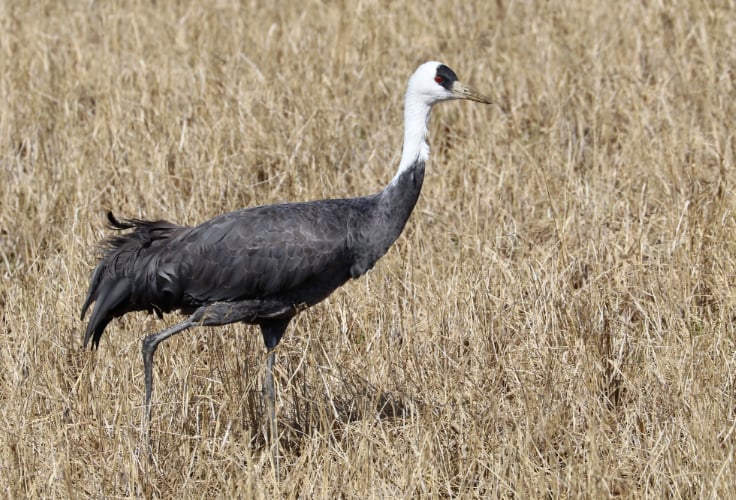
The Hooded Crane is one of the rarest and most remarkable crane species ever recorded in North America, representing a true milestone sighting for observers. This species measures 91 to 100 centimeters (35.8 to 39.4 inches) in length with a wingspan around 180 centimeters (70.9 inches). Its proportions are slimmer and more compact than those of larger North American cranes, and its distinctive head pattern immediately sets it apart when seen well.
Adults are mostly gray, with black primaries that show clearly in flight. The head and neck are strikingly patterned, with a white head and neck forming a hood-like appearance that contrasts sharply with the dark facial area, and a small patch of bare red skin on the forecrown. The eye is orange to red, adding to the sharp facial contrast. Sexes are similar in appearance, though males are slightly larger on average. Juveniles show brownish-tinged plumage with a darker, feathered crown and less sharply defined head markings.

In the field, Hooded Cranes behave much like other cranes, walking deliberately while probing and picking food from the ground or shallow water. They are usually silent while feeding but can give loud, rolling, high-pitched calls that carry over long distances. For North American birders, the greatest challenge is detection rather than identification: when feeding with heads down among Sandhill Cranes, a Hooded Crane can blend in surprisingly well at long range. Careful attention to the fully white neck and head, combined with the smaller size and lack of a red crown, is essential. Unlike Whooping Crane, which is overwhelmingly white-bodied, the hooded crane remains gray overall.
Globally, the species breeds in isolated wetlands of southeastern Russia and northeastern China, favoring bogs and forested marshes, and winters mainly in Japan, Korea, and eastern China, where it uses river margins, shallow lakes, rice paddies, and agricultural fields. In North America, the Hooded Crane has no regular range and occurs only as a vagrant. Well-documented records involve single birds associating with Sandhill Cranes, including prolonged stays at major crane staging and wintering areas. The most famous North American occurrence involved a bird that appeared in multiple states between 2010 and 2012, often within Sandhill Crane flocks, followed by a decisive Alaska record in 2020 that confirmed natural vagrancy and led to acceptance of the species on the ABA Checklist.
Across its native Asian range, the Hooded Crane has a limited and geographically concentrated population that depends heavily on a small number of breeding and wintering sites. In North America, it remains an exceptionally rare and unpredictable visitor, and every occurrence is of high significance, requiring thorough documentation given the species’ scarcity and the historical scrutiny surrounding its provenance.
Demoiselle Crane
Grus virgo
- Identification: Small, slender crane with a gray body, black head and neck, distinctive white ear tufts trailing from behind the eye, and entirely feathered head lacking any red skin.
- Where found: Breeds across central Eurasia and winters mainly in South Asia and sub-Saharan Africa; in North America recorded only as an exceptionally rare and irregular visitor.
- How to spot: Look for a noticeably smaller crane within Sandhill Crane flocks, with bold white ear plumes, a darker neck, and a more delicate, compact build.
- Conservation status: Least Concern (IUCN); globally widespread and increasing, though North American occurrences are rare and often subject to origin review.

The Demoiselle Crane is the smallest crane species in the world and one of the most strikingly patterned, making any appearance in North America a major milestone for birders. Adults measure 90 to 100 centimeters (35.4 to 39.4 inches) in length and are notably slimmer and lighter-built than Sandhill Cranes, with proportionally longer legs and a more delicate silhouette. Its combination of small size, elegant posture, and high-contrast head pattern makes it instantly distinctive when seen well.
Adult plumage is largely uniform gray across the body and wings, contrasting with a black head and neck and a pair of long, white ear tufts that extend from behind the eye to the upper nape. These trailing plumes are unique among cranes and remain visible even at distance or in flight. The head is fully feathered, lacking any bare red skin. The elongated black feathers of the lower foreneck hang slightly below the breast, adding to the species’ refined appearance. Males average slightly larger than females, though the sexes are alike in plumage. Juveniles appear duller gray overall, with less distinct ear tufts and a paler head and neck, though the darker foreneck remains evident.

In the field, Demoiselle Cranes are most likely to be detected in North America when closely associating with Sandhill Cranes, as all documented records involve birds embedded within larger crane flocks. Compared to Sandhills, they appear smaller, slimmer, and more compact, with a darker neck and the unmistakable white ear plumes providing the most reliable field mark. When foraging, they walk slowly while picking seeds and invertebrates from the ground, often in agricultural fields. Their contact and flight calls closely resemble those of Common Crane but are rarely useful for detection in North America due to the rarity of observations and the dominance of Sandhill Crane vocalizations in mixed flocks.
The species breeds across central Eurasia from the Black Sea region east through Mongolia and northeastern China, and it winters mainly on the Indian subcontinent and across parts of sub-Saharan Africa. In North America, the Demoiselle Crane is known only from a handful of widely scattered records, most involving single birds moving with Sandhill Cranes. A well-documented individual wintered in California from autumn 2001 into early 2002 and was later photographed in British Columbia and possibly Alaska during spring migration. Additional reports have surfaced sporadically, including more recent photographic documentation from southern Ontario, underscoring the species’ extreme rarity and unpredictable appearance on the continent.
Globally secure and increasing, the Demoiselle Crane remains the rarest crane species ever recorded in North America, with each occurrence treated as exceptional and carefully scrutinized due to the species’ presence in captivity worldwide and the long intervals between confirmed wild-origin records.
Where and When to See Cranes in North America
Across North America, cranes are most reliably encountered in open wetland-grassland landscapes, where shallow water, broad sightlines, and nearby agricultural fields provide feeding and roosting habitat. The two native species set the baseline: Sandhill Cranes occur widely across the continent during migration and winter, while Whooping Cranes are restricted to a narrow migratory corridor between northern Canada and the U.S. Gulf Coast. As a result, the best opportunities to see cranes come during migration, when birds concentrate at traditional staging areas, often in large, visible flocks.
Spring (February-April) and fall (September-November) are peak seasons, with especially notable gatherings along the Platte River in Nebraska, one of the most important crane staging areas in the world. Other key regions include Bosque del Apache National Wildlife Refuge in New Mexico, California’s Central Valley, the Upper Midwest, and southern Texas coastal marshes in winter. Rare Eurasian vagrants, such as Common, Hooded, and Demoiselle Cranes, have almost always been found within or near flocks of Sandhill Cranes, typically in open agricultural fields or wetland complexes along major flyways. For North American birders, careful scanning of large crane congregations in these habitats offers the best chance of encountering both the continent’s iconic native cranes and the occasional, extraordinary visitors from across the globe.