
Ontario supports two regularly occurring eagle species, each associated with different landscapes across the province. The Bald Eagle is widespread and closely tied to large lakes, rivers, and other aquatic habitats, where it occurs year-round in many areas and often gathers in higher numbers during winter. The Golden Eagle is much less common and is primarily a bird of remote northern regions and open landscapes, appearing more widely only during migration and winter. This guide provides identification notes, seasonal patterns, regional distribution, and key locations for observing eagles in Ontario.
Bald Eagle
Haliaeetus leucocephalus
- Identification: Very large eagle with a heavy body and a massive hooked beak; adults show a white head and tail contrasting sharply with a dark brown body and wings.
- Where found: Occurs widely across Ontario near large lakes and rivers, with highest concentrations in northern regions and along major water systems including the Great Lakes.
- How to spot: Look for slow, powerful wingbeats, long periods of soaring with wings held flat, frequent perching near water, and gatherings near open water in winter.
- Conservation status: Least Concern (IUCN); increasing and reestablished across Ontario, though still locally sensitive to disturbance and contamination.

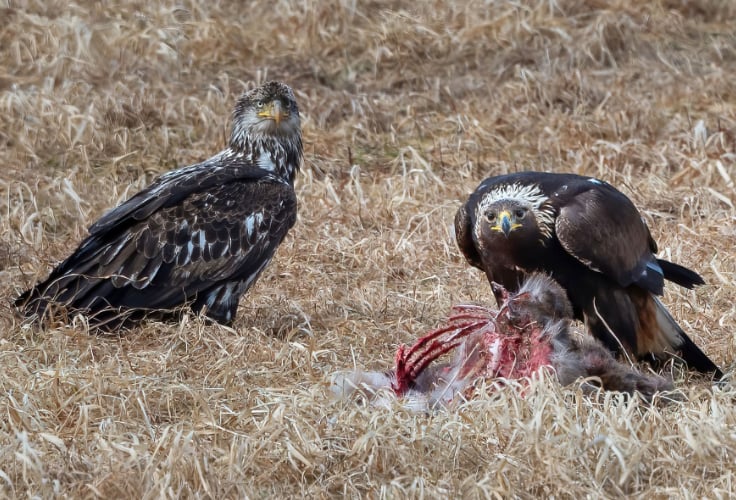
The Bald Eagle is the most familiar and frequently observed eagle in Ontario and one of the largest raptors in the region. Adults measure 71 to 96 centimeters (28.0 to 37.8 inches) in length, with a wingspan of 168 to 244 centimeters (66.1 to 96 inches), and have a heavy body, large head, and massive hooked beak. Adult plumage shows a dark brown body and wings set off by a bright white head and tail, while immature birds are mostly dark with irregular white mottling and lack the clean white head and tail of adults. The species is closely associated with aquatic environments throughout the province.
In the field, Bald Eagles are most often detected by their size and flight style. They fly with slow, deliberate, powerful wingbeats and frequently soar or glide on broad wings held flat in a straight horizontal line. Individuals often perch conspicuously in tall trees along shorelines or on forested islands. The species feeds primarily on fish, which are caught directly, scavenged, or stolen from other birds such as Osprey, but it also takes waterfowl and other prey. Activity is most noticeable near nest sites from late winter through summer, when adults are highly visible on territory.

In Ontario, the Bald Eagle is broadly distributed but shows clear regional patterns. It is most common and continuously distributed across northern Ontario, especially in the northwest where large lake systems support high densities. Breeding occurs mainly near shorelines of lakes and large rivers, often on forested islands or in tall supercanopy trees. In southern Ontario, distribution is more localized, with concentrations along Lakes Erie and Huron and scattered sites across eastern and central regions, while the Lake Ontario shoreline remains a notable gap. The species is resident or partially migratory, with many southern birds remaining year-round, while northern birds move south in winter and concentrate around areas of open water.
The Bald Eagle has undergone a strong recovery in Ontario following significant mid-20th century declines caused by pesticide contamination, habitat loss, and disturbance. Populations have increased substantially in both range and abundance, with particularly rapid growth in southern regions where the species was formerly scarce. Long-term monitoring shows continued increases across Canada, with especially large gains in central and southern Ontario. The species is now firmly reestablished as a top predator in the province, though it remains vulnerable to localized threats such as lead exposure, shoreline development, and human disturbance near nesting sites.
Golden Eagle
Aquila chrysaetos
- Identification: Very large, dark-brown eagle with long broad wings, a relatively small head, and a long tail; adults show a golden sheen on the nape.
- Where found: Occurs sparsely in Ontario, breeding only in the far north and appearing more widely as a migrant and winter visitor in open and semi-open landscapes.
- How to spot: Watch for solitary birds soaring with wings held in a slight “V,” often over open terrain or along shorelines and ridges.
- Conservation status: Least Concern (IUCN); Endangered in Ontario, rare and local with a very small breeding population and sensitivity to disturbance.

The Golden Eagle is a rare and highly localized species in Ontario, associated with remote northern landscapes where open terrain and cliffs provide suitable nesting habitat. Adults measure 70 to 99 centimeters (27.6 to 39.0 inches) in length and have a wingspan of 185 to 222 centimeters (72.8 to 87.4 inches). The species has a heavy body, long broad wings, and a long tail, with a relatively small head that gives it a distinctive profile in flight. Plumage is predominantly dark brown, with golden feathers on the rear of the crown and nape that can show a warm sheen in good light.
In the field, Golden Eagles are most often detected by flight behavior and silhouette. They are usually seen alone, soaring and gliding for extended periods with wings held in a shallow “V” and widely spread “fingered” primaries, using updrafts over ridges, shorelines, and open terrain. Flapping flight is infrequent and consists of deep wingbeats interspersed with glides. The species hunts primarily over open ground, taking small to medium-sized mammals and birds, and also scavenges carrion.

In Ontario, the Golden Eagle has a highly restricted breeding distribution. Confirmed nesting is limited to the Hudson Bay Lowlands and adjacent northern regions, particularly in remote areas such as the Sutton Ridges and along major river systems. Nests are typically placed on inaccessible bedrock cliffs overlooking open tundra, large burns, or water. The provincial breeding population is very small, likely on the order of only a few dozen pairs, and densities are low. Outside the breeding season, the species occurs more widely as a migrant and winter visitor, with individuals moving through or wintering in southern and central Ontario and along the Great Lakes, while some winter as far north as central Ontario where conditions allow.
The Golden Eagle remains rare in Ontario, with a small and localized breeding population and limited overall abundance. Long-term data across Canada suggest relatively stable populations, though trends are difficult to assess due to low survey coverage. In Ontario, the species is considered at risk and is particularly vulnerable to disturbance at nest sites, which can lead to abandonment. Additional threats include human-related mortality such as collisions, contamination through prey, and broader environmental changes that may affect breeding success.
Distinguishing Bald and Golden Eagles in the Field
Immature Golden Eagles are most often confused with immature and subadult Bald Eagles, since both lack the white head and tail of adults and can appear uniformly dark at a distance.
Structure is usually the most reliable way to separate them. Bald Eagle shows a larger, more protruding head and a massive beak that extends well beyond the body in flight, whereas Golden Eagle has a smaller head and more streamlined profile. In flight, the head of a Bald Eagle projects clearly beyond half the tail length, while the head of a Golden Eagle projects less. Bald Eagle also has unfeathered lower legs, while Golden Eagle has fully feathered tarsi.

Plumage provides additional clues. Immature Bald Eagles show irregular white mottling across the body, underwing coverts, and tail, often appearing patchy or uneven. Golden Eagle lacks white on the body and instead shows white confined to the base of the flight feathers and tail, forming cleaner, more sharply defined panels.
At a distance, Golden Eagles can also be confused with vultures and large buteo hawks. Turkey Vulture is smaller, holds its wings in a deeper dihedral or “V,” and rocks side to side while soaring, with underwings that appear darker toward the leading edge and paler behind. Golden Eagle soars more steadily, with a shallower wing angle and little to no rocking except in strong winds. Large buteos are smaller and broader-winged, lacking the long-winged, long-tailed proportions typical of an eagle. Careful attention to wing shape, tail length, and overall flight style is essential when identifying distant birds.
Where and When to See Eagles in Ontario
Eagles in Ontario are most closely tied to large water systems, and timing plays a key role in where they can be found. Bald Eagles are widespread and increasingly common, especially in northern Ontario where they occur year-round around large lakes and river systems. In southern Ontario, they are most easily observed along the Great Lakes and major inland waterways, with numbers increasing during migration and winter as birds concentrate near open water. Late fall through early spring is often the most reliable period in the south, when eagles gather at ice-free rivers, reservoirs, and shorelines.
Golden Eagles are far less predictable and much rarer, occurring mainly as migrants and winter visitors in southern and central Ontario. They are most often detected in open landscapes and along migration corridors, where careful scanning of ridgelines, shorelines, and other elevated viewpoints can reveal soaring birds.
Key Eagle Viewing Locations in Ontario
- Rainy Lake (northwestern Ontario) – Extensive shoreline and islands support high densities of breeding Bald Eagles.
- Lake of the Woods (Kenora District) – One of the strongest areas for Bald Eagles in the province, especially during the breeding season.
- French River (near Georgian Bay) – Reliable area for Bald Eagles along a major waterway connecting inland lakes to Lake Huron.
- Lake Erie shoreline (e.g., Point Pelee National Park) – Good location for wintering Bald Eagles and occasional migrating Golden Eagles.
- Niagara River (Niagara Region) – Consistent winter concentrations of Bald Eagles near open water and fish-rich currents.
- Presqu’ile Provincial Park (Northumberland County) – Regular Bald Eagle sightings, especially during migration and winter.
- Algonquin Provincial Park (central Ontario) – Scattered Bald Eagle presence during the breeding season and migration periods.
- Lake Superior north shore (e.g., Thunder Bay area) – Important migration corridor where both Bald and occasional Golden Eagles can be observed.


