
Texas is home to a diverse assemblage of birds of prey, ranging from widespread species such as Turkey Vulture and Red-tailed Hawk over open country to wetland-associated hunters like Osprey and large, conspicuous species such as Bald Eagle along major waterways. The state’s size and ecological diversity support raptors adapted to a wide range of habitats, while seasonal movements further shape this community, with migrants and wintering birds increasing diversity across much of Texas. This guide highlights the most characteristic and regularly encountered species, focusing on identification, distribution, and seasonal patterns across the state’s varied landscapes.
Turkey Vulture
Cathartes aura
- Identification: Large, long-winged vulture with a dark body, small bare red head in adults, and silvery underwings contrasting with darker coverts.
- Where found: Breeds throughout Texas in habitats ranging from eastern forests and swamplands to prairies and arid Trans-Pecos landscapes, with winter concentrations mainly in eastern portions of the state.
- How to spot: Look for low, buoyant soaring flight with wings held in a shallow “V,” rocking side to side and rarely flapping, often gliding over open country while searching for carrion.
- Conservation status: Least Concern (IUCN); population stable in Texas with large seasonal movements along major migration routes.

The Turkey Vulture is the most widespread and frequently encountered scavenging raptor in Texas, occupying nearly all regions of the state as an obligate carrion feeder. It plays a critical ecological role by removing animal remains across a wide range of landscapes, from humid eastern woodlands to arid western basins. Adults measure 64 to 81 centimeters (25.2 to 31.9 inches) in length, with a wingspan of 150 to 200 centimeters (59.1 to 78.7 inches). The species has long, broad wings, a relatively small, bare head, and a long tail that extends beyond the toe tips in flight, producing a large but lightly built silhouette. Plumage is dark brown to blackish overall, with distinctly two-toned underwings that appear silvery on the flight feathers and darker on the coverts; the head is red in adults.

In the field, Turkey Vultures are most easily recognized by their flight style. They soar extensively, holding their wings in a shallow “V” and rocking from side to side as they glide, using thermals and low-level air currents with minimal flapping. Birds often fly low over open ground while searching for carrion, relying on both vision and a well-developed sense of smell. In Texas, they feed on a wide range of carcasses, particularly mammals such as nine-banded armadillos, raccoons, and livestock, but also take reptiles, birds, and other remains. They are typically silent away from nests, though hisses and low grunts may be heard at close range.
The Turkey Vulture breeds throughout Texas and is highly adaptable in habitat use. It occupies eastern forests and swamplands, open prairies across central regions, and the arid landscapes of the Trans-Pecos. Abundance is highest in eastern Texas and remains common to fairly common across much of the state, though the species can be scarce in the northwestern Panhandle and parts of far west Texas. Nesting occurs in sheltered, often concealed locations such as caves, rocky crevices, hollow logs, brush piles, and abandoned structures, typically on the ground without a constructed nest. The species is partially migratory: many birds remain year-round in eastern and southern Texas, while winter populations are concentrated mainly east of a line from Wichita Falls to Del Rio. Texas also lies along a major migration corridor, with large numbers passing through the lower Rio Grande Valley in both fall and spring.
The Turkey Vulture is considered stable and secure in Texas, with long-term monitoring indicating little overall change in population levels. Its continued success is supported by broad habitat tolerance and the state’s position along major migration routes, which brings large seasonal influxes of birds. Although populations remain healthy, the species is still exposed to threats such as poisoning, lead contamination from carcasses, and habitat changes associated with land use and development. Despite these pressures, it remains one of the most ecologically important and consistently observed raptors across Texas.
Red-tailed Hawk
Buteo jamaicensis
- Identification: Large, stout-bodied hawk with broad, rounded wings and a short, wide tail; many adults show a reddish upper tail and dark markings along the leading edge of the underwing.
- Where found: Widespread across Texas in open country, shrublands, woodland edges, and agricultural landscapes, with slightly lower densities in the High Plains, Pineywoods, and lower Rio Grande Valley.
- How to spot: Commonly seen perched on utility poles or trees, or soaring in broad circles with slow wingbeats; listen for its hoarse, rising scream.
- Conservation status: Least Concern (IUCN); common and increasing in Texas, with stable long-term population growth.

The Red-tailed Hawk is one of the most frequently encountered birds of prey in Texas, occupying a broad range of open and semi-open landscapes across the state. As a dominant open-country predator, it plays a key role in regulating populations of small mammals and other prey in agricultural, suburban, and natural systems. The species measures 45 to 65 centimeters (17.7 to 25.6 inches) in length, with a wingspan of 114 to 133 centimeters (44.9 to 52.4 inches), and shows classic buteo proportions with broad, rounded wings and a short, wide tail adapted for soaring and perch hunting. Plumage is highly variable, but many adults show a reddish upper tail with a narrow darker band near the tip. Light individuals are typically brown above and paler below, often with darker streaking across the belly and a darker band along the trailing edge of the underwing, along with darker markings along the leading edge of the underwing.
In the field, Red-tailed Hawks are most often detected by their behavior. They frequently hunt from elevated perches such as utility poles, fence posts, or isolated trees, dropping in controlled dives onto prey. When airborne, they soar in broad circles on thermals or glide with slow, heavy wingbeats, and in strong winds may face into the wind and hold position with little movement. Their familiar hoarse, rising scream carries over open landscapes and is often given by soaring birds. In Texas, their diet consists mainly of small to medium-sized mammals such as rodents and rabbits, along with birds and reptiles.

The Red-tailed Hawk is widespread across most of Texas, breeding widely from lowland coastal regions to uplands reaching about 1,500 meters (4,900 feet) in elevation. It is most frequent in open habitats with scattered trees or shrubs, including rangelands, farmland, and woodland edges, and is less common in dense forests and extensive unbroken grasslands. Breeding occurs from late February through late June, with nests placed in trees or, in parts of the Texas Panhandle, within canyon systems. Although present year-round, populations increase noticeably from mid-October through mid-March as migrants from northern regions join resident birds. Seasonal distribution can vary, with winter movements influenced in part by broader climatic patterns.
The Red-tailed Hawk is considered common and increasing across Texas, with long-term survey data indicating steady population growth. Its adaptability to a wide range of habitats, including human-altered landscapes, has supported its success across the state. While densities are somewhat lower in regions such as the High Plains, Pineywoods, and the lower Rio Grande Valley, the species remains widespread and secure overall. Its continued stability reflects both a broad prey base and an ability to exploit diverse landscapes, suggesting a strong long-term outlook within Texas.
Black Vulture
Coragyps atratus
- Identification: Medium-sized, compact vulture with broad wings, a very short tail, entirely black plumage, a bare gray-black head, and white patches on the outer primaries visible in flight.
- Where found: Widespread across the eastern two-thirds of Texas, with highest concentrations in central and southern regions and more limited presence in the High Plains and Trans-Pecos.
- How to spot: Look for compact vultures soaring or flying with frequent wingbeats and short glides, often in groups, with flat wings and a short-tailed silhouette.
- Conservation status: Least Concern (IUCN); populations increasing in Texas with strong long-term growth despite localized threats.

The Black Vulture is a common and highly social scavenging raptor across much of Texas, particularly in central and eastern regions where it often occurs alongside Turkey Vultures. As an obligate scavenger, it plays an important role in removing carrion, especially in landscapes influenced by livestock and human activity. Adults measure 60 to 68 centimeters (23.6 to 26.8 inches) in length, with a wingspan of 137 to 150 centimeters (53.9 to 59.1 inches). The species has broad wings, a very short, square tail, and a relatively small bare head, giving it a compact, stocky silhouette in flight. Plumage is entirely black, with contrasting pale patches on the outer primaries visible from below; the head is gray to blackish and unfeathered.
In the field, Black Vultures are distinguished by both structure and behavior. They soar on thermals but use more frequent, stronger wingbeats than Turkey Vultures, often alternating flapping with short glides. The wings are typically held flat, and the short tail creates a distinctive, squared-off profile. Birds often travel and feed in groups, locating carrion primarily by sight and by following other scavengers. At carcasses, they frequently dominate through group feeding behavior, quickly displacing other species. Their diet consists mainly of carrion, especially large mammals, and they are commonly seen along roadsides or open fields. Vocalizations are limited but may include grunts, hisses, or short barking sounds at feeding or roosting sites.

In Texas, the Black Vulture is a largely resident species, breeding mainly across the eastern two-thirds of the state and reaching its highest abundance in central and southern regions. It is less common in the High Plains, Rolling Plains, and far western areas, though small resident populations occur in the Trans-Pecos along the Rio Grande from eastern Val Verde County to northern Presidio County. Breeding occurs from late January through summer, with nests placed in dark, sheltered sites such as thickets, hollow trees, caves, rock crevices, brush piles, or abandoned structures. The species typically uses dense low vegetation and bottomland woodlands for nesting, while foraging in adjacent open habitats. During winter, some birds in northern parts of the state shift southward, but overall numbers remain stable due to replacement by migrants.
The Black Vulture has increased significantly in Texas over the past century and is now common to locally abundant across much of its range. Population growth has been supported in part by the availability of carrion, including road-killed animals and livestock remains. Historical declines associated with persecution, poisoning, and pesticide contamination have been followed by strong recovery and expansion. Despite this success, the species remains affected by threats such as loss of large trees used for nesting, disturbance at roost and nest sites, and collisions with vehicles while feeding on roadkill. Overall, its adaptability and social foraging behavior continue to support a stable and growing population in Texas.
American Kestrel
Falco sparverius
- Identification: Small, slender falcon with long pointed wings and a relatively long tail; males show slate-blue wings and rufous back; females are barred rufous overall with bold black facial markings.
- Where found: Occurs across Texas in open habitats including prairies, agricultural lands, deserts, and urban areas, but is scarce or absent as a breeder in much of southern coastal Texas.
- How to spot: Often seen perched on wires or poles or hovering over fields, frequently pumping its tail; listen for its rapid, repeated “killy” call.
- Conservation status: Least Concern (IUCN); declining in Texas with negative trends in recent decades despite widespread winter occurrence.

The American Kestrel is the smallest and most numerous falcon species in Texas, commonly seen in open landscapes, especially along roadsides and agricultural areas. As a small, adaptable predator, it feeds heavily on insects and small vertebrates, occupying a lower trophic level than larger hawks and falcons. Adults measure 22 to 31 centimeters (8.7 to 12.2 inches) in length, with a wingspan of 51 to 61 centimeters (20.1 to 24.0 inches). The species has long, pointed wings, a relatively long tail, and a compact, lightly built body adapted for agile flight and hovering. Plumage is strongly dimorphic: males show slate-blue wings and a rufous back with a mostly unbarred tail, while females are barred rufous above and more heavily streaked below; both sexes have two bold black facial slashes.
In the field, American Kestrels are most often detected perched conspicuously on utility wires, poles, fence posts, or small trees in open country. They hunt primarily by scanning from perches and dropping onto prey, but also hover into the wind over fields, maintaining position with rapid wingbeats while the head remains steady. Tail pumping is frequent when perched. In Texas, their diet consists largely of insects such as grasshoppers and beetles, along with small mammals, birds, and reptiles. Their characteristic rapid, repeated “killy” call is often heard in open habitats and helps reveal their presence.

In Texas, the American Kestrel occurs statewide but shows strong regional and seasonal variation. It breeds mainly in open regions such as the High Plains, Rolling Plains, and Trans-Pecos, where it is an uncommon to common nesting species, while it is rare to uncommon as a breeder in the Pineywoods and largely absent from much of southern Texas east of the Rio Grande and coastal areas. The species occupies open country with scattered trees, woodland edges, and increasingly urban and suburban environments. As a cavity nester, it uses a wide variety of sites, including tree cavities, woodpecker holes in utility poles, cliff cavities, and numerous human-made structures such as buildings, towers, and equipment. Although breeding and winter ranges overlap, many birds present in spring are migrants, with peak passage occurring in early April and most migrants departing by mid- to late April. In winter, the species is common to abundant across the state.
The American Kestrel shows signs of decline in Texas despite remaining widespread, with long-term trends indicating slight decreases and more pronounced short-term declines. While still common in winter and locally common in some breeding regions, reductions in breeding distribution in parts of central and eastern Texas suggest regional pressures. The causes are not fully understood but are likely related to habitat change, loss of nesting cavities, and broader environmental factors affecting prey availability. Continued monitoring is important to track these trends, as this once ubiquitous small falcon shows evidence of ongoing population stress in parts of its range.
Great Horned Owl
Bubo virginianus
- Identification: Large, powerful owl with broad wings, prominent ear tufts, a white throat patch, and striking yellow eyes, showing a mottled mix of brown, buff, and black.
- Where found: Occurs statewide across Texas in habitats ranging from forests and swamps to deserts, grasslands, and suburban areas.
- How to spot: Listen for deep, multi-note hoots at night or watch for a large owl perched on exposed limbs or flying with steady wingbeats along field edges at dusk.
- Conservation status: Least Concern (IUCN); common and stable in Texas, supported by high adaptability to varied habitats.
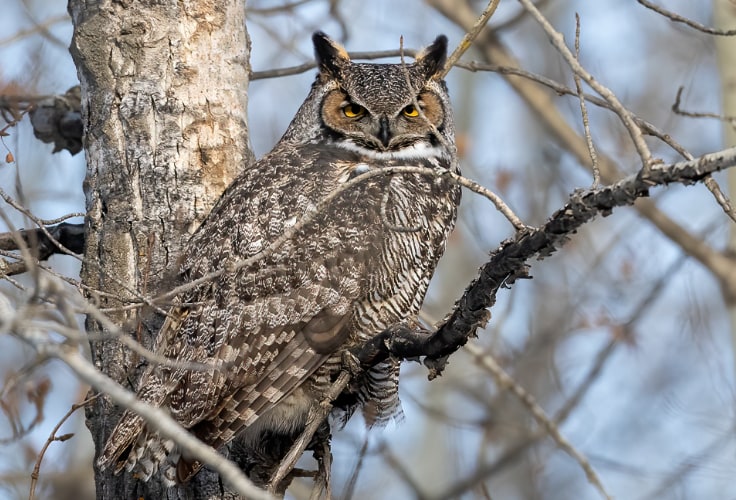
The Great Horned Owl is the most widespread and likely to be encountered nocturnal raptor in Texas, occupying nearly all regions of the state year-round. As a powerful apex predator, it exerts strong influence on local prey populations and can dominate other raptors within its range. Adults measure 46 to 63 centimeters (18.1 to 24.8 inches) in length and are large, thick-bodied owls with broad wings, a wide head, and prominent ear tufts. Their plumage is heavily mottled in brown, buff, gray, and black, providing excellent camouflage, with a contrasting white throat patch and large yellow eyes that stand out in low light.
In the field, Great Horned Owls are most often detected by their deep, resonant hooting, typically delivered in a slow series of four to six notes, often beginning at dusk. They perch upright on exposed branches, fence posts, or other elevated sites, scanning for prey. Flight is strong and deliberate, with steady wingbeats and short glides, usually low over open ground. Although primarily nocturnal, individuals in Texas may hunt during the day, especially under overcast conditions. Their diet is broad and includes mammals, birds, and other vertebrates, ranging from small rodents to larger prey, reflecting their role as a highly versatile predator.
The Great Horned Owl occurs throughout Texas in a wide variety of habitats, from eastern forests and swamps to open prairies, arid deserts, and suburban landscapes. It is present across the state during the breeding season, with records from nearly all regions, including strong representation in southern Texas. Preferred habitat typically consists of semi-open country with a mix of woodland, open ground, and watercourses, conditions that are widespread across Texas. The species does not build its own nest but commonly uses abandoned nests of Red-tailed Hawks or other large birds, as well as tree cavities, caves, cliff ledges, large cacti, or even ground sites. Its adaptability allows it to nest successfully in both natural and urban environments.
The Great Horned Owl is common and stable across Texas, with long-term data indicating little overall change in population. Its success is linked to its broad diet, flexible habitat use, and ability to exploit a wide range of nesting sites. Although it can be under-detected in surveys due to nocturnal habits, it remains one of the most consistently present large raptors in the state. While threats such as habitat alteration, disturbance, and secondary poisoning exist, they have not significantly impacted its overall status, and the species is expected to remain a secure component of Texas ecosystems.
Cooper’s Hawk
Astur cooperii
- Identification: Medium-sized hawk with short, rounded wings and a long, rounded tail; adults are blue-gray above with rufous barring below, while juveniles are brown above with streaked whitish underparts.
- Where found: Occurs across Texas in wooded habitats including riparian corridors, oak woodlands, scrub, and suburban areas, with patchy breeding distribution.
- How to spot: Watch for a fast, agile hawk flying with a flap-flap-glide pattern through trees or along edges, often appearing suddenly in pursuit of birds; listen for sharp “cak-cak-cak” calls near nests.
- Conservation status: Least Concern (IUCN); generally stable and increasing, with winter numbers boosted by migrants.

The Cooper’s Hawk is one of the most common hawks in Texas, an agile woodland predator, best known as a specialist bird hunter in forest edges, riparian corridors, and suburban landscapes. It measures 37 to 45 centimeters (14.6 to 17.7 inches) in length, with a wingspan of 62 to 90 centimeters (24.4 to 35.4 inches), and shows the classic accipiter structure with short, rounded wings and a long tail adapted for rapid maneuvering through dense vegetation. Adults are blue-gray above with warm rufous barring on pale underparts, while juveniles are brown above with crisp streaking below. The relatively large head and broad shoulders help distinguish it from similar hawks.
In the field, Cooper’s Hawks are often detected by their swift, purposeful flight. They move with several quick wingbeats followed by a short glide, a characteristic flap-flap-glide pattern, and frequently fly low through trees, hedgerows, or along woodland edges. Hunting behavior involves sudden bursts of speed and tight turns as they pursue small to medium-sized birds, often using cover to approach undetected before launching an attack. In Texas, their diet is dominated by birds such as doves and songbirds, with small mammals and reptiles taken occasionally. Their sharp, repeated “cak-cak-cak” calls are most often heard near nesting territories.

In Texas, the Cooper’s Hawk breeds in a patchy but widespread pattern, with most confirmed nesting records concentrated in regions such as the Pineywoods, Edwards Plateau, South Texas Brush Country, Coastal Sand Plain, and parts of the Trans-Pecos. Breeding is less frequent in the High Plains and Coastal Prairies, with scattered records elsewhere. The species uses a variety of wooded habitats, especially riparian woodlands and mixed tree communities that include oak, mesquite, pine, juniper, cottonwood, willow, and hackberry, as well as live oak mottes and scrub. It nests in trees, typically in areas that provide both cover and access to open hunting grounds. The population is augmented in winter by migrants arriving from late August through September, with birds remaining into May.
The Cooper’s Hawk is generally stable and increasing in Texas, reflecting broader recovery trends across North America following past declines. Its ability to use fragmented woodlands and suburban habitats has supported its continued success, particularly where prey such as doves and other birds are abundant. Although breeding distribution remains uneven across the state, especially in more open regions, winter influxes contribute to its widespread presence. Local threats include habitat fragmentation and collisions in developed areas, but overall the species remains a well-established and resilient predator in Texas.
Mississippi Kite
Ictinia mississippiensis
- Identification: Medium-sized, slender raptor with long pointed wings and a fairly long square-tipped tail; adults appear smooth gray with darker wings and a black tail.
- Where found: Breeds mainly in north-central Texas, especially in riparian woodlands and prairie regions with trees, with scattered and local occurrences elsewhere.
- How to spot: Look for buoyant, acrobatic flight with frequent soaring and aerial hunting, often catching insects on the wing.
- Conservation status: Least Concern (IUCN); stable or increasing in Texas, with range expansion and strong regional populations.

The Mississippi Kite is a graceful and highly aerial raptor, most characteristic of the north-central portion of the state where it reaches some of its highest regional abundance. As a specialized aerial hunter, it feeds primarily on flying insects and occupies a distinct ecological niche among Texas raptors. Adults measure 34 to 37 centimeters (13.4 to 14.6 inches) in length, with a wingspan of 88 to 112 centimeters (34.6 to 44.1 inches), and show a slim body, long pointed wings, and a relatively long, square-tipped tail adapted for agile flight. Adults appear smooth gray overall, with darker wings and a black tail, creating a clean, streamlined appearance in flight.
In the field, the Mississippi Kite is most easily identified by its flight behavior. It spends much of its time aloft, soaring and gliding with buoyant, flexible wingbeats and making quick, agile turns while foraging. The species frequently captures prey in midair, often consuming insects such as grasshoppers, cicadas, beetles, and dragonflies while still in flight. It may hunt singly or in loose groups, and during migration can form larger flocks. Vocalizations are soft and whistled, though often inconspicuous compared to its highly visible flight activity.

In Texas, the Mississippi Kite has a relatively restricted breeding distribution centered in the north-central region, where it is fairly common and regularly confirmed as a breeder, including across parts of the Panhandle. Additional breeding records occur locally in southeastern Texas, particularly around Matagorda County, and more sparsely in northeastern areas, with isolated records elsewhere, including near El Paso. Outside these areas, it is considered a rare and local breeder. The species favors riparian woodlands, open prairies with scattered trees, and similar habitats, often nesting near water and sometimes in loose colonies. It also adapts to urban environments and is known to nest in cities such as Lubbock. Migration is pronounced, with birds arriving early in spring and forming large flocks in southern Texas during late summer and early fall, with most departing the United States by mid-October.
The Mississippi Kite is stable or increasing in Texas, reflecting broader positive trends across parts of its range. After historical declines, the species has rebounded and expanded westward, aided in part by the availability of nesting trees in shelterbelts and urban areas. Its success in Texas appears strong, particularly in core breeding regions, though its long-term status depends not only on breeding habitat but also on conditions along migration routes and wintering grounds in South America. Overall, it remains a distinctive and increasingly familiar summer raptor across suitable parts of the state.
Osprey
Pandion haliaetus
- Identification: Large, long-winged raptor with brown upperparts, mostly white underparts, a white head with a dark eye stripe, and angled wings with dark wrist patches.
- Where found: Occurs across Texas near coastal and inland waters, most commonly along the Gulf Coast in winter and during migration, with scattered inland presence.
- How to spot: Look for steady flight with slightly bowed wings over water, often hovering before plunging feet-first to catch fish.
- Conservation status: Least Concern (IUCN); populations increasing in North America, but a rare and local breeder in Texas.

The Osprey is a highly specialized raptor, most often encountered along coastal and inland waters where it hunts almost exclusively for fish. It occupies a distinct ecological niche among Texas raptors as an obligate piscivore closely tied to aquatic systems. Adults measure 54 to 58 centimeters (21.3 to 22.8 inches) in length, with a wingspan of 150 to 180 centimeters (59.1 to 70.9 inches), and show a long-winged, angular profile with a slim body, long legs, and relatively small head. Plumage is dark brown above and mostly white below, with a white head marked by a bold dark eye stripe and contrasting dark patches at the wrist.
In the field, Ospreys are most easily recognized by their flight and hunting behavior. They fly with steady, deliberate wingbeats and often hold their wings in a slightly bowed or kinked, M-like shape. Individuals frequently hover over shallow water before plunging feet-first to capture fish, then carry prey head-first in flight. In Texas, they are most often seen along shorelines, reservoirs, and rivers, where their conspicuous hunting behavior makes them easy to detect. Their diet consists almost entirely of live fish taken near the water surface.

In Texas, the Osprey occurs primarily as a migrant and wintering species, with peak movements from mid-March to late May and again from early September to mid-November. During winter, it is most common along the Gulf Coast and can also be found locally inland, especially in eastern portions of the state as far north as the Dallas area. Breeding is rare and localized, with only a few confirmed sites, mainly along the coast and lower sections of major river systems. Suitable breeding habitat requires both shallow, fish-rich waters and elevated nesting structures, such as trees, platforms, or other man-made supports, and some birds present in summer may be nonbreeding individuals.
The Osprey remains uncommon as a breeder in Texas but benefits from strong population growth across North America following recovery from mid-20th century declines. Its overall outlook is positive, supported by increasing continental populations and adaptability to artificial nesting structures. In Texas, its status is influenced by the availability of suitable nesting sites and aquatic foraging habitat, while most individuals observed are migrants or wintering birds. Despite localized limitations in breeding, the species is a regular and often conspicuous presence along Texas waters during migration and winter.
Northern Harrier
Circus hudsonius
- Identification: Slender, long-winged and long-tailed raptor with a distinct white rump patch and owl-like facial disk; males are gray above and whitish below with black wingtips, females are brown with streaked underparts.
- Where found: Occurs across Texas mainly in open habitats such as prairies, marshes, and fields, most commonly as a migrant and wintering species, with limited breeding in the north.
- How to spot: Look for low, slow flight over open ground with wings held in a strong “V,” rocking side to side and coursing just above vegetation.
- Conservation status: Least Concern (IUCN); declining in Texas and across North America due to habitat loss and other pressures.

The Northern Harrier is the state’s distinctive open-country raptor, best known as a wintering and migratory species that hunts low over grasslands and wetlands. It occupies a unique ecological niche as a low-flying predator that relies on both vision and hearing to locate prey. Adults measure 46 to 50 centimeters (18.1 to 19.7 inches) in length, with a wingspan of 102 to 118 centimeters (40.2 to 46.5 inches), and show a slim body, long wings, and a long tail adapted for buoyant, low-level flight. The species is strongly sexually dimorphic: males are gray above and pale below with black wingtips, while females are brown above with streaked underparts; all individuals show a conspicuous white rump patch.
In the field, Northern Harriers are most easily identified by their low, coursing flight over open landscapes. They fly slowly with steady wingbeats and tilting glides, holding their wings in a pronounced dihedral and weaving back and forth just above vegetation. This hunting style allows them to detect small mammals and birds below, aided by their owl-like facial disk, which enhances hearing. In Texas, they are most often seen singly, though they may gather loosely in suitable wintering habitat. Their movements are most noticeable during migration, when individuals pass through open regions and agricultural areas.

In Texas, the Northern Harrier occurs primarily as a migrant and winter resident across much of the state, especially in open habitats such as prairies, coastal plains, and agricultural landscapes. It is most easily observed from late August through mid-October and again from early April to mid-May, when migration peaks. Wintering birds are widespread, with particularly high densities in parts of western Texas, where they favor shortgrass prairies, vegetated playa basins, and similar open habitats, while also using agricultural fields under certain conditions. Breeding is rare and localized, with scattered records primarily in the High Plains and coastal regions; it nests on the ground in open, treeless areas where vegetation provides concealment.
The Northern Harrier is considered uncommon to rare as a breeder in Texas and has shown gradual declines consistent with broader North American trends. Habitat loss, particularly the conversion of grasslands and wetlands, has reduced suitable breeding and wintering areas, while pesticide exposure and changes in land use continue to affect prey availability. Additional pressures include disturbance and shooting at communal winter roosts. Although still regularly encountered during migration and winter, the species’ long-term outlook depends on the conservation of large, open landscapes across its range.
American Barn Owl
Tyto furcata
- Identification: Medium-sized owl with a pale, heart-shaped facial disc, long rounded wings, short tail, and buff-and-gray upperparts contrasting with whitish underparts.
- Where found: Occurs across most of Texas in open habitats including farmland, grasslands, and urban areas, but is scarce in the eastern forested regions and high mountains of the Trans-Pecos.
- How to spot: Look for a pale owl flying low over fields at night with buoyant wingbeats, or listen for its harsh, rasping scream near barns and other structures.
- Conservation status: Least Concern (IUCN); generally stable in Texas but sensitive to habitat change, nesting site loss, and rodenticide exposure.

The American Barn Owl is one of the most recognizable owls in Texas, found primarily in open landscapes where it acts as an efficient rodent specialist in agricultural and grassland ecosystems. It is easily identified by its pale coloration and heart-shaped facial disc. The species measures 32 to 40 centimeters (12.6 to 15.7 inches) in length and has long rounded wings, a short tail, and long legs, giving them a lanky, lightly built appearance compared to other owls. Plumage shows warm buff and gray tones above with a largely whitish face and underparts, creating a striking contrast in low light.
In the field, Barn Owls are most often detected at night by their flight and voice. Individuals fly low over open ground with buoyant, silent wingbeats, quartering fields and grasslands while hunting. Their long, rasping scream carries over open landscapes and is often heard near nesting or roosting sites. The species hunts primarily by sound, locating prey beneath vegetation with exceptional auditory precision. In Texas, its diet consists mainly of small mammals such as voles, mice, cotton rats, and other rodents, making it an important natural control agent in agricultural areas.
The American Barn Owl is a year-round resident across most of the state, occupying a wide range of open habitats from rural farmland and grasslands to urban and suburban areas. It is rare in the densely forested eastern counties and at higher elevations above about 1,500 meters (4,900 feet) in the Trans-Pecos. The species nests in cavities, using a broad variety of sites including hollow trees, cliffs, caves, riverbanks, barns, silos, church steeples, and other structures, as well as nest boxes. It readily adapts to human environments where suitable nesting sites and prey are available, and often roosts in sheltered vegetation such as dense junipers during winter.
The Barn Owl is generally stable in Texas, though precise population trends are difficult to determine due to its nocturnal and secretive habits. Its reproductive strategy, including variable clutch sizes and the ability to breed multiple times in favorable conditions, supports resilience in fluctuating environments. However, the species remains vulnerable to habitat change, loss of nesting cavities, and secondary poisoning from rodenticides. Conservation efforts such as maintaining open habitats and providing nest boxes have proven beneficial, particularly in agricultural regions where the species continues to play a valuable ecological role.
Crested Caracara
Caracara plancus
- Identification: Medium-sized, long-legged raptor with a black cap, white neck and cheeks, bright orange facial skin, long tail, and bold white patches in the wings and tail visible in flight.
- Where found: Year-round across southern and southeastern Texas in open habitats such as pastures, brushlands, and coastal prairies, with highest concentrations in the South Texas Brush Country.
- How to spot: Often seen walking on the ground or perched on posts and trees, or flying low with steady wingbeats; frequently gathers at carcasses with vultures.
- Conservation status: Least Concern (IUCN); increasing in Texas with expanding distribution, though dependent on open habitat availability.

The Crested Caracara is one of the most distinctive and unusual raptors in Texas, combining traits of falcons, hawks, and scavengers, and occupying a unique ecological role in open landscapes. It is especially characteristic of southern parts of the state, where it functions as both an opportunistic predator and a scavenger. It measures 49 to 64 centimeters (19.3 to 25.2 inches) in length, with a wingspan of 120 to 130 centimeters (47.2 to 51.2 inches), and shows a long-legged, upright posture with a relatively long tail and broad wings. Plumage is striking black and white, with a sharply defined black cap, pale neck and face, and bright orange facial skin, while bold white patches in the wings and tail are conspicuous in flight.
In the field, Crested Caracaras are often detected on the ground as much as in the air. They frequently walk deliberately across open terrain, scanning for prey or carrion, and may be seen perched on fence posts, utility poles, or isolated trees. Flight is low and steady, with shallow wingbeats and wings held flat, giving a heavy, deliberate impression. In Texas, they feed on a wide variety of food items, including insects, small mammals such as cottontail rabbits, reptiles, birds, and carrion, which can make up a substantial portion of the diet. They often forage alongside vultures and may dominate smaller groups at carcasses.

In Texas, the Crested Caracara is a resident species concentrated mainly in the southern and southeastern portions of the state. Breeding is most common in the South Texas Brush Country, Coastal Sand Plain, Coastal Prairies, and southern Post Oak Savannah and Blackland Prairies, with additional scattered records extending northward and west toward the Edwards Plateau. It occupies open and semi-open habitats such as mesquite savannas, thornscrub, coastal prairie, pastureland, and agricultural areas with scattered trees or shrubs. Nests are typically placed in the tallest available vegetation, including live oaks, mesquite, or thorny shrubs, often within open landscapes near feeding areas. The species is nonmigratory, though local movements and seasonal changes in abundance may occur.
The Crested Caracara has shown positive population trends in Texas, where it supports the largest breeding population in the United States. After historical declines earlier in the 20th century, recent decades have seen increasing numbers and expansion into new areas, particularly across south-central and southeastern Texas. Its success is linked to the availability of open rangelands, livestock operations, and carrion resources, though habitat conversion and changes in land use remain potential concerns. Overall, the species is now considered stable to increasing and remains a characteristic raptor of Texas open-country ecosystems.
Swainson’s Hawk
Buteo swainsoni
- Identification: Medium-large hawk with a slim body, long tapered wings, and a grayish banded tail; many light birds show a contrasting dark chest “bib” and pale wing linings against darker flight feathers.
- Where found: Breeds mainly in western and northern Texas, especially the High Plains and Rolling Plains, with more limited and scattered occurrence elsewhere.
- How to spot: Look for buoyant soaring flight with wings held in a shallow “V,” often perched on poles or trees in open country; large migrating flocks may form in late summer and fall.
- Conservation status: Least Concern (IUCN); uncommon to common in parts of Texas but showing gradual declines linked to habitat change and pesticide exposure.

The Swainson’s Hawk is a characteristic raptor of open landscapes and one of the most notable long-distance migrants passing through the state. As a predator of both small vertebrates and large insects, it occupies a flexible ecological role in prairie and agricultural ecosystems. The species measures 48 to 56 centimeters (18.9 to 22.0 inches) in length, with a wingspan of 117 to 137 centimeters (46.1 to 53.9 inches), and shows a slimmer build than most North American buteos, with long, tapered wings and a relatively long tail. Plumage is variable, but many individuals show a pale underside with a darker chest “bib” and a grayish, finely banded tail; in flight, pale wing linings often contrast strongly with darker flight feathers.
In the field, Swainson’s Hawks are recognized by their buoyant, graceful flight. They soar frequently with wings held in a shallow dihedral and use thermals extensively, especially during migration. In Texas, large numbers may be seen moving south in late summer and fall, forming loose lines or “kettles” of birds high overhead. On the breeding grounds, they hunt from perches or by flying low over open terrain, sometimes dropping to the ground to pursue prey. Their diet includes small mammals, reptiles, and birds, but also large numbers of insects such as grasshoppers and dragonflies, especially during the breeding season.

In Texas, the Swainson’s Hawk breeds primarily in the High Plains, Rolling Plains, northern Edwards Plateau, southern South Texas Brush Country, and parts of the Trans-Pecos, with more scattered breeding elsewhere and limited presence in eastern forested regions. It favors open habitats such as prairies, plains, and desert grasslands, typically nesting in isolated trees, small groves, riparian corridors, or occasionally on artificial structures such as power poles. The species arrives from late February through mid-June, with most birds appearing between late March and mid-May, and breeds through summer. Southbound migration begins as early as late July, with peak movement from early August through early November, when large numbers pass through Texas on their way to South America.
The Swainson’s Hawk is considered uncommon to common in its core breeding regions of Texas but remains rare in southern and coastal parts of the state. Long-term monitoring suggests a gradual population decline in Texas, consistent with broader continental trends. While habitat change on the breeding grounds plays a role, significant threats also occur outside the state, particularly pesticide exposure on the South American wintering grounds. Despite these pressures, the species remains a regular and often conspicuous raptor of open country in Texas, especially during migration when its large-scale movements are among the most striking raptor events in the region.
Harris’s Hawk
Parabuteo unicinctus
- Identification: Medium-large, long-legged hawk with a lanky build, dark brown plumage with chestnut patches, and a dark tail with a white base and terminal band.
- Where found: Year-round in southern and western Texas, especially in the South Texas Brush Country and Coastal Sand Plain, with more scattered distribution in the Edwards Plateau, Trans-Pecos, and southern High Plains.
- How to spot: Often seen perched on cacti, poles, or trees, sometimes in small groups, or flying low with a flap-and-glide pattern over open terrain.
- Conservation status: Least Concern (IUCN); locally common in parts of Texas but showing slight long-term declines.

The Harris’s Hawk is one of the most distinctive raptors in Texas, especially in the south, where it occupies semi-open brushlands and desert-edge habitats. It stands out both for its bold appearance and its unusual social behavior among birds of prey. It measures 46 to 59 centimeters (18.1 to 23.2 inches) in length, with a wingspan of 103 to 119 centimeters (40.6 to 46.9 inches), and shows a long-legged, long-tailed build adapted for maneuvering through thornscrub and open woodland. Plumage is rich dark brown with contrasting chestnut patches on the shoulders and flanks, along with white upper and lower tail coverts and a dark tail marked by a bold white base and terminal band.
In the field, Harris’s Hawks are often identified by their behavior as much as their appearance. They frequently perch in exposed locations such as mesquite trees, cacti, or utility poles, scanning for prey. Flight is typically low and deliberate, with a flap-and-glide pattern and wings held relatively flat. They feed on a wide range of prey, especially medium-sized mammals such as rabbits and hares, along with birds and reptiles. This species is well known for cooperative hunting, in which individuals work together to flush and capture prey, sometimes taking turns in pursuit or surrounding hidden animals before attacking.

In Texas, Harris’s Hawks are year-round residents with a patchy distribution centered in southern and western parts of the state. They are most common in the South Texas Brush Country, Coastal Sand Plain, and southern Coastal Prairies, with additional scattered populations in the Edwards Plateau, Trans-Pecos, and southern High Plains. The species is strongly associated with mesquite woodlands, thornscrub, and semi-open habitats with scattered trees or large shrubs, often with prickly pear understory. Nests are placed in trees or large shrubs such as mesquite, live oak, hackberry, or yucca, typically in areas that provide both cover and access to open hunting grounds.
The Harris’s Hawk is locally common in its core Texas range, which supports a large portion of the United States population, but shows signs of gradual decline in long-term monitoring. Habitat fragmentation, particularly the loss of mesquite woodlands and thornscrub, has reduced suitable areas in some regions, and changes in land use can affect prey availability. Despite these pressures, the species remains resilient due to its adaptability and social hunting strategy, and it continues to be a characteristic and often conspicuous raptor of southern Texas landscapes.
Bald Eagle
Haliaeetus leucocephalus
- Identification: Very large eagle with broad, flat-held wings; adults show a stark white head and tail contrasting with a dark brown body and wings.
- Where found: Occurs across Texas near large bodies of water, with breeding concentrated in coastal regions, eastern Texas, and along major rivers and reservoirs.
- How to spot: Look for slow, powerful wingbeats, long periods of soaring on flat wings, and frequent perching near water or open shorelines.
- Conservation status: Least Concern (IUCN); increasing in Texas following historical declines, with ongoing localized threats.

The Bald Eagle is the most widespread eagle in Texas, strongly associated with major aquatic systems where it functions as both a fish specialist and an opportunistic scavenger. Adults measure 71 to 96 centimeters (28.0 to 37.8 inches) in length, with a wingspan of 168 to 244 centimeters (66.1 to 96 inches), giving them a commanding presence. The species has a heavy body, large projecting head, and massive hooked bill. Adult plumage is unmistakable, with a dark brown body and wings contrasting sharply with a white head and tail and bright yellow bill and legs; younger birds are darker overall and lack the clean white head and tail of adults.
In the field, Bald Eagles are often detected first by their size and silhouette. They fly with slow, deliberate wingbeats and frequently soar or glide with wings held flat, forming a straight horizontal profile. Individuals commonly perch in large trees near water, scanning for prey. In Texas, they feed primarily on fish but also take waterfowl, mammals, and carrion, and may steal food from other birds. Their high-pitched, gull-like calls are most often heard near nests or feeding sites.

In Texas, the Bald Eagle occurs statewide but is most closely associated with large water bodies, including coastal bays, reservoirs, rivers, and wetlands. Breeding is concentrated in the Coastal Prairies, southern Pineywoods, and northern Coastal Sand Plain, with additional nesting along major river systems and reservoirs, including areas near the Red River. The species breeds from near sea level to about 1,100 meters (3,600 feet), placing large stick nests high in mature trees or occasionally on cliffs. Populations increase seasonally, with birds arriving as early as August and numbers peaking from early October through late May as migrants join resident individuals.
The Bald Eagle has recovered significantly in Texas following earlier declines caused by persecution and pesticide contamination. Current populations are increasing, with roughly over one hundred breeding pairs documented in recent decades, and the species has expanded within suitable habitats. Despite this recovery, threats such as lead poisoning, habitat disturbance, and shoreline development persist locally. Overall, the Bald Eagle is now a stable and growing component of Texas raptor communities, especially along the state’s major water systems.
Golden Eagle
Aquila chrysaetos
- Identification: Very large, dark-brown eagle with long broad wings, a relatively small head, and a long tail; adults show golden feathers on the nape, and younger birds may show white in the wings and tail.
- Where found: Occurs in western Texas, especially the Trans-Pecos and Panhandle, in open, rugged landscapes such as mountains, canyons, and desert grasslands.
- How to spot: Watch for solitary birds soaring with wings held in a slight “V,” often over ridges or open terrain, or flying low in contour over the ground while hunting.
- Conservation status: Least Concern (IUCN); rare to locally uncommon in Texas, with stable broader populations but ongoing human-related threats.

The Golden Eagle is the largest bird of prey in Texas, primarily associated with the rugged and sparsely populated landscapes of the western part of the state. As a top predator, it occupies a high trophic level, feeding mainly on mammals and occasionally scavenging carrion. Adults measure 70 to 99 centimeters (27.6 to 39.0 inches) in length, with a wingspan of 185 to 222 centimeters (72.8 to 87.4 inches), and show a heavy-bodied build with long broad wings and a long tail that projects beyond the body in flight. Plumage is predominantly dark brown, with a golden sheen on the nape that gives the species its name.
In the field, Golden Eagles are most often identified by their flight profile and behavior. They are usually seen alone or in pairs, soaring and gliding over open terrain, often along ridges or above canyons. Wings are typically held in a shallow dihedral, with widely spread primary “fingers.” They may also hunt in low contour flight, scanning the ground for prey. In Texas, their diet consists largely of mammals such as rabbits and hares, including black-tailed jackrabbits, as well as ground squirrels and other small to medium-sized prey. They may also scavenge carrion, particularly outside the breeding season.

The Golden Eagle is a resident species in Texas with a distribution largely confined to the Trans-Pecos and Panhandle regions, where suitable open terrain and nesting sites are available. Breeding occurs in remote mountainous and canyon landscapes, with nests placed on cliffs, in large trees, or occasionally on human-made structures. Territories are extensive, reflecting the species’ need for large foraging areas. Winter populations are augmented by additional birds arriving from farther north, with numbers peaking from early October through mid-March. The species is generally absent from eastern and more densely vegetated parts of the state.
The Golden Eagle is considered rare to locally uncommon in Texas, with breeding populations limited to remote western regions. While broader North American populations are stable or increasing, local trends in Texas are less well defined due to limited data. The species faces ongoing threats from human activity, including shooting, poisoning, and collisions or electrocution on infrastructure. Its dependence on large, undisturbed landscapes makes it sensitive to habitat changes, but its continued presence in western Texas reflects the persistence of suitable conditions in these regions.
Where and When to See Birds of Prey in Texas
Birds of prey can be found across Texas year-round, with diversity driven by the state’s wide range of habitats. Open-country species such as Red-tailed Hawk, American Kestrel, and Swainson’s Hawk are most easily seen across the High Plains, Rolling Plains, and central prairies, especially where fields, rangelands, and scattered trees create ideal hunting conditions. Southern and coastal regions support species like Crested Caracara and Harris’s Hawk in brushlands and savannas, while aquatic specialists such as Bald Eagle and Osprey are most often encountered near reservoirs, rivers, and along the Gulf Coast. Woodland raptors, including Cooper’s Hawk and Great Horned Owl, occur widely wherever tree cover is available, from riparian corridors to suburban neighborhoods.
Seasonally, winter and migration offer the greatest variety. From October through March, northern migrants boost numbers of Red-tailed Hawks, Northern Harriers, and Bald Eagles across the state, while Ospreys and Swainson’s Hawks pass through in large numbers during spring and fall, particularly along major flyways and open landscapes of western and southern Texas. Summer brings breeding species such as Mississippi Kite, especially in north-central Texas, along with resident raptors across suitable habitats. Dusk and night reveal owls such as Barn Owl and Great Horned Owl in open fields and wooded edges, while daytime scanning of roadsides, shorelines, and open country remains one of the most effective ways to locate Texas’s diverse and widespread raptor community.
For a broader perspective, explore our guide to the types of birds of prey, and visit the Birds of Texas and Birds of the United States pages for additional regional and national bird guides.


