North America supports a small but varied group of cormorants, with six species occurring regularly, from widespread inland and coastal birds to highly localized seabirds of the Pacific and Atlantic coasts. All belong to the family Phalacrocoracidae, the cormorants and shags, and are dark aquatic birds with long necks, hooked bills, webbed feet, low swimming postures, underwater pursuit-diving habits, and the familiar tendency to perch with wings spread after fishing. This guide highlights the cormorants most likely to be encountered in the United States and Canada, from the familiar Double-crested Cormorant to coastal specialists such as the Brandt’s Cormorant, along with the Anhinga as a useful southeastern confusion species. It focuses on practical field identification, distribution, habitat preferences, behavior, and the key features that separate similar dark waterbirds in the field.
Double-crested Cormorant
Nannopterum auritum
- Identification: Large, dark cormorant with a heavy body, long kinked neck, thin hooked bill, yellow-orange facial skin, and mostly brown-black to blackish plumage.
- Where found: Widespread across North America on coasts, large lakes, rivers, reservoirs, estuaries, marshes, and other aquatic habitats, with many inland and Atlantic Coast populations migrating south in winter.
- How to spot: Look for a low-floating bird that dives for fish, perches on rocks, docks, pilings, trees, or channel markers, and often holds its wings spread after fishing.
- Conservation status: Least Concern (IUCN); populations have rebounded strongly after earlier declines from persecution and pesticides, though conflicts with fisheries, contamination, and habitat disturbance remain concerns.

The Double-crested Cormorant is the most widespread cormorant in North America and the one most often seen on freshwater lakes as well as along coasts. The species measures 70 to 90 centimeters (27.6 to 35.4 inches) in length and has a heavy body, a small head, a long kinked or S-shaped neck, and a thin, strongly hooked bill. The body sits low in the water, often with only the head and sinuous neck clearly visible, giving the bird a distinctive low, dark profile when swimming.
Adults are mostly brown-black to blackish, with a dull greenish or bronze gloss that may be difficult to see when feathers are worn. The most consistent field mark is the yellow-orange skin on the face and throat, which remains visible throughout the year. During the breeding season, adults develop the short “double crest” of stringy feathers that gives the species its name, but this feature is temporary and often hard to see in the field. The crests are white in Alaskan birds and black in most other regions. Sexes are similar, though males average slightly larger. Immatures are duller and browner overall, usually paler on the neck and upper breast and darker on the belly.

Double-crested Cormorants are usually identified by posture and behavior as much as by plumage. Birds swim low on the water, tilt the bill slightly upward, and dive from the surface to pursue fish underwater, using the feet for propulsion while holding the wings against the body. After fishing, they commonly stand on docks, rocks, pilings, trees, shipwrecks, or other exposed sites with their wings spread, a posture associated with drying their wettable feathers. Flight is direct and steady, with regular wingbeats and only brief glides; flocks often travel in irregular lines, echelons, or shallow V-formations. The species is generally quiet away from colonies, but birds at nesting sites, roosts, and large fishing flocks give deep guttural grunts and related harsh calls. The diet consists mainly of fish, especially small or schooling species, but it can also include aquatic insects, crustaceans, eels, amphibians, and other aquatic prey.
The Double-crested Cormorant breeds in several broad regions, including Alaska, the Pacific Coast from southern British Columbia to northern Mexico, the Canadian and United States interior, the Atlantic Coast from Newfoundland south to New York, and Florida with parts of the western Caribbean. Interior breeding occurs around productive lakes, rivers, reservoirs, and wetlands from the Prairie Provinces and Great Lakes region south into parts of the central and western United States. Pacific birds breed along coastal areas and locally inland, while Atlantic birds nest mainly along the coast of eastern Canada and the northeastern United States, with recent expansion into some mid-Atlantic and inland sites. The species uses diverse aquatic habitats in all seasons but usually forages in shallow water near shore and within sight of land. It nests colonially, building stick nests high in trees on islands or in flooded timber, and also uses other protected colony sites near feeding areas. Many interior and Atlantic Coast birds migrate south in winter, while Pacific Coast and Florida populations are more resident.
The Double-crested Cormorant is now widespread and abundant across much of North America. Its populations declined during earlier periods of shooting, westward settlement, and pesticide contamination, but they have increased strongly since the late twentieth century as persecution decreased and pesticide impacts lessened. The species has expanded or rebounded especially rapidly in some regions, including the Great Lakes. This recovery has also created conflicts where cormorants are viewed as competitors with commercial or recreational fisheries or as threats to aquaculture, and controlled shooting is permitted in some situations to protect fishery interests. Other continuing concerns include chemical contamination, disturbance at nesting colonies and roosts, and local habitat changes. Overall, the species remains secure because of its broad range, flexible habitat use, colonial nesting habits, and ability to exploit both natural and human-altered aquatic environments.
Neotropic Cormorant
Nannopterum brasilianum
- Identification: Small, slim cormorant with mostly black plumage, a long neck, long wedge-shaped tail, thin hooked bill, emerald green eye, and pale yellow gular pouch outlined by a white V-shaped border.
- Where found: Occurs in sheltered fresh, brackish, and saltwater habitats from the southern United States through the Caribbean, Mexico, Central America, and South America, with U.S. breeding concentrated mainly in the South and Southwest.
- How to spot: Look for a small, long-tailed cormorant that swims low, dives for fish, perches on trees, posts, wires, or low islands, and sometimes plunge-dives from just above the water.
- Conservation status: Least Concern (IUCN); the United States population has increased after earlier declines, but threats include shooting at fish and shrimp farms, disturbance at colonies, and human pressure around nesting sites.

The Neotropic Cormorant is a widespread tropical and subtropical species of the Americas that reaches North America mainly in the southern United States, where it often shares waters with the larger Double-crested Cormorant. It measures 61 to 71 centimeters (24.0 to 28.0 inches) in length and has a slim body, a long neck, broad rounded wings, a rather long wedge-shaped tail, and a fairly thin bill with a hooked tip. When seen beside a Double-crested Cormorant, it looks smaller, longer-tailed, and more evenly balanced in flight, with the tail extending about as far behind the wings as the head and neck extend in front.
Adult Neotropic Cormorants are nearly all black, with a faint dark greenish or olive gloss on the upperwings and back in good light. The eye is emerald green, the bill is grayish, and the pale yellow gular pouch is bordered behind by a narrow white line that forms a distinct horizontal “V.” This small, V-shaped throat patch is one of the best marks for separating adults from Double-crested Cormorants, which have a larger, brighter orange-yellow facial patch with a more rounded rear border and bare skin extending in front of the eye. Breeding adults develop small white filoplumes near the sides of the head and neck, often giving a lightly streaked appearance. Sexes are alike. Juveniles are browner overall, with a yellower bill and pale brownish tones on the head, neck, and breast.

Neotropic Cormorants are usually recognized by their compact size, long tail, low swimming posture, and flexible use of perches. Birds swim with the bill held at an angle and sometimes with only the head and neck visible above the surface. They forage mainly by pursuit-diving from the water, using the feet for propulsion and folding the wings against the body, but they are also notable as the only cormorant known to plunge-dive, making short low flights before diving headfirst into shallow water or breaking waves after small fish. They often rest in small flocks on islands, banks, trees, posts, pilings, buoys, utility wires, and other exposed sites, and they hold their wings open after feeding to dry their plumage. The voice is most often heard at colonies, when disturbed, or in large fishing groups, and consists of low guttural grunts, pig-like croaks, and baritone sounds. The diet consists mainly of fish, but the species also takes shrimp and other aquatic prey where available.
In North America, the Neotropic Cormorant is most closely associated with the southern United States. It breeds along the Gulf Coast from Texas to Louisiana and has established or local inland breeding colonies in areas such as Florida, Arkansas, Oklahoma, Kansas, South Dakota, New Mexico, Arizona, and several parts of Texas. Beyond the United States, it is largely resident through Mexico and Central America, common in parts of the Caribbean, and widespread across lowland South America. The species uses a broad range of fresh, brackish, and saltwater habitats, including coastal marshes, sheltered bays, inlets, estuaries, lagoons, swamps, rivers, ponds, reservoirs, fish farms, and inland lakes. It nests colonially in trees or on bare ground near water, often on barrier islands, small lake islands, flooded timber, cliffs, rock outcrops, or human-made structures.
The Neotropic Cormorant remains widespread and abundant across its broad American range, though global numbers have not been studied as thoroughly as those of some more northerly cormorants. In the United States, the species declined sharply in Texas during the 1960s but has since increased and expanded slowly into additional inland areas. Its ability to use many wetland types, sheltered coastal waters, reservoirs, and fish farms supports its regional growth. At the same time, it can come into conflict with aquaculture and fisheries, and birds are sometimes shot at fish and shrimp farms. Human disturbance at nesting colonies, loss or alteration of wetland habitat, and pressure around roosting and breeding sites remain the main conservation concerns in North America.
Brandt’s Cormorant
Urile penicillatus
- Identification: Medium-sized cormorant with dark brownish black plumage, a relatively short tail, blue gular pouch, blue eyes in breeding plumage, and wispy white head, neck, and shoulder plumes.
- Where found: Occurs along the Pacific Coast of North America from British Columbia to Baja California, chiefly in marine nearshore waters, kelp beds, rocky coasts, islands, cliffs, large bays, and coastal upwelling zones.
- How to spot: Look for dark cormorants flying low over the ocean, gathering in large feeding flocks, nesting densely on rocky cliffs or islands, and showing a vivid blue throat patch in breeding season.
- Conservation status: Least Concern (IUCN); populations appear to be declining, with threats including oil spills, pollution, shooting, prey changes, and disturbance at colonies.

The Brandt’s Cormorant is the largest cormorant regularly found on the Pacific Coast of North America and one of the seabirds most closely tied to the California Current system. It measures 70 to 79 centimeters (27.6 to 31.1 inches) in length and has a heavy body, long neck, fairly long hooked bill, short legs, large webbed feet, and a medium-length to relatively short tail. Its structure is intermediate between the heavier, kink-necked Double-crested Cormorant and the slimmer, thinner-necked Pelagic Cormorant, a useful comparison when distant birds are seen from shore.
Adults are uniformly dark brownish black to blackish, usually with a green luster on the body and a purple sheen on the head and neck in breeding plumage. The most distinctive mark is the blue gular pouch, bordered behind by buffy to whitish feathers that form a pale band. Breeding adults also show blue eyes and loose, irregular white plumes on the sides of the head, neck, and scapulars, giving the bird a whiskered or frosted appearance at close range. Non-breeding adults are more uniformly dark and lack the conspicuous white plumes. Sexes are similar. Juveniles are browner overall and show throat skin bordered by buffy plumage.

Brandt’s Cormorants are often identified by their marine setting, flocking behavior, and breeding-season bare-part color. Birds usually fly rapidly and low over the water with regular, constant wingbeats and little gliding, often following shorelines rather than crossing land. They swim low in the water and dive with a quick upward thrust before entering headfirst, using the feet for underwater propulsion while keeping the wings held tight against the body. The species feeds mainly on fish, including schooling and bottom-associated species, and occasionally takes squid or other invertebrates. It forages singly, in dense rafts, or in large mixed-species feeding flocks with other seabirds and sometimes marine mammals, especially where schooling fish are concentrated near the surface. It is the least vocal of the North American cormorants at the nest, giving low hoarse croaks, growls, gargles, and repeated harsh notes audible only at close range.
The Brandt’s Cormorant occurs almost entirely along the Pacific Coast, from Vancouver Island and the outer coast of British Columbia south through Washington, Oregon, California, Baja California, and the Gulf of California. Its highest breeding concentrations occur from Cape Blanco, Oregon, to Point Conception, California, where coastal upwelling is strongest and most persistent. The species nests on rocky islands, sea cliffs, reefs, and coastal rocks, often in very dense colonies. It forages mainly in nearshore marine waters, especially around kelp beds, rocky reefs, sandy or muddy bottoms, large bays, and estuaries near the ocean. It seldom uses fresh or brackish inland waters and is rarely found far from shore except during seasonal movements. Winter range is broadly similar to the breeding range but extends north to southern Alaska and south to the tip of Baja California and through much of the Gulf of California.
The Brandt’s Cormorant remains a characteristic seabird of the Pacific Coast, but available assessments indicate that its populations have declined. Its restricted range and dependence on productive coastal waters make it sensitive to changes in marine food supply, especially in warm-water or low-productivity years. Oil spills are a major threat because birds forage in coastal waters where spilled oil can concentrate, and chemical pollution can affect both cormorants and their prey. Although shooting is illegal, some birds are still shot. Disturbance at breeding colonies by boaters, aircraft, people, and dogs can cause adults to leave nests, allowing eggs to be broken, taken by gulls, or abandoned. Protection of nesting colonies and reduction of marine pollution are important for maintaining this distinctive Pacific Coast cormorant.
Pelagic Cormorant
Urile pelagicus
- Identification: Medium-small, slender cormorant with a thin straight neck, small head, slender bill, long tail, glossy dark plumage, red facial skin in breeding season, and white flank patches on breeding adults.
- Where found: Occurs along the Pacific Coast from Alaska south to Baja California, mostly near rocky coasts, cliffs, islands, bays, inlets, surge channels, kelp edges, and other nearshore marine habitats.
- How to spot: Look for a slim cormorant flying low with a straight, outstretched neck, usually alone or in pairs, or perched on coastal rocks, pilings, cliffs, and ledges close to shore.
- Conservation status: Least Concern (IUCN); populations have declined substantially in recent decades, with threats including gill-net mortality, oil spills, chemical pollution, persecution, and disturbance at nesting colonies.

The Pelagic Cormorant is the smallest and slimmest cormorant in North America, a Pacific Coast species that stays mostly near rocky shores despite a name that suggests a bird of the open ocean. It measures 51 to 76 centimeters (20.1 to 29.9 inches) in length and has a narrow body, small head, thin bill, very slender neck, and relatively long tail. In areas where it occurs with Brandt’s and Double-crested Cormorants, it usually appears more delicate, more elongated, and less heavy-bodied, with a straight “broomstick” neck in flight rather than the thicker profile of the larger species.
Adult plumage is glossy black, with greenish, violet-bronze, and purple tones that are strongest on the body, neck, mantle, and wing coverts. Breeding adults show dark reddish facial skin at the base of the bill, short crests on the crown, tiny white plumes on the neck and upper back, and conspicuous white flank patches that are often visible in flight. These white patches help separate breeding adults from Double-crested Cormorants, while the red facial skin and dark face distinguish them from breeding Brandt’s Cormorants, which show a blue throat patch bordered by pale feathers. Non-breeding adults are similar but duller, with reduced or absent crests, duller facial skin, and no white flank patches. Sexes are similar, though males average larger. Juveniles are darker brown and less glossy, with no adult crests or flank patches.

Pelagic Cormorants are usually identified by shape, flight posture, and close association with rocky shorelines. Birds fly rapidly with continuous wingbeats, holding the head, neck, and tail in a straight profile parallel to the water. They are less gregarious than Brandt’s and Double-crested Cormorants and are often seen singly or in pairs, although they may join mixed feeding flocks when food is concentrated. The species forages mainly by pursuit-diving from the water’s surface, using the feet for propulsion and taking fish, marine worms, crustaceans, and other invertebrates from rocky reefs, kelp edges, shallow waters, and nearshore currents. It often feeds in the morning or late afternoon and spends much of the day resting or drying its plumage on rocks, ledges, pilings, logs, or other waterside perches. Vocalizations are mostly heard at colonies and include low groans, croaks, hisses, and sex-specific greeting calls.
In North America, the Pelagic Cormorant breeds along inner and outer coastal areas from northern Alaska through the Bering Sea, Aleutian Islands, Gulf of Alaska, British Columbia, Washington, Oregon, and California south to northern Baja California. It is widespread along the Pacific coast but is often the least numerous of the three commonly encountered coastal cormorants. The species nests on rocky islands, coastal cliffs, narrow ledges, headlands, sea caves, and sometimes human-made structures such as navigation beacons, bridges, wharves, and abandoned towers. It usually forages close to nesting or roosting areas and is rarely seen more than a few kilometers from land, using rocky shorelines, shallow bays, inlets, estuaries, surge narrows, harbors, lagoons, kelp fringes, and waters with strong tidal movement. Northern populations move in response to sea ice, while many birds south of British Columbia remain near breeding areas throughout the year, with some post-breeding dispersal southward.
The Pelagic Cormorant remains widespread along the North Pacific, but recent assessments indicate substantial population declines. The species is vulnerable to several threats linked to its coastal habits and cliff-nesting behavior. Gill nets and other fishery operations can kill birds, and some cormorants are persecuted because of mistaken assumptions about their impact on commercially valuable fish. Oil spills have caused major mortality, especially in Alaska, and chemical pollutants such as organochlorines and PCBs have contributed to past losses. Disturbance at nesting colonies can cause adults to leave nests, increasing egg and chick losses to predators or leading to nest abandonment. Protection of coastal colonies, reduction of bycatch, and prevention of marine pollution are important for this slender Pacific cormorant.
Great Cormorant
Phalacrocorax carbo
- Identification: Very large, heavyset cormorant with blackish plumage, thick neck, blocky head, heavy hooked bill, white throat area, yellowish facial skin, and white thigh patches in breeding plumage.
- Where found: In North America, occurs mainly along the Atlantic Coast from Greenland and Atlantic Canada south to the northeastern United States, using rocky maritime coasts, islands, headlands, jetties, breakwaters, estuaries, and sheltered inshore waters.
- How to spot: Look for a large, thick-necked cormorant standing on coastal rocks or flying with strong goose-like wingbeats, often among slimmer Double-crested Cormorants but usually in smaller flocks.
- Conservation status: Least Concern (IUCN); northeastern North American populations appear generally stable, though regional declines have been noted, with threats including gill-net mortality, oil pollution, persecution, and colony losses linked to predation.

The Great Cormorant is the world’s largest and most widespread cormorant, but in North America it is a range-restricted Atlantic species of the northeastern coast. It often shares rocky shorelines and inshore waters with the slimmer and more numerous Double-crested Cormorant. It measures 80 to 100 centimeters (31.5 to 39.4 inches) in length and has a heavy body, thick neck, blocky head, broad wings, fairly long tail, and a strong hooked bill. Males average larger than females and may show a more massive bill, but the sexes are otherwise similar in appearance.
Adults are mostly blackish with a bluish gloss, while the wings are browner with a greenish sheen and bronze-toned coverts edged in black. The face and throat show pale yellow to yellowish bare skin bordered by short white or pale feathers, producing a white-faced or white-throated appearance that helps separate the species from Double-crested Cormorant. In late winter and early breeding season, adults develop white plumes on the head and upper neck and a conspicuous white patch on each thigh. The face can become darker around breeding, and the small triangular bare patch near the gape may appear yellow, orange, or reddish. Non-breeding adults look duller and less sharply patterned. Immatures are browner and more variable, often with a pale belly or whitish throat and underparts.

Great Cormorants are usually identified by size, structure, and coastal behavior. Birds look thick-necked and large-headed compared with Double-crested Cormorants, which usually show a more extensive orange facial patch and lack the white throat border and white breeding thigh patches. Great Cormorants swim low in the water, dive from the surface, and pursue mostly fish underwater using the feet for propulsion while keeping the wings close to the body. They spend long periods out of the water resting, digesting, and drying their wings on rocks, jetties, breakwaters, ledges, and other exposed coastal sites. Flight is strong and direct, with regular, rather shallow wingbeats that can appear goose-like, and flocks often move in ragged V-formations or oblique lines. The species is usually silent away from colonies but gives deep guttural calls at nesting sites and fewer similar calls at roosts.
In North America, the Great Cormorant breeds only in the northwestern Atlantic region. Colonies occur in West Greenland, Newfoundland, the Gulf of St. Lawrence, the Magdalen Islands, Anticosti Island, the Gaspé Peninsula, Prince Edward Island, Nova Scotia, and south to the central Gulf of Maine. The species is strongly maritime in this region and breeds on rocky coasts, cliff ledges, sea stacks, offshore islands, boulders, and other predator-free coastal sites, with occasional nesting in low trees or on human-made structures. It forages mainly in sheltered inshore waters, usually in shallow marine areas, but may also use estuaries and nearby freshwater much less often than Double-crested Cormorant. In winter, many birds remain near ice-free waters within or near the breeding range, while others disperse south along the Atlantic Coast. The species winters regularly south to the Carolinas and occurs in small numbers on large rivers such as the Hudson and Delaware.
Great Cormorants in northeastern North America appear generally stable, although the species has been reported in steep decline in Maine. Its North American population is small compared with the much larger global population, most of which occurs outside the continent. Major threats include drowning in gill nets and other fishing gear, marine oil pollution, and occasional killing by people who mistakenly view cormorants as competitors for valuable fish. Colony disturbance can also affect nesting success, and in Maine, Bald Eagle predation has been suggested as a cause of decline. Continued protection of rocky nesting sites, reduction of bycatch, and prevention of oil pollution are important for maintaining this large Atlantic cormorant in North America.
Red-faced Cormorant
Urile urile
- Identification: Medium-sized cormorant with glossy blackish plumage, long thick neck, long tail, yellowish bill, vivid red facial skin in breeding plumage, and white flank patches on breeding adults.
- Where found: Occurs mainly in coastal Alaska, especially the Aleutian Islands, Pribilof Islands, Alaska Peninsula, Kodiak Island, and parts of the Gulf of Alaska, using remote rocky islands, steep cliffs, and adjacent inshore waters.
- How to spot: Look for a shy, cliff-nesting cormorant near remote Alaskan coasts, usually close to shore, with a stockier build, paler bill, and more extensive red face than the similar Pelagic Cormorant.
- Conservation status: Least Concern (IUCN); populations have declined sharply, with threats including colony disturbance, oil spills, chemical contamination, plastic pollution, commercial fishing, and nest predation by introduced foxes on Aleutian islands.

The Red-faced Cormorant is one of the least-known cormorants in North America, largely because it lives in remote North Pacific island habitats and nests on inaccessible cliffs. The species measures 71 to 76 centimeters (28.0 to 29.9 inches) in length and has a long thick neck, relatively large head, long tail, large feet, and a smallish bill that is larger than that of the similar Pelagic Cormorant. In North America, it is mainly an Alaskan species, with its range centered on the Aleutian Islands, Pribilof Islands, Alaska Peninsula, Kodiak Island, and scattered parts of the Gulf of Alaska.
Adults are glossy blackish, with bronze-green gloss on the head, greenish gloss on the body, and purple tones on the rest of the head. In breeding condition, the face becomes bright red, the bill is yellowish with a pale blue base near the gape, and each flank shows a conspicuous white patch. Breeding adults also show crown and nape crests, yellowish carunculations around the gular area, a sky-blue mouth interior, and scattered fine white plumes on the neck and upper back. Non-breeding adults are similar but have duller red facial skin, lack the white flank patches, and appear less glossy. Sexes are similar, though males are larger. Immatures are dark brownish, lack crests and colored facial skin, and have a contrasting pale bill.
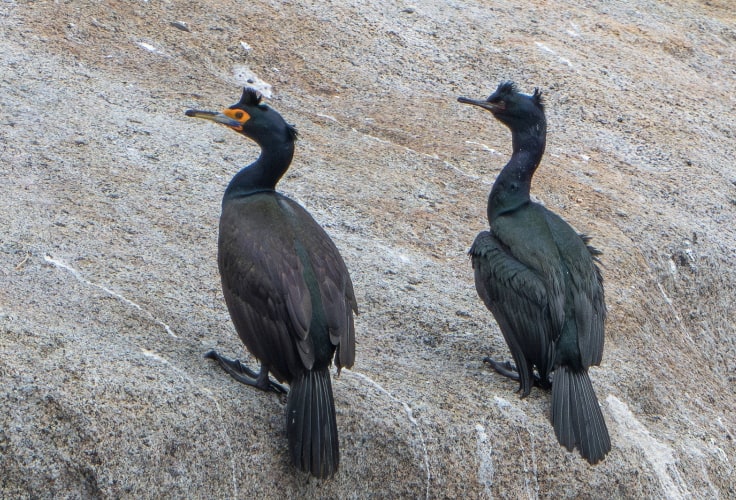
Red-faced Cormorants are most likely to be identified by range, cliff habitat, and comparison with Pelagic Cormorants. Adults are larger and stockier than Pelagic Cormorants and show brighter, more extensive red facial skin, a paler yellowish bill, a bare forehead, and browner-looking wings. Both species fly with the head, neck, and tail held in a straight line, and distant birds can be difficult to separate, especially outside breeding plumage. The species forages mainly by pursuit-diving from the water’s surface, using the feet for propulsion and taking mostly fish associated with coastal and inshore waters. It probably swallows much prey underwater but may struggle with large or spiny fish at the surface. Vocalizations are poorly studied and include low groans, croaks, and hisses, mostly heard around nesting sites.
In North America, the Red-faced Cormorant breeds in a narrow North Pacific band from the Alaska Peninsula west through the Aleutian Islands to Attu Island, with scattered colonies in the Gulf of Alaska, the Shumagin Islands, Kodiak Island, Bristol Bay, and the Pribilof Islands. Its easternmost known colony is on Middleton Island, and some of the largest North American colonies are in the Near Islands. The species is strongly coastal and has no known inland or freshwater records. It nests on steep cliffs of rocky islands and headlands, often using ledges near seabird colonies of murres, kittiwakes, and fulmars. Birds usually forage in littoral and inshore waters near breeding colonies, often within a few kilometers of nesting islands, though some feed farther from shore than Pelagic Cormorants. The species is not truly migratory, but birds disperse after breeding and northern populations may shift southward in response to sea ice.
The Red-faced Cormorant remains a poorly studied North Pacific seabird, and much of its ecology is still known only in outline. Recent assessments indicate steep declines and a low conservation outlook despite its broad North Pacific distribution. The species is sensitive to disturbance at nesting cliffs because exposed eggs and chicks may be lost to weather or predators when adults leave the nest. Oil spills, chemical contamination, plastic pollution, commercial fishing, and other marine threats can affect both adults and prey. Introduced foxes on some Aleutian islands have also taken eggs and chicks, and fox removal programs have been used to help seabird colonies recover. Continued protection of remote nesting cliffs and reduction of marine pollution are important for this shy Alaskan cormorant.
Anhinga
Anhinga anhinga
- Identification: Large, slender waterbird with a very long snakelike neck, straight dagger-like bill, long fan-shaped tail, dark body, and silvery white markings on the back and wings.
- Where found: Occurs mainly in the southeastern United States, especially Florida and the Gulf Coast region, using shallow freshwater lakes, ponds, swamps, marshes, slow-moving streams, and some brackish coastal waters with nearby perches.
- How to spot: Look for a long-necked bird swimming with the body mostly submerged, drying its wings and spread tail on branches or logs, or soaring high with a cross-shaped silhouette.
- Conservation status: Least Concern (IUCN); populations have increased in North America in recent decades, though threats include wetland development, loss of shallow aquatic habitat, and entanglement in discarded fishing line.

The Anhinga is the only member of the darter family found in North America and a distinctive waterbird often confused with cormorants in the southeastern United States. This species measures 75 to 95 centimeters (29.5 to 37.4 inches) in length and has a slim body, very long snakelike neck, small head, straight dagger-like bill, and long fan-shaped tail. Compared with Double-crested and Neotropic Cormorants, it looks longer-necked, longer-tailed, and more slender, and its bill is straight and pointed rather than hooked at the tip.
Adult male Anhingas are mostly black, with distinctive silvery to white streaks and spots on the upper back, scapulars, and wing coverts. The long, stiff tail is fan-shaped and often looks broad when spread, giving rise to the old name “Water Turkey.” Females are duller than males and show a buffy head, neck, and breast, while the body remains dark with pale markings on the upperparts. Juveniles resemble adult females but are browner overall and have less distinct pale markings. Both sexes develop sparse white feathering on the sides of the head and neck during the breeding season. The bill, legs, and feet are yellowish orange.

Anhingas are usually identified by their swimming posture, drying posture, and flight silhouette. Birds often swim with the body partly or almost completely submerged, leaving only the long neck and head above the surface. Cormorants may also swim low, but they usually show more of the body and do not create the same snakelike impression. After swimming, Anhingas commonly perch on branches, logs, or waterside vegetation with wings open and the tail spread to dry their waterlogged feathers. In flight, they hold the neck and tail straight out and the wings flat, producing a cross-shaped silhouette, and they often soar high on thermals like raptors or vultures. The species forages mostly alone in shallow vegetated water, moving slowly underwater and spearing fish with a rapid thrust of the bill. Its diet consists mainly of fish, but it also takes crayfish, amphibians, snakes, lizards, mollusks, leeches, and aquatic insects. Anhingas are generally quiet away from breeding sites, where they give rapid clicking, chattering, and harsh calls.
In North America, the Anhinga breeds mainly in the southeastern United States. Its range includes Florida, the Gulf Coast, eastern Texas, parts of Oklahoma and Arkansas, Mississippi, Alabama, Georgia, the Carolinas, and very local areas farther inland. It is resident through much of Florida and the southern part of its range, while many birds from more northern breeding areas withdraw southward in winter. The species also occurs through Mexico, Central America, Cuba, and much of tropical South America. Anhingas use shallow, slow-moving, sheltered waters with nearby perches for drying and sunning, including freshwater lakes, ponds, cypress swamps, marshes, sloughs, slow streams, wooded wetlands, and sometimes mangrove-bordered brackish bays, lagoons, and tidal creeks. They avoid extensive open water and are most typical of edges with trees, shrubs, logs, banks, or other perches close to shallow foraging areas. Breeding birds often nest in colonies with herons, egrets, ibises, storks, and cormorants, usually in trees or shrubs near water.
The Anhinga remains secure across its broad range and has increased in North America in recent decades. Its dependence on shallow wetlands, wooded edges, and reliable drying perches makes it vulnerable to wetland drainage, shoreline development, and loss of sheltered aquatic habitat. Discarded fishing line is another threat because birds can become entangled while foraging or perching near popular fishing areas. Winter distribution in the southeastern United States is also influenced by temperature and sunshine, because the species relies on sunning and wing-drying after swimming. Protection of shallow wetlands, wooded pond edges, and nesting colonies helps maintain this distinctive darter and reduces confusion with the cormorants that often share the same waters.
North America’s Cormorant Diversity
Cormorants in North America range from the widespread Double-crested Cormorant of lakes, rivers, reservoirs, and coasts to highly specialized Pacific species such as Brandt’s, Pelagic, and Red-faced Cormorants. The Atlantic Coast adds the large, heavy-billed Great Cormorant, while the Neotropic Cormorant brings a more tropical element to southern wetlands. Together, these birds occupy freshwater lakes, rocky ocean cliffs, estuaries, kelp beds, islands, bays, and sheltered coastal waters, showing how one group of dark, diving birds has adapted to many different aquatic habitats. The Anhinga, though not a cormorant, is worth knowing as a southeastern confusion species with a longer neck, straight dagger-like bill, and distinctive snakelike swimming style.